Whitepaper: Seamless Connections: Driving Rail Innovation with Data
Explore the path to smarter rail networks with this whitepaper. Unlock the potential of rail expansion through data-driven insights. Discover how leveraging digitalization can optimize design, construction, and operations, ensuring increased capacity, enhanced safety, and improved efficiency for a more sustainable future.
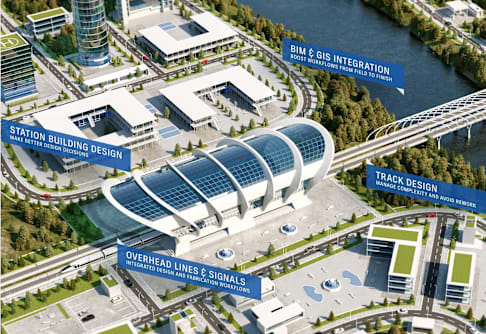
Seamless connections: using data to drive rail innovation Optimizing design, construction, and operations for rail expansion projects
A growing population and increasing urbanization are driving the need for more transport capacity. By leveraging data and digitizing everyday processes, rail can move ahead of other forms of mobility, and become the solution of choice for governments, local authorities—and the everyday traveler.
Introduction The business benefits Increased capacity and operational capabilities are the ultimate destination. Data is the fuel that can get you there, by helping you:
2 Increase operational efficiency 3 Increase efficiency in project delivery
1 Manage safety during construction and maintenance
01 | Seamless connections: using data to drive rail innovation
By 2030, the European Commission hopes to cut greenhouse gas emissions by 55%. By 2050, it aims to be climate neutral. While a growing urban population could seem a threat to this, it also presents the rail industry in Europe with an opportunity. As one of the most greenhouse-gas-efficient methods of transportation, rail can help governments meet their sustainability goals faster, and still meet the needs of urban and inter-city travelers.
Clearly, this will mean increasing both capacity and operational capabilities. But while rail may be the best route to Europe’s ambitions, there are challenges along the way. Rail expansion projects are increasing in complexity. A shortage of labor and materials is pushing budgets to the limit. Plus, as traffic loads increase, networks will be under more strain than ever before.
Advances in technology could be the enablers the industry needs to meet these challenges. Through digitalization, and its ability to replace guesswork with accuracy and insight, rail has the potential to move European transportation forward, faster—while maintaining safety and increasing efficiency in project delivery and operations.
The transport sector is currently responsible for 16.2%* of global greenhouse gas emissions. Rail is responsible for less than 0.5%**
*Source: Climate Watch, the World Resources Institute (2020). **Data Source: Our world in Data based on International Energy Agency (IEA) and the International Council on Clean Transportation (ICCT).
02 | Seamless connections: using data to drive rail innovation
If ever there were an industry suited to exploiting the advantages of digitalization, it’s rail. With employees and assets spread over far-reaching networks, digitalizing your processes allows you to connect thousands of disparate pieces of information together – and gain more control. A major benefit being the impact on safety.
Take routine maintenance schedules, for instance, which often overrun due to unforeseen problems. Digitalization can help you plan ahead and prepare better. With the aid of a digital twin—a digital replica representing assets in the physical world—3D models allow maintenance crews to pinpoint the location of every on-site asset. Especially beneficial for night works.
Keeping safety a top priority
They can help determine the working area between machinery and overhead power lines and the location of underground utilities. As a bonus, with models and other project information accessible on mobile devices on-site, supervisors can keep supervising instead of making frequent trips to site offices.
Digitalizing will also enable your personnel to operate equipment more safely. Automated machine avoidance not only ensures safe proximity between man and machine, it also helps operators of machines with extending arms and tools (such as excavator buckets) to avoid straying into clearance corridors.
01
03 | Seamless connections: using data to drive rail innovation
With digitalization at the heart of any new project from the beginning, improving operational efficiency becomes even simpler. Through GIS, project data can provide insights into flood-prone areas, say, giving designers accurate information influencing a structure’s location, orientation, and use of materials. These insights deliver an asset that operates more efficiently from the beginning, rather than one that reveals operational issues only when built.
And for the future? With the signaling industry increasingly shaped by software solutions and real-time data transmission between train control centers and the trains themselves, as a next step, the disparate signaling systems of different countries could be connected via common data environments, massively increasing operational efficiency.
With assets often hundreds of kilometers apart, pinpointing problems consumes time. Through digitalization, those assets needn’t seem so remote. Using sensors connected to the cloud (Internet of Things), common issues such as a points failure can be identified and dealt with rapidly. Maintenance crews can be instantly alerted to the exact location of the fault, and that same connectivity can also be used for predictive maintenance, allowing you to replace equipment before it fails.
Rail networks are unusual in their combination of vertical assets (buildings and stations) and linear assets (tracks and sidings). The digital world can bring the two together. While BIM aids the design and construction of buildings, GIS (geographic information system) is critical for planning and maintenance during operation. To help phasing and scheduling, BIM and GIS data can now be integrated with scheduling data to provide essential insights into where to divert trains while tracks are repaired or rebuilt.
02
04 | Seamless connections: using data to drive rail innovation
Improving operational efficiency
Using connected data in open platforms, you can now build your next major expansion project in the virtual world before you come to construct it for real.
By adopting BIM (building information modeling) methodology at the earliest stages of the project, you can create a digital twin here, too—in this case, a dynamic digital replica of the physical structure or asset—that will provide a strong digital thread of information, from planning to operation. All stakeholders in the project—architects, engineers, maintenance managers—specify then capture the necessary data around every aspect of the project: groundworks, track, signaling, bridges, etcetera. The data can then be leveraged to prevent on-site errors and rework that causes schedule overruns and unforeseen costs. Via the digital twin, the ‘as-built’ asset also becomes the ‘as-maintained’ asset, making for exceptional efficiency of operations.
03 You can also anticipate real-world behaviour at the design stage through reality capture.
Using LiDAR (light detection and ranging) technology, it is possible to digitize existing conditions—with millimeter precision—enabling the design process to begin faster and with more accuracy. Then once complete, scan the rails that have been laid, feed the measurements back into the “as built” digital model, and ensure that this information is 100% correct. This means that once the new track is built, reality capture will rapidly provide geometric information, updated daily, informing maintenance teams of any critical changes that may have occurred.
The same technology can also be used to optimize the placement of signals. By modeling the driver’s line of sight and factoring in the surrounding environment, signal positions can be established immediately, instead of the weeks of work usually required to do this manually.
05 | Seamless connections: using data to drive rail innovation
Case Study: VolkerWessels Zwolle-Herfte Railway Expansion Connecting eight directions of travel, Zwolle Station is the biggest train traffic junction in the Netherlands. But it had become a bottleneck to the nearby Herfte Junction. For construction company VolkerWessels, the key to the success of this expansion project was exchanging data through open formats—across disciplines and project stakeholders. According to team leader, Jan-Peter Ter Maaten, “The benefits are about transparency and better collaboration.”
Learn more
ArGIS® 3D Scene of railway underpass | Courtesy of VolkerWessels
Delivering projects more efficiently
https://www.autodesk.com/customer-stories/volkerwessels-zwolle-herfte-railway
01 Develop a data strategy:Digitize your processes to give total visibility across your infrastructure, assets and ongoing operations. The data captured will enable you to model your operations and will provide the foundation for digital twins.
03 Upskill your employees: There’s no point investing in digital infrastructure if your teams aren’t equipped to understand and analyze the data. Upskill your teams so they understand how data will enhance their role and can derive real value from it.
05 Evaluate for efficiencies: Once your data tools have been deployed, however, the hard work doesn’t stop. It’s essential to innovate continuously to identify areas where greater efficiencies can be made. The good news is, the more data you’re able to gather, the better the recommendations and predictions will be.
04 Deploy a digital twin: With technologies, processes and data foundations in place, you’re ready to deploy 3D data models or digital twins and track information in real-time to ensure everything is operating as it should. Use that data to predict potential issues, outline actions to address them—or to be more efficient at reactive problem solving.02 Enable collaboration: Break down silos within your business so
your internal systems are connected and can feed into each other. This will improve collaboration across the business by ensuring different teams, disciplines and departments have access to the data they need.
Five ways to drive innovation by becoming data driven:
06 | Seamless connections: using data to drive rail innovation
Everything optimized for efficiency, reduced risk, better safety—and a more sustainable future.
07 | Seamless connections: using data to drive rail innovation
Autodesk and the Autodesk logo are registered trademarks or trademarks of Autodesk, Inc., and/or its subsidiaries and/or affiliates in the USA and/or other countries. All other brand names, product names, or trademarks belong to their respective holders. Autodesk reserves the right to alter product and services offerings, and specifications and pricing at any time without notice, and is not responsible for
typographical or graphical errors that may appear in this document. © 2022 Autodesk, Inc. All rights reserved.
Digitalization and the managing and sharing of data leads to more certainty and more predictability. More projects on schedule and less guesswork. Everything optimized for efficiency, reduced risk, better safety —and a more sustainable future.
If you’d like to know more about digitizing your processes to increase capacity while maintaining safety and improving efficiency —let’s talk.
Taking charge of your data