Guide | From complexity to clarity in five steps
Actions you can take today to improve project coordination, reduce rework, and build the foundation for long-term business performance.
Introduction
Across Europe, public investment in transportation infrastructure—from rail to roads—is rising, challenging set project schedules and budgets. Expectations are climbing as well. Civil design teams are being asked to deliver faster, collaborate more closely, and manage increasingly complex requirements across disciplines. At the same time, staffing shortages and disconnected tools are creating delays, rework, and missed opportunities.
To explore how industry leaders are tackling these challenges, Autodesk partnered with Norconsult for a webinar on connected data in transportation infrastructure. More than 500 professionals across 45 countries joined to hear real-world insights into how connected data strategies are reshaping project delivery.
What emerged is clear: organizations responsible for designing, developing, and owning transportation infrastructure are shifting how they manage and use data. Instead of relying on fragmented files and slow handoffs, they are building integrated data ecosystems that support real-time decision-making and greater consistency across every stage of the project lifecycle.
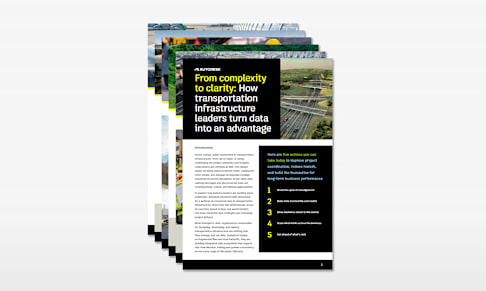
Here are five actions you can take today to improve project coordination, reduce rework, and build the foundation for long-term business performance
1
From complexity to clarity: How transportation infrastructure leaders turn data into an advantage
1 2 3 4 5
Break the cycle of misalignment
Make data trustworthy and usable
Move decisions closer to the source
Scale what works across the business
Get ahead of what’s next
1. Break the cycle of misalignment
Adopt shared data. Coordinate faster. Build trust as the standard.
Disjointed information is one of the biggest sources of inefficiency in transportation and infrastructure projects. Critical files often live in different formats, updates aren’t tracked consistently, and teams work in parallel with little visibility into each other’s progress. These misalignments lead to costly delays, safety risks, and duplication of effort.
Forward-thinking firms are adopting shared data environments that serve as a single, real- time source of truth. Instead of fragmented file exchanges, everyone—from designers to contractors—has access to the same up-to-date information. This transparency reduces duplicate work, accelerates coordination, and ensures that every decision reflects the latest project context.
This shift ensures that decisions are made based on the latest project context. Coordination becomes faster. Changes become traceable. Trust becomes standard.
Discover Pioneering Projects
2
https://www.autodesk.com/eu/industry/transportation?mktvar004=6217600020&internalc=true#pioneer%E2%80%A6
Beyond eliminating silos, leading firms are rethinking how they treat data itself. Rather than seeing it as a byproduct of design, they view it as a strategic foundation for performance. Data strategies now emphasize accessibility, accuracy, and real-time updates.
By standardizing and structuring information, teams gain confidence in its reliability. Stop debating which version is correct and start acting on trusted insights. This shift reduces uncertainty, speeds up delivery, and builds lasting trust in the process at every stage. In doing so, they turn information into a true driver of efficiency and innovation.
2. Make data trustworthy and usable
Stop debating versions. Act on trusted insights.
3
Late-stage decisions are expensive. They trigger change orders, delay approvals, and introduce risk into downstream phases. In transportation and civil infrastructure projects, where timelines are tight and margins thin, this dynamic can derail momentum.
Data-mature firms are resolving this by empowering their teams to act earlier. With connected, real- time data, engineers and coordinators can spot issues as they emerge—rather than after they’ve compounded. Early visibility leads to proactive problem-solving, faster stakeholder alignment, and smoother handovers.
The result is a delivery rhythm where less time is lost to back-and-forth clarification, and more time is spent refining quality. Teams move with confidence. Review cycles shorten. Outcomes improve.
3. Move decisions closer to the source
Spot issues early. Solve problems faster. Improve outcomes.
4
4. Scale what works across the business
In a fast-moving market, repeatable success is a competitive edge. But when workflows are reinvented for every project, consistency becomes elusive. Quality fluctuates. Timelines drift. Best practices stay siloed.
Digitally mature transportation and infrastructure firms identify what works—then scale it. A model- based review process, a quality control workflow, or a data-sharing protocol with contractors doesn’t just stay local; it becomes repeatable across teams, locations, and markets. Autodesk’s 2025 State of Design & Make report confirms that digitally mature companies are more resilient, complete projects faster, and gain a competitive edge by leveraging data effectively.
By codifying success, organizations shorten onboarding, raise efficiency, and create a foundation that adapts as standards evolve and client expectations increase.
Autodesk’s 2025 State of Design & Make report confirms that digitally mature companies are more resilient, complete projects faster, and gain a competitive edge by leveraging data effectively.
Codify success. Repeat it everywhere. Gain a competitive edge.
5
www.autodesk.com/design-make/research/state-of-design-and-make-2025 www.autodesk.com/design-make/research/state-of-design-and-make-2025
As artificial intelligence and automation begin to reshape the architecture and construction industry, firms with clean, connected data are already experiencing the benefits.
When design teams invest in foundational data quality, the payoff extends far beyond compliance. Forecasting improves, collaboration tightens, and cost control becomes clearer. According to Autodesk’s 2025 State of Design & Make report, most digitally mature organizations are achieving more than 50% return on investment from digital transformation, with measurable gains in productivity, customer satisfaction, and innovation. These firms also report stronger overall performance and greater confidence in their ability to navigate the future.
Such outcomes illustrate why data maturity matters: the way information is created, connected, and used today determines how quickly teams can adopt advanced capabilities like simulation, optimization, and predictive planning tomorrow.
Start building your future Data Strategy
5. Get ahead of what’s next
In summary
Delivering better transportation and linear infrastructure starts with delivering better data. When project teams work from a connected foundation, they reduce risk, accelerate progress, and deliver outcomes that last.
Now is the time to define your data strategy for today’s projects and to secure tomorrow’s competitive edge.
Let’s build it together.
Invest in clean data. Unlock AI, automation, and predictive planning.
6
https://www.autodesk.com/eu/industry/transportation?mktvar004=6217600021&internalc=true#transpo%E2%80%A6