E-book | Transform transportation infrastructure with digital project delivery
Learn how digital project delivery is transforming transportation by increasing efficiency, fostering collaboration, and promoting sustainability to build resilient infrastructure for the future.
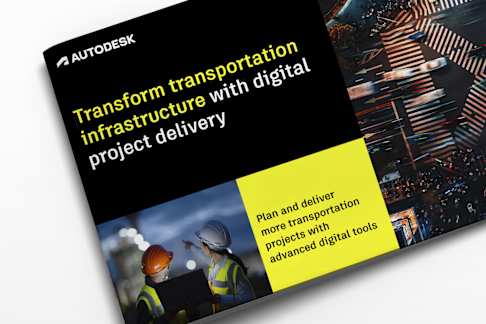
Transform transportation infrastructure with digital project delivery
Plan and deliver more transportation projects with advanced digital tools
Contents
Introduction 03
Chapter 1: Ageing infrastructure calls for a new approach 05
Chapter 2: Digital project delivery as the way forward 08
Chapter 3: Standardized processes in digital project delivery 12
Chapter 4: Rely on trusted tools and leverage partnerships 14
Chapter 5: On the digital track with industry partnerships 16
Chapter 6: Investing in the future with AI and sustainable infrastructure 20
Take the next step in your digital journey 24
2Transform transportation infrastructure with digital project delivery
Introduction Transportation networks are the backbone of society, keeping goods, economies, services, and people moving around the world.
Across Europe, transportation infrastructure projects such as roads, rail, bridges, tunnels and airports are being built at record pace, with investment pipelines exceeding €1.6 trillion. The Trans-European Transport Network (TEN-T) alone represents more than €500 billion in planned rail investment, while the EU’s Global Gateway strategy is mobilizing up to €300 billion to fund sustainable infrastructure worldwide.
+24.9% in passenger travel between 1995 and 2022
Transport activity in Europe in numbers
+24.8% in passenger car transport between 1995 and 2022
+142.5% in air travel between 1995 and 2022
+44.6% in freight transport between 1995 and 2022
3Transform transportation infrastructure with digital project delivery
https://www.unife.org/wp-content/uploads/2021/03/For-completion-TEN-T-networks-needs-EUR-500-billion-RailwayPRO.pdf https://www.wilsoncenter.org/sites/default/files/media/uploads/documents/Global%20Gateway%208-1-22.pdf
Source: Our World in Data
At the same time, transportation continues to be one of the most carbon-intensive sectors, responsible for 24% of direct CO2 emissions from fuel combustion. Therefore, a significant proportion of investments are directed not only to stimulate economies, but also to meet climate goals. For example, 83% of the EU’s €7 billion CEF Transport budget is dedicated to climate-related objectives; and Germany’s €500 billion climate-neutral infrastructure fund further illustrates this trend.
The major increase in transportation projects presents huge opportunities for successful growth across national and local economies. But it comes with its unique challenges–from rapid expansions to infrastructure maintenance, to workforce shortages, to meeting net-zero goals.
This e-book explores how flexible and secure transportation engineering software enables efficient, resilient, and sustainable infrastructure–helping leaders turn bold visions into reality.
50 billion t
40 billion t
30 billion t
20 billion t
10 billion t
0 t
1990 1995 2000 2005 2010 2015 2022
Other fuel combustion
Aviation and shipping
Waste
Buildings
Industry
Fugitive emissions
Agriculture
Manufacturing and construction
Transport
Electricity and heat
Greenhouse gas emissions by sector
4Transform transportation infrastructure with digital project delivery
https://ourworldindata.org/grapher/ghg-emissions-by-sector-stacked https://unfccc.int/ttclear/tec/transport.html?utm_source=chatgpt.com https://www.unife.org/wp-content/uploads/2021/03/For-completion-TEN-T-networks-needs-EUR-500-billion-RailwayPRO.pdf https://www.webuildvalue.com/en/infrastructure/german-infrastructure.html
Source: CIC GlobalData
Chapter 1
Ageing infrastructure calls for a new approach In EMEA, governments are committing record investment to close infrastructure gaps.
Significant EU investment in transportation European TEN-T plan is creating a real pipeline for linear transport and civil structures
RAIL
70k km AIRPORTS
+560 However, while demand for new infrastructure is soaring, much of Europe’s existing network is ageing and in urgent need of asset management and modernization to combat severe weather, natural disasters and for overall up-keep.
ROAD
€660b (pipeline)
CIVIL STRUCTURES
€425b (pipeline)
5Transform transportation infrastructure with digital project delivery
https://transport.ec.europa.eu/index_en
Crumbling infrastructure: Despite historic investment, Europe continues to struggle with maintenance backlogs. For example, Germany faces extensive bridge renewal needs within a €425 billion civil structures pipeline, while the Turin– Lyon tunnel and other cross-border projects highlight the importance of upgrading Europe’s transport corridors.
Fragmented data across different software tools: Unreliable, lost, or unavailable data on key performance indicators impact certain infrastructure sectors. Moreover, many infrastructure categories lack a basic inventory of assets and are therefore unable to implement effective asset management practices.
Climate concerns: Governments are stepping up investment in sustainable infrastructure, from the EU’s Recovery and Resilience Facility and TEN-T to national programs like the UK’s £92B Plan for Change and Germany’s €500B climate-neutral fund. But with the UN’s 2050 net-zero target demanding trillions in annual investment, engineers face mounting pressure to deliver and upgrade transport infrastructure with integrated electric charging.
Shortage of skilled labor: Delivering the infrastructure of the future demands a highly skilled workforce, yet retirements are outpacing new talent entering the field. According to reports from World Economic Forum, 39% of today’s workforce skills will be obsolete by 2030 and construction is among the industries most at risk of disruption.
Here are some of the most common challenges civil engineering teams are facing
6Transform transportation infrastructure with digital project delivery
https://www.weforum.org/stories/2025/01/future-of-jobs-report-2025-jobs-of-the-future-and-the-skills-you-need-to-get-them/
Achieve more with less
As projects continue to grow larger and more complex, the demands on transport companies are intensifying. Governments, including those in Europe, are mandating the adoption of digital technologies such as BIM and requiring public works to align with ISO 19650 and open standards like IFC and BCF.
This adds a new layer to existing pressures: delivering ambitious new projects while maintaining aging infrastructure, all under the watchful eye of sustainability and resilience targets. The challenge is clear: how can the industry meet rising expectations with finite resources?
To succeed, transportation leaders must find ways to achieve more, faster and smarter–with less.
Digital project delivery (DPD) is emerging as the critical enabler of that shift.
7Transform transportation infrastructure with digital project delivery
Chapter 2
Digital project delivery as the way forward Given their complexity, architecture, engineering, and construction (AEC) projects require precise planning, close collaboration, and real-time coordination across multiple teams and stakeholders. This is where digital project delivery comes in.
Digital project delivery is a cloud-based collaboration process that connects people, data, and workflows in a common data environment throughout the project lifecycle. Instead of working in silos with fragmented data and incompatible files, teams can collaborate on a single, connected platform– minimizing delays, rework, and inefficiencies while enabling seamless coordination among stakeholders.
The result: large-scale infrastructure projects are delivered more efficiently, with fewer errors and greater agility.
Visual representation of the value of a common data environment
Traditional Common Data Enviroment (CDE)
8Transform transportation infrastructure with digital project delivery
Enhanced communication and collaboration: Interoperability improves cross-discipline collaboration, reducing delivery time and field changes.
Better design quality and more efficient processes: Digital transformation drives efficiency across the project lifecycle, enabling delivery of long- lasting transportation assets.
Business growth and competitiveness: Meeting owner requirements and delivering higher design quality helps organizations win more work and secure infrastructure contracts.
Better decision-making: Incorporating input from all stakeholders and data in real time supports faster, more informed decisions.
Operational efficiency and risk management: Improved communication and a single source of truth reduce errors, rework, and project uncertainties–saving time and money.
Future-ready workforce: Teams develop the skills to operate and maintain resilient transportation systems in a digital-first environment.
By adopting a digital project delivery approach, businesses can achieve significant improvements in all aspects of project management and execution, ensuring they are well-equipped to meet the challenges of the future.
Autodesk’s digital project delivery platform maintains data continuity, and enables built-in communication with automatic version tracking–avoiding duplication and ensuring a single source of truth.
Digital project delivery offers several key benefits that improve team collaboration, deliver operational efficiencies, and position organizations to be future-ready:
9Transform transportation infrastructure with digital project delivery
Opportunities with digital project delivery
Building Information Modeling (BIM) provides the core modeling and data integration framework that underpins digital project delivery. It supports a unified, data- driven approach across project planning, execution, and lifecycle management.
By leveraging digital project delivery solutions, businesses can meet BIM mandates and owner requirements more effectively–especially important for winning work, including government infrastructure projects.
As a leader in BIM technology, Autodesk is an ideal partner for transportation companies looking to improve their workflows and achieve better project outcomes. Autodesk’s digital project delivery platform streamlines early-stage BIM, making projects more efficient from day one.
10Transform transportation infrastructure with digital project delivery
Case study TELT, Consortium CO 6-7 Tunneling rail success in the Alps with digital project delivery
The 270-km Mont Cenis base tunnel lies at the heart of a landmark project connecting France and Italy, aimed at reducing freight traffic through the Alps. Its complex geology requires advanced construction techniques.
With Autodesk Construction Cloud and advanced BIM tools, project teams achieved seamless data integration and digital collaboration. These advanced solutions enabled virtual construction and proactive problem-solving before physical work began, ensuring accuracy in construction and efficiency in long-term maintenance.
By improving coordination and decision- making, these technologies helped teams tackle the tunnel’s geological challenges with greater confidence and control.
“BIM means building virtually beforehand. Any problems we may encounter on- site are anticipated during the virtual phase.”
Michele Positano BIM Manager, Consortium CO 6–7
Learn more
1 1Transform transportation infrastructure with digital project delivery
https://www.autodesk.com/customer-stories/telt-consortium-co-6-7-story
Chapter 3
The importance of standardized processes in digital project delivery As projects adopt digital project delivery, the next step is ensuring that the information it generates is managed in a consistent, reliable way.
The sheer complexity and scale of transportation infrastructure projects require a structured approach to managing the flood of information and data they generate. This involves connecting tools, people, and processes, while keeping all stakeholders up to date with a project’s progress.
Benefits of standardized processes:
Improved project outcomes: Data is codified and quality-checked, leading to more reliable information throughout the project lifecycle.
Enhanced confidence and security: Each team member knows their roles and responsibilities.
Efficient information management: Information is stored centrally, streamlining access and usage.
Consistency and clarity: Files are clearly identified and used appropriately.
1 2Transform transportation infrastructure with digital project delivery
To ensure BIM information is managed consistently across large, complex projects, ISO 19650 provides a standardized framework. ISO 19650 is a milestone in the evolution of BIM standards. It defines clear roles, responsibilities, workflows, naming conventions, and data exchange protocols, reducing risk and improving project outcomes. Governments across Europe are mandating ISO 19650 compliance for public infrastructure projects.
Transportation projects that adopt digital delivery standards and ISO 19650 for cloud-based collaboration are leaner, more effective, and transparent, improving productivity and managing modern infrastructure complexities.
“If an organization is following the ISO 19650 protocols, everyone working on a project can have confidence that the data they’ll access is appropriate and codified to indicate what it can be used for.”
Marek Suchocki Head of Industry Associate Strategy, Autodesk
13Transform transportation infrastructure with digital project delivery
Chapter 4
Rely on trusted tools and leverage partnerships Today’s transportation projects demand flexibility, connectivity, and tools that can adapt to diverse workflows. Autodesk’s open platform, powered by robust APIs through Autodesk Platform Services (APS), enables seamless customization and integration with multiple data sources. This openness allows teams to tailor tools to their needs, enhance workflows, and innovate more efficiently.
That same openness must be matched with reliability. Delivering large transportation networks demands trusted tools and strong partnerships. Autodesk’s integrated solutions simplify complexity, streamline
collaboration, and maintain a single source of truth for hundreds of team members. Through interoperability and strategic industry alliances, Autodesk provides a complete, connected toolset for transportation infrastructure projects.
At the heart of this approach is Autodesk Construction Cloud (ACC), a secure common data environment that ensures every stakeholder works with the right, real-time information. With advanced horizontal and vertical design capabilities, ACC helps teams accelerate delivery while maintaining confidence in every decision.
“The benefit of using Autodesk Platform Services is not only having access to roadway project data, but it’s also being able to share it with anyone.”
Raf Vanlathem Consultant and BIM/OTL Expert, Agentschap Wegen en Verkeer
Learn more
14Transform transportation infrastructure with digital project delivery
https://aps.autodesk.com/customer-stories/awv-and-pau
ACC supports both BIM and ISO 19650 standards. With a centralized, cloud-based platform for collaboration and data management, it enables project teams to:
Simplify configuration: The open platform makes it easier to configure projects following ISO 19650 standards, reducing the complexity for users in deploying digital project delivery processes.
Streamline workflows: Project participants can quickly understand their roles; information is planned and managed effectively.
Centralize data access: Stakeholders can have access to necessary information, enhancing collaboration and reducing the risk of errors.
Automate checks and approvals: Data is correctly named, uploaded, and authorized for use.
Through open standards and strategic partnerships, Autodesk ensures its tools integrate seamlessly with multiple software solutions and disciplines–helping project teams coordinate more effectively, reduce errors, and boost productivity.
With trusted tools, cloud-based collaboration, and strong partnerships, transportation projects can meet ambitious goals, improve efficiency, and deliver resilient, high-quality infrastructure.
“We have projects sometimes spanning hundreds of team members, so we need something that allows everyone to have access to the one source of truth, and to be able to properly collaborate in almost real time.”
Imad Sabonji Senior Manager for Delivery, Khatib & Alami
1 5Transform transportation infrastructure with digital project delivery
Chapter 5
On the digital track with industry partnerships Just as transportation infrastructure projects are becoming increasingly complex, so are the solutions required to cover all aspects of the design, build, and operation processes.
By leveraging open platforms, connected workflows, and strategic partnerships, transportation projects can coordinate more effectively, reduce errors, and improve overall outcomes. These capabilities not only streamline today’s design, construction, and
operations processes but also create the foundation for forward-looking innovation. They provide the foundation for incorporating sustainability and AI into infrastructure projects, enabling smarter, more responsible outcomes.
By combining Autodesk’s open platform with industry partnerships, engineering firms can plan and design in the broader context of society, nature, and the environment.
1 6Transform transportation infrastructure with digital project delivery
Efficiency booster: Subsurface data analysis
Autodesk’s partnership with Fugro has seen the launch of the GeoDin® Ground plugin for Autodesk Civil 3D software.
GeoDin® is a comprehensive geo-technical data management software widely used in Europe that consolidates various types of subsurface data collected during construction processes. This integration represents the next big step in bringing the most useful data to customers and enhancing the accuracy and efficiency of asset development.
1 7Transform transportation infrastructure with digital project delivery
Climate care: Road designs with carbon assessments
Through a collaboration with ORIS, carbon assessment and emissions modeling capabilities are now embedded into Civil 3D.
ORIS’s certified calculator is applied in European road projects to streamline processes, deliver comprehensive impact assessments, and quantify embodied carbon emissions. This aligns infrastructure planning with EU Green Deal targets and national climate strategies, supporting more sustainable road designs.
Sweco Cut Pavement Design Time by 90% with ORIS Plug-In for Infrastructure LCA for Autodesk® Civil 3D®
Learn more
18Transform transportation infrastructure with digital project delivery
https://commission.europa.eu/strategy-and-policy/priorities-2019-2024/european-green-deal_en https://www.oris-connect.com/en/case-studies/how-sweco-cut-pavement-design-time-by-90-with-oris-plug-in-for-infrastructure-lca-forautodesk-civil-3d
Connected and interoperable: BIM & GIS
The partnership between Autodesk and Esri is the first of its kind that lets planners, engineering firms, contractors, and owners connect teams, workflows, and data across the project lifecycle, bringing together the natural and built environment.
Interoperable platforms help teams imagine, design, make, and manage new infrastructure and existing assets– delivering better decisions, smarter workflows, and a more resilient future.
“The integration between BIM and GIS is essential…and the partnership between Esri and Autodesk is fundamental for FSTechnology.”
Marcella Faraone Head of BIM & GIS Systems Department, FSTechnology
Know more
19Transform transportation infrastructure with digital project delivery
https://www.autodesk.com/customer-stories/fstechnology-bim-gis-story
Chapter 6
Investing in the future with AI and sustainable infrastructure AI is emerging as a critical enabler for smarter, more resilient, and efficient infrastructure delivery. Sustainability, once primarily a regulatory requirement, is increasingly becoming a measurable outcome. Autodesk’s State of Design & Make 2025 report highlights that sustainability is turning from a regulatory pressure into a source of opportunity and profitability.
These figures to the right make it clear that the next wave of transformation is about adopting AI into day- to-day workflows, so transportation engineers have more capacity to solve today’s challenges. Combined with standardized processes and connected platforms, AI enables teams to manage complexity, improve decision-making, and support sustainable outcomes.
84% of business leaders in civil infrastructure sector believe that sustainability measures can generate in excess of 5% of their annual revenue
73% of digitally mature civil engineering firms are well prepared to handle unforeseen changes vs. 52% at less digitally mature firms
35% are using internal data to gain a competitive edge vs. 27% at less digitally mature firms
75% of leaders at digitally mature civil engineering firms say they will increase investment in AI, vs. 65% at their less digitally mature peers
20Transform transportation infrastructure with digital project delivery
https://www.autodesk.com/design-make/research/state-of-design-and-make-2025 https://www.autodesk.com/design-make/research/state-of-design-and-make-2025
Digital trends driving change
The WEF Future of Jobs Report 2025 identifies AI, cloud computing, and big data as the most transformative trends across industries.
In the AEC sector, four digital trends are driving change and AI is at the center of each:
AI-powered project management
Digital twins and real-time analytics
Automation and robotics on job sites
IoT-enabled smart job sites
Autodesk and AI have a long-standing relationship, with investments in AI dating back to the early 2000s. From building a legacy in generative design to investing in APIs to now becoming one the first few companies globally to achieve ISO 42001–the world’s first international standard for AI management.
Decision-makers leverage Autodesk’s AI innovations to meet sustainability goals, improve project accuracy, and enhance delivery and cost efficiency. Among these innovations, Autodesk Assistant stands out as a powerful tool designed to streamline workflows, provide AI-driven insights, and support better decision-making.
2 1Transform transportation infrastructure with digital project delivery
https://www.weforum.org/publications/the-future-of-jobs-report-2025/
Applying AI in transportation businesses
For transportation companies, data is the key to becoming more resilient and future- ready–it forms the backbone of connected workflows and insights that drive business opportunities. Standardized processes unlock the full value of this data, enabling digital twins, AI-driven automation, and advanced analytics to improve margins and win rates.
These capabilities translate into tangible benefits:
Augment and automate processes: Reduce repetitive tasks, boost productivity, and get more from your talent.
Predictive analytics: Anticipate market shifts and adapt operations proactively.
Data-driven insights: Understand business health to increase margins, win more projects, and innovate offerings.
Connected platforms: Use cloud-based workflows to improve sustainability, streamline operations, and enhance risk management.
Companies like Arcadis and other European firms are already leveraging ACC to bring these capabilities to practice. Projects such as the UK’s Midlands Rail Hub and Germany’s €148 billion Deutsche Bahn modernization request demonstrate how digital collaboration accelerates delivery of sustainable transport networks across EMEA.
“I think we’re all on a digital journey. You can’t do it all at once. But everybody has to move, and is moving. If not, you’ll really get left behind. So get your focus right, get your priorities right. And make sure it’s part of your strategy.”
Bas Bollinger Global Director for Rail and Transit, Arcadis
22Transform transportation infrastructure with digital project delivery
https://www.networkrailmediacentre.co.uk/news/midlands-rail-hub-looks-to-the-future-with-appointment-of-alliance-partners https://constructionreviewonline.com/news/deutsche-bahn-seeks-e150-billion-to-modernize-germanys-aging-rail-system/
Trust and transparency in an AI era
As technology drives infrastructure decisions, responsible AI is critical to ensure safety, fairness, and accountability.
Autodesk collaborates with policymakers to shape and advocate for responsible AI. Autodesk is among the first companies to sign the EU’s AI Pact and proactively align with European AI regulations. For transportation decision-makers, Autodesk’s AI and sustainability investments provide the tools and technologies needed to deliver resilient, efficient, and environmentally responsible infrastructure.
23Transform transportation infrastructure with digital project delivery
Take the next step in your digital journey As the AEC sector evolves, the industry must embrace the digital future and maximize the value of its data. Autodesk understands what’s needed today and in tomorrow’s transportation projects in EMEA–and can help your organization succeed.
Ready to take your organization into a technology-driven future?
Speak to your Autodesk partner and explore transportation engineering solutions that will get you there.
24Transform transportation infrastructure with digital project delivery
https://www.autodesk.com/industry/transportation https://www.autodesk.com/industry/transportation