E-book | Digital transformation solutions for road and highway engineers
As regulations increase, deadlines shorten, and projects become more complex, civil engineers must embrace digital technologies to be as efficient as possible and keep design quality up. Our e-book is packed with valuable insights for road and highway engineers dealing with these pressures.
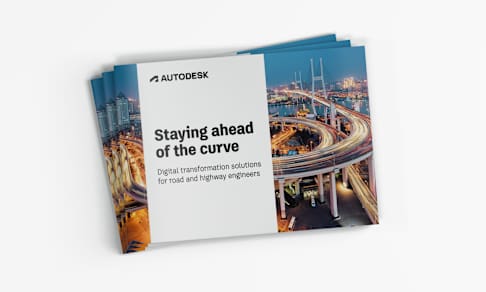
As regulations increase, deadlines shorten, and projects become more complex, civil engineers must embrace digital technologies to be as efficient as possible and keep design quality up. Our e-book is packed with valuable insights for road and highway engineers dealing with these pressures.
Staying ahead of the curve Digital transformation solutions for road and highway engineers
2 STAYING AHEAD OF THE CURVE | DIGITAL TRANSFORMATION SOLUTIONS FOR ROAD AND HIGHWAY ENGINEERS
Contents
Section 3
Industry Solutions BIM for Roads & Highways 6 Convergence of BIM & GIS 7 Digital Project Delivery 8 Reality Capture 9 Interoperability 10
Section 1
Industry challenges 4
Section 2
The benefits of digital transformation 5
Closing 11
Introduction 3
3 STAYING AHEAD OF THE CURVE | DIGITAL TRANSFORMATION SOLUTIONS FOR ROAD AND HIGHWAY ENGINEERS
Roads and highways make for some of our most complex and challenging projects due to their sheer size, public impact, increased owner requirements, and need for extensive project teams.
To support post-COVID economic recovery, governments worldwide have earmarked $1.2T in infrastructure stimulus specifically for transportation,1 leading to a surge in opportunities for engineering service providers.
In pursuit of these government-funded infrastructure projects, firms are looking to and embracing technology and industry solutions for new and innovative ways of working. The processes for planning, designing, constructing, and delivering road and highway systems are evolving rapidly to adapt to industry demands.
To meet these new requirements, firms should leverage connected solutions such as digital project delivery, interoperable solutions, reality capture, and the integration of Building Information Modeling (BIM) and Geographic Information Systems (GIS).
The opportunity is clear, and embracing digital practices is the surest path to more efficient workflows and surpassing owner expectations. Autodesk has the solutions and partners to enable limitless possibilities to digitally transform your business to shape the future of roads and highways.
1 Global Infrastructure HUB, InfraTracker, 2021 COVID-19 stimulus tracker
Introduction
4 STAYING AHEAD OF THE CURVE | DIGITAL TRANSFORMATION SOLUTIONS FOR ROAD AND HIGHWAY ENGINEERS
Today’s civil engineering firms face many competing pressures to address cost control and climate change, all while working on increasingly complex projects. According to the Autodesk 2024 State of Design & Make report, here are some of the top industry challenges that heavily impact road and highway firms on their digital transformation journey.
Talent 31% of civil engineering professionals cite attracting, training, and retaining talent as their top challenge.1
The industry grapples with bridging the gap between younger team members who are more tech-savvy and experienced professionals who offer a wealth of knowledge and IP. While training for the next generation should continue to prioritize digital solutions, it should also preserve valuable insights gathered over years of experience.
Sustainability 26% of leaders and experts maintain that sustainability remains a top challenge, with transportation contributing to 17% of global greenhouse gas emissions.2
As the infrastructure sector moves towards carbon management solutions like PAS 2080 certification, new projects face increased requirements to reduce carbon footprints across their entire lifecycle.
Data management Collaborating on complex projects across time zones and disciplines presents data management challenges, with 95.5% of data going unused in engineering and construction.3
Poor data management contributes to over half of global rework.4 Embracing digital practices is key to increasing project efficiency, reducing risk, and staying competitive in an evolving industry.
1 Autodesk’s 2024 State of Design and Make 2 WRI Dataset – GHG Emissions 2019 3 FMI Report 4 www.autodesk.com/design-make/articles/digital-project-delivery
Industry challenges
Section 1 Industry Challenges
http://www.autodesk.com/design-make/articles/digital-project-delivery
5 STAYING AHEAD OF THE CURVE | DIGITAL TRANSFORMATION SOLUTIONS FOR ROAD AND HIGHWAY ENGINEERS
Improved productivity and data exchange 29% of civil engineering leaders cited improved productivity, often achieved through cloud-based platforms facilitating seamless collaboration and information sharing through a single source of truth.
Better decision-making 25% called out easier planning and better decision-making for their businesses. For example, Pennsylvania DOT has created a connected common data environment accessible to all stakeholders, leading to faster decisions for over 600 concurrent projects.
Better customer satisfaction 30% of civil engineering respondents claimed a better reputation due to improved customer satisfaction as a top benefit of digital transformation. Many also said it enabled them to more easily and effectively present work to clients.
Improved profitability 28% in the civil engineering sector highlighted improved profitability, thanks to fewer expensive errors, more informed decision-making about everything from sustainable building materials to safety- conscious suppliers, and absolute visibility and accountability for entire project lifecycles.
Reducing risk 22% emphasized better risk management, citing clash detection with unified project data and design automation to forecast accuracy and reduce rework. 35% are going even further, using AI for workplace safety and risk analysis.
As transportation infrastructure rapidly evolves, embracing cloud-connected, data-driven approaches is essential for road and highway firms to meet industry demands. In the Autodesk 2024 State of Design & Make report, respondents highlighted several key benefits of a successful digital transformation.
“ Integrating both a single platform and database allows different teams to communicate better, share information that otherwise would not be easily accessible by all, and ensure all variables and factors are carefully assessed and taken into account at any point in time during the lifecycle of an infrastructure or part of it.”
-Marcella Faraone, BIM & GIS team leader, FS Technology
The benefits of digital transformation
Section 2 The Benefits of Digital Transformation
6 STAYING AHEAD OF THE CURVE | DIGITAL TRANSFORMATION SOLUTIONS FOR ROAD AND HIGHWAY ENGINEERS
BIM (Building Information Modeling) is a holistic process for creating and managing information for a built asset. BIM has become an industry standard for many engineering firms by connecting teams, workflows, and data across the entire project lifecycle to realize better ways of working. It provides a digital representation of an infrastructure asset by developing an accurate, data-rich, and 3D project model. With Autodesk tools and partner capabilities, BIM helps improve collaboration and generate deeper insights across the lifecycle of road or highway assets.
BIM for Roads & Highways
Effectively manage complex projects
Increase operational efficiency
Reduce overall design time
“ We expect to reduce planning amendments by 10% as a result of integrating BIM with other computing systems, plus our digitization and standardization.”
- Erika Carloni, Head of BIM Development and Coordination, Heratech
Section 3 Industry Solutions: BIM for Roads & Highways
7 STAYING AHEAD OF THE CURVE | DIGITAL TRANSFORMATION SOLUTIONS FOR ROAD AND HIGHWAY ENGINEERS
GIS informs BIM. BIM fuels GIS.
Improves data exchange between stakeholders
Decreases risk by reducing errors and costly rework with enhanced model accuracy
Allows for better decision-making through holistic understanding of an asset’s natural and built environment
GIS informs BIM by providing the real-world context of an asset’s existing environment, within which you can explore and evaluate its design and construction.
BIM provides GIS with information-rich and accurate models that owners can leverage in asset management and operations.
The convergence of BIM and GIS is essential to understanding and making more informed decisions for the longevity of roads and highways in the real world.
A more seamless exchange of rich data between design and GIS workflows helps teams plan, design, build, and manage assets with enhanced sustainability and resiliency.
“ We are on the verge of an explosive movement within the AEC industry to streamline how we overlay, understand, visualize, and analyze infrastructure design data.”
- Darin Welch, Associate VP Geospatial and Visual Engagement Solutions, HNTB
Bridging design information with location intelligence provides infrastructure owners and their engineering service providers with a greater understanding of their built assets and natural environments. BIM & GIS integration streamlines the flow of project data, resulting in improved decision making, fewer costly errors, and enhanced collaboration and communication among project stakeholders.
Section 3 Industry Solutions: Convergence of BIM & GIS
8 STAYING AHEAD OF THE CURVE | DIGITAL TRANSFORMATION SOLUTIONS FOR ROAD AND HIGHWAY ENGINEERS
Road and highway firms are facing challenges around data exchange and collaboration across disciplines, questions of model accuracy, and communication with stakeholders. Digital Project Delivery (DPD) solves these challenges. DPD is a cloud-based collaboration process for building and infrastructure projects that connects people, data, and workflows in a Common Data Environment (CDE) across the project lifecycle. It is the next step in your firm’s digital transformation journey to be future-ready.
Centralizing data from multiple sources in a secure CDE ensures that all stakeholders can access the right information in the right format when they need it. Each controls their data while collaborating with the broader project team on shared models and plans, leading to better quality, greater productivity, and delivery that is on-time and on-budget.
By integrating live, multi-discipline data like BIM and GIS in a CDE, every stakeholder can access projects and work together in real- time, from planning to handover. This approach opens the door to workflow automation and cross-discipline workflows, minimizing inefficiencies, improving accuracy, and connecting global teams. Powerful tools like BIM Collaborate Pro dissolve data silos and communication barriers, allowing seamless collaboration between team members, no matter where they are.
Road and highway owners across the globe are discovering the value of DPD, giving their teams the power to design, manage project schedules and budgets, and communicate all in a common environment, freeing up time and resources to focus on the most impactful work.
Improves data exchange between stakeholders
Facilitates collaboration across project teams
Provides the right insights for better decision-making
“ The long-term vision for our digital project delivery is to remove the silos, bring everything together into one area, and start incorporating GIS. We want all stakeholders to have this accessibility— whether it’s involving the public to be part of the conversation and understand a project, our stakeholders, or a highway engineer working on a design.”
- Kelly M. Barber, Division Chief, Engineering Automation and Services Division, Pennsylvania Department of Transportation
Digital Project Delivery
Section 3 Industry Solutions: Digital Project Delivery
https://redshift.autodesk.com/articles/digital-project-delivery https://redshift.autodesk.com/articles/digital-project-delivery https://www.autodesk.com/solutions/architecture-engineering-construction https://www.autodesk.com/solutions/architecture-engineering-construction
9 STAYING AHEAD OF THE CURVE | DIGITAL TRANSFORMATION SOLUTIONS FOR ROAD AND HIGHWAY ENGINEERS
Facilitates better decision-making by elevating understanding of existing conditions
Increases productivity by capturingusing automation to capture a new layer of data to enhance model accuracy
Decreases risk by reducing errors and rework
All project stakeholders can access digital models generated from reality capture to extract information or make changes. The model is updated in real-time, reflecting these changes within an asset’s existing conditions, ensuring an accurate digital twin, and eliminating the need to send multiple reports or datasets to stakeholders for their related tasks.
These accessible models also help reduce data management and distribution costs, save time by allowing all involved parties to access and work concurrently, and enable stakeholders to view and modify the model remotely without needing to travel to the site.
All road and highway projects are faced with planning and designing around existing environments. Reality capture is a vital tool for the capture and assessment of an asset’s existing or as-built conditions. Utilizing advanced technologies, devices, and software like Autodesk’s ReCap Pro to gather detailed information on existing conditions provides for a quick, accurate, high-resolution, and up-to-date “digital twin” view of this environment. Combined with design information and spatial data (BIM & GIS), the 3D digital view or “twin” is further enriched, establishing a comprehensive digital model of the asset within its real- world context. Reality capture, BIM, and GIS enable owners and engineering firms to make better planning decisions and to design and deliver more sustainable roads and highways.
Reality Capture
Section 3 Industry Solutions: Reality Capture
10 STAYING AHEAD OF THE CURVE | DIGITAL TRANSFORMATION SOLUTIONS FOR ROAD AND HIGHWAY ENGINEERS
Interoperability & openness with IFC Road and highway project teams often use multiple solutions from different vendors to provide models for maintenance and operations, leading to information loss during handover to owners. Autodesk prioritizes interoperability, allowing seamless data exchange across disciplines, products, vendors, and file formats. This is fueled by open standards like IFC, enhancing collaboration among all project stakeholders.
Autodesk’s support for IFC 4.3 underscores our investment in interoperability and openness across the project lifecycle, aligning with global BIM mandates and wide-ranging adoption of the IFC format.
Direct integrations with Civil 3D and Revit enable interoperable solutions and information exchange in the build environment, while scripted integrations help customize workflows. The open API and cloud allow the development of plug-ins and the incorporation of third-party tools.
Improves data exchange between stakeholders
Decreases risk by reducing errors and costly rework with enhanced model accuracy
Boosts collaboration, productivity, and decision-making across project lifecycles
“ The great advantage of Autodesk for us is that its solutions cover the entire value chain and guarantee interoperability.”
- Thomas Tschickardt, Digital Construction Manager, Wayss & Freytag Ingenieurbau AG
“ We’ve noticed increasing interest in using BIM for road construction over the entire life cycle. The data and standards we’ve developed in this project make for an important foundation—cultural change in our industry has begun.”
- Daniel Krause, Head of Digital Construction, Wayss & Freytag Ingenieurbau AG
Section 3 Industry Solutions: Interoperability
11 STAYING AHEAD OF THE CURVE | DIGITAL TRANSFORMATION SOLUTIONS FOR ROAD AND HIGHWAY ENGINEERS
Connect with us to learn more
From digital project delivery to the convergence of BIM & GIS, Autodesk has the end-to-end workflows, solutions, and partners to help your firm meet your desired business outcomes from planning to handover.
Ready to embark on your digital transformation journey? Now is the time to position your firm for long-term success by embracing these innovative solutions for road and highway projects. Autodesk is here to partner with you on this journey.
Reach out to an Autodesk representative today to explore ways to revolutionize your operations and keep your business ahead of the curve.
About the 2024 State of Design & Make Report Data for this eBook was compiled from the Autodesk 2024 State of Design & Make survey. This year’s survey is comprised of 5398 industry leaders, futurists, and experts in architecture, engineering, and construction; design and manufacturing; and media and entertainment from countries around the globe. More information about the 2024 State of Design & Make survey and report can be found here..
Closing
https://www.autodesk.com/industry/roads-highways https://www.autodesk.com/design-make/research/state-of-design-and-make
The information provided in this report is for general informational purposes only and strictly for the convenience of our customers. Autodesk, Inc. does not endorse or warrant the accuracy or completeness of any information, text, graphic, links or other items contained within the report.
Autodesk, Inc. does not guarantee that you will achieve any specific outcomes or results if you follow any advice in the report.
© 2024 Autodesk Inc. All rights reserved
Autodesk is changing how the world is designed and made. Its technology spans architecture, engineering, construction, product design, manufacturing, and media and entertainment, empowering innovators everywhere to solve challenges big and small. From greener buildings to smarter products to more mesmerizing blockbusters, Autodesk software helps customers design and make a better world for all. For more information, visit autodesk.com or follow @autodesk on social media.