Next generation wastewater treatment for Kongsberg
SWECO
Kongsberg in southern Norway is known for its advanced technology sector, but the town’s growth is hindered by its outdated wastewater infrastructure. Built in the 1970s, the existing plant has reached full capacity, blocking residential and commercial development. To address the challenge, Kongsberg municipality has partnered with, among others, Biowater Technology and Sweco to deliver a forward-looking facility that will double capacity, reduce energy usage, and transform waste into a valuable resource.
Stalling growth
Kongsberg’s population growth has stalled. “If someone wants to build a hotel or a new industrial plant, they can’t get approval,” explains Zinta Rize, MEP Engineer at Sweco.
“The current plant has reached its maximum
capacity.” Compounding the issue are outdated mechanical and chemical treatment processes that risk releasing untreated nutrients into rivers and fjords, creating environmental concerns that demand immediate attention.
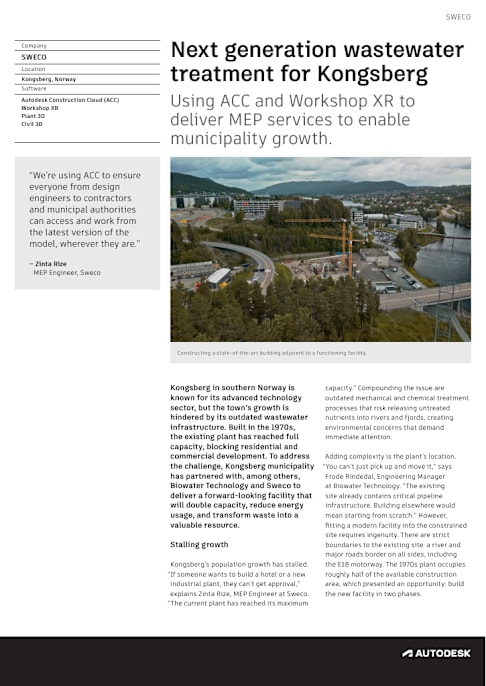
Adding complexity is the plant’s location. “You can’t just pick up and move it,” says Frode Rindedal, Engineering Manager at Biowater Technology. “The existing site already contains critical pipeline infrastructure. Building elsewhere would mean starting from scratch.” However, fitting a modern facility into the constrained site requires ingenuity. There are strict boundaries to the existing site: a river and major roads border on all sides, including the E18 motorway. The 1970s plant occupies roughly half of the available construction area, which presented an opportunity: build the new facility in two phases.
Next generation wastewater treatment for Kongsberg Using ACC and Workshop XR to deliver MEP services to enable municipality growth.
Constructing a state-of-the-art building adjacent to a functioning facility.
“We’re using ACC to ensure everyone from design engineers to contractors and municipal authorities can access and work from the latest version of the model, wherever they are.”
– Zinta Rize MEP Engineer, Sweco
Company
SWECO Location Kongsberg, Norway Software
Autodesk Construction Cloud (ACC) Workshop XR Plant 3D Civil 3D
SWECO
Enabling remote project teams to operate as if they were together on site.
Innovation
In the first phase, a new building is constructed alongside the existing plant with enough capacity and updated processes to meet permits and provide immediate relief. Once operational, the old plant will be demolished, making way for phase two: an expansion that fully complies with the EU’s tougher discharge regulations, due for implementation by 2029.
Unlike the original plant, which relies on mechanical and chemical treatment, the new system incorporates a biological process built on advanced biofilm technology. “We’ve developed a way to keep bacteria alive with less energy,” says Rindedal. “It’s a smart, circular economy approach.”
The technology being deployed isn’t just newer, but significantly more sustainable.
“The old approach was chemical-heavy,” adds Rize. “What we’re building is based on biology – it’s more environmentally friendly and uses less energy.”
Designing with collaboration
Sweco and Biowater Technology are pushing the project’s design and engineering forward. Biowater established the conceptual framework and treatment strategy, while Sweco is managing mechanical engineering.
“It’s like getting a box of Lego from Biowater with all the instructions,” Rize laughs. “Our job is to put it together in 3D.”
Coordination is critical, not least because of the aggressive timeline. That means constant communication across disciplines, streamlined workflows, and shared models.
Autodesk Construction Cloud
To manage this complexity, Sweco turned to Autodesk Construction Cloud (ACC) as a central collaboration platform across all stakeholders. “It’s our common data environment,” explains Rize. “We’re using ACC
to ensure everyone from design engineers to contractors and municipal authorities can access and work from the latest version of the model, wherever they are.”
With ACC, version control and data integrity are baked into the process. The ability to coordinate across disciplines in real time is especially valuable given the phased construction and tight spatial constraints, which see the walls of the new building placed just 1m from the existing facility.
From Biowater’s perspective, ACC has proven just as essential. “Everything is always live,” says Rindedal. “As an engineering manager, I can go in at any time, see the latest updates, and comment directly in the model. It makes communication smoother and helps us resolve issues faster.”
That level of real-time collaboration is transforming how project teams operate. Stakeholders no longer need to be on site to stay informed. Reviews can happen remotely, reducing the need for travel and accelerating approvals. “It means fewer site visits, better communication, and more confidence in what’s being built,” Rize explains. “Everyone’s working from the same source of truth.”
Exploring Designs in Virtual Reality
Alongside cloud-based collaboration, Sweco is also integrating Workshop XR – Autodesk’s virtual reality platform – to bring the plant design into a fully immersive experience.
“It’s incredibly powerful to walk through the plant in VR and identify access constraints or design clashes that aren’t obvious on screen,” says Rize. “We’ve also used Workshop XR in meetings with the municipality, helping them visualise exactly what’s being built. That’s been instrumental in securing buy-in. You might understand what 4m is on paper, but in VR you really see it, and feel the space.”
The immersive environment also supports interdisciplinary communication. Engineers
can meet in the same virtual space, walk through the model together, and make informed decisions in real time. “It’s making coordination feel much more natural,” Rize notes. “You’re not just reviewing drawings
– you’re experiencing the building. It’s like you’re on site together even though one person might be in Oslo, one in Bergen, one in England…”
Impact and Outlook
The new Kongsberg wastewater treatment plant will serve up to 40,000 people, almost doubling the current capacity and enabling the town to resume building homes, schools, and commercial space. Just as importantly, it secures the local environment by drastically reducing nutrient discharge into surrounding waterways.
“We’re building a plant not just for today, but for the future,” says Rindedal. “It allows Kongsberg to grow, and it protects the environment. That’s a win-win.”
Rize is equally enthusiastic. “This will be one of the best treatment plants in Norway in terms of technology and environmental impact,” she says. “It’s a complex puzzle, but everyone’s committed to the outcome.”
Engagement in VR The Sweco team leaned into Workshop XR’s capabilities to better engage with stakeholders across the project.
Autodesk, the Autodesk logo, FlexSim are registered trademarks or trademarks of Autodesk, Inc., and/or its subsidiaries and/or affiliates in the USA and/or other countries. All other brand names, product names, or trademarks belong to their respective holders. Autodesk reserves the right to alter product and services offerings, and specifications and pricing at any time without notice, and is not responsible for typographical or graphical errors that may appear in this document. © 2025 Autodesk, Inc. All rights reserved.