Report: Spotlight on Sustainability
Exploring how industry leaders can approach sustainability as a data problem with a technology solution.
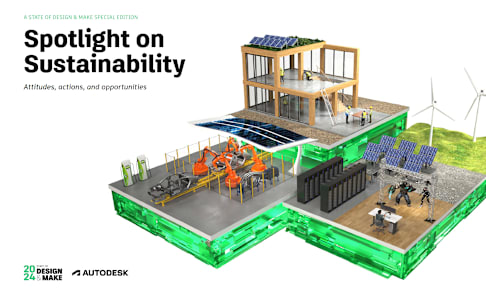
A STATE OF DESIGN & MAKE SPECIAL EDITION
Spotlight on Sustainability Attitudes, actions, and opportunities
97% of design & make industry leaders say their organizations have made changes to be more sustainable.
2 SPOTLIGHT ON SUSTAINABILITY
Sustainability initiatives have gone from trendy to necessary as the general public becomes more carbon-conscious and the world starts to feel the acute and severe impacts of climate change.
Introduction
There were 398 notable weather events worldwide in 2023, and damage from global natural disasters totaled $380 billion in economic losses.1 As adverse climate events continue, the public is growing more climate- conscious and governments are taking action through increased legislation and regulatory requirements, racing to catch up.
“It’s rare to find a large organization today that hasn’t taken steps to address sustainability issues,” says Joe Speicher, chief sustainability officer at Autodesk. “Whether we like it or not, we are all now in the decarbonization business.”
Leaders in Design and Make industries agree—97% of Autodesk’s 2024 State of Design & Make survey respondents say their organizations have made changes to be more sustainable.
“We are putting a consolidated ESG [environmental, social, and governance] report and strategy in place as an organization,” says Severin Tenim, head of strategic projects and development for ALEC Engineering & Contracting, a Tier 1 construction and contracting firm. “We’re near the beginning of that roadmap—we need to first quantify where we are to have a robust baseline, then identify where the top levers are in terms of quick wins and the highest value for the lowest effort. From there, we can really drive impact.”
Survey question: How influential are the following groups in pressuring your company or organization to create and meet sustainability goals?
Customers Investors Employees The Next Generation The Government
83% 81% 80% 80% 75%
3 SPOTLIGHT ON SUSTAINABILITY
The architecture, engineering, construction, and operations (AECO) industry generates 42% of global CO2 emissions, with 27% attributed to operational carbon and 15% to embodied carbon.2 Building operations also account for almost 55% of global electricity use.3 Design and manufacturing (D&M), while lower, accounts for 20% of the world’s carbon emissions.4 And the media and entertainment (M&E) industry, particularly the postproduction and VFX process, has a significant environmental impact driven by the extensive use of electricity for operating sophisticated hardware and software—it is estimated that by 2027 data consumption will be 9.7 million petabytes, up from 3.4 petabytes in 2022.5
Under pressure
With impact numbers like those, it’s understandable that leaders in the Design and Make industries are facing increased scrutiny from all sides to reduce their environmental impact.
“Sustainability is a challenge for our industry,” says Damir Jaksic, CIO at KEO International Consultants, a design and engineering firm. “We are under pressure to design and construct sustainable buildings and infrastructure, and this requires a shift in mindset and willingness to adopt new technologies and new approaches for which we may not be ready.”
The group leading the charge for change is customers. Eighty-three percent of 2024 State of Design & Make respondents said customers are the most influential in shaping their sustainability goals.
Feeling the sustainability pressure Customers have the most impact on sustainability goals
“ We are under pressure to design and construct sustainable buildings and infrastructure.” — Damir Jaksic
CIO, KEO International Consultants
79% of investors have sustainability policies in place.
4 SPOTLIGHT ON SUSTAINABILITY
Right behind customers, 81% of leaders say investors are influential, followed by employees and younger generations at 80%. Regulatory concerns are lower, with 75% of leaders saying the government is influential when creating sustainability goals. But, given the speed at which countries are enacting environmental standards, this number could increase in the coming years as organizations transition from voluntary to mandated reporting, and sustainability results become standardized across industries.
“We have set up a Low Carbon Research Centre and a Zero Carbon Institute to work with Zero Carbon UK to research the integrated application of digital and low-carbon technologies,” says Quansheng Xu, president of Beijing Institute of Architectural Design, an architectural design and consulting institute. “In the project, more and more owners are putting forward low-carbon requirements, and we will form a list of low-carbon technologies according to the specific requirements of the project.”
But along with pressure comes opportunity. In the United States, for example, the Inflation Reduction Act offers tax incentives for organizations to transition to more sustainable business practices. More sustainable companies are also likely to be more attractive to investors—79% now have sustainability policies in place, up from 20% five years ago.6
UNDER PRESSURE
5 SPOTLIGHT ON SUSTAINABILITY
Increasing awareness of the business value of sustainability has many leaders changing their perspective—seeing sustainability less as a cost burden and more as a source of revenue.
From cost burden to revenue opportunity
The number of executives globally who understand the business case for sustainability tripled between 2022 and 2023,7 and 78% of 2024 State of Design & Make survey respondents say that sustainability is crucial for future business growth in the next three years. This signals a massive shift in sentiment and priorities, driven by the long-term opportunities that sustainability can provide.
say sustainability is crucial for business growth
say sustainability goals are a requirement of modern business
of respondents of respondents 70% 78%
Sustainability moves beyond “nice to have”
$ $ $ $ $ $ $ $ $ $ $ $ $ $ $ $ $ $ $ $ $ $ $ $ $ $ $ $ $ $ $ $ $ $ $ $ $ $ $ $ $ $ $ $ $ $ $ $ $ $ $ $ $ $ $ $ $ $ $ $ $ $
$ $ $ $ $ $ $ $ $
56 %
23 % 14 %
6 % 1 %
6 SPOTLIGHT ON SUSTAINABILITY
In terms of revenue potential, 79% of State of Design & Make survey respondents say sustainability can generate more than 5% of annual revenue, up from 44% of respondents, representing an 80% increase year-over-year.
Survey question: How much business value (as a % of annual revenue) can sustainability measures generate in the long term for your company?
<1% 1%-5% 5%-10% >10% Don’t know
Most see sustainability as a revenue driver 79% say sustainability can generate 5%+ of revenue
FROM COST BURDEN TO REVENUE OPPORTUNITY
15
AMER
11 %
25 % 20 %
27 % 23 %
28 %
APAC EMEA
27 %28 % 22 % 22 %
26 %
%
AECO D&M M&E
2023 2023 2024 2023 20242024
2023 2023 2024 2023 20242024
15
AMER
11 %
25 % 20 %
27 % 23 %
28 %
APAC EMEA
27 %28 % 22 % 22 %
26 %
%
AECO D&M M&E
2023 2023 2024 2023 20242024
2023 2023 2024 2023 20242024
7 SPOTLIGHT ON SUSTAINABILITY
Percent of respondents who selected sustainability as a top three business challenge their company or organization faces today.
Improving sustainability practices is a good long-term business decision, according to 87% of respondents. Moreover, 69% think sustainability is a good short-term business decision—up from 55% last year—a sign that organizations are starting to reap the benefits of their sustainability efforts.
While most leaders now see the revenue opportunity, they are also recognizing the complexity of solving sustainability
from an organizational standpoint. Twenty-seven percent of survey respondents chose sustainability as a top business challenge, up from 20% last year. The Americas region saw the most noticeable year-over-year shift—a 127% increase in leaders who identified sustainability as a top challenge.
“One of the hardest things about sustainability is keeping up with changing regulations and laws that are different throughout the world,” says Kim Dabbs, global VP, ESG and
social innovation at Steelcase, a furniture manufacturer. “Non-financial impacts haven’t been standardized in the way that financial impacts have, and it’s really hard for companies that are on a climate journey or making improvements in equity, if they don’t have metrics that they’re using to achieve those goals.”
Region Industry
Sustainability attitudes are shifting More leaders are identifying sustainability as a top business challenge
FROM COST BURDEN TO REVENUE OPPORTUNITY
$ $ $ $ $ $ $ $ $ $ $ $ $ $ $ $ $ $ $ $ $ $ $ $ $ $ $ $ $ $ $ $ $ $ $ $ $ $ $ $ $ $ $ $ $ $ $ $ $ $ $ $ $ $ $ $ $ $ $ $ $ $
$ $ $ $ $ $ $ $ $
8 SPOTLIGHT ON SUSTAINABILITY
With sustainability now firmly established as a strategic priority, businesses are adjusting their budgets to match. Seventy-one percent of 2024 State of Design & Make survey respondents say their organizations have increased investments in environmental sustainability over the past three years. Spending is only expected to rise, with 76% of respondents planning to increase investments in the next three years, up 29% from last year.
Sustainability is a data problem
One area seeing a dramatic increase in spending is artificial intelligence (AI)—77% of survey respondents say they will increase spending on AI and emerging tech over the next three years.
This increase in AI spending is already making an impact on sustainability actions across organizations. In fact, 34% of leaders say they are using AI to be more sustainable, more than any other action.
“There are many use cases for AI solutions—they can help us forecast outcomes based on historical data, optimize project timelines, and allocate resources,” says Maria Fernanda Olmos, global principal, digital integration at Unispace, a workplace strategy, design, and construction firm. “AI can also be used to create design alternatives and help firms assess the environmental impact of buildings or designs before getting on-site.”
The speed of adoption of AI as a sustainability solution makes sense when considering sustainability in terms of data, according to Autodesk’s Speicher:
“It doesn’t surprise me at all that the top action around sustainability is to leverage AI tools, because, at its heart, sustainability is a local data problem.”
The U.S. Green Building Council estimates that building to Leadership in Energy and Environmental Design (LEED) standards can reduce energy use by 30%, carbon emissions by 35%, water use by 30% to 50%, as well as generate waste cost savings of 50% to 90%. Organizations that want to get the most out of sustainable design technologies should first make sure their data is comprehensive and well-organized.
“In architecture, for example, a sustainable building in Riyadh is not the same as the sustainable building in Reykjavik,” says Speicher. “Your ability to design a sustainable building is dependent upon the specifics of that locale. It’s all data. What better application of artificial intelligence than to be able to use these data sets to improve and optimize the greenhouse gas emissions associated with any given project?”
71% of organizations have increased their sustainability investments
9 SPOTLIGHT ON SUSTAINABILITY
Lake|Flato, a sustainable architecture firm, undertook an adaptive reuse project for its corporate headquarters, transforming a 100-year-old former car dealership into a modern, eco-friendly workplace. Using AI-integrated design and 3D modeling technology, the building was repurposed rather than demolished, significantly reducing carbon emissions associated with new construction. For instance, the wooden roof of the former parking garage was carefully deconstructed and reused in the interior (as work surfaces and ceiling accents) instead of being discarded. The design also focused on optimizing natural light and creating a healthy indoor environment for employees.
In the design and manufacturing industries, where 80% of a product’s environmental impact is influenced by decisions made at the design stage, AI is helping organizations think about sustainability from conception through production.8
Decathlon, a French sports equipment manufacturer and retailer, has successfully redesigned the traditional diving fin with a strong focus on sustainability and performance. To create the fin, the firm used generative design software, which employs machine learning and artificial intelligence to explore multiple design alternatives. The new React fin uses 50% less material and cuts the carbon footprint in half compared to market standards. Moreover, it’s designed from a single type of plastic for easy recycling at the end of its lifecycle.
34% Used AI to be more sustainable
33% Used more recycled materials
33% Increased share of renewable energy sources used
32% Applied sustainable design principles
31% Decreased waste from production and construction
AI is a top sustainability action Emerging tech is helping organizations reach their goals
SUSTAINABILITY IS A DATA PROBLEM
Survey question: What changes has your company or organization already made to be more sustainable?
10 SPOTLIGHT ON SUSTAINABILITY
Looking toward the future, data democratization and collaboration will play an even more important role in improving sustainable outcomes in Design and Make industries. The insights derived from leveraging large data sets will help leaders make better, more strategic, and more sustainable choices across their organizations. “AI is going to enable designers to deliver much more sustainable projects by leveraging existing data to support their design choices,” says Autodesk’s Speicher. “Right now it’s still a bit of the Wild West in terms of the ability to connect those data sets. In the future, I think the use of algorithmic tools to connect silos and collaborate across various phases of project life cycle will be enabled by AI to a much greater degree than it is today.”
To reach new sustainability goals, Henning Larsen and Ramboll relied on building data to deliver one of the largest timber structures in Denmark, with an eye toward reducing embodied carbon. Embodied carbon refers to the GHG emissions associated with the manufacturing, transportation, installation, maintenance, and disposal of building materials, and these emissions are irreversible once a building or infrastructure asset is built. Mitigating these emissions requires data-driven decisions during the design, procurement, and construction stages. Using a lifecycle program to analyze building data provided calculations for environmental impact over the entire building lifecycle, including procurement, production of materials, energy consumption, and more. The use of data for this eight-story building project has the potential to reduce embodied carbon by up to 65%.
Lisette Heuer, director of business transformation at Royal HaskoningDHV, a consulting engineering firm providing solutions for the natural and built environment, notes the importance of ongoing interaction with customers to improve outcomes: “For our big projects, we work with the client to look into the climate and biodiversity impact of the project, what it means for resource usage and circularity, and also the social impact. We have done that for 1,000 projects so far. For those 1,000 projects, we know what the scores are and we also monitor how they improve throughout the project up until delivery. It’s not just a conversation with the client at the start of a project.”
SUSTAINABILITY IS A DATA PROBLEM
11 SPOTLIGHT ON SUSTAINABILITY
Increased focus on, and investment in, sustainability is paying off—79% of survey respondents say their company is on track to reach its sustainability goals.
The sustainability effect
Beyond the bottom line, sustainability initiatives are paying dividends across organizations. Sustainability efforts have a positive impact on how employees view their company. Seventy-eight percent of survey respondents say they are proud of their company’s sustainability initiatives—a full 50% increase over last year—and 73% see their company as a sustainability leader.
Sustainability and talent seem inextricably linked as the global workforce becomes more distributed. With the opportunity to work from anywhere, environmentally conscious employees are digitally migrating to sustainability-focused organizations.
Survey respondents say sustainability can be a tool to strengthen their employer’s brand and gain a competitive edge in the talent market, with a full 72% of respondents agreeing that sustainability aids in talent attraction and retention.
EMEA 75 % AMER 73 %
67 %APAC
D&M 74 % AECO 72 %
68 %M&E
Percentage of respondents who agree with the statement, “My company’s sustainability efforts help to attract and retain talent.”
Sustainability is a top talent attractor Sustainable initiatives boost attraction and retention
12 SPOTLIGHT ON SUSTAINABILITY
THE SUSTAINABILITY EFFECT
“Everybody looks at sustainability from an environmental perspective,” says David Spilsbury, chief technology officer at Axis Studios, an animation and VFX studio. “But we want to be socially sustainable as well. We want to build an industry where there is a career path and we have people from all generations and all walks of life included in our workforce. That’s good for creativity, and it’s good as a sustainable social environment for our business.”
With top talent comes increased innovation, and this is another area where organizations are receiving a boost from sustainability. Design and Make industries are typically risk- averse, but sustainability offers an opportunity for adopting new ways of doing business and producing goods that can be truly transformative for the industry.
13 SPOTLIGHT ON SUSTAINABILITY
Delivering on the promise to design and make a better world
“Companies need to accelerate their digital transformation,” says Autodesk’s Speicher. “This means taking all analog processes, 2D, and CAD and transitioning into 3D and BIM so you can make sure that the data is interoperable with all downstream participants on a project. That is an absolute prerequisite for delivering more sustainable outcomes because you need interoperable data to be able to calculate what the whole carbon impact is of a specific project.”
Other experts agree that technology is the key to solving the sustainability problem.
“Digital twins create huge new opportunities in the field of design and engineering, not only in the CAPEX world but also in the OPEX world,” says David de Graaf, global director, digital at Royal HaskoningDHV. “It makes an engineering company with strong digital competencies very relevant in finding solutions to the big issues of this planet, including energy transition and climate change.”
The impact of digital transformation on sustainability is impressive—survey respondents who chose sustainability as the top benefit of digital transformation said it has increased sustainability by 61% at their organization.
“I think climate change is a solvable problem,” says Speicher. “We have the vast majority of technology solutions today to be able to deliver on it; we just need to implement and execute.”
Organizations that want to start reaping the benefits that sustainability offers should approach it as a data problem with a technology solution.
14 SPOTLIGHT ON SUSTAINABILITY
To deliver on the promise to design and make a better world, leaders need to continue centering sustainability at their organizations. While sustainability initiatives have made huge gains over the past few years, organizations need to be more aggressive with their goals to reach global sustainability milestones.
The transformative power of technology, particularly artificial intelligence, offers a robust toolkit to navigate the complexities of implementing sustainable solutions at every level of the design and make process. For maximum impact, organizations need to reimagine their products, services, and operations with a sustainability-first mindset, focusing on reducing resource consumption, waste, and carbon footprint at the earliest stages of creation.
Perhaps most importantly, leaders must foster a culture of sustainability, embedding sustainable practices in all aspects of their business, from strategy formulation to day-to-day operations. They need to set ambitious sustainability goals, monitor progress, and continuously innovate to improve their sustainability performance. Leaders should visibly commit to these goals and encourage all employees to take part in sustainability initiatives.
“We’ve embedded sustainability into everything that we do,” says Kim Dabbs at Steelcase. “It’s not just a sustainability team— we had a cross-functional team that built a sustainable design framework and now everything that we produce goes through that framework. This is critical to changing the entire ecosystem and not just pockets of the ecosystem.”
DELIVERING ON THE PROMISE TO DESIGN AND MAKE A BETTER WORLD
About the State of Design & Make: Spotlight on Sustainability Attitudes, Actions, and Opportunities Data for the State of Design & Make: Spotlight on Sustainability Attitudes, Actions, and Opportunities report was compiled from the Autodesk 2024 State of Design & Make survey data. For the 2024 report, Autodesk surveyed 5,368 industry leaders, futurists, and experts in the architecture, engineering, construction, and operations; design and manufacturing; and media and entertainment industries from countries around the globe. This report contains key findings from this research, including details at the sector and regional level.
The quantitative data (n= 5,368) was collected between July and September 2023, through a 20-minute online survey. Autodesk partnered with Qualtrics for the collection of this data. In addition, seven qualitative interviews with business leaders and futurists were conducted in October and November 2023. In some instances, aggregated and anonymized Autodesk customer data has been analyzed to identify trends.
In addition to survey data and qualitative interviews, the Spotlight on Sustainability Attitudes, Actions, and Opportunities report contains interviews from the Automotive Innovation Forum, an Autodesk event in May 2024.
Sources 1. Aon 2. Architecture 2030 3. United Nations Environment Programme 4. World Economic Forum 5. PwC 6. Deloitte 7. World Economic Forum 8. Ellen MacArthur Foundation
The information provided in this report is for general informational purposes only and strictly for the convenience of our customers. Autodesk Inc. does not endorse or warrant the accuracy or completeness of any information, text, graphic, links, or other items contained within the report.
Autodesk, Inc. does not guarantee that you will achieve any specific outcomes or results if you follow any advice in the report.
© 2024 Autodesk Inc. All rights reserved