autodesk-fy24-impact-report.pdf
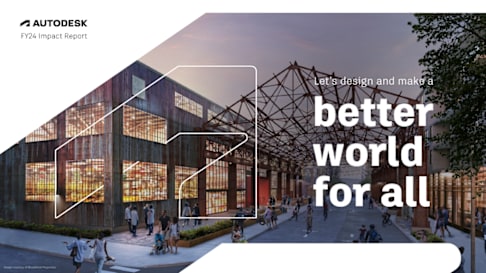
FY24 Impact Report
Image courtesy of Brookfield Properties
Let’s design and make a
better world for all
Contents Overview A message from our President and CEO
FY24 highlights
Our company
Company strategy
Impact strategy
Improve our operations Energy & Materials
• Advancing our sustainable business practices
• Autodesk Carbon Fund
• Our carbon footprint
Health & Resilience
• Resilience and well-being
• Employee health and safety
Work & Prosperity
• Living our culture
• Diversity and belonging
• Flex Forward
• Learning and talent development
• Employee impact at work
Partner with customers Architecture, Engineering & Construction
Energy & Materials
Health & Resilience
Work & Prosperity
Design & Manufacturing
Energy & Materials
Health & Resilience
Work & Prosperity
Media & Entertainment
Energy & Materials
Health & Resilience
Work & Prosperity
Education
Advance industries Autodesk Foundation
Energy & Materials
Health & Resilience
Work & Prosperity
Research
Partnership
Public policy
Operate with integrity Privacy and data security
Trust
Human rights
Ethics and compliance
Suppliers and business partners
Appendix ESG ratings, rankings, and memberships
Impact strategy assessment
Materiality assessment
Data summary
Sustainability Accounting Standards Board index
United Nations reporting frameworks
Customer ESG commitments and goals
2024 State of Design & Make report
Sustainability-enabling solutions
Endnotes
Performance data included in this report are based on the Autodesk fiscal year when noted, and the calendar year otherwise. The Autodesk 2024 fiscal year ran from February 1, 2023, through January 31, 2024. Performance data cover Autodesk’s global operations, unless otherwise stated. In some cases, segments in tables do not add up to the total due to rounding. All dollar amounts listed are in USD.
2FY24 IMPACT REPORT
Overview
Autodesk’s mission—to help everyone, everywhere, design and make anything—drives us to develop powerful solutions that help our customers tackle the world’s biggest challenges.
A message from our President and CEO Sustainability is a local data problem. Autodesk industry cloud platforms enable our customers to connect data across teams and workflows. We equip them with the information and insights they need to make sustainable choices throughout their design and make processes.
Our company Autodesk focuses on understanding our business, customer, market, and industry dynamics to determine our multiyear intent for our business, product development, and go-to- market strategies. Our impact strategy is a part of Autodesk’s annual strategic planning process and engages all aspects of our business.
Impact strategy Supporting our employees, customers, and industries to accelerate positive outcomes is key to the success of our company and delivering on our promise of a better world designed and made for all.
3FY23 IMPACT REPORTOVERVIEW IMPROVE OUR OPERATIONS PARTNER WITH CUSTOMERS ADVANCE INDUSTRIES OPERATE WITH INTEGRITY APPENDIX 3FY24 IMPACT REPORT
A message from our President and CEO
Andrew Anagnost President and Chief Executive Officer
Humanity continues to face increasingly complex global challenges, a rapidly accelerating pace of change, and, in the short term, finite resources to address these issues. Yet despite these daunting constraints—and frankly, because of them—we at Autodesk see unprecedented opportunity.
We believe that technology will always be one of society’s most powerful catalysts for progress. Autodesk’s mission—to help everyone, everywhere, design and make anything—drives us to develop powerful solutions that help our customers tackle the world’s biggest challenges. Today’s advances in digital transformation, cloud-connected technology, and generative AI will yield monumental changes in how we design and make our world. As a trusted partner to our customers and ecosystem writ large, we will ensure that the innovators and creators building our future have the best tools to do so.
The following report outlines our successes and challenges in this space. We believe that by holding ourselves accountable in our own sustainability journey, we can credibly engage and support our industries in the transition to a more sustainable, resilient, and inclusive future. Together, we can accelerate our path toward the collective future to which we all aspire.
This starts with how we manage our own operations. As governments around the world implement more rigorous sustainability regulations, we recognize our opportunity to continue to lead by example. We support and advocate for more ambitious public sector action to solve our collective challenges. And by aligning our business practices with these emerging regulations and standards, we aim to set a new standard for sustainability in the industries we serve.
Through innovative practices and technologies, we have made significant strides in reducing our carbon emissions, optimizing resource utilization, and promoting energy efficiency across our business. We continue to invest in the expansion of renewables on the grid and nurture the nascent but growing carbon removal industry. Our Culture Code and diversity and belonging (D&B) commitments are best in class and yield significant rewards via employee recruitment and retention. This year we are sharing the results of our three-year D&B commitments—and while we have made significant progress in this arena, there is still more work to be done.
Our commitment to sustainability extends well beyond our own operations; we recognize the need to support our customers in their sustainability commitments.
At its core, sustainability is a local data problem. By building and deploying the industry cloud platforms that enable our customers to connect data across teams and workflows, we equip them with the information and insights they need to make sustainable choices throughout their Design and Make processes.
We released a suite of analytical tools and features to measure and manage carbon emissions associated with buildings, products, and infrastructure. We also expanded our portfolio of water management, factory design, and simulation solutions. These capabilities are embedded within our Design and Make Platform to help our customers make informed decisions throughout their processes, ultimately leading to more sustainable outcomes in our industries.
The rise of generative AI presents unprecedented opportunities for advancing sustainability. While we have been harnessing this technology for years, Autodesk AI-driven design solutions now enable our customers to explore a multitude of options while optimizing for environmental performance—quite literally redefining the possibilities for a more sustainable future.
We recognize that progress requires collaboration and partnership. That is why we are dedicated to nurturing a sustainable ecosystem—a network of like-minded individuals, organizations, and communities working together to drive positive change. By demonstrating what is possible with the right technology, participating in collective action with our stakeholders and strengthening market incentives for sustainability, we believe we can transform markets.
We invest in our communities to level the playing field and support people and innovations that will create a better world. For example, we have contributed $5 million to Cal State Northridge to provide opportunities for underprivileged students, complementing other initiatives across our educational and workforce partnerships. We are empowering everyone to participate in creating this new, sustainable future.
Autodesk is uniquely positioned as a catalyst for positive change. By staying ahead of the curve and embracing emerging sustainability trends, we are shaping the future of sustainable Design and Make innovation.
I want to express my gratitude to our employees, partners, customers, and communities who share our vision for a more sustainable world. Together, we can make a meaningful difference and leave a lasting impact on future generations.
I invite you to explore our annual Impact Report and join us on this journey in the relentless pursuit of a better world, designed and made for all.
Sincerely,
4FY23 IMPACT REPORTOVERVIEW IMPROVE OUR OPERATIONS PARTNER WITH CUSTOMERS ADVANCE INDUSTRIES OPERATE WITH INTEGRITY APPENDIX 4FY24 IMPACT REPORT
FY24 highlights Autodesk appointed its first chief sustainability officer and trust officer
Sourcing 100% renewable energy for our facilities, cloud services, and employee work from home*
Received A- CDP Climate Change score and ranked #1 in our industry (Software) on the Corporate Knights Global 100
49.5% increase in the number of women in tech roles globally (compared to the beginning of FY22)
$1.1 million in financial support provided during FY24 by our employees, combined with company matching and Autodesk Foundation grants, to help respond to crises worldwide
Launched Autodesk AI to help drive sustainable outcomes across industries
Enhanced sustainability- enabling solutions across three industry clouds (Forma, Fusion, Flow)
Gifted $1.5 million to the University of Florida Colleges of Design, Construction and Planning, and Engineering
$16.2 million in financial capital and $9.2 million of in-kind contributions deployed to the Autodesk Foundation portfolio
Joined Frontier, a $1 billion advance market commitment, to accelerate the market of permanent carbon removal
Supported the launch of Buildings Breakthrough during COP28 in the UAE to strengthen global collaboration necessary to decarbonize the built environment
18 technology integrations developed by ecosystem of 30 participants from the Sustainability Tech Partner Program
* This refers to a combination of renewable energy generated on-site, virtual power purchase agreements, and renewable energy certificates.
5FY23 IMPACT REPORTOVERVIEW IMPROVE OUR OPERATIONS PARTNER WITH CUSTOMERS ADVANCE INDUSTRIES OPERATE WITH INTEGRITY APPENDIX 5FY24 IMPACT REPORT
Our company Every day, innovators use Autodesk’s Design and Make Platform to solve challenges, big and small. Our technology spans many industries, from architecture, engineering, and construction, to product design and manufacturing, to media and entertainment. Over four decades, we have worked together with our customers to transform how things are designed and made, and in doing so we have also transformed what can be made–from the greenest buildings to the cleanest cars, from the smartest factories to the biggest stories.
Our customers are expected to deliver increasingly complex projects on accelerated timelines while balancing trade-offs among cost, compliance, performance, and impact. To keep up with the pace of change, they are embracing and accelerating their digital transformation—generating an extraordinary amount of data across multiple tools and systems. This data presents new opportunities.
Advancements in cloud-connected technology and artificial intelligence (AI) are unlocking new possibilities to automate tasks, analyze data, and augment creativity–driving efficiency, sustainability, and growth. From insights to optimize energy and material use across a building’s full lifecycle to integrated factory planning that improves efficiency and environmental performance in manufacturing–the Autodesk Design and Make Platform offers innovators new pathways to sustainability.
At Autodesk, we are developing the solutions needed to measure, manage, and automate Design and Make processes while helping customers connect their data, teams, and entire ecosystems. Innovators can generate new ideas, explore more options, and make better decisions—so together we can continue to transform how things are designed, made, and operated.
All this begins by being a better business ourselves. By building a culture of belonging where all employees have opportunities to succeed and contribute, together we thrive. And by continuing to improve the impact of our own operations, we can serve as a trusted partner to our customers and support our industries in the transition to a more sustainable, resilient, and inclusive future.
Autodesk’s technology is used by millions of people to design and make millions of things that impact billions of lives. The world’s innovators, designers, engineers, builders, and creators trust Autodesk to help them design and make a better world for all.
Architecture, Engineering & Construction
Autodesk’s architecture, engineering, and construction software enhances the design, build, and operation of building, infrastructure, and industrial projects.
Design & Manufacturing
Autodesk’s product development and manufacturing software equips manufacturers with holistic solutions for projects throughout the Design and Make process.
Media & Entertainment
Autodesk’s suite of media and entertainment solutions enables studios to push the bounds of what’s possible with lifelike computer graphics characters, immersive scenes, and compelling effects for film, TV, and games.
6FY23 IMPACT REPORTOVERVIEW IMPROVE OUR OPERATIONS PARTNER WITH CUSTOMERS ADVANCE INDUSTRIES OPERATE WITH INTEGRITY APPENDIX 6FY24 IMPACT REPORT
Company strategy Autodesk’s annual strategy process focuses on understanding our customers, markets, and industry dynamics to determine our business, product development, and go-to-market strategies. Through this process, we develop corporate goals and strategic intents in relevant areas, including Impact. Each goal has accountability from the relevant executive vice president, the CEO, and the Board.
Our impact strategy is a part of Autodesk’s annual strategic planning process and engages all aspects of our business.
Corporate governance The Autodesk Board of Directors provides independent leadership in the exercise of its responsibilities.
Our directors have a mix of critical skills and diverse perspectives, and their backgrounds include leadership roles in the technology industry, in academia, and internationally. In FY24, our Board consisted of 11 members, of whom 10 were independent and 5 were women.
We believe the highest standards of corporate governance and business conduct are essential to running our business in a sustainable manner, serving our stakeholders, and maintaining our integrity. Our Corporate Governance Guidelines set forth the principles that guide our Board in overseeing corporate governance, maintaining its independence, evaluating its own performance, and setting corporate strategy. The Board reviews our governance practices, corporate governance developments, and stockholder feedback on a regular basis to ensure continued effectiveness.
Board of Directors Our Board is committed to ensuring that stockholder feedback informs our strong governance practices. Members of our management team and, in certain instances, our Board participate in annual stockholder outreach to discuss topics such as diversity, sustainability, board composition, executive compensation, and governance. This outreach enables us to gather feedback from a cross section of Autodesk’s stockholder base, maintain an open dialog, and ensure that we have an in-depth understanding of our stockholders’ perspectives. Our directors also engage with our employees in various ways throughout the year, developing direct relationships below the executive management level. For example, members of our Board attend and participate in Autodesk’s annual leadership meetings and Autodesk University, and visit our technology centers and other facilities.
Our Board of Directors regularly assesses the skills important for exercising its strategic oversight and fiduciary responsibilities on behalf of Autodesk shareholders. The Board also conducts self- assessments to determine if the requisite skills are appropriately represented on the existing Board. This process occurs annually and results in specific skills and experiences that inform the board development process.
Regular continuing education programs enhance the skills and knowledge our directors use to perform their responsibilities. This includes internally and externally developed programs related to environmental, social, and governance (ESG) issues and other relevant topics.
To support effective corporate governance, our Board delegates certain responsibilities to its committees, who report on their activities to the Board. The Corporate Governance and Nominating Committee and Compensation and Human Resources Committee assist our Board with oversight of ESG issues in the areas defined in their charters. All chairs of our Board committees are women.
Our management oversees a strong system of internal controls and compliance with corporate policies and applicable laws and regulations.
Learn more about corporate governance at Autodesk:
● Corporate Governance Guidelines
● Committee charters
● Committee composition
● Autodesk executive bios
● Board of Directors bios
● Autodesk Annual Reports
Accountability
We utilize our governance structure to help ensure coordination of Autodesk’s ESG efforts across all areas of our business.
Our Board has oversight responsibility for ESG, with assistance from our Corporate Governance and Nominating Committee and our Compensation and Human Resources Committee in specific areas defined in their committee charters.
Ultimately, our CEO has the highest level of direct responsibility for driving progress in our impact opportunity areas. CEO staff reviews progress on Strategic Realization and relevant goals quarterly, including those related to our impact strategy. The Autodesk Board of Directors reviews annual Strategic Intent and Strategic Realizations and regularly reviews status. CEO staff and the Autodesk Board of Directors are informed annually by Autodesk’s chief sustainability officer, who oversees coordination of efforts across these impact opportunity areas.
Autodesk’s ESG Steering Committee convenes quarterly to review and prioritize issues relevant to the company’s ESG strategy. The council comprises leaders from Finance, Legal, Human Resources, and Impact with accountabilities for ESG across the business. This group is responsible for ensuring that Autodesk assesses and addresses issues that are relevant and specific to our external ESG objectives, including materiality assessment (see summary of assessment conducted in 2022), measurement, management, and disclosure. Cross-functional teams support this strategic approach while dedicated functional leadership drives the day-to-day work with teams across the business.
Functional Leadership and Execution
ESG governance at Autodesk
Corporate Governance and Nominating Committee
Compensation and Human Resources Committee
Executive Leadership Team
Board of Directors
ESG Steering Committee
Global Impact Team Functional leadership
Learn more
In FY24, Autodesk appointed its first chief sustainability officer.
7FY23 IMPACT REPORTOVERVIEW IMPROVE OUR OPERATIONS PARTNER WITH CUSTOMERS ADVANCE INDUSTRIES OPERATE WITH INTEGRITY APPENDIX 7FY24 IMPACT REPORT
https://investors.autodesk.com/static-files/68278541-f4d5-4928-a016-e0a7a4d43cce https://investors.autodesk.com/static-files/f5454d35-ba06-4de7-8e1e-d6dca49d8e66 https://investors.autodesk.com/corporate-governance/committee-composition https://www.autodesk.com/company/newsroom/corporate-info/executive-bios https://www.autodesk.com/company/newsroom/corporate-info/executive-bios https://investors.autodesk.com/financials/annual-reports https://adsknews.autodesk.com/fr/pressrelease/autodesk-appoints-joe-speicher-as-its-first-chief-sustainability-officer/ https://adsknews.autodesk.com/fr/pressrelease/autodesk-appoints-joe-speicher-as-its-first-chief-sustainability-officer/
Impact strategy Progress demands that we work within our business, in partnership with our customers, and across our industries to accelerate positive impact—building trust and delivering better outcomes for our business, customers, and the world.
We focus our efforts to advance positive outcomes across three primary areas. These impact opportunity areas, informed by the UN Sustainable Development Goals, align the top needs of our stakeholders, the most important issues of our business, and the areas where we can best accelerate positive impact at scale.
Learn about assessments that inform our impact strategy.
Learn about how we drive progress toward the UN Sustainable Development Goals.
Our impact strategy aligns closely with these United Nations Sustainable Development Goals.
Impact opportunity areas
Energy & Materials Health & Resilience Work & Prosperity
Enable better energy and material choices, reducing carbon emissions and waste. Encompasses key aspects related to energy, materials, waste, and supply chain.
Accelerate the design and make of places and products that are safer, healthier, and more resilient. Encompasses key aspects related to safety, health, well-being, resilience, and adaptation.
Facilitate the acquisition of in-demand skills and lifelong learning to meet the workforce needs of our industries. Encompasses key aspects related to diversity, inclusion, mindset, skills, and learning.
How we create impact
Improve our operations
Elevate sustainable business practices—by setting the standard in our culture,
governance, and operations
Advance industries
Accelerate the transition of our industries to be
more sustainable, resilient, and inclusive
Partner with customers
Achieve positive impact at scale—by partnering with our customers to deliver
sustainable outcomes
8FY23 IMPACT REPORTOVERVIEW IMPROVE OUR OPERATIONS PARTNER WITH CUSTOMERS ADVANCE INDUSTRIES OPERATE WITH INTEGRITY APPENDIX 8FY24 IMPACT REPORT
Executive compensation and ESG performance
Sustainability financing and impact investing
To drive the achievement of our key strategic ESG priorities around environmental sustainability and philanthropy as well as diversity, inclusion, and belonging, our executive compensation program allows for the CEO to recommend to the Board of Directors Compensation and Human Resources Committee adjustments to awards for the other executive officers based on ESG performance.
Given that long-term incentive awards are the largest component of executive officers’ compensation, ESG adjustments will generally focus on equity grants. The Committee will take into account the CEO’s recommendations when determining the final awards for the other executive officers and will also consider the overall company progress and outcomes on ESG when it determines long-term incentive awards for the CEO.
For FY24, we added more structure to our approach to linking ESG to executive officers’ long-term incentive awards. As part of this effort, we defined quantitative and qualitative measures that leaders were assessed against to inform the CEO’s recommendations to the Committee for the other executive
We continue to further align our impact strategy with our financial strategy to drive resources and capital into strategies, projects, and initiatives that deliver results across the corporate impact strategy. This includes aligning both how we raise capital (through the issuance of sustainability bonds) and how we deploy capital (across philanthropic and procurement funds) to optimize for sustainable outcomes.
Raising capital In FY23, we published the results of Autodesk’s first sustainability bond, a $1 billion bond issued in FY22 and deployed in alignment with Autodesk’s Sustainability Financing Framework.
Deploying capital We use the Autodesk Carbon Fund, funded through an internal price on carbon, to follow through on the company’s public commitments for its operations. The fund invests in decarbonization projects across our business operations, finances renewable energy projects, and procures high-quality carbon credits. In FY24, we deployed $3.8 million at a carbon price of $20 per metric ton.
officers and the Committee’s determination of the final awards for all executive officers. These metrics focus on diversity and belonging and environmental sustainability, and include:
● Employee belonging and engagement outcomes
● Turnover rates and representation of women and people of color
● Achievement of decarbonization, greenhouse gas (GHG) neutralization, and renewable energy goals
● Executive involvement in and support of employee groups, external organizations, and other efforts that promote diversity, belonging, and environmental sustainability
Only when we significantly exceed our ESG goals or fail to achieve these metrics are long-term incentive awards adjusted upward or downward. For FY24, the CEO and Committee concluded that the leadership team’s performance aligned with expectations for progress on ESG initiatives and therefore adjustments to executive officers’ long-term incentive awards were not warranted.
Additionally, Autodesk uses its philanthropic capital, managed by the Autodesk Foundation, to de-risk innovations that advance our industries to being more inclusive, resilient, and sustainable. During the year, the Autodesk Foundation deployed $16.2 million in grants and investments using a variety of instruments, from grants and recoverable grants to return-seeking debt and market-based private equity.
Learn more
Learn more about our integrated approach.
Learn more
Autodesk has committed to target 1% of annual operating profit for the long-term support of our impact programs, which includes our philanthropic work and our climate commitments.
9FY23 IMPACT REPORTOVERVIEW IMPROVE OUR OPERATIONS PARTNER WITH CUSTOMERS ADVANCE INDUSTRIES OPERATE WITH INTEGRITY APPENDIX 9FY24 IMPACT REPORT
https://investors.autodesk.com/static-files/c93d8bb3-99f5-4acd-9e4c-2382101bc3a4 https://investors.autodesk.com/static-files/607edbba-3b8d-4997-b9fb-099b84f311dd https://investors.autodesk.com/static-files/607edbba-3b8d-4997-b9fb-099b84f311dd https://www.climatepolicyinitiative.org/wp-content/uploads/2023/09/2023-corporate-climate-finance-playbook.pdf#page=14
Impact measurement and management
Moving forward
For more than 10 years, we have publicly reported metrics that demonstrate our progress and impact, such as GHG emissions, energy use, employee demographics, and philanthropic investments.
We have also set, achieved, or disclosed progress against goals related to our carbon footprint and diversity and belonging. Our biggest opportunity to create impact at scale is by enabling our customers worldwide and across industries to harness data and generate insights. Although these activities are complex, multidimensional, and outside of our direct control, it is essential to equip our customers with the tools they need to measure, manage, and improve the impacts of their design and make decisions.
The Autodesk Foundation has gained important insights into how impact measurement and management can establish accountability, inform decision making, and provide the evidence base to support deep, broad, and durable impact. As we advance and scale Autodesk’s impact strategy, we continue to apply these learnings to better enable customers to measure and manage impact—and drive collective progress in our markets and industries overall.
We continue working to integrate our impact strategy into our business. In the coming years, we will continue expanding our governance frameworks, refining our operating model, improving metrics and management, and driving accountability throughout the company. This will enable us to better meet growing stakeholder expectations, manage rapidly evolving risks, and address emerging regulations. We are also keenly focused on the tremendous opportunities presented by advancing our impact strategy—for Autodesk, our customers, and the industries we serve.
Philanthropy Autodesk's philanthropy catalyzes progress toward a more sustainable, resilient, and inclusive world.
Funding
$16.2 million in strategic philanthropy deployed by the Autodesk Foundation* during FY24 to a portfolio of 60 nonprofits and start-ups globally
$21.6 million in charitable contributions, including $18.4 million by Autodesk,† $2.7 million Autodesk Foundation match of employee giving, and $0.5 million Autodesk Foundation contributions for crisis response and ERG grantmaking
Technology Talent
Millions of students and educators used Autodesk software at no charge to learn design and make skills (see Education)
$42.0 million in Autodesk software donated to 3,200 nonprofits and start-ups worldwide
24,400 employee volunteer hours, including Pro Bono Consulting volunteer hours
* The Autodesk Foundation funds its portfolio through a donor advised fund (DAF). † Includes a $1.5 million gift to the University of Florida.
See the Employee impact at work section for more information.
See the Autodesk Foundation section for more information.
See detailed performance metrics in the Data summary.
10FY23 IMPACT REPORTOVERVIEW IMPROVE OUR OPERATIONS PARTNER WITH CUSTOMERS ADVANCE INDUSTRIES OPERATE WITH INTEGRITY APPENDIX 10FY24 IMPACT REPORT
Improve our operations
By continuing to improve the impact of our own operations, we are better able to serve as a trusted partner to our customers and ecosystems in the transition to a more sustainable, resilient, and inclusive world.
Energy & Materials In addition to purchasing sustainable aviation fuel (SAF), we joined Sustainable Aviation Buyers Alliance (SABA) to scale up sustainable fuels that can drive decarbonization of the aviation industry.
Health & Resilience Our Flex Forward program allows us to reimagine how we collaborate, innovate, and shape inclusive team norms in a hybrid-first environment.
Work & Prosperity We have increased the number of women in tech roles globally by 49.5% compared to the beginning of FY22.
FY24 IMPACT REPORT 11FY23 IMPACT REPORTOVERVIEW PARTNER WITH CUSTOMERS ADVANCE INDUSTRIES OPERATE WITH INTEGRITY APPENDIX 11IMPROVE OUR OPERATIONSFY24 IMPACT REPORT
Energy & Materials
FY24 IMPACT REPORT 12FY23 IMPACT REPORTOVERVIEW PARTNER WITH CUSTOMERS ADVANCE INDUSTRIES OPERATE WITH INTEGRITY APPENDIX 12IMPROVE OUR OPERATIONSFY24 IMPACT REPORT
Advancing our sustainable business practices Autodesk continues to strive for excellence in embedding sustainability throughout our business—which we believe to be essential for any company operating in today’s business environment. Our programs not only reduce our own footprint, but they also enable us to thoughtfully engage with our customers and partners on their own sustainability journeys.
Our sustainable operations efforts are an iterative journey guided by:
● Climate targets grounded in the latest science and aligned to a 1.5˚C climate trajectory
● Prioritization of internal investments and activities that decarbonize our operations and support our suppliers to become more sustainable1
● A commitment to responsibly neutralize our residual emissions by purchasing high-quality carbon credits, renewable energy certificates, and virtual power purchase agreements (vPPAs) that meet our climate impact criteria (these criteria include fostering measurable, meaningful, and additional climate mitigation impact)
The SBTi validated our GHG emissions reduction targets in FY222 and determined that our FY31 Scope 1 and 2 target is aligned with the 1.5˚C trajectory. For the fourth year in a row, we made meaningful progress on our journey to decarbonize our operations and neutralized3 our residual emissions across our operations and entire value chain through the deployment of the Autodesk Carbon Fund. Autodesk first committed to neutralizing our carbon emissions across Scopes 1, 2, and 3 on an annual basis beginning in FY21. Our environmental policy underpins the company’s efforts in our own operations and with our products and services.
FY24 IMPACT REPORT 13FY23 IMPACT REPORTOVERVIEW PARTNER WITH CUSTOMERS ADVANCE INDUSTRIES OPERATE WITH INTEGRITY APPENDIX 13IMPROVE OUR OPERATIONSFY24 IMPACT REPORT
https://www.autodesk.com/sustainability/corporate-environmental-policy
Reducing our emissions Sourcing renewable energy
50% reduction in Scope 1 and Scope 2 GHG emissions by FY31, compared to FY20 SBTi validated 14.5% reduction achieved*
100% renewable energy sourcing our facilities, cloud services, and employee work from home by FY21§
SBTi validated Achieved and ongoing
55%† minimum reduction in Scope 3 GHG emissions per dollar of gross profit by FY31, compared to FY20 SBTi validated 57.9% reduction achieved
Neutralize residual carbon emissions for Scope 1, 2, and 3 annually, beginning FY21 Achieved and ongoing
26.5% of suppliers for purchased goods and services and business travel, by emissions, will have science- based targets by FY27 17.5% achieved‡
Sustainable business practices targets
Ongoing commitments
* The 14.5% decrease from our FY20 baseline was due primarily to the elimination of diesel cars in our fleet operations in the Europe, Middle East, and Africa region, as well as refinement of utility data from our workplaces in North America.
† This target is an approved science-based target that covers portions of our purchased goods and services, business travel, employee commuting, and fuel- and energy-related activity emissions.
Engage our top suppliers to set GHG emissions reduction targets
Use an internal price on carbon
Report climate change information in mainstream financial reports
See Autodesk Annual Reports
Integrate sustainable design capabilities into our products and services
See Sustainability-enabling solutions
Conduct responsible corporate engagement in climate change policy
Neutralize our residual GHG emissions
Learn more
See Autodesk’s California AB1305 disclosure.
‡ Autodesk’s spend by supplier as well as emission factors may change on a yearly basis, which will in turn impact progress against this target. To accommodate these factors and provide a performance buffer, we aim to engage a higher percentage of suppliers by emissions than the stated goal of 26.5%.
§ This refers to a combination of renewable energy generated on-site, virtual power purchase agreements, and renewable energy certificates.
FY24 IMPACT REPORT 14FY23 IMPACT REPORTOVERVIEW PARTNER WITH CUSTOMERS ADVANCE INDUSTRIES OPERATE WITH INTEGRITY APPENDIX 14IMPROVE OUR OPERATIONSFY24 IMPACT REPORT
https://sciencebasedtargets.org/ https://investors.autodesk.com/financials/annual-reports https://investors.autodesk.com/financials/annual-reports https://damassets.autodesk.net/content/dam/autodesk/www/pdfs/ca-ab1305-autodesk-fy24.pdf https://damassets.autodesk.net/content/dam/autodesk/www/pdfs/ca-ab1305-autodesk-fy24.pdf
The Autodesk Carbon Fund supports GHG emissions reduction efforts within our business and value chain, helps address our residual emissions, and delivers positive outcomes for the planet and our communities.
FY24 IMPACT REPORT 15FY23 IMPACT REPORTOVERVIEW PARTNER WITH CUSTOMERS ADVANCE INDUSTRIES OPERATE WITH INTEGRITY APPENDIX 15IMPROVE OUR OPERATIONSFY24 IMPACT REPORT
Autodesk Carbon Fund
The Autodesk Carbon Fund supports our efforts to mitigate climate change in ways that are measurable and additional by funding activities that:
● Deliver on Autodesk’s sustainability commitments
● Advance Autodesk’s unique climate impact opportunity afforded by its employees, its customers, and its position within industry
During FY24, our internal price on carbon remained at $20 per metric ton. These funds support GHG emissions reduction initiatives within our operations and value chain and reinforce our commitment to neutralizing our residual emissions through the purchase of high-quality carbon credits. As we look ahead, we recognize our carbon price will not be fixed. We will modify it periodically to reflect the social cost of carbon and the fluctuating costs of the voluntary carbon markets.
We make investments from the Carbon Fund in four types of projects and initiatives: decarbonization, knowledge building and training, carbon leadership and engagement, and voluntary carbon markets.
Knowledge building and training We invest in programs and initiatives to enhance the knowledge and capabilities of our employees and partners and drive progress in our climate efforts. During FY24, we:
● Conducted a training about our supplier procurement program with more than 50 Autodesk employees, to support suppliers to set science-based targets for GHG emissions reductions
● Finalized a training to help our suppliers with the largest GHG emissions better understand and reduce their carbon footprints
● Launched a survey to improve our understanding of employee commuting post-pandemic
Carbon leadership and engagement Autodesk actively engages with industry peers, advisors, and partners working to scale decarbonization solutions and create markets for innovations we believe are critical to decarbonizing our industries. For example, we are members of the Business Council on Climate Change (BC3), the Business Alliance for Scaling Carbon Solutions (BASCS), Ceres, First Movers Coalition, and Sustainable Aviation Buyers Alliance.
Decarbonization During FY24, we invested in the following initiatives to advance decarbonization at Autodesk:
● Expanded our efforts related to sustainable aviation. See Business travel.
● Reduced the number of diesel cars in our global auto fleet by 90% compared to FY22, and increased our hybrid and electric vehicle capacity.
● Finalized a new vPPA, an aggregated purchasing opportunity in collaboration with Sustainability Roundtable, Inc. This 100 MW renewable energy project will go online during 2024.
We remain committed to sourcing 100% renewable energy4 in our operations and this year focused our efforts on making additional contributions to renewable energy.
One hundred percent of our owned facilities now generate renewable energy on-site that meets a portion of their energy needs. In addition to sourcing 100% renewable energy for our workplaces in FY24 (as in FY22 and FY23), we purchased renewable energy certificates for all employees working from home (as in FY23).
Voluntary carbon markets We purchase carbon avoidance and removal credits to address residual GHG emissions that remain after making the previously mentioned investments, while also delivering positive outcomes in alignment with our broader impact opportunity areas. We recognize the concerns that some stakeholders have regarding the voluntary carbon market, related to monitoring, reporting, and verification of carbon reduction. We continue to strive for transparency as the sector evolves, and we uphold high integrity in aligning with industry standards while welcoming changes to improve on existing standards.
For example:
● Our carbon neutralization strategy included procurement of carbon removal and avoidance credits associated with the architecture, engineering, and construction and design and manufacturing industries. For example, we purchased carbon credits from CarbonCure, which manufactures low-carbon concrete building materials.
● We also identify high-integrity nature-based carbon removal projects as a source of credits. For example, we purchased credits from the International Small Group and Tree Planting Program (TIST) Kenya, which engages rural communities to plant trees on and around small agricultural plots. The plots remove carbon from the atmosphere on land that would otherwise be underutilized (for example, uncultivated field margins or low-intensity cropping).
See detail.
See Employee commuting and remote work.
$3.8 million in projects that align with the company’s impact opportunity areas In FY24 the Autodesk Carbon Fund invested
80,800MWh of renewable energy purchased in FY24 in line with RE100 commitment
155,000 metric tons of CO₂e emissions were offset by climate finance provided to 21 projects during FY24
FY24 IMPACT REPORT 16FY23 IMPACT REPORTOVERVIEW PARTNER WITH CUSTOMERS ADVANCE INDUSTRIES OPERATE WITH INTEGRITY APPENDIX 16IMPROVE OUR OPERATIONSFY24 IMPACT REPORT
https://flysaba.org https://flysaba.org https://damassets.autodesk.net/content/dam/autodesk/www/pdfs/CA-AB1305.pdf https://damassets.autodesk.net/content/dam/autodesk/www/pdfs/CA-AB1305.pdf
Our carbon footprint5
Procurement We strive to embed sustainability into our purchasing practices, from our events and IT equipment vendors to office supplies such as paper. Since FY21, we have partnered with CDP to engage our suppliers and enhance collaboration and disclosure.
Through FY24, 146 of our suppliers (representing 17.5% of our supply chain GHG emissions) set science-based GHG emissions reduction targets validated by or aligned with SBTi, and we are working with suppliers to increase this number significantly during the coming years. We collect GHG emissions data from suppliers representing about 9% of our overall supplier spend and also use internal data analytics to identify suppliers representing another 20% of spend to include in our supplier engagement program. While we expect supplier-related GHG emissions to fluctuate as we advance these efforts, we strive to provide suppliers the needed resources and training to continually improve their programs and performance.
Business travel We continue to explore ways to reduce business travel–related GHG emissions by promoting virtual/hybrid meetings, educating employees on sustainable travel practices, partnering with sustainable hoteliers globally, and incorporating sustainability expectations into our standard meeting contracts. During FY24, we joined SABA to help accelerate the transition to net zero aviation. To reduce our future business air travel GHG emissions, we continued our commitment to purchasing sustainable aviation fuel through our partnerships with the United Airlines EcoSkies Alliance, Alaska Airlines, Delta Airlines, and the Lufthansa Group. While our GHG emissions from business travel increased by 30% in FY24 compared to FY23, we increased our procurement of SAF by 60% during that period.
We are also working to decarbonize our fleet using hybrid and electric leased vehicles. Through FY24, we reduced the number of diesel cars in our fleet by 90% compared to FY22, and by the end of the year we had converted 72% of our leased vehicles to hybrid or electric. Our low emission ride-share trips from Uber Green vehicles in the United States increased to 38% of total Uber rides, up from 28% the prior year. Travelers worldwide can select fuel-efficient hybrid and EV rental vehicles from our preferred rental car partners within the booking platform, although car rentals continued to decrease globally.
Major conferences Autodesk University (our annual customer conference), One Team Conference (our annual channel partner and sales summit), and TechX (our largest internal, employee-driven conference) are all carbon neutral, including the events, attendee travel, and GHG emissions related to virtual participation.6 We achieve this by enhancing efficiency, providing virtual attendance options, reducing waste, and purchasing carbon credits. In FY24, these conferences were all held in person and virtually.
To lower the impact of Autodesk University 2023, we helped participants to coordinate shared rides between the airport and hotels and provided shuttle service back to the airport, limited higher climate impact meal options, worked with event vendors to choose sustainable options for event space and exhibit construction, and donated leftover food and materials to local organizations after the event. To increase awareness about these sustainable behaviors, we communicated with attendees through an FAQ. We also engaged with on-premise staff to learn more about renewable energy challenges and opportunities at the conference site.
Customer carbon emissions
Regulatory pressures, investor sentiment, and public sector incentives are increasingly driving Autodesk’s customers to measure and manage the carbon emissions associated with their business activities. Autodesk products have an important role to play in supporting this move toward the decarbonization of the industries we serve. Due to the breadth and size of our customer base, we have an uncommon opportunity to influence progress in this area.
Autodesk’s ability to calculate the carbon emissions associated with our customers’ projects requires access to rigorous and auditable sustainability data. Our corporate strategy to offer end-to-end software solutions and the evolution of our product offerings into platform-based industry clouds will enable this to a much greater degree. We will continue working to offer more rigor and clarity on this in the coming years.
90% fewer diesel cars in our fleet in FY24 compared to FY22 72% of our leased vehicles were hybrid or electric by the end of FY24
FY24 IMPACT REPORT 17FY23 IMPACT REPORTOVERVIEW PARTNER WITH CUSTOMERS ADVANCE INDUSTRIES OPERATE WITH INTEGRITY APPENDIX 17IMPROVE OUR OPERATIONSFY24 IMPACT REPORT
Cloud and data centers
Since 2019, we have shifted more of our data centers from Autodesk facilities to cloud infrastructure providers, increasing efficiency due to higher infrastructure capacity utilization. In addition, we strive to minimize data center energy use through server virtualization and selection of efficient equipment that meets respected industry standards and by streamlining our code. During FY24, storage consolidation enabled us to eliminate 108 servers, routers, and storage devices globally from our data centers, contributing to an 8% reduction in our data center GHG emissions in FY24.
We source 100% renewable energy for our data centers, and we have purchased carbon credits to neutralize the GHG emissions associated with our cloud services since FY16.
Employee commuting and remote work
To account for the impact of remote workers, in FY24 we again included GHG emissions associated with home office energy consumption in our footprint (as a part of the employee commuting category based on the GHG Protocol).7 In FY24, we conducted a commuting survey to update our understanding of employee commuting post-pandemic and to collect primary data to calculate associated GHG emissions. Through this initiative, we also collected information about employee expectations and priorities related to sustainability.
Workplaces.
We assess our facilities’ environmental operating practices related to energy use and other impact areas, and we work to continuously review and make sustainability improvements. We use our operations as test cases to help refine the functionality of our solutions, improve our environmental performance, and showcase how customers can use our solutions to meet their sustainability objectives. Due to workplace closures and increased work from home, GHG emissions in this category were 2% lower than in FY23. Our offices have sourced 100% renewable energy since FY16.
62% Procurement
25% Business travel
6% Major conferences
4% Employee commuting and remote work
1% Workplaces
1% Cloud and data centers†
3% Other‡
155,000 metric tons CO₂e*
Autodesk total GHG emissions in FY24
* During FY24, our GHG emissions equaled 155,000 metric tons CO2e, up 35% compared to FY23. This increase was primarily due to a methodological change in our calculations (see footnote 7 in the Carbon footprint data table for detail). Not including that change, our GHG emissions increased 9%, due primarily to business travel. Segments do not add up to 100% due to rounding.
† We anticipate that GHG emissions in this category will rise in the coming years due to increased Scope 3 reporting by cloud service providers.
‡ Includes upstream transport (2.7% of total GHG emissions), fleet (0.3%), and leased assets (0.1%).
FY24 IMPACT REPORT 18FY23 IMPACT REPORTOVERVIEW PARTNER WITH CUSTOMERS ADVANCE INDUSTRIES OPERATE WITH INTEGRITY APPENDIX 18IMPROVE OUR OPERATIONSFY24 IMPACT REPORT
Health & Resilience
FY24 IMPACT REPORT 19FY23 IMPACT REPORTOVERVIEW PARTNER WITH CUSTOMERS ADVANCE INDUSTRIES OPERATE WITH INTEGRITY APPENDIX 19IMPROVE OUR OPERATIONSFY24 IMPACT REPORT
Resilience and well-being
Autodesk is committed to supporting our employees to adapt, grow, and bounce back from disruption or change. By cultivating a workplace where all employees can realize their potential, we offer more than just a place to work. As a company leading change, we are creating opportunities for people to thrive.
Autodesk is committed to supporting the resilience and well- being of our employees.
Organizational and community resilience
At Autodesk, building resilience is not just about the individual. Purposeful connections, flexibility on how work gets done, and work-life balance are all part of building organizational resilience collectively.
Purposeful connections
Employee Resource Groups: Our vibrant and growing network of Employee Resource Groups (ERGs), open to anyone at Autodesk, provides a space for peer support and mentorship and helps drive partnerships with local communities.
Flexibility on how work gets done
Flex Forward: The Flex Forward program allows us to reimagine how we collaborate, innovate, and shape inclusive team norms in a hybrid-first environment. We have created a set of tools to support managers and their teams to do their best work with a focus on belonging and well-being.
Focus Fridays and Smart Sundays: This companywide initiative reserves Friday afternoons from noon until the end of the day (local time) as a no-meeting block. In Israel, Jordan, and Saudi Arabia, the focused work block takes place on Sunday afternoons and is called Smart Sundays. This no-meeting time supports and encourages employees to boost productivity, and experience some relief from meeting fatigue.
Work-life balance
Recharge Days: In addition to each country’s annual time- off package, we provided six one-time, paid Recharge Days in 2023 for well-deserved breaks to support meaningful ways to disconnect and rejuvenate. For example, in the United States, these days included World Mental Health/Inclusion Day in October and the period from Christmas through the day after New Year’s.
Digital Life Insights: To help Autodesk employees understand their work patterns—including in areas such as meeting length and structure, collaboration partners, and tool usage—we offer Digital Life Insights. Employees can use this internal product to discover personalized resources that help them plan workdays, set meeting goals, and avoid burnout.
Autodesk builds and supports organizational and personal resilience with a broad range of programs and initiatives.
FY24 IMPACT REPORT 20FY23 IMPACT REPORTOVERVIEW PARTNER WITH CUSTOMERS ADVANCE INDUSTRIES OPERATE WITH INTEGRITY APPENDIX 20IMPROVE OUR OPERATIONSFY24 IMPACT REPORT
Benefits and personal resilience As a key part of our Total Rewards package, our Benefits program helps Autodesk attract, develop, and retain high-performing employees. Our benefits are comprehensive and flexible enough to support our employees through various stages of their time at Autodesk. Through these offerings, employees are better equipped to adapt, thrive, and help our customers solve critical global challenges.
Benefits My Way Our employees have diverse needs, so we offer a variety of benefits. Our Benefits My Way wellness reimbursement program provides our employees increased flexibility to support their physical, emotional, financial, and sustainable wellness. With a broad range of eligible items and activities, employees can receive reimbursements that support their well-being. For example, employees in the United States receive up to $1,000 per year in reimbursements (amount varies by country).
The following categories include a long list of eligible items, such as:
Physical – Gym and sports club membership fees, activity trackers, camping equipment, activity/sports equipment, and fitness trainers
Emotional – Arts and crafts supplies, hobby classes, massages, music instruments and lessons, relationship workshops, sleep assistance equipment and programs, and yoga classes
Financial – Pet care, childcare services, elder care services for family members, financial advice, planning, and seminars/ classes, legal services, and student loan repayment
Sustainable – Electric vehicles, solar products, recycling, composting, and other items to support a greener lifestyle
Learn more
Bravely Bravely gives employees access to confidential and free coaching services through a global community of on-demand professionally certified coaches. The coaches through Bravely can help with work-related topics such as managing workplace challenges and giving advice to employees to help them develop and grow at Autodesk.
Supporting neurodiverse family members and colleagues Neurodiversity includes the invisible differences in the ways we think and behave. This might include differences in speech and action in our day-to-day lives or a diagnosed challenge such as ADHD or autism spectrum disorder. During 2023, in collaboration with our new ERG, MIND (Mental Inclusion, Neurodivergence, and Disability), we introduced RethinkCare. This third- party solution provides Autodesk employees and family members access to parenting expert consultations, workplace neurodiversity expert consultations, and the RethinkCare platform and mobile app (which includes thousands of training courses and other resources in this area).
Employee Assistance Program (EAP) Autodesk’s Employee Assistance Program provides our employees and their families with counseling services, as well as online access to well-being and self-care resources for additional support when needed. These resources cover a broad range of areas, such as:
Life issues – Stress management, relationships, health and well- being, and work-life balance
Financial services – Budgeting, getting out of debt, credit, collections, saving, and investing
Family issues – Parenting, childcare, pregnancy, infertility, and adoption
Work matters – Career development, coworker relationships, and job stress
Legal services – Estate planning, real estate, landlord-tenant disputes, and IRS concerns
While benefits vary by country, see additional detail about benefits available to US employees, including health and wellness, financial, time away (including parental leave), everyday living, and more.
We recognize that a rewarding career and personal life depend in part on good health and peace of mind.
FY24 IMPACT REPORT 21FY23 IMPACT REPORTOVERVIEW PARTNER WITH CUSTOMERS ADVANCE INDUSTRIES OPERATE WITH INTEGRITY APPENDIX 21IMPROVE OUR OPERATIONSFY24 IMPACT REPORT
https://benefits.autodesk.com/everyday-living/neurodiversity-and-parenting-support https://benefits.autodesk.com/everyday-living/neurodiversity-and-parenting-support https://blogs.autodesk.com/autodesk-life/diversity/autodesk-mind-network/ https://benefits.autodesk.com/
At Autodesk, we work to maintain a strong health and safety culture. We help our employees work safely and productively through participation in programs that mitigate occupational safety risks in our workplaces. All company sites have emergency response guidance, and many also have safety committees and emergency response teams to help keep our employees safe.
Through our Autodesk Flex Forward program, we provide our employees flexibility while meeting the demands of our business. We support a blend of office-based, home-based, and hybrid work, and we are dedicated to ensuring employee health and safety across these settings.
During FY24, we further refined our approach to health and safety training, based on an assessment of job classifications as well as relevant Autodesk and governmental training requirements. We confirmed that the training we deliver matches the needs of employees’ roles and, to provide more tailored information, we increased the amount of training that we deliver in-house.
Autodesk offers flexible workspaces that are intentionally designed not only for collaboration but to be ergonomically correct. To mitigate ergonomic risk in the office setting or at home, we offer an online ergonomic self-assessment and safety training program that tracks personal ergonomic risks identified by employees and suggests alternative work habits to potentially resolve those issues. If issues persist, certified ergonomists are available worldwide to provide further evaluations, conduct training, and recommend corrective measures, including work habit changes and, in some cases, workstation modifications. In some locations, during FY24 our certified ergonomist held office hours (both in-person and virtual) for product demonstration and stretching lessons. We also provide tailored ergonomic guidance for employees in home-based settings and offer them buying guides and input regarding the most appropriate available solutions.
Autodesk’s in-person emergency response team program conducts drills and offers support to offices and employees worldwide. Every company location globally with at least 50 employees has an emergency response team on-site as well as an action plan that includes detailed guidance and protocols for a wide variety of safety- and security-related emergency situations. In the case of fires, flooding, and other emergencies, the local team sends alerts to employees in affected areas and offers evacuation and injury support.
During the year, we also developed five trainings for the Autodesk Technology Centers, covering areas such as hand and power tool safety; personal protective equipment; and slips, trips, and falls.
The recordable injury/illness rate at Autodesk (including home- based work) equaled 0.06 in 2023. Our days away, restrictions, and transfers (DART) rate equaled 0.05 during the year.
Employee health and safety
FY24 IMPACT REPORT 22FY23 IMPACT REPORTOVERVIEW PARTNER WITH CUSTOMERS ADVANCE INDUSTRIES OPERATE WITH INTEGRITY APPENDIX 22IMPROVE OUR OPERATIONSFY24 IMPACT REPORT
Work & Prosperity
FY24 IMPACT REPORT 23FY23 IMPACT REPORTOVERVIEW PARTNER WITH CUSTOMERS ADVANCE INDUSTRIES OPERATE WITH INTEGRITY APPENDIX 23IMPROVE OUR OPERATIONSFY24 IMPACT REPORT
Living our culture
Across our teams
● We embrace the expertise of others, and move faster together
● We are accountable, sharing successes, failures, and learnings
● We make courageous decisions while understanding the impact on others
For our customers
● We ensure all our services are reliable and secure
● We improve outcomes through transparent use of data
● We help customers succeed today and win tomorrow
For our communities
● We help educate the workforce for the future
● We partner with our customers to enable a sustainable, resilient, and inclusive future
● We deliver innovation for the world’s more pressing environmental challenges
We are trusted partners
At Autodesk, we predicate our success on being a trusted partner across our teams, for our customers, and for our communities. What it means to be a trusted partner:
Employee engagement*
Living our culture
At Autodesk, we take great pride in our unique culture. Our success comes from unlocking the passion, talents, and potential of all Autodeskers, who in turn help our customers achieve better outcomes.
Together, we harness the power of our culture to:
● Unite Autodeskers through our shared purpose and sense of belonging
● Ensure a globally diverse workforce and culture of inclusion that drives innovation
● Amplify our Culture Code to improve professional growth and business outcomes
Culture drives employee retention
We believe our strong company culture, including our diversity and belonging programs and approach to hybrid work anchored in flexibility, continues to contribute to a lower turnover rate as compared to our Worldwide Software industry peers. Overall turnover for Autodesk in FY24 was 9.1%, including both voluntary and involuntary exits, compared to an industry average of 15.4% as of January 31, 2024. This placed us below the 25th percentile. Our voluntary turnover rate in FY24 was 4.6%, compared to an industry average of 10.1%. This also placed Autodesk below the 25th percentile, for the third consecutive year during a time of heightened turnover.8
Learn why former Autodeskers return to the company.
Fast Company Best Workplaces for Innovators list (2023)
Built In 2024 Best Places to Work list
Glassdoor’s Best Places to Work 2024 list
Our Culture Code—putting our values to work
The Autodesk Culture Code expresses Our Values and the Ways We Work that make us a Customer Company. It puts our culture into meaningful, actionable terms and is embedded into performance evaluations, recognition programs, and companywide learning. By harnessing the power of our culture, we deliver a world-class employee experience, partnering with and enabling our people to thrive and realize their potential. 2021 82
2022 82
2023 83
* Represents the average employee engagement score over three pulses during a given fiscal year. The engagement score is on a scale of 1–100 measuring the average outcome of two questions, eSat, and Recommend. These data are reported on a calendar year basis.
FY24 IMPACT REPORT 24FY23 IMPACT REPORTOVERVIEW PARTNER WITH CUSTOMERS ADVANCE INDUSTRIES OPERATE WITH INTEGRITY APPENDIX 24IMPROVE OUR OPERATIONSFY24 IMPACT REPORT
https://blogs.autodesk.com/autodesk-life/culture/boomerang-employees-china/ https://blogs.autodesk.com/autodesk-life/culture/boomerang-employees-china/ https://adsknews.autodesk.com/fr/news/best-workplaces-for-innovators-2023/ https://adsknews.autodesk.com/fr/news/best-workplaces-for-innovators-2023/ https://builtin.com/awards/us/2024/best-large-places-to-work https://builtin.com/awards/us/2024/best-large-places-to-work https://www.glassdoor.com/Award/Best-Places-to-Work-LST_KQ0,19.htm https://www.glassdoor.com/Award/Best-Places-to-Work-LST_KQ0,19.htm
Our Values Our Values define how we at Autodesk work, both as individuals and as a company, and express the essence of who we are. They bring clarity to what we believe and what we expect of those who work with us. Our Values are organized around how we think, how we feel, and what we do. They guide and inspire our mindsets, choices, and actions.
Ways We Work The Ways We Work describe how we operate as team members, as departments, and as a company. The Ways We Work help build a rich understanding of what we expect of ourselves and our colleagues.
We act as one Autodesk to get the best results for our customers, our business, and our employees.
We actively foster an environment where people can bring their authentic selves to work.
We empower decision makers.
We hold ourselves to the highest ethical standards by embodying integrity.
Think Smart Innovative Agile
Feel Inclusive Impactful Humble
Do Courage Accountable Pragmatic
FY24 IMPACT REPORT 25FY23 IMPACT REPORTOVERVIEW PARTNER WITH CUSTOMERS ADVANCE INDUSTRIES OPERATE WITH INTEGRITY APPENDIX 25IMPROVE OUR OPERATIONSFY24 IMPACT REPORT
Autodesk’s vision of a better world designed and made for all.
Our culture of impact brings to life
FY24 IMPACT REPORT 26FY23 IMPACT REPORTOVERVIEW PARTNER WITH CUSTOMERS ADVANCE INDUSTRIES OPERATE WITH INTEGRITY APPENDIX 26IMPROVE OUR OPERATIONSFY24 IMPACT REPORT
Learning and living our Culture Code Our culture is a journey we take together every day. Autodesk employees learn about our Culture Code, engage with it, and contribute to it.
Through purposeful conversations, workshops, and reflective exercises, teams across Autodesk identify actions they can take to bring our culture to life in sustained and meaningful ways. Each culture learning activity gives us the opportunity to examine our current actions, identify roadblocks, and apply practical solutions. The goal is for participants to form new habits and processes, both individually and organizationally, to make our culture real at Autodesk. We aim to embed our Culture Code into all aspects of the employee experience, from talent acquisition and new employee onboarding to recognition programs and promotions.
Inclusion in the hybrid workplace
At Autodesk, belonging means being welcomed and celebrated for who you are and what you do. We strive to create an environment where everyone, everywhere, is excited to come to work, feels a sense of belonging, and can fully contribute their talents in the workplace.
Our Flex Forward program supports managers to lead in a hybrid workplace. This includes Harnessing Hybrid training to equip our people managers to strengthen trust and accountability within our teams as we further develop our capability of managing in a hybrid world.
As Autodesk commits to a hybrid-first work environment, we see the need to revisit our rituals and norms around gathering, ensuring they are, by design, fostering productivity, human connection, and belonging. While most gatherings will default to fully remote or hybrid, in-person gatherings will still be a critical part of our culture and how we get work done. Our Gathering Guidelines focus on in-person gathering, offering guidance and considerations to people managers, site leads, and employees with a shared mindset for “why” and “when” to gather. These are used in combination with our Intentional Gathering resources to ensure we design our time together to be meaningful, inclusive, and outcome-focused.
Empowering decision makers
At Autodesk, we empower decision makers. As one of the Ways We Work in our Culture Code, we clarify roles in the decision making process and work together to arrive at the best result. Instead of defaulting to consensus, deferring or rushing a decision, or making the decision but forgetting to communicate it, we work within a common framework toward more efficient and purposeful business decisions. We empower all employees from senior leaders to individual contributors to help build a culture of effective decision making at Autodesk.
Human-centered design
At Autodesk, we recognize the transformative power of design thinking. For several years, we have embraced the LUMA SystemTM for human-centered design as a crucial component of our approach. This system equips us with an empathetic mindset and consistent tools that are utilized throughout the company.
When the pandemic forced us to suspend in-person classes, we adapted the LUMA System program to accommodate remote work. This has since evolved into a hybrid model. Training sessions and structured collaboration projects now take place within digital collaboration platforms as well as in-person settings.
Nearly half of Autodesk employees have received training in designing and facilitating human-centered design sessions, both internally and with our customers. Teams have reported enhanced collaboration, significantly increased confidence in employee and customer meeting facilitation, and more diversity of thought stemming from the combination of design thinking and collaborative tools.
We are proud of the positive impact that human-centered design has had on our company, and we remain committed to fostering a culture of innovation and empathy in all aspects of our work.
Learn more in Diversity and belonging.
Autodesk designs effective hybrid work with Mural and the LUMA System.
Learn more in Flex Forward.
Flex Forward: Saying yes to a hybrid-first work culture.
Employee spotlights
Learn more
Learn more
“Regardless of the responsibilities you have in life, having flexibility at work is important to living a balanced life, so you don’t feel guilty or have to miss important milestones.”
“One of my favorite things about working at Autodesk? The culture! Company culture is at the top of my list when considering a role, and I’m fortunate to work with great leaders who help shape our culture at Autodesk and keep it fun.”
Querida Xie Diversity Program Manager
Kaili Linville Territory Account Sales Executive
FY24 IMPACT REPORT 27FY23 IMPACT REPORTOVERVIEW PARTNER WITH CUSTOMERS ADVANCE INDUSTRIES OPERATE WITH INTEGRITY APPENDIX 27IMPROVE OUR OPERATIONSFY24 IMPACT REPORT
https://www.mural.co/case-studies/autodesk https://www.mural.co/case-studies/autodesk https://www.mural.co/case-studies/autodesk https://adsknews.autodesk.com/en/news/flex-forward-hybrid-work/ https://adsknews.autodesk.com/en/news/flex-forward-hybrid-work/ https://blogs.autodesk.com/autodesk-life/culture/hybrid-work/ https://blogs.autodesk.com/autodesk-life/culture/hybrid-work/ https://blogs.autodesk.com/autodesk-life/culture/global-sales-culture-hero/ https://blogs.autodesk.com/autodesk-life/culture/global-sales-culture-hero/
In a world that is increasingly more complex and diverse, we believe that our culture of belonging fuels innovation and competitive advantage well into the future.
We are committed to building and maintaining an environment that inspires our employees globally to do their best work and bring their full selves. Diversity of background, minds, and capabilities is fundamental when crafting products and solutions that solve the most complex challenges and address market needs worldwide.
We strive to continuously nurture an environment where everyone has the chance to unleash their full potential, flexibly define how they do so, and help Autodesk continue to transcend the traditional approaches to work and productivity.
As a company, we endeavor to help everyone, everywhere design and make a better world for all. This challenges and inspires us to be the most innovative and inclusive trusted partners for our customers, our communities, and each other, to achieve our bold mission.
Global diversity and belonging strategy
Since 2020, our holistic global diversity and belonging strategy has focused on individual, interpersonal, and structural dimensions of change and transformation. To drive progress, during 2023 we continued to focus on three change levers:
● Attract and retain a diverse workforce
● Expand leadership diversity
● Foster a culture of belonging
Through a data-driven approach, we are building our programs and measuring success.
Learn more
Diversity and belonging
Autodesk named a 2023 Leader in LGBTQ+ Workplace Inclusion
Autodesk earned a score of 100 on the Human Rights Campaign Foundation’s Corporate Equality Index and was designated a recipient of the 2023 Equality 100 Award: Leader in LGBTQ+ Workplace Inclusion.
Forbes 2023 Best Employers for Diversity
Autodesk ranked number 197 on Forbes’ list of Best Employers for Diversity, which showcases organizations leading the charge in fostering inclusive workplaces across various industries.
FY24 IMPACT REPORT 28FY23 IMPACT REPORTOVERVIEW PARTNER WITH CUSTOMERS ADVANCE INDUSTRIES OPERATE WITH INTEGRITY APPENDIX 28IMPROVE OUR OPERATIONSFY24 IMPACT REPORT
https://www.autodesk.com/company/diversity-and-belonging https://www.hrc.org/resources/cei-equality-100-award https://www.hrc.org/resources/cei-equality-100-award https://www.forbes.com/lists/best-employers-diversity/?sh=7c9cb92f6468 https://www.forbes.com/lists/best-employers-diversity/?sh=7c9cb92f6468
Attract a diverse workforce Expand leadership diversity Foster a culture of belonging
Objective Increase representation of women in tech, women in sales, and underrepresented people of color employees in the United States Increase geographic and demographic diversity of leadership Transform our culture so that all employees feel they belong
Goals (by the end of FY24) Increase the number of women in tech roles globally by
25%* Progress through FY24:
Increase the number of leaders (director and above) based in EMEA, APAC, Japan, Canada, and LATAM by
10%* Progress through FY24:
Reduce gaps between all demographic groups and companywide survey scores on belonging to
5 points or less Progress through FY24:
Increase the number of women in sales roles globally by
25%* Progress through FY24:
Increase the number of leaders (senior director and above) in the United States who are people of color† by
40%* Progress through FY24:
Reduce gaps between all demographic groups and companywide survey scores on engagement to
5 points or less Progress through FY24:
Increase the number of US employees who are underrepresented people of color‡ by
30%* Progress through FY24:
Increase the number of US Black employees by
100%* Progress through FY24:
Increase the number of Black and Latinx leaders (senior director and above) in the United States by
300%* Progress through FY24:
Launch diversity and belonging training companywide, and achieve greater than
75% employee participation Progress through FY24: (based on biennial Professional Behaviors mandatory training, last conducted in FY23)
* Compared to the beginning of FY22. † People of color includes the following United States EE0-1 categories: Asian, Black or African American, Hispanic or Latino, Native Hawaiian or Pacific Islander, Native American or Alaska Native, Two or More Races. ‡ Underrepresented people of color includes the following United States EE0-1 categories: Black or African American, Hispanic or Latino, Native Hawaiian or Pacific Islander, Native American or Alaska Native.
Diversity and belonging objectives and goals This page summarizes the final outcomes against our three- year diversity and belonging goals. We closed out this leg of our journey celebrating notable successes and progress in each of our focus areas. We also identified opportunities where additional effort is needed moving forward.
Met 198% of goal Met 204% of goal Within 5 points
Met 150% of goal Within 5 points
96.5% achievedMet 60% of goal
Met 57% of goal
Met 97% of goal Met 63% of goal
Missed
Just below target
Achieved
Missed
FY24 IMPACT REPORT 29FY23 IMPACT REPORTOVERVIEW PARTNER WITH CUSTOMERS ADVANCE INDUSTRIES OPERATE WITH INTEGRITY APPENDIX 29IMPROVE OUR OPERATIONSFY24 IMPACT REPORT
FY26 objectives and goals Three years ago marked our first endeavor to establish goals centered on diversity and belonging. We encountered significant challenges due to fluctuating market dynamics and hiring conditions, and we fell short of achieving some of our key metrics. Nevertheless, during this period we witnessed significant advancements in fostering greater gender and ethnic diversity within our talent pool.
Moving forward, we are setting our focus on percentage of diverse workforce representation, acknowledging the need for a more comprehensive framework that better encapsulates our commitment to diversity and belonging within our workforce.
We have learned a lot over the past three years and gained an appreciation for the challenges of setting stretch goals to achieve increases in representation across the areas upon which we focus. Despite a global pandemic, the great resignation, and a softening of diversity and belonging–related commitments across the industry, we remain steadfast on creating a culture where employees, no matter their background, feel they belong.
We believe our strategies have significantly helped us attract and retain more diverse talent across the globe, enabling our employees to be more productive and innovative in ways that help them, and our business, succeed.
Over the next two years, we will remain committed to building on the momentum we have achieved and will push ourselves to make further advances across the following areas.
Workforce representation Culture of belonging
Objective Make additional gains in workforce diversity Maintain a culture where all employees feel they belong
Goals (by the end of FY26) Achieve
25% women in tech roles globally
Maintain a
4 point or smaller difference between all demographic groups and companywide survey scores on belonging† and care‡
Achieve
31% women in commission-eligible sales roles globally
Achieve
7.5% Black, Latinx, and Indigenous individuals in senior director* and above roles in the United States and Canada
* Director level and above. † Based on responses to the statement “I feel a sense of belonging at Autodesk.” ‡ Based on responses to the statement “At work, I feel cared about as a person.”
Achieve
12% Black, Latinx, and Indigenous employees in the United States and Canada
FY24 IMPACT REPORT 30FY23 IMPACT REPORTOVERVIEW PARTNER WITH CUSTOMERS ADVANCE INDUSTRIES OPERATE WITH INTEGRITY APPENDIX 30IMPROVE OUR OPERATIONSFY24 IMPACT REPORT
Attract and retain a diverse workforce We all win when we attract, retain, and advance talented individuals. This requires a holistic, multifaceted approach. We continuously work to integrate inclusive hiring practices into every step of our recruitment process, including evaluating and revising job descriptions to be more inclusive, using market intelligence to identify strong, diverse talent, and incorporating early career recruitment into our hiring plan.
Expanding the leadership pipeline
To promote diversity at executive levels globally, for all leadership roles at and above the director level, we are committed to identifying and engaging with a diverse slate of candidates in terms of gender globally and race in the United States.
Early talent pipeline
Engagement with Historically Black Colleges and Universities (HBCUs) and Hispanic-Serving Institutions (HSIs) remains a cornerstone of our diversity strategy in the United States. We partner with key organizations, including California State University, Northridge; HSI Career Collaborative; HBCU 20x20; Howard University; Management Leadership for Tomorrow (MLT); and National Action Council for Minorities in Engineering (NACME).
Through our partnership with NACME and HBCU 20x20, we offer the immersive pre-internship Empowering Potential, Inclusivity & Connection (EPIC) program for students who have been hired though partner universities. Taking place three months prior to the internship cycle, EPIC sets out to elevate the experience through mentorship, networking, and professional development. Participants gain practical experience by engaging in hands- on learning and solving real technical challenges under the guidance of experienced Autodesk engineers.
Hosted by Career Services at the College of Engineering and Architecture at Howard University, Autodesk participated in a three-day event series aimed at fostering and strengthening relationships with students. The series consisted of an in-person career fair, on-campus networking, and an on-site interview day to encourage students to pursue internships at Autodesk.
In 2023, we expanded our partnership portfolio with the addition of Management Leaders for Tomorrow, a professional organization focused on students who identify as Black, Indigenous, and Latinx from any US university.
External diversity partnerships
To support our diversity goals, we collaborate with organizations such as NACME, Lesbians Who Tech, AfroTech, and PowerToFly. These collaborations are key to reaching a wide array of candidates.
Global focus on CARE
In 2023, we expanded our Career Advancement Retention Effort (CARE) program. Initially focused on employees of underrepresented populations, this initiative now extends to all employees globally. CARE sets out to enhance the manager- employee relationship by enabling leaders to better understand employee motivations and aspirations, build trust, and pinpoint areas for development. We provide reference materials and conversation guides for leaders (translated into 10 languages) that contain supporting context and research on the experiences of underrepresented people and those from intercultural and non-US backgrounds.
These attraction efforts are yielding positive results, with more job candidates who identify as women (globally) and people of color (in the United States) than ever before. For example, 37.7% of external hires during FY24 identified as women (up 1.5 percentage points since FY23). Partly as a result, women increased from 33.4% of Autodesk’s overall workforce globally at the end of FY20 to 35.6% at the end of FY24. In the United States, 9.6% of external hires during FY24 were Black. This contributed to the rise from 1.7% of the US workforce that Black employees represented at the end of FY20 to 3.9% at the end of FY24.
FY24 employee workforce data*
59.3% White
25.4% Asian
7.4% Hispanic or Latino
3.9% Black or African American
2.6% Two or More Races
0.9% Not specified
0.3% Native American or Alaska Native
0.2% Native Hawaiian or Pacific Islander
35.6% Female
64.4% Male
0.0% Chose not to state
* Data are as of the end of FY24.
Overall workforce, by gender
US workforce, by race/ ethnicity
See detailed performance metrics in the Data summary.
FY24 IMPACT REPORT 31FY23 IMPACT REPORTOVERVIEW PARTNER WITH CUSTOMERS ADVANCE INDUSTRIES OPERATE WITH INTEGRITY APPENDIX 31IMPROVE OUR OPERATIONSFY24 IMPACT REPORT
Expand leadership diversity
Representation at the top
We continue our efforts to expand and sustain leadership diversity from the Board of Directors to senior leadership and to all areas of Autodesk. As a global company, it is critical that our leadership reflects the perspectives of our customers around the world. Therefore, we have prioritized growing our leadership capabilities globally.
Our Board of Directors consists of 11 members and reflects diversity in terms of both race and gender. Women represent 45% of Autodesk’s Board membership. Our commitment to attracting and retaining diverse talent extends to our senior leadership team, and 60% of our executive team is women.
Focusing on inclusive growth and development
In 2022, we launched NEXT LEVEL, a leadership development and sponsorship program designed to increase under- represented people of color in senior leadership. The cohort that graduated in 2022 continued to benefit from the program throughout 2023, with a focus on profile elevation. Graduates received dedicated support from Autodesk’s Talent Acquisition
67.7% White
22.7% Asian
2.9% Hispanic or Latino
2.9% Black or African American
1.8% Two or More Races
1.4% Not specified
0.6% Native American or Alaska Native
34.7% Female
65.3% Male
* Data are as of the end of FY24.
FY24 leadership data*
Overall leadership, by gender
US leadership, by race/ ethnicity
See detailed performance metrics in the Data summary.
team in highlighting accomplishments and connecting the graduates with hiring managers looking for exceptional leaders to join their teams. Since the start of the program, 25% of participants have received promotions and 5% have benefited from expanded roles.
Building inclusive leaders
In partnership with Simmons University Institute for Inclusive Leadership, we introduced Actions of an Inclusive Leader. This learning journey encompasses interactive, experiential, and practical elements that inspire and equip leaders to enhance inclusion for all employees through their daily actions. Nearly 1,000 leaders across Autodesk participated in 2023. To support ongoing learning, we launched the complementary Inclusive Leader site, which contains self-assessments, team discussion guides, action plans, and other resources.
FY24 IMPACT REPORT 32FY23 IMPACT REPORTOVERVIEW PARTNER WITH CUSTOMERS ADVANCE INDUSTRIES OPERATE WITH INTEGRITY APPENDIX 32IMPROVE OUR OPERATIONSFY24 IMPACT REPORT
In 2023, we:
● Continued granting a $10,000 appreciation bonus to each global ERG lead on completion of every year of service, for the many ways they help our employees feel supported and included, both in times of celebration and in the face of social injustice.
● Launched two new ERGs—our Indigenous Network and our MIND Network.
● Included ERGs at each of our three major conferences: Autodesk University, One Team Conference, and TechX. At Autodesk University, the ERG-led panel Going Beyond Boundaries: How Allyship Fuels Inclusion received an award in the category “Top-Rated Sessions for Additional Industries and Audiences.”
● Sent an ERG team to the Autodesk World Cup, an annual internal event that brings together self-organized teams from across Autodesk to participate in a soccer tournament and celebration of teamwork, community, and being One Autodesk.
Foster a culture of belonging We are committed to building a culture of belonging at Autodesk by listening deeply, providing education, implementing programs, and, most importantly, inspiring collective accountability.
Employee Resource Groups
We have a vibrant and growing network globally of ERGs, employee-led communities composed of individuals who come together based on common backgrounds or dimensions of diversity aligned with Autodesk’s global diversity and belonging strategy. Each ERG is sponsored by a member of our Executive Leadership Team, and our ERG Global Leads partner with the Diversity & Belonging team to continue to help make our workplace a more diverse, inclusive environment where everyone can bring their authentic selves. Our ERGs provide opportunities for all Autodesk employees to grow and shape our workplace and the world.
In FY24, Autodesk had nine ERGs: Asian Network, Black Network, Indigenous Network, Latinx Network, MIND (Mental Inclusion, Neurodivergence, and Disability) Network, Pride Network, Veterans Network, Women’s Network, and Young Professionals Network.
Autodesk’s ERG program is continually evolving to make an even greater impact on our employee experience and our business globally.
Learn more
“From my perspective, one of the biggest opportunities is how the innovative minds within this group will advocate for an even more equal and accessible experience for all of Autodesk. There is a saying within the disability community, ‘Nothing About Us Without Us,’ which means decisions made about and for people within our community need to be made with people in our community at the table.”
Kassidi Sorenson Global Lead of the MIND Network
Learn more
“I am very excited to find ways to give back to Indigenous communities and the land we inhabit. Our culture has a very strong connection to the earth and living sustainably—I think Autodesk’s values align well with Indigenous beliefs.”
Elissa Flandro Global Lead of the Autodesk Indigenous Network
FY24 IMPACT REPORT 33FY23 IMPACT REPORTOVERVIEW PARTNER WITH CUSTOMERS ADVANCE INDUSTRIES OPERATE WITH INTEGRITY APPENDIX 33IMPROVE OUR OPERATIONSFY24 IMPACT REPORT
https://blogs.autodesk.com/autodesk-life/diversity/autodesk-mind-network/ https://blogs.autodesk.com/autodesk-life/diversity/autodesk-indigenous-network/ https://blogs.autodesk.com/autodesk-life/diversity/autodesk-indigenous-network/ https://blogs.autodesk.com/autodesk-life/diversity/autodesk-indigenous-network/
Fostering a global mindset
Honoring the local traditions and customs of Autodeskers around the world is central to our culture of inclusion and belonging. Throughout 2023, we highlighted numerous Days of Observance (DO). These included: Lunar New Year, Ramadan/ Eid al-Fitr, Golden Week, Rosh Hashanah/Yom Kippur/Sukkot, Mid-Autumn Festival/Moon Festival, Dia de los Muertos, Diwali/Deepavali, and Kwanzaa. In some cases, these days are allocated as public holidays in locations where they are widely acknowledged or celebrated. To increase employee awareness about the significance, histories, and customs of these observances, we developed fact sheets and made them available on Autodesk’s intranet. This information also helps managers understand how these days may affect team members inside and outside of the workplace to foster a global leadership mindset and consider the impact that these events may have on business initiatives.
A company’s headquarters country often has a larger proportion of global leadership roles, and this is true at Autodesk. Looking ahead, we will focus on locating a greater proportion of leadership roles outside of the United States, which can offer diversity in leadership perspectives, more leadership roles located where employees are, and better career opportunities to attract and retain the best talent in each country where we operate.
Programs across the business
Employee-driven initiatives play a significant role in advancing Autodesk’s broader corporate diversity and belonging strategy. Several division-specific diversity committees/councils exist across the company. Composed entirely of employee volunteers, these groups partner closely with leadership, the corporate Diversity & Belonging team, and respective executive VP sponsors to foster a culture of inclusion within their divisions.
The Autodesk Women in Enterprise Systems & Experience (ESE) initiative supports our goal to increase representation of women in tech through career and professional development. During 2023, ESE established the Women in Leadership community, a series of salons focused on authenticity, intentional networking, and navigating the impact of gender in leadership.
The Finance Diversity and Belonging Committee is dedicated to promoting a workplace culture where diversity is celebrated and everyone feels a powerful sense of belonging and authenticity. The committee champions these efforts within Finance through a variety of initiatives. Notable work in 2023 included: sponsoring women for the WILpower leadership development program, launching education for leaders
focused on career allyship and advocacy, connecting 300 students in the United States with Autodesk Finance employees for career path–focused chats, and linking mentors from Autodesk Finance with students in Dublin, Ireland, to devise solutions for societal challenges, culminating in an inspiring in- person event.
Autodesk Women in Sales (AWIS) is a corporate initiative launched to improve the recruitment and retention of female employees in Worldwide Sales and Customer Success. In 2023, AWIS collaborated with our Women’s Network ERG to enhance a global speaker series, which featured virtual sessions and on-site events around the world, including in Amman (Jordan), San Jose (Costa Rica), Munich (Germany), Barcelona (Spain), and Atlanta and Denver in the United States. AWIS also focused during 2023 on encouraging a wide range of diverse and talented candidates to apply for sales roles at Autodesk, and the sales organization piloted an analytics tool that measures inclusiveness in job descriptions and makes recommendations to ensure those descriptions speak to all candidates. During the year, the number of female applicants for sales roles rose significantly within six months, and Autodesk adopted use of the tool companywide.
The Legal Diversity, Inclusion, and Belonging (LDIB) team is a group of volunteers in Autodesk’s legal department dedicated to promoting the company’s ongoing objective of creating and sustaining a culture of belonging and respect for people of diverse backgrounds, beliefs, and ways of living. In 2023, the team hosted the second annual LDIB week, a global virtual event series featuring live workshops, recorded webinars, and facilitated discussions on a variety of topics, such as mentorship, career development, unconscious bias, inclusive decision making, introversion, and career paths.
To further align and expand the reach and momentum of employee-driven initiatives across a greater segment of our company, we also established the Products and Platform Diversity Council during 2023. This group will support efforts to attract and retain the best talent and drive diversity and belonging, focused primarily on technical roles.
FY24 IMPACT REPORT 34FY23 IMPACT REPORTOVERVIEW PARTNER WITH CUSTOMERS ADVANCE INDUSTRIES OPERATE WITH INTEGRITY APPENDIX 34IMPROVE OUR OPERATIONSFY24 IMPACT REPORT
Diversity and belonging in Autodesk Foundation programs Diversity and belonging is core to the Autodesk Foundation’s aim to catalyze solutions to climate change and inequality. The Autodesk Foundation advances diversity and belonging through grantmaking and investing, programs, operations, and storytelling. Through its work, the Autodesk Foundation is enhancing equal access to capital—and expanding the gender, racial, and geographic representation of leadership teams across its portfolio.
Grantmaking with Employee Resource Groups
In 2023, the Autodesk Foundation partnered with Autodesk’s Diversity & Belonging team to run the second year of a participatory grantmaking program through which the company’s nine ERGs each directed $20,000 in unrestricted funding to nonprofits of their choosing. This collaboration— which brings ERG members into the Autodesk Foundation’s work as stakeholders and decision makers—enables ERGs to strengthen the bonds they are creating within and beyond Autodesk’s walls, leading to positive impacts in the communities they represent. Through this initiative, ERG grantmaking teams learn best practices for effective philanthropy, how to engage ERG members in decision making, and how to conduct due diligence for the grants. The collaboration also benefits the Autodesk Foundation, by connecting team members more closely to issues and organizations that the company’s employees care about passionately.
The organizations selected by Autodesk ERGs in 2023 included: American Indian Science and Engineering Society, Ascend Foundation, Black Girls Do STEM, Build Out Alliance, CenterLink, Fab Lab El Paso, Freedom Service Dogs, Gameheads, #LatinaGeeks, Path Forward, Roots for Boots, The Arc, and Wetech.
Learn more
Supporting pay equity Autodesk is committed to pay equity for our employees. We regularly conduct pay analyses to compare the alignment of pay levels across different demographic groups and make appropriate adjustments if needed. We have continued Fair Pay at Hire, which means that we do not ask candidates about their prior company compensation in the United States. Autodesk was also a proud early signer of the California Equal Pay Pledge, which affirms the commitment to conducting an annual pay analysis, reviewing hiring and promotion processes and procedures to reduce unconscious bias and structural barriers, and promoting best practices that will close the pay gap.
We are transparent about our salary structures, bonus targets, and long-term incentive guidelines to ensure employees are clear on where they stand and give them insight on how they compare to the external market. All employees are eligible for long-term incentives, delivered via stock grants or cash, depending on the country. To attract, retain, and support our highly qualified employees, we offer competitive compensation and benefits, which include an element of choice to meet the needs of our diverse population globally.
Learn more about the Autodesk Foundation’s efforts, including its Inclusive Climate Innovation Initiative and Engineering for Change Fellowship program.
$180,000 in unrestricted grant funds was awarded to 13 nonprofits during the year addressing issues important to ERGs, including STEM education for girls of color, access to essential services and employment, and advancing human rights around the world.
“We all have things we care deeply about outside of our work at Autodesk, and this opportunity provides an ability to bridge personal and professional worlds while delivering amazing impact for the nonprofits selected.”
Brandon Cramer Global Lead, Autodesk Black Network, Research Manager, Autodesk
FY24 IMPACT REPORT 35FY23 IMPACT REPORTOVERVIEW PARTNER WITH CUSTOMERS ADVANCE INDUSTRIES OPERATE WITH INTEGRITY APPENDIX 35IMPROVE OUR OPERATIONSFY24 IMPACT REPORT
https://blogs.autodesk.com/autodesk-foundation/2024/01/31/fy24-erg-grantmaking/
We worked with 343 diverse suppliers in FY24, up 81% during the last two years.
Number of US-based diverse suppliers
See detailed performance metrics in the Data summary.
Supplier diversity At Autodesk, we use our purchasing power to increase diversity and inclusion in our supplier base, helping to create jobs and wealth in historically marginalized communities. We value our impactful relationships with diverse businesses, including small businesses as well as person of color-, women-, disability-, veteran-, service-disabled veteran-, and LGBTQ+- owned businesses. Creating a supplier base that reflects the demographics of Autodesk’s marketplace provides us with access to better ideas and ways to innovate.
To increase our engagement with diverse businesses, Autodesk belongs to the National Minority Supplier Development Council (NMSDC), the National LGBT Chamber of Commerce (NGLCC), the Western Regional Minority Supplier Development Council (WRMSDC), and tech:SCALE. During 2023, Autodesk participated in the following events to provide mentoring and business opportunities to diverse suppliers:
● WRMSDC: The Business Opportunity Connections, Matchmaking & Mentoring Parts 1 and 2, and Multi-Industry Supplier Diversity Expo
● NGLCC: Mentorship Protege Program, Platinum Circle B2B & B2C Matchmakers, and Communities of Color Initiative Matchmaking
● Women’s Business Enterprise Council-West: The National Black Pitch Contest
We spent $50.2 million9 with US-based diverse businesses during FY24, equivalent to 5.5% of addressable spend, down from 6.9% in FY23 and up from 4.4% in FY22.
FY22 189
FY23 280
FY24 343
FY24 IMPACT REPORT 36FY23 IMPACT REPORTOVERVIEW PARTNER WITH CUSTOMERS ADVANCE INDUSTRIES OPERATE WITH INTEGRITY APPENDIX 36IMPROVE OUR OPERATIONSFY24 IMPACT REPORT
Autodesk embraces flexibility in the world of hybrid work—one that fuels our mission, enhances our culture, connects us to one another, and positions Autodesk as a hybrid-first tech company.
Through Flex Forward, our flexible work program, Autodesk aims to boost productivity, connection, and belonging, and foster a hybrid-first culture that serves our vision and mission while enabling us to access the untapped potential of a much more diverse talent pool. Our model is hybrid flexible, meaning that work arrangements should match the needs of the job, while providing as much personal flexibility and choice as possible. We believe that flexibility and choice drive engagement, increase productivity, and support a more inclusive environment for all employees.
We empower our people managers to lead, role-model, and inspire, which positions employees to thrive. Our Culture Code serves as our foundation as we continually adapt to ways of working that are more flexible and sustainable, and that enhance our employee experience while meeting the needs of our dynamic and growing business.
Flex Forward
This includes:
● Providing employees flexibility to work wherever it makes sense for them and their roles, including the opportunity to utilize Autodesk’s locations worldwide and experience life and work outside their home country
● Empowering people leaders to role-model and inspire, to hire the best talent, and to enable employees to thrive
● Harmonizing work-from-home benefits for all employees, to ensure they are set up to do their best work
● Investing in intentional office design to promote on-site experiences for gathering, collaboration, and focused work, and continuing to build out meeting spaces that support great in-person gatherings when required
● Providing people managers with training and toolkits that enable them to continue to lead in a flexible workspace
Harnessing hybrid work
Flex Forward is a promise, not just a policy. We believe that connection and belonging are more important than ever. We will continue to invest in programs that foster strong employee connection and provide our people leaders with the skills, capabilities, resources, and tools to drive connectedness and belonging in a hybrid world.
We will continue to review and adjust our benefits and policies as needed to provide parity to employees regardless of where they choose to work. We remain focused on key initiatives related to belonging, collaboration, and well-being.
While embracing hybrid work, we also recognize the incomparable benefits of spending time together in person to build relationships, collaborate, and solve complex business problems. We will continue to invest in enabling meaningful, intentional, and purpose-driven gatherings.
FY24 IMPACT REPORT 37FY23 IMPACT REPORTOVERVIEW PARTNER WITH CUSTOMERS ADVANCE INDUSTRIES OPERATE WITH INTEGRITY APPENDIX 37IMPROVE OUR OPERATIONSFY24 IMPACT REPORT
We will offer flexibility in how and where work gets done.
Design for flexibility in how and where work gets done while balancing the needs of our dynamic and growing business.
We will embrace our culture.
Our Culture Code will continue to be our beacon that guides how we will work together as we explore new ways of working.
We will foster an inclusive, distributed work experience.
Promote the creation of thoughtful and inclusive team norms so every Autodesker can do their best work and belong, no matter where work happens.
We will prioritize the well- being of our people.
Design policies and programs with employees’ physical, mental, emotional, and social health in mind, ensuring they feel valued, energized, and supported every step of the way.
We will enable in-person and digital collaboration and connection.
Design offices to inspire collaboration, creativity, and innovation. Bridge the digital and physical world with investment in space and technology to enable collaboration and solidify connection.
Flex Forward Promise Our Flex Forward Promise, which applies to all Autodesk employees, underpins our efforts in the area and helps us to reimagine how we collaborate, innovate, and shape inclusive team norms.
FY24 IMPACT REPORT 38FY23 IMPACT REPORTOVERVIEW PARTNER WITH CUSTOMERS ADVANCE INDUSTRIES OPERATE WITH INTEGRITY APPENDIX 38IMPROVE OUR OPERATIONSFY24 IMPACT REPORT
In response to economic, workforce, and technology disruptions, Autodesk is focused on ensuring our team members have the skills they need, when they need them. We invest continually in the development of our global employee base at every level of the organization, including individual contributors, managers, directors, and executives.
Career Development Month celebrates our commitment to learning and development at Autodesk and focuses primarily on individual contributors. Virtual and on-site events and activities highlight expert insights from speaker presentations, as well as additional support building individual development plans.
Digital learning To help employees upskill on the job and navigate their development, the MyLearning platform connects users to the world’s largest collection of professional learning content from both inside and outside Autodesk.
We continually review our digital learning libraries to ensure relevance and in FY24 we added the Harvard ManageMentor catalog.
To address the need to develop relevant skills quickly and customize them to different business requirements, we maintained focus on the community of learning champions across Autodesk. These employees have unique domain expertise and are passionate about curating learning experiences for others. This community grew to over 100 members who published more than 480 new learning pathways in 2023. Most of these training programs cover specialized or emerging skills and enable employees to stay current in their industry. Autodesk also supports growing interest in AI by providing three digital learning platforms with deep technical content.
Learning and talent development
Coaching Autodesk offers three complementary coaching programs that provide employees comprehensive support based on various needs. Through Bravely, we offer all employees shorter-term, on-demand, and free coaching, to support them in challenging career moments. We also offer a six-month transformational coaching experience through BetterUp, and in FY24 we expanded this offering to include executive coaching for our most senior leaders.
These programs support employees who are navigating the demands of work and personal life, or who want to develop key leadership skills through goal-oriented engagements with a certified coach. During 2023, about 1,600 employees participated in our coaching offerings and completed almost 6,600 sessions, a 10% increase compared to the prior year.
Mentorship Mentorship is integrated into the larger career development journey, manager development, and ERG programming. All employees can participate in the Autodesk Mentorship Program as a mentor, mentee, or both. The employee-driven program breaks down the barriers of meeting and learning from colleagues around the world and gives people the space and resources they need to take ownership of their development and build their network as best suited for their careers. During 2023, the program grew to about 3,700 users with 1,000 active connections. Our group mentorship program grew 55% during the year, reaching almost 1,000 participants. This year, employees also enjoyed a companywide month of mentorship.
We also launched an “Onboarding Buddy” pilot program in North America during the year, through which each new employee is paired with a tenured peer mentor from a different department who provides help and support.
Learn more
Leadership development Throughout FY24, we expanded our development offerings for people leaders. At the director and executive levels, we redefined our leadership model to focus on future-facing leadership competencies and embedded that model into our talent identification and development processes. At Autodesk’s annual senior leader meeting, 120 executives participated in the workshops Boundary Spanning Leadership and Decision Making. In addition, we implemented an Agile Leadership learning experience for our most senior leaders, focused on responding productively to changing circumstances and ambiguity. In the coming year, we plan to expand this offering to a broader audience.
We also initiated a project in FY24 to refresh our development for managers. Highlights during the year included the following:
● We launched Manager Essentials, a customized, multi- month, cohort-based learning journey created to provide new managers and those new to management at Autodesk the essential skills to be effective people leaders. The program features on-demand learning, personalized immersive simulation practice, and group mentorship circles led by director and above level leaders. In FY24, we launched two cohorts. To date, over 200 managers have participated, across all geographies worldwide.
● We added new classes for people managers focused on emotional intelligence, hiring, leading teams through change and utilizing the talent on teams. Around 300 employees participated during FY24.
● We launched Hiring Essentials, a program for hiring managers, interview panelists, and recruiters to learn about our hiring principles, best practices, interview process, and overall approach to driving consistent and inclusive global hiring. This program includes scaled, always-on learning modules, culminating in an immersive simulation practice. During FY24, about 275 employees participated.
10,700+ employees consumed approximately 232,000 learning assets (such as articles, videos, and podcasts) on the MyLearning platform during FY24
More than 3,000 employees participated in career management events virtually and at nine sites in person.
Instructor-led classes Autodesk offers employees high-impact instructor-led classes that cover essential skills, as well as other career development learning opportunities. For example, in FY24 Autodesk launched three new classes to support people managers and individual contributors in their continued development: Search Inside Yourself (developing mindfulness and emotional intelligence), Leading Through Change, and Multipliers (learning to utilize the talent on teams). During 2023, more than 2,200 learners participated in 146 instructor-led classes in areas such as communication skills, negotiation, leadership, and hiring.
FY24 IMPACT REPORT 39FY23 IMPACT REPORTOVERVIEW PARTNER WITH CUSTOMERS ADVANCE INDUSTRIES OPERATE WITH INTEGRITY APPENDIX 39IMPROVE OUR OPERATIONSFY24 IMPACT REPORT
https://blogs.autodesk.com/autodesk-life/benefits/month-of-mentorship/ https://blogs.autodesk.com/autodesk-life/benefits/month-of-mentorship/ https://blogs.autodesk.com/autodesk-life/benefits/month-of-mentorship/
FY24 highlights 34% of employees logged a donation and/or volunteer time
24,400 employee volunteer hours, including 1,840 Pro Bono Consulting volunteer hours
$5.3 million in employee giving (including Autodesk Foundation match)
Our employees and our culture of impact are key to bringing Autodesk’s vision of a better world to life. By integrating sustainability features into our tools, helping our customers and partners meet their environmental objectives, volunteering time and skills with nonprofit partners and local communities, and providing support during crises, our global workforce is key in advancing our impact strategy.
The more our employees engage in making a positive impact at Autodesk, the more effectively we can help the industries we serve drive positive outcomes at scale.
Employee impact at work Employee volunteering and giving In FY24, Autodesk employees continued to contribute their talent, time, and money in service of impact.
Employee volunteering From the first day on the job, Autodesk full-time employees are given 48 paid hours a year to volunteer for causes most important to them (part-time employees receive 24 paid hours a year).
During our annual Global Month of Impact in May 2023, more than 1,900 employees globally participated in over 50 events. Employees in 10 countries gathered in person to build solar- powered lights for people experiencing crises, construct pollinator hotels to support bee populations, make native species seed balls to increase native foliage, and other activities.
Employees also joined events virtually, participating in activities such as creating an audio library for the visually impaired and making climate conversation cards for international children’s programs. In an educational session, employees learned about the climate impact of digital storage and then cleaned up their own digital storage, reducing associated GHG emissions by an estimated 260 metric tons CO2e on an annual basis.10
In addition, our Impact Champion network hosted global volunteer events throughout the year to amplify Autodesk’s brand and help volunteers make a meaningful impact in their communities. For example, a group of Autodesk volunteers from our office in Bengaluru, India, spent a day cleaning the shore of Vibhutipura Lake to support the well-being of the aquatic ecosystem as well as the surrounding community. The volunteers collected 15 bags of trash, including plastic and glass bottles. Many of our offices globally conduct monthly cleanups to enhance the health and cleanliness of local communities.
In South Korea, our Seoul Impact Champions led an event benefiting World Share, a global relief organization. Employees decorated and packaged “jumping shoes” for underprivileged children, to help them avoid exposure to diseases from walking barefoot.
Learn more
1,900+ employees globally participated in over 50 events during our annual Employee Global Month of Impact in May 2023
FY24 IMPACT REPORT 40FY23 IMPACT REPORTOVERVIEW PARTNER WITH CUSTOMERS ADVANCE INDUSTRIES OPERATE WITH INTEGRITY APPENDIX 40IMPROVE OUR OPERATIONSFY24 IMPACT REPORT
https://www.worldshare.or.kr/en/html/main.html https://blogs.autodesk.com/autodesk-life/impact/volunteering/
Employee giving
In a year when many organizations and individuals needed extra support, Autodesk employees responded by donating to nonprofits around the world. Employees receive 1:1 matching funds (up to $5,000 per employee) from the Autodesk Foundation, doubling the impact of their charitable giving to communities and the causes they care about most.
Additionally, our employees, combined with company matching and Autodesk Foundation grants, provided $1.1 million in financial support during FY24 to help respond to crises worldwide, including earthquakes in Morocco, Syria, and Turkey, fires in Maui, Hawaii, flooding in Libya, and the conflict in Israel and Gaza.
Pro Bono Consulting
Employees also contributed Pro Bono Consulting volunteer hours during the year. We invite Autodesk employees to volunteer and apply their expertise—ranging from engineering and design to marketing and communications—in support of nonprofits and social enterprise start-ups addressing challenges that align with our impact opportunity areas.
This can involve 1:1 Pro Bono Consulting (online hour-long volunteer consulting engagements) and Pro Bono Team Projects (teams of three to five employees volunteering their skills for one to three hours a week over 12 weeks). During FY24, 112 employees participated in this program.
Autodesk legal pro bono program
Autodesk’s Legal, Government Affairs, and Public Policy (LGAPP) department hosts a custom pro bono program with the mission to help marginalized communities receive equal access to justice. In FY24, LGAPP department members researched laws in 11 US states to support advocacy work for foster and homeless youths, assisted individuals with immigration issues, and partnered with the Autodesk Foundation to educate approximately 40 nonprofits and small businesses on intellectual property, marketing, and privacy issues. In recognition of its efforts, Autodesk’s LGAPP department was honored by Legal Aid of Marin with the Partner in Justice Award, for helping unhoused and other marginalized individuals navigate the Marin County courts. Forty percent of the Autodesk’s LGAPP team participated in pro bono volunteering during the year, for a total of over 250 hours.
1,400+ employees gave a total of
$1.1 million which the Autodesk Foundation matched 100%, during our annual Employee Global Month of Giving in mid-November through December 2023
Pallet
An Autodesk Pro Bono Consulting team helped Pallet, the leader in rapid response shelter villages, to research and develop a new panel system for the organization’s small modular shelters. Several features are important to the design: the panels must have a class “A” fire rating, need to meet demanding structural requirements related to snow and wind load, and must support high volume production. The team used Autodesk Fusion and Inventor software to design concepts for evaluation and analysis. This supported a rapid design iteration process to identify a range of innovative options within a compressed timeframe.
Learn more
Sangam Ventures
Autodesk pro bono consultants helped Sangam Ventures, which focuses on clean-tech investments in India, enhance various aspects of its internal operations. The team developed a structured framework to help Sangam identify potential business risks associated with prospective investments. Using a human-centered design framework, the consultants also created a system that Sangam can use to help start-ups take progressive steps toward impact measurement, operate in compliance with ESG guidelines, and promote sustainable long-term growth.
Learn more
Vartega
Vartega partnered with Autodesk pro bono consultants to develop an impact-focused employer brand and marketing strategy to attract and retain talent, improve messaging, and drive greater impact. The pro bono team also supported Vartega’s adoption of tools for digital marketing, recruitment, and design—enhancing its online presence. Since the engagement, the company has hired and retained more than a dozen new employees to support its continued growth.
Learn more
Learn more
Image courtesy of Pallet
Image courtesy of Sangam Ventures
Image courtesy of Cyrus Martin
FY24 IMPACT REPORT 41FY23 IMPACT REPORTOVERVIEW PARTNER WITH CUSTOMERS ADVANCE INDUSTRIES OPERATE WITH INTEGRITY APPENDIX 41IMPROVE OUR OPERATIONSFY24 IMPACT REPORT
https://www.autodesk.org/portfolio/pallet https://www.autodesk.org/portfolio/pallet https://www.autodesk.org/portfolio/sangam-ventures/pro-bono https://www.autodesk.org/portfolio/sangam-ventures/pro-bono https://www.autodesk.org/what-we-do/case-studies/vartega https://www.autodesk.org/what-we-do/case-studies/vartega https://blogs.autodesk.com/autodesk-foundation/2022/02/18/customizing-pro-bono-for-legal-expertise/ https://blogs.autodesk.com/autodesk-foundation/2022/02/18/customizing-pro-bono-for-legal-expertise/
Empowering employees to drive impact
Autodesk sales employees
The Autodesk Making the Future sales incentive program rewards our account teams for partnering with customers to achieve outcomes aligned with the United Nations Sustainable Development Goals. Winners in FY24 spanned account sizes and industries.
Our Sustainability G.O.A.L. program equips our customer-facing employees with information, resources, and skills to support customers on their sustainability journeys and create positive impact with Autodesk solutions. Employees can earn digital badges across four program levels—Guest, Official, Ambassador, and Leader—by demonstrating an advanced understanding of and ability to communicate Autodesk’s impact strategy, and helping customers address their sustainability goals and initiatives with Autodesk solutions. The program has over 400 members, and in FY24 we added customized elements for roles, including consultants and customer success experts, focused on Autodesk’s largest customers.
Learn more about our employees’ connection to giving and community.
Autodesk technical community
As a technology company, our technical employees play a pivotal role in driving impact. We offer incentives to engage their critical and emerging skills, and we encourage innovative thinking that motivates and effects positive change in the world:
● As part of our annual technical summit, we give a Better World Builder Award—selected from nominees across the company— for outsized contributions helping our customers design and make a better world using Autodesk technology. At TechX 2023 in Dallas, our annual internal technical conference, the award went to an Autodesk Research employee who designed a generative design solution that can optimize how a building withstands a variety of competing forces (including tension, compression, dead/live loads, seismic, and wind loads) while helping to decarbonize the structure.
● The Employee patent program incentivizes creative thinking and sustainable innovation; employees who have new patents granted are given bonuses of up to $4,000.
FY24 IMPACT REPORT 42FY23 IMPACT REPORTOVERVIEW PARTNER WITH CUSTOMERS ADVANCE INDUSTRIES OPERATE WITH INTEGRITY APPENDIX 42IMPROVE OUR OPERATIONSFY24 IMPACT REPORT
https://www.autodesk.com/sustainability/employee-engagement https://www.autodesk.com/sustainability/employee-engagement
Partner with customers
Our customers are our most powerful lever for positive change. By building and deploying the industry cloud platforms that enable our customers to connect data across teams and workflows, we can equip them with the insights they need to make better decisions throughout their design and make processes, accelerating sustainable outcomes.
Architecture, Engineering & Construction Autodesk Forma, the industry cloud for architecture, engineering, construction, and operations (AECO), unites teams from design to build to operate.
Design & Manufacturing Autodesk Fusion, the industry cloud for manufacturing, connects everyone throughout the product lifecycle.
Media & Entertainment Autodesk Flow, the industry cloud for media and entertainment, brings together the entire production lifecycle.
Education At Autodesk, we are committed to inspiring and empowering students to gain the skills, hands- on experiences, and credentials needed to design and make a better world for all.
Learn more
Learn more Learn more
Learn more
43PARTNER WITH CUSTOMERS 43FY24 IMPACT REPORT OVERVIEW ADVANCE INDUSTRIES OPERATE WITH INTEGRITY APPENDIX IMPROVE OUR OPERATIONS
https://www.autodesk.com/company/autodesk-platform/aec https://www.autodesk.com/company/autodesk-platform/aec https://www.autodesk.com/products/fusion-360/fusion-cloud-manufacturing https://www.autodesk.com/products/fusion-360/fusion-cloud-manufacturing https://www.autodesk.com/company/autodesk-platform/me https://www.autodesk.com/company/autodesk-platform/me https://www.autodesk.com/education/home https://www.autodesk.com/education/home
Architecture, Engineering & Construction
44PARTNER WITH CUSTOMERS 44FY24 IMPACT REPORT OVERVIEW ADVANCE INDUSTRIES OPERATE WITH INTEGRITY APPENDIX IMPROVE OUR OPERATIONS
Energy & Materials
Sustainability is at the top of corporate agendas, in the front of consumers’ minds, and a consistent theme of legislation, regulations, and government funding around the globe. Other pressures such as technological advancements, rising material costs, and shifting labor markets further accelerate an unprecedented rate of change in the architecture, engineering, and construction (AEC) industry. This creates an urgent need for businesses to be more agile, adaptable, and collaborative across the sector.
The built environment generates 42% of global CO2 emissions, with 27% attributed to operational carbon (emissions from building operations) and 15% to embodied carbon (emissions from construction).1
Regulations and incentives such as the EU’s Carbon Border Adjustment Mechanism and the Inflation Reduction Act in the United States are pushing companies to adopt sustainable practices now, not later. Amidst increased scrutiny, over 65 global water and wastewater utilities have already established targets for net-zero emissions and carbon and climate neutrality.2
Urban population is projected to grow from half to 66% of the global total by 2050. An estimated 75% of the infrastructure necessary to accommodate this expansion remains unbuilt,3 presenting industry with both a challenge in managing escalating emissions and an opportunity to adopt innovative technologies and sustainable practices for a more promising future.
The AEC industry is increasingly using technology to aid sustainability efforts. According to the 2024 State of Design & Make report, 62% of civil respondents are currently using cloud platforms in their workflows.4 Through centralized storage and management of project data, intelligent cloud-based software makes it simpler to measure and meet internal and external sustainability requirements throughout the design and build project stages.
Advancing AI and machine learning
Doing things faster, more sustainably, at lower cost, and with higher quality is becoming the new norm for the AEC industry. Few technologies hold as much potential as artificial intelligence in helping the industry meet these demands while pushing the bounds of what is possible. Within two to three years, 66% of industry leaders5 predict that AI will be an integral part of their business—and many have already started this transition. AI became the top method AEC leaders indicated they used to be more sustainable in 2023, a rise of four places over the previous year.6
Autodesk anticipated this monumental shift years ago, and we have been investing in AI advancement for more than a decade. Autodesk has published over 60 peer-reviewed papers on related topics and is already using these insights to benefit customers. Applications include interactive flood maps, connections between formerly siloed workflows, rapid analyses for early- stage site planning, and beyond.
Introducing Autodesk Forma, the industry cloud for AECO
Autodesk has a history of adapting its products to better serve its customers—whether it is shifting from the drafting table to Autodesk AutoCAD software or extending building information modeling (BIM) to the cloud. Autodesk Forma continues Autodesk’s vision for next-generation building design in the cloud by expanding it to the entire AEC ecosystem. Forma is open and extensible, which stimulates creativity, accommodates individual needs, and encourages collaboration.
With origins in Spacemaker and FormIt, today’s AI-powered Forma targets early-stage planning and design with an in- market offering that:
● Simplifies the exploration of design concepts, making it possible to work with many different project proposals at the same time
● Eases project setup and offloads repetitive tasks
● Provides early and improved access to contextual site data, leading to more sustainable and precise outcomes
● Uses the power of AI and machine learning to perform faster, predictive analyses for wind, operational energy, and noise in real time, to enable design decisions that improve outcomes
66% of industry leaders predict that AI will be an integral part of their business within two to three years.5
45PARTNER WITH CUSTOMERS 45FY24 IMPACT REPORT OVERVIEW ADVANCE INDUSTRIES OPERATE WITH INTEGRITY APPENDIX IMPROVE OUR OPERATIONS
https://damassets.autodesk.net/content/dam/autodesk/www/pdfs/sdm-report-final-022024-en.pdf https://damassets.autodesk.net/content/dam/autodesk/www/pdfs/sdm-report-final-022024-en.pdf
Reducing embodied carbon Embodied carbon refers to the GHG emissions associated with the manufacturing, transportation, installation, maintenance, and disposal of building materials. Given projections that the global building floor area will double by 2060,7 and considering that cement, iron, steel, and aluminum—four key building materials—are responsible for 7.3% of annual global GHG emissions,8 it is crucial that we take immediate action to reduce embodied carbon.
Embodied carbon emissions are irreversible once a building or infrastructure asset is built, so mitigating them requires data-driven decisions during the design, procurement, and construction stages. However, according to the 2023 State of Design & Make: Spotlight on Decarbonization report, only 46% of companies are familiar with digital tools that measure embodied carbon.9
Embodied carbon attributed to materials used within the built environment is typically quantified by third parties according to industry standards and reported in verifiable Environmental Product Declarations (EPDs). Material and product data from EPDs can be linked to BIM data to aid AEC professionals with more sustainable, data-driven decision making.
Sustainability Tech Partner Program
The Autodesk Sustainability Tech Partner Program cultivates an ecosystem of companies on the Autodesk Platform who develop technology applications and solutions that foster improved environmental outcomes. The program reached a total of 30 companies in FY24, with participants receiving hands-on support from Autodesk experts, access to tools, training opportunities, and participation in high- profile events. To date, these companies have developed 18 integrations that support Autodesk customers in driving sustainable outcomes across the architecture, engineering, and construction and design and manufacturing industries.
Learn more
Image courtesy of Robert G Gomez
Autodesk uses EPD data from the Embodied Carbon in Construction Calculator (EC3) database, managed by the nonprofit Building Transparency, to deliver insights throughout design and construction. Within Autodesk Revit software, the Carbon Insights Tech Preview uses EC3 data to provide real- time guidance about embodied carbon during the early design phase of a project. As the design becomes more established, users can utilize EC3’s material database using the TallyCAT plug-in for Revit. This streamlines the calculation of embodied carbon emissions directly in Revit and enables the generation of sustainability reports through the EC3 tool.
Autodesk also developed a new integration connecting the EC3 tool with Autodesk Takeoff software to aid low-carbon decisions during the material quantification and product selection process of procurement projects. Following the updated International Cost Management Standard (ICMS), EC3 data can be exported to Autodesk Docs for easier generation of embodied carbon project reports.
46PARTNER WITH CUSTOMERS 46FY24 IMPACT REPORT OVERVIEW ADVANCE INDUSTRIES OPERATE WITH INTEGRITY APPENDIX IMPROVE OUR OPERATIONS
https://damassets.autodesk.net/content/dam/autodesk/www/pdf/state-of-design-and-make-2023-special-edition-spotlight-on-decarbonization-en.pdf https://damassets.autodesk.net/content/dam/autodesk/www/pdf/state-of-design-and-make-2023-special-edition-spotlight-on-decarbonization-en.pdf https://www.autodesk.com/campaigns/sustainability-tech-partner-program https://www.autodesk.com/campaigns/sustainability-tech-partner-program
Change that and you change the world.
The built environment is responsible for more than 40% of all carbon emissions.10
47PARTNER WITH CUSTOMERS 47FY24 IMPACT REPORT OVERVIEW ADVANCE INDUSTRIES OPERATE WITH INTEGRITY APPENDIX IMPROVE OUR OPERATIONS
Optimizing operational carbon The GHG emissions produced by an asset during its operational phase are called operational carbon. With building operations accounting for almost 55% of global electricity use,11 the AEC industry is under pressure to cut emissions via energy efficiency, electrification, and renewable energy.
Autodesk software aids users in minimizing energy use at various stages of design for optimal impact. During building massing model design, real-time visualizations in Autodesk Forma’s Rapid Operational Energy Analysis feature show the impact that design changes have on predicted operational energy, aiding architects in optimizing energy efficiency. Within Revit, users can delve deeper into energy trade-offs in Autodesk Insight or further optimize building systems and energy settings in Revit Systems Analysis.
In particular, Revit Systems Analysis enables designers to test the energy performance of HVAC systems, operating schedules, and other settings directly within Revit using the EnergyPlus simulation program (funded by the US Department of Energy and managed by the National Renewable Energy Laboratory).
InfraWorks aids the design for sustainable transportation through 3D coordination models for complex project modeling, design, and analysis. Infrastructure such as railway networks can be designed directly in InfraWorks or imported from Civil 3D. The InfraWorks Mobility Simulation feature aids the road and highway sector in creating intersection patterns and analyzing transport options, supporting efficient road networks that help lower fuel use, traffic, and vehicle NOx and CO2 emissions.
Autodesk Tandem, a digital twin solution, enables operators to manage energy data, identify inefficiencies, and prevent physical failures through scenario testing in digital models. Users can now connect the digital twin model in Tandem to IoT sensors and live and historical data. This facilitates tracking operational energy trends12 and utilizing exploratory analysis to find opportunities for reducing energy use and associated operational emissions. Continuous feedback helps pinpoint performance issues due to operations, subpar materials, or other factors, so designers can apply these insights to future projects.
Besides energy efficiency, minimizing operational carbon also involves using renewable energy like solar, which is expected to constitute over 40% of new power capacity by 2030.13 Autodesk is facilitating this transition through solar energy analyses in Forma and Revit. With Forma’s Solar Energy analysis, users can identify which facades or roofs on a building site have the most exposure to sun radiation and estimate how much electrical power can be generated annually by installing solar panels. In Revit, Solar Analysis enables in-context solar radiation analysis to analyze site generation potential and estimate energy generation to maximize the integration of solar power.
48PARTNER WITH CUSTOMERS 48FY24 IMPACT REPORT OVERVIEW ADVANCE INDUSTRIES OPERATE WITH INTEGRITY APPENDIX IMPROVE OUR OPERATIONS
Unifying sustainable construction In the European Union, construction and demolition waste accounts for more than a third of all waste generated.14 Sustainable construction best practices can significantly reduce this waste and carbon emissions overall. By incorporating recyclable, low-carbon, and more sustainable materials, and adopting efficient practices such as industrialized construction, lean methods, and design for manufacture and assembly (DfMA), the industry can dramatically reduce its environmental impact. Additionally, amidst rising material costs—like the 35.4% increase in the price of insulation materials in the United Kingdom15—these low-waste methodologies also yield positive economic outcomes.
Autodesk Construction Cloud offers a comprehensive suite of solutions designed to maximize efficiencies, improve collaboration, and enable lean methodologies. For example, Autodesk Build software provides construction project management capabilities that streamline construction, improve communication, and keep the entire team on the same page. This helps to reduce rework caused by out-of-date information and miscommunication and ultimately reduces waste. Autodesk Takeoff promotes sustainable and efficient use of materials through precise measurement and quantification, including EC3 integration for evaluating embodied carbon impacts. Autodesk Assemble software further enhances visibility and control over materials, aiding in the reduction of excess consumption and waste.
Other Autodesk offerings provide additional support for sustainble construction. For example, new model coordination and change tracking capabilities in Revit enhance the integration of virtual design and construction (VDC) by enabling users to reference other models, regardless of the original file format or Revit version used. Later in the project, Autodesk Navisworks software enhances BIM project coordination by merging design and construction into one model. Features such as clash detection assist with identifying and resolving interferences between different types of models, preventing on-site rework and associated waste.
In many cases, the lowest impact building is one that has already been built. Making the most of existing structures through adaptive reuse—the repurposing of an existing building for new use—avoids demolition waste and reduces procurement of new material while preserving architectural heritage. Renovation and reuse projects typically save between 50% and 75% of embodied carbon emissions compared to new construction.16
In the bustling King’s Cross area of London, UK architecture firm Orms renovated and reimagined an outdated 1974 office building into a 266-room boutique hotel, The Standard London. The existing building,
located opposite two major railway stations, was a former municipal facility built in the architecturally significant Brutalist style.
As lead consultant on the project, the Orms team was responsible for the exterior architecture shell and building core. Using an adaptive reuse model, the renovation project retained as much of the existing building as possible to preserve its post-war architectural heritage. From there, the building was extended and extensively remodeled, with a bold design that added three new stories atop the existing structure to host a restaurant, bar, and roof terrace. Learn more.
Orms revives a 1970s building as a boutique hotel using adaptive reuse architecture
When heritage buildings are repurposed, every project is unique—there are no prototypes to follow. Using Autodesk Revit, 3D modeling, and digital twin technology, Orms and MEP and structural consultants Arup and Heyne Tillett Steel created models of the building’s highly complex structures, integrated its systems, and mapped out solutions for heating, cooling, ventilation, and lighting to optimize sustainability. With these technology tools and adaptive resource processes, the project team transformed an obsolete building into a modern, style- savvy London flagship for a trendy international hotel group.
Image courtesy of Orms
49PARTNER WITH CUSTOMERS 49FY24 IMPACT REPORT OVERVIEW ADVANCE INDUSTRIES OPERATE WITH INTEGRITY APPENDIX IMPROVE OUR OPERATIONS
https://www.autodesk.com/customer-stories/orms-adaptive-reuse-story
Elevating renovation and adaptive reuse Experts predict that 90% of real estate development in the next decade17 will focus on renovating and reusing existing structures. This shift will help the AEC industry meet climate goals, as renovations reduce up to 75% of embodied carbon emissions compared to an equivalent new building.18 For older buildings, missing, incomplete, or outdated plans can lack key details about the existing structure and its systems. The design process often begins with repurposing an existing building, which includes the challenging task of documenting current conditions. Digital tools can mitigate these difficulties.
Autodesk helps owners overcome retrofitting and renovation hurdles with data-rich BIM models and organizational features. Autodesk ReCap Pro software aids professionals in incorporating existing buildings and infrastructure into BIM workflows by creating high-quality 3D models from imported photographs, laser scans, and other physical images. In the early stages of planning and design, Forma’s real-time machine learning– based noise and wind analyses provide designers with a deeper
Japan’s largest architectural firm is doubling down on its efforts to help combat climate change
Nikken Sekkei sees potential in using Autodesk Forma to help shift the implementation of sustainability strategies to early-stage design and eliminate existing bottlenecks.
Learn more
A new generation of embodied carbon software tools is simplifying the job
With Sweco’s Carbon Cost Compass, it is possible to compare different solutions and quickly find the best climate and budget options.
Learn more
A multistory timber building reaches a new sustainable design milestone
Henning Larsen and Ramboll drive environmental and social sustainability in their innovative design of the Marmormolen project.
Learn more
An adaptive reuse project brings retro chic to a revived waterfront
Perkins&Will used Revit to quantify environmental impact factors and perform lifecycle assessments for their Building 12 project.
See a summary of Autodesk Architecture, Engineering & Construction solutions.
“The construction industry on its own is responsible for one-third of the waste of this planet. We cannot keep on knocking down buildings and building new ones. There are lots of different projects where we can adapt them, save the construction carbon, and turn them into something new and beautiful.”
understanding of how a site’s conditions can contribute to improved sustainability and business outcomes. Within the AutoCAD Architecture toolset, a Renovation Mode feature automatically assigns objects to existing, demolition, or new categories for additional support outside of BIM workflows.
Christian Natterodt Associate/Project Architect, Orms
Learn more
Image courtesy of Henning Larsen
50PARTNER WITH CUSTOMERS 50FY24 IMPACT REPORT OVERVIEW ADVANCE INDUSTRIES OPERATE WITH INTEGRITY APPENDIX IMPROVE OUR OPERATIONS
https://blogs.autodesk.com/forma/2023/11/13/nikken-sekkei-the-idea-is-to-find-more-ways-to-help-us-achieve-our-sustainability-goals/ https://www.autodesk.com/design-make/articles/carbon-emissions-calculator https://www.autodesk.com/customer-stories/henning-larsen-ramboll https://www.autodesk.com/design-make/articles/building-12-adaptive-reuse
Health & Resilience
2023 marked unparalleled climate extremes, including destructive floods, droughts, severe heatwaves, and the hottest July ever documented.19 The worldwide toll of natural disasters such as these was calculated at $250 billion—equivalent to New Zealand’s gross domestic product—and claimed 74,000 lives.20 Utilizing data-driven insights, digital tools can help AEC professionals to proactively design buildings and infrastructure assets that better withstand the world’s evolving climate.
With the global population expected to grow to nearly 10 billion by 2050,21 the pressures on climate and global infrastructure are set to intensify. Over the next two decades, an estimated $94 trillion will need to be invested in infrastructure22 to meet this burgeoning demand. Meanwhile, unreliable infrastructure services are already costing households and enterprises hundreds of billions of dollars annually.23 Therefore, it is not only new projects that require attention—existing assets must also be upgraded. As climate crises increasingly threaten critical infrastructure, the urgency to renovate and construct resilient infrastructure has never been greater.
In addition to environmental considerations, constructed spaces must prioritize construction worker and occupant well-being. Prioritizing safety, using nontoxic materials, and making design and construction choices that mitigate health risks are essential, given that people spend about 90% of their time indoors.24 AI- powered software supports these goals by enabling simulations, enhancing collaboration, and consolidating data to optimize planning for healthier, more sustainable environments.
Analyzing occupancy comfort
Over the next 40 years, global floor space in buildings is expected to double,25 underscoring the need for sustainable building practices to meet climate targets. Forma provides physics-based simulations that make it possible for any designer to analyze their site’s microclimate, wind, noise, or sun conditions without any technical expertise. By starting at the earliest stages of design, living conditions can be improved at the lowest cost and effort. For detailed design phases, Autodesk Revit offers Lighting Analysis that enables users to measure and manage lighting levels under various conditions throughout the year, further enhancing design precision.
$94 trillion22 will need to be invested in infrastructure globally over the next two decades to meet growing demand.
51PARTNER WITH CUSTOMERS 51FY24 IMPACT REPORT OVERVIEW ADVANCE INDUSTRIES OPERATE WITH INTEGRITY APPENDIX IMPROVE OUR OPERATIONS
Streamlining water utility management
Water usage has increased at more than twice the rate of population growth over the last century.26 Systematic issues, including the estimated daily worldwide water loss of 346 million cubic meters— about 30% of water system production—are intensifying this problem.27 Autodesk provides solutions such as AI-driven predictive maintenance and modeling of daily wear and tear, helping AEC professionals address these and other infrastructure challenges.
Water management
Water infrastructure exists underground in an uncontrolled environment, making changes hard to observe, and failures can occur unexpectedly. While information can help water utilities better respond to emergencies and build more resilient infrastructure, technological barriers often impede their digital transformations due to:
● Incomplete, siloed data streams that are quickly outdated
● Stand-alone modeling and simulation tools that are not tied to operational key performance indicators (KPIs)
● Generic analytics and business intelligence tools that require expensive customization to support the water industry
● Excessive costs and implementation timelines that put digital transformation projects out of reach for most utilities
Autodesk’s interconnected water portfolio addresses many of these technological challenges. Centralized water asset management helps optimize expenses, facilitate sustainable planning for population growth, and support regulatory compliance. Simulations aid utilities in preparing for emergencies arising from wear, pollution, and floods. Combined with Autodesk’s other design and analysis solutions such as Autodesk Civil 3D software and Construction Cloud, Autodesk’s water-related offerings unify how civil engineers and water utility companies manage water infrastructure projects.
Autodesk Info360 products, comprising Autodesk’s first dynamic digital twin for water infrastructure, support real-world water lifecycle management through three cloud-based offerings: Info360 Plant, Info360 Insight, and Info360 Asset. Info360 Plant is a business intelligence platform for water and wastewater treatment plants; Info360 Insight is a business intelligence platform for water and wastewater networks, assisting operators with incident management and reporting; and Info360 Asset enables operators to add programmatic, risk-based asset management to water and wastewater networks. Each distinct but interrelated Info360 product targets the diverse needs of water professionals while simplifying workflows and collaboration.
Autodesk InfoWorks WS Pro is a hydraulic modeling software for efficient, safe water distribution management. It allows simultaneous analysis, planning, and design on the same model, with clear visual results. Simulations of emergencies like pipe bursts help utilities prepare for and respond to emergencies before they happen, helping to preserve the earth’s precious water resources.
Autodesk InfoWater Pro software can now adapt pattern data to match dynamic time series data from Info360 Insight. This allows direct transfer of data calculated from Supervisory Control and Data Acquisition (SCADA) and forecasting calculated in Info360 Insight. Utilities can also use InfoWater Pro to scale existing model demands to match the time series data coming in from Info360 Insight, improving calibration and decision making so they can respond to events faster.
Planning for better flood resilience Environmental risks such as flooding also threaten rail and other infrastructure. For instance, floods in the aftermath of Storm Daniel in Libya compromised 50% of nearby roads,28 limiting access to relief efforts. Grading is an important part of mitigation because it sets the site’s elevation and slope, which influences appropriate drainage and water movement. Autodesk products simplify data-driven decision making and collaboration to assist designers in managing future environmental hazards.
Another aspect of flood management is drainage design because increasing flood severity requires higher drainage capacity. Autodesk Civil 3D, InfoDrainage, and InfoWorks ICM software help professionals proactively design and analyze stormwater systems to better handle future flood events. Features like floodplain mapping, hydraulic design of storm drains, culverts, detention ponds, and hydrologic runoff analyses provide insight into both site-scale and urban-scale water flow before a flood occurs. InfoDrainage and InfoWorks ICM are designed to work in conjunction with Civil 3D, enabling engineers to exchange information by importing and exporting drainage networks within Civil 3D. InfoDrainage offers more detailed flow paths and allows for the seamless integration of hydraulic and energy grade lines into Civil 3D plot sections, while InfoWorks ICM supports analysis of numerous rainfall events within the context of the entire watershed. Both offerings now have cloud integrations to facilitate better collaboration across teams.
Drainage is influenced by the grade of site and landscape conditions, so optimal grading is an important factor to consider for flood mitigation. Revit’s new Toposolid feature enables users to create precise 3D terrain models, including the ability to generate a Toposolid from imported CAD or CSV files, streamlining modeling tasks. Editing grade surface points is more efficient with the point editor, making it easier to iterate for better drainage.
52PARTNER WITH CUSTOMERS 52FY24 IMPACT REPORT OVERVIEW ADVANCE INDUSTRIES OPERATE WITH INTEGRITY APPENDIX IMPROVE OUR OPERATIONS
Sustainable transportation infrastructure
To meet essential climate targets, CO2 emissions from the transport sector must decrease by more than 3% annually until 2030.29 Autodesk products facilitate data-driven decision making and enhance collaboration, empowering designers to navigate the complexities of modern infrastructure projects effectively.
Autodesk InfraWorks software supports sustainable transportation initiatives with 3D coordination models, enabling complex project modeling, design, and analysis. The InfraWorks Mobility Simulation feature enhances the creation of efficient intersection patterns and the analysis of transportation options. This not only improves road network efficiency but also helps reduce fuel consumption, traffic congestion, and vehicle emissions of NOx and CO2.
As the mode of passenger transport with the lowest emissions intensity,30 rail represents a vital strategy for reducing transportation emissions. With ongoing global investments in rail, such as China’s expansion of the world’s largest high- speed rail system to 50,000 km by 2050,31 the push for more sustainable transit solutions is clear. Civil 3D equips civil engineers with the tools to tackle complex rail infrastructure challenges within a 3D model-based environment, offering grading functionalities tailored for rail design. Within InfraWorks, engineers can aggregate large volumes of data to generate rich contextual models like railroad tracks or civil structures directly in the software or import them from Civil 3D or Revit. This integration unifies the design process and enhances the accuracy and understanding of proposed solutions—supporting the bidding process and reducing potential misunderstandings.
Ongoing construction safety
Ensuring a safe job site is a top priority for construction firms, but safety issues can arise unexpectedly and require prompt resolution and documentation. Autodesk Construction Cloud facilitates this process by supporting observations and inspections, training and safety meetings, and predictive insights to improve safety management.
Within Autodesk Construction Cloud, Construction IQ employs AI and machine learning to pinpoint and prioritize risks associated with a project. Construction IQ sifts through numerous data points daily to categorize top design, RFI, quality, and safety risks. Less effort is spent identifying risks, so more effort can be spent proactively resolving them.
A new beta version of Model Viewer for mobile devices enables off-site 3D model walkthroughs, allowing users to complete checklists on their mobile devices and instantly flag safety issues. Last year, over 250 new feature releases and enhancements were introduced across Autodesk Construction Cloud, highlighting Autodesk’s ongoing dedication to solving industry issues.
See a summary of Autodesk Architecture, Engineering & Construction solutions.
What if Hurricane Harvey had hit San Antonio?
San Antonio River Authority (SARA) built flood warning models in InfoWorks ICM to focus its protection efforts on the critical facilities most susceptible to flooding.
Rebuilding a resilient, inclusive Christ Church Cathedral
Warren and Mahoney used laser point scanning and cloud- based platforms to rebuild a more sustainable cathedral.
Learn more
Storing the water directly beneath an amphitheater
Jacobs designed flood-resistant sites using MicroDrainage, Civil 3D, and InfraWorks, creating a beautiful dual-use amenity for residents.
Learn more
Adaptive reuse project transforms 100-year- old building into design-forward headquarters
Lake|Flato leads with sustainable design, using Revit and Forma in a transformative adaptive reuse project.
Learn more
Amsterdam elevates urban water management with innovative blue-green roof project
RESILIO’s smart approach to urban flooding uses InfoWorks ICM to harness rooftop potential.
Learn more
Learn more
Image courtesy of Jacobs
Image courtesy of Warren and Mahoney
Image courtesy of Robert G Gomez
Image courtesy of RESILIO and Wieke Braat
53PARTNER WITH CUSTOMERS 53FY24 IMPACT REPORT OVERVIEW ADVANCE INDUSTRIES OPERATE WITH INTEGRITY APPENDIX IMPROVE OUR OPERATIONS
https://www.autodesk.com/design-make/videos/christchurch-cathedral-new-zealand https://www.autodesk.com/blogs/water/2023/04/04/how-jacobs-built-a-beautiful-suds-friendly-sustainable-amphitheater-for-sidmouth/?redirected=1 https://www.autodesk.com/customer-stories/lake-flato-adaptive-reuse-story https://www.autodesk.com/blogs/water/2023/07/06/what-if-hurricane-harvey-had-hit-san-antonio/?redirected=1 https://www.autodesk.com/blogs/water/2023/07/06/what-if-hurricane-harvey-had-hit-san-antonio/?redirected=1 https://www.autodesk.com/blogs/water/2024/01/10/putting-the-squeeze-in-sponge-cities-amsterdams-waternet-and-the-innovative-resilio-blue-green-roof-project/
Türkiye is a beautiful and topographically diverse country, with mountainous coasts bordered by major bodies of water. Increasingly severe weather events have led to catastrophic flooding, but a national flood warning system that utilizes InfoWorks ICM and ICM Live will help sound the alarm before disaster strikes.
Risk management rather than crisis management As Türkiye is situated in the Mediterranean climate zone, it is anticipated to be among the regions most profoundly impacted by the consequences of climate change. There has already been a significant increase in both the severity and consequences of flooding incidents.
The General Directorate of Water Management of the Ministry of Agriculture and Forestry has introduced the National Flood Forecasting and Early Warning System (TATUS) within the context of risk management, rather than crisis management, in order to avoid loss of life and to minimize economic losses due to possible floods.
Predicting rainfall runoff The 15 Pilot Sub-Basins Project was initiated in 2021 under the contractorship of Universal Software in 15 selected sub-basins from the Eastern Black Sea, Western Black Sea, Antalya, and Eastern Mediterranean basins. The project aims to predict rainfall and runoff that may occur within 72 hours and provide warnings to institutions for preparedness against possible flooding.
The prediction and warning system combines hydraulic and hydrological engineering analyses with dynamic meteorological predictions, creating prediction models by integrating various types of data flows and analytical solutions.
Saving lives with Türkiye’s National Flood Forecast Early Warning System (TATUS)
Using InfoWorks ICM and ICM Live to simulate basin behavior flow Many inputs, analyses, and modeling processes are running in the background of the system, and its advantage lies in its continuous accessibility and user-friendly interactive control panel. Additionally, the system identifies potential flood areas, generates warnings, and records rainfall-related data.
The flood forecasting and early warning system is built on data from a wide range of disciplines, including hydrology, meteorology, and surface and groundwater engineering. Creating accurate predictions is a complex undertaking, requiring the integration of multiple solutions and capabilities to facilitate collaboration, data integration, and visualization.
In order to generate reliable predictions and warnings, in addition to dynamic information about hydraulic structures and fluid mechanics, data from GIS and telemetry systems are also required.
Beyond data, the system must integrate analytical and computational capabilities, which may include live and static data systems, continuous prediction, verification, and calibration techniques.
InfoWorks ICM integrated catchment modeling software was used to develop hydrological and hydrodynamic models. ICM Live was used to perform simulations of basin flow and behavior based on three leading weather forecast models (WRF, ECMWF, and ALARO). A test of the system found that in a weather event, the predicted flow rate differed from the model-predicted amount by only 3%.
Although floods are due to severe weather conditions, the ability to predict their impact and alert relevant authorities can help reduce their harm. The General Directorate of Water Management aims to further develop TATUS and disseminate it throughout Türkiye .
Main components of TATUS ● InfoWorks ICM software generated advanced hydraulic and
hydrological studies
● Online data were collected and integrated from dozens of meteorological sources
● Three rainfall prediction models managed by ICM Live created hourly automated simulations
● A web-based custom GIS application includes simulation outputs and integrations
Learn more
54PARTNER WITH CUSTOMERS 54FY24 IMPACT REPORT OVERVIEW ADVANCE INDUSTRIES OPERATE WITH INTEGRITY APPENDIX IMPROVE OUR OPERATIONS
https://www.autodesk.com/customer-stories/turkiye-national-flood-warning-system-tatus
Work & Prosperity
As global demand for AEC projects surges, many regions face historically low unemployment rates, compounding hiring challenges. For instance, 60% of Japanese construction firms report labor shortages,32 a problem mirrored in the United States where 41% of the construction workforce is projected to retire by 2031.33 Addressing these shortages presents opportunities to enhance worker skills, recruit from underrepresented groups, and adopt new technologies that streamline workflows and improve access to quality jobs.
While AEC companies recognize the importance of digital skills, there is still a significant gap in these capabilities among workers. For instance, in the United States about half of all workers in construction, transportation, and storage industries lack necessary digital skills.34 According to data from the Associated General Contractors of America (AGC) and Autodesk, 91% of firms acknowledge the need for their employees to have digital technology skills.35 These trends highlight substantial challenges within the industry. Although the integration of AI will assist companies in meeting demands, there will always be a need for creative talent with digital skills.
Learning market-leading technology
A key part of the solution to the labor problem is investing in people to meet the roles of tomorrow, today. Many businesses are using a combination of methods to future-proof their workforce, including enhancing existing training capabilities, increasing professional development budgets, and expanding individual capacities. Seventy-one percent of respondents in the 2024 State of Design & Make report indicated digital maturity as a top attractor of talent,36 underscoring the competitive advantage of digitalization.
Before initiating any upskilling efforts, companies must first identify areas for improvement. Team Insights assists by providing valuable data about a team’s product usage and identifying how to optimize user assignments.
Once upskilling opportunities are identified, Autodesk offers various training methods, including online courses, in-product tutorials, and tailored programs to enhance talent development. The Autodesk Foundation also supports initiatives like Education Design Lab, a nonprofit that develops and scales education-to- workforce models using a human-centered design process.
After upskilling is complete, Autodesk Certification showcases learners’ new skills. Developed with industry partners, these product-aligned certifications reflect job readiness and help educators stay current. Over the past three years, certifications from Autodesk’s AEC certifications portfolio increased by 71%,37 reflecting growing industry interest.
Autodesk also partners with industry organizations such as the American Institute of Architects (AIA) to highlight the future of technology with the next generation of professionals. At AIA Conference on Architecture 2023, Autodesk illustrated how Forma enables rapid evaluation of multiple design options, boosting productivity and enhancing design quality. Forma simplifies the use of advanced analysis without requiring deep technical expertise, democratizing access to data-driven insights for industry professionals anywhere, anytime.
See a summary of Autodesk Architecture, Engineering & Construction solutions.
Improving access to quality jobs
The AEC industry faces significant challenges with diversity and inclusion. For instance, despite making up a substantial portion of the population, underrepresented groups are less prevalent in construction roles. Additionally, there is a notable gender disparity in the industry. For example, in Mexico, women make up only about 3% of construction workers,38 highlighting the need for increased efforts toward diversity and inclusion in the sector.
Autodesk Construction Cloud supports diversity through BuildingConnected software’s extensive Builders Network. With BuildingConnected’s certification tracking, subcontractors can add certifications to their profiles, aiding contractors in finding diverse partners like Disadvantaged Business Enterprises (DBEs). Additionally, by dividing bid packages into smaller work scopes, general contractors can more readily involve the community, draw in talent, and establish new relationships. Risk management is another benefit, as contractors can now proactively annotate ongoing risk issues with vendors during the project by adding flags on vendor applications.
Learn how fostering employee diversity can support business performance.
Learn more in Education.
55PARTNER WITH CUSTOMERS 55FY24 IMPACT REPORT OVERVIEW ADVANCE INDUSTRIES OPERATE WITH INTEGRITY APPENDIX IMPROVE OUR OPERATIONS
https://damassets.autodesk.net/content/dam/autodesk/www/pdfs/sdm-report-final-022024-en.pdf https://www.autodesk.com/certification/overview https://www.autodesk.com/design-make/articles/diversity-inclusion-and-belonging https://www.autodesk.com/design-make/articles/diversity-inclusion-and-belonging
Design & Manufacturing
56PARTNER WITH CUSTOMERS 56FY24 IMPACT REPORT OVERVIEW ADVANCE INDUSTRIES OPERATE WITH INTEGRITY APPENDIX IMPROVE OUR OPERATIONS
Energy & Materials
The design and manufacturing (D&M) industry is already responsible for 20% of the world’s carbon emissions,39 yet it faces even greater emissions due to population growth, the expansion of the middle class, and a rising consumerism. To mitigate these effects, the industry must pivot toward more sustainable design and manufacturing practices, such as incorporating sustainable and recyclable materials, methods that minimize environmental impacts across product lifecycles, and innovative technologies like digital twins that promote efficiency and reduce waste.
Learn more
“Products need to become circular in their design and take into consideration end-of-life processing. You can design products using sustainable materials. But if you have no way to practically disassemble and process them, then circularity cannot become a reality. We want to be part of that solution.”
Mark Lyons Co-Founder and Chief Technology Officer, Molg
Inspired by the vision of a circular economy, Mark Lyons and Rob Lawson-Shanks founded Molg to develop a solution for the disassembly of electronic products for reuse and recycling, that took into account product design and manufacturing.
Molg’s principal offering is a microfactory—a two-meter cube with robotic arms and a workspace capable of disassembling electronic products up to the size of a rackmount server and harvesting a precise stream of components for reuse or recycling. Many parts from electronic products such as laptops or servers may be perfectly functional for a second life, while other parts may be too worn and require recycling. The microfactory can identify and sort every item, down to the screws, metals, and plastics.
To enable the robot to disassemble a wide range of electronic products, Molg uses Autodesk Fusion to create a catalog of assembly patterns for the microfactory to use. When defining a new pattern, Molg first creates a simplified model of the product using Fusion. That model is then parameterized (defining lengths, widths, tolerances, and so on) and captured
in a data structure. In the context of product design, Molg uses a Fusion plug-in to generate assembly features and capture assembly parameters. Finally, a design package is exported that contains the model geometry and a collection of assembly metadata.
Repair, remanufacturing, and recycling jobs can be dynamically synthesized and rapidly completed using this assembly intelligence, in addition to visual inspection, device telemetry, and service data. A server can be synthesized, disassembled, and processed to its individual components in less than five minutes.
Closed Loop Partners and Elemental Excelerator are collaborating with Molg to support its vision. The company also recently joined the Autodesk Sustainability Tech Partner Program. As Molg continues to make new inroads with its microfactory, its core mission remains creating a new path for circular manufacturing—from start to finish.
Pressures from regulatory authorities are increasingly driving considerations for environmental and social impacts. For example, the European Union’s Ecodesign Directive sets mandatory ecological requirements for energy- using products, improving energy efficiency and reducing environmental impact. Alongside this, regulations like the EU’s Conflict Materials Regulation compel companies to ensure responsible sourcing, further pushing them toward local manufacturing and enhanced visibility across their supply chains.
Investors and consumers have similar priorities. An IBM survey reported that 62% of investors indicated they are considering environmental sustainability, up from 48% in 2021.40 Customer spending mirrors this trend, with products making ESG claims accounting for 56% of all consumer spending growth from 2017 to 2022.41 Additionally, by 2030, Millennials and Gen Z will dominate the global workforce and control $68 trillion in income.42 With a strong preference for sustainability over brand loyalty, these generations will continue to push the industry to innovate and adopt more sustainable practices.
As the D&M industry moves toward more sustainable methods, embracing digitalization presents significant opportunities. D&M leaders and executives in the 2024 State of Design & Make report agree, with most of them identifying AI and other emerging technologies as a top investment priority.43
While innovations like generative design have transformed the industry through data-driven insights, challenges like siloed data complicate decision making and reporting. Achieving digital maturity involves not just investing in technology, but also managing these tools effectively to achieve positive business outcomes and sustainability objectives.
This new microfactory disassembles electronics for reuse and recycling
57PARTNER WITH CUSTOMERS 57FY24 IMPACT REPORT OVERVIEW ADVANCE INDUSTRIES OPERATE WITH INTEGRITY APPENDIX IMPROVE OUR OPERATIONS
https://www.autodesk.com/products/fusion-360/blog/molg-microfactory-circular-economy/ https://www.autodesk.com/products/fusion-360/blog/molg-microfactory-circular-economy/
Responsible supply chain management
Supply chain transparency plays a crucial role in sustainability as well, as emissions from an organization’s supply chain are often over 11 times higher than their operational emissions.45 Implementing data-driven strategies can significantly reduce these emissions, which originate from sources as diverse as procurement and inventory management.
Autodesk Fusion Manage cloud-based product lifecycle management software connects people, processes, and data. It enhances workflows and improves collaboration across teams, partners, suppliers, and customers wherever they work. Users can improve supply chain visibility by managing and collaborating with suppliers in a single source of truth, and they can track and trace material or sustainability measures across a product’s lifecycle. Configurable workspaces, like NPI and quality management, accelerate product development and increase product quality, helping to make a product more efficient and greener throughout its lifecycle.
The Autodesk Fusion Design Extension (formerly Product Design Extension) offering in Fusion prepares designs for manufacturing, freeing designers to concentrate on function and aesthetics. For instance, the volumetric lattice feature helps reduce the material and energy used during additive manufacturing.
Autodesk Moldflow simulation software provides plastic injection molding and compression molding insights to improve manufactured part quality. Advanced tools and a simplified user interface help address manufacturing challenges such as part warpage, cooling channel efficiency, material selection, machine utilization, and cycle time reduction.
Within the Fusion Simulation Extension, generative design takes design goals and parameters—such as materials and costs—and outputs design alternatives for quicker prototyping, lightweighting, and lower-impact manufacturing options. Users can also simulate the physical response of their designs to stresses, assess manufacturability with injection molding simulations, and evaluate the cooling efficiency of electronic devices. These capabilities help enhance thermal management, minimizing heat concentration that could otherwise lead to damage or failure in smart products.
In Fusion, configurations enhance support for prototyping and iterative design. By allowing the exploration of multiple design alternatives within the initial model, they minimize the need for physical prototypes, significantly cutting down on material usage. Moreover, these configurations are interconnected, enabling core designs to seamlessly integrate across various workspaces and design documents for swift implementation.
Autodesk also recently released the Fusion Fastener Library, so designers can select from a vast library of nuts, bolts, and washers within Fusion. All parts are adaptive, so the library automatically chooses the correct fastener size when a user selects a hole, saving time. Manufacturers can reduce development and inventory costs for each custom part they replace with a readily available commercial option. Additionally, Fusion Fastener Library helps detect interference, reducing scrapped material use and affiliated carbon emissions due to clashes in the physical product.
See a summary of Autodesk Design & Manufacturing solutions that enable sustainable design.
Introducing Autodesk Fusion industry cloud
Since the launch of Fusion ten years ago, Autodesk has been dedicated to delivering the best cloud product development solution on the market. Autodesk has invested in more than 100 product updates and 650 new features and enhancements to Fusion since 2020. Continuing this trend, Autodesk announced the evolution of Fusion into the open and extensible Autodesk Fusion industry cloud in 2022—with the vision of connecting capabilities, data, people, and processes across the entire product development lifecycle.
Autodesk Fusion extends its capabilities beyond traditional product planning and design by utilizing AI, automation, and generative design analyses. Fusion enables users to:
● Expand design exploration, allowing designers to enhance energy and material efficiency within tight time and budget constraints
● Enhance communication among teams to optimize workflows, collaboration, and oversight
● Enable seamless data interoperability with third-party partners, fostering unified design environments that streamline product development
● Harness AI to accelerate production line analyses across design, manufacturing, and operations stages
Minimizing material use during product design
Approximately 80% of a product’s environmental impact is determined during the design phase,44 making early modifications the most sustainable and cost-effective approach. For instance, prioritizing material efficiency can help reduce waste and resource exhaustion and incorporating circularity principles can extend material use and recycling through thoughtful product lifecycle design.
Makersite, the creator of an AI-powered sustainability add-on for Fusion, offers real-time insights into CO2 emissions. It evaluates materials’ environmental impact and suggests more eco-friendly alternatives. This proactive approach optimizes resource use, decreases the likelihood of producing nonconforming products, and reduces associated costs, material waste, and energy consumption.
Embracing technology and innovation to support the planet Decathlon is using Fusion to adopt sustainable product design and development practices, transform products and operations, and manage the supply chain.
Learn more
Image courtesy of Decathlon
Smart and energy-efficient manufacturing
The CO2 emissions related to a product are not limited to the design phase—they extend to the production process on the factory floor. In 2023, Autodesk acquired FlexSim factory simulation technology to complement Autodesk’s existing factory design solutions. FlexSim enables the creation of digital twins to help planners optimize their processes within a digital framework. Users can plan, simulate, and control operations to accurately predict performance, forecast energy consumption and emissions, analyze safety, and measure equipment utilization.
With Autodesk Factory Design Utilities software, designers and engineers can design and reconfigure factory floor plans in an integrated digital model, ensuring design issues are detected early. The financial and carbon costs of energy use can also be reduced through the simulation, analysis, and optimization of factory designs.
After physical production begins, Autodesk helps D&M professionals manage operations with Autodesk Prodsmart software. Prodsmart gathers data about waste, employee performance, and maintenance at every stage of the manufacturing process for real-time manufacturing insights.
58PARTNER WITH CUSTOMERS 58FY24 IMPACT REPORT OVERVIEW ADVANCE INDUSTRIES OPERATE WITH INTEGRITY APPENDIX IMPROVE OUR OPERATIONS
https://www.autodesk.com/customer-stories/decathlon-sustainable-product-design-and-development
helps make a better world.
Every product we help design and make better,
59PARTNER WITH CUSTOMERS 59FY24 IMPACT REPORT OVERVIEW ADVANCE INDUSTRIES OPERATE WITH INTEGRITY APPENDIX IMPROVE OUR OPERATIONS
Health & Resilience
Global supply chains are beginning to rebound from the disruptions caused by the COVID-19 pandemic, yet ongoing geopolitical crises continue to inject uncertainty and instability. Firms downstream of global value chains are hardest hit by supply chain disruptions, making the D&M sector especially vulnerable. In response, there is an increasing trend among businesses to source from nearby countries and geopolitical allies.
In this evolving landscape, improved data visibility and efficient communication are becoming critical in enhancing supply chain resilience. Many D&M leaders are recognizing emerging opportunities and are enhancing their supply chain and financial operations through digital transformation.46
Facilitating supply chain resilience
Autodesk Fusion Manage not only enhances supply chain transparency, but also assists users in identifying critical suppliers and operational threats. It provides secure data access for everyone involved in the product lifecycle, helping to create reliable and traceable processes for quality product delivery. Autodesk Fusion Manage’s extensibility through open APIs can connect to other solutions to surface inventory and capacity buffers, enhancing resilience.
Factories also require flexibility to quickly adapt to production changes amidst evolving safety protocols and fluctuating product demands. Autodesk Factory Design Utilities enables designers and engineers to design efficient factory layouts, plan for equipment installation and commissioning, assess productivity impacts, and optimize factory designs to reduce waste. Digital twins built in FlexSim allow designers, engineers, and equipment providers to understand how a facility or process will work in a digital space, before committing to costly capital investments. The long-term impact of decisions made in the planning and operational phases can be determined by executing simulations that can run years into the future.
See a summary of Autodesk Design & Manufacturing solutions that enable sustainable design.
3D printing models that help train surgeons, provide better treatment, and eliminate the need for animal testing during practice procedures It is difficult for surgeons to practice the intricacies of any surgery, especially in the brain. Dr. Hannes Schwenke of the University Hospital Schleswig-Holstein in Lübeckcon, Germany, is pioneering an entirely new way to understand brain aneurysms, train doctors, and provide better treatment by 3D printing artery models and a replica of the vascular system.
With 3D printing, Dr. Schwenke can reproduce the individual anatomy of an aneurysm with high precision, enabling a deep understanding of the diseased vessel. Surgeons can visualize patient-specific aneurysms to begin operations with as much prior knowledge as possible, and patients can feel more at ease with a visual understanding of their upcoming surgery.
The operating surgeon uses a keyhole technique to travel the human body’s full arterial pathway, from the inguinal arteries all the way into the brain. With the 3D printed models, Dr. Schwenke and his team have been able to improve training, operations, and procedure outcomes dramatically.
Dr. Schwenke and his team rely on Autodesk tools for their entire process, typically isolating a relevant artery through a combination of CT scans and 3D rotational angiography. After processing and prepping the data in Autodesk Netfabb software, the team can transfer the data over to Autodesk Fusion 360 software. Once in Fusion 360, they can transfer the data to 3D print a physical scale model of the artery.
Every new model provides an opportunity for Dr. Schwenke to learn, run simulations, and visualize what’s usually hidden within our bodies. He’s excited about what’s on the horizon with 3D printing.
“We have new 3D printing materials and new resin grades,” he says. “The process is always evolving. We’re talking about manufacturing implants next. I think that’s where our journey can go.”
Learn more
Images courtesy of Dr. Hannes Schwenke
60PARTNER WITH CUSTOMERS 60FY24 IMPACT REPORT OVERVIEW ADVANCE INDUSTRIES OPERATE WITH INTEGRITY APPENDIX IMPROVE OUR OPERATIONS
https://www.autodesk.com/products/fusion-360/blog/dr-schwenke-3d-printed-brain-artery-models-vascular-system/ https://www.autodesk.com/products/fusion-360/blog/dr-schwenke-3d-printed-brain-artery-models-vascular-system/
Work & Prosperity Globally, 10 million manufacturing jobs are unfilled due to labor shortages,47 hindering production. In addition, the combination of sector growth, an aging workforce, and the adoption of new technologies is forcing the industry to compete for specialized talent. Autodesk is investing in programs and technologies to ensure manufacturing firms have access to the workforce they need to succeed. By supporting apprenticeship training programs, digital skills acquisition, and industry- recognized credentials, firms are finding ways to overcome the talent gap.
Many roles in manufacturing require understanding new technologies and workflows—throughout product development and production. In the 2024 State of Design & Make report, respondents identified the top three skills of the future as the ability to work with AI, software development, and digital project management.48 Guided learning helps develop these skills; however, while 77% of survey respondents agreed that upskilling is important, only 41% say their organizations have the necessary skills and resources for internal training.49 Digital collaboration tools and third-party training platforms are some of the ways employers can keep pace with sweeping industry changes.
Upskilling the workforce of today and tomorrow
Autodesk invests in upskilling and apprenticeship programs through BluLever Education, a start-up addressing South Africa’s plumbing and electrical skills gap. The Autodesk Foundation also invests in the Manufacturing Institute’s FAME USA, which collaborates with businesses and educators to train future US manufacturing technicians. Both organizations aim to increase the representation of women in the workforce.
Software provides additional support for upskilling talent. Fusion’s open ecosystem enables developers like CloudNC to integrate their AI tools into our industry cloud, enhancing functionality and fostering innovation across user bases. Building on this capability, Autodesk and CloudNC introduced CAM Assist last year, a transformative add-in that quickly converts 3D models of 3-axis components into CNC toolpaths,
reducing programming times by up to 80%.50 This efficiency boost allows seasoned programmers to focus on high-value tasks while accelerating the advancement of junior staff, who can contribute to complex projects sooner.
Tedious tasks increase the risk of errors and distract from the harder, more satisfying, experience-gaining moments of design. Fusion’s Drawing Automation feature enhances productivity across all skill levels by automating the creation of consistent, preconfigured 2D drawings. This enables newcomers to swiftly acclimate and focus on advancing their skills, while experienced professionals can dedicate more time to innovation and complex tasks. The streamlined process accelerates project timelines and supports business growth by optimizing training and boosting overall efficiency.
In 2023, Autodesk acquired BlankAI, a generative AI technology, to automate the design process. Designers can quickly create 3D models in milliseconds, overcoming technical barriers for early-career professionals so they can free their creativity and drive innovation.
Better collaboration through digitalization
Collaboration is no longer a bonus, it is a fundamental part of successful teams. Results from a recent survey suggest that remote hiring is continuing,51 even as return to work mandates increase. Amidst high inflation, hiring remote workers from low cost-of-living areas may help companies save on costs. Autodesk Fusion Team centralizes design changes, comments, and markups in the cloud so project progress is clearer, no matter where teams are located.
Autodesk has enhanced cross-functional collaboration in the printed circuit board (PCB) domain through its ongoing partnership with Cadence Design Systems. Fusion users can now directly export files to Allegro X, using Cadence’s advanced, AI-driven PCB tools while maintaining synchronicity with Fusion’s 3D design environments. This integration ensures that any component adjustments are dynamically reflected, whether modifications are made in the mechanical or electrical aspects, providing a seamless workflow for Cadence users.
The Autodesk Fusion Signal Integrity Extension powered by Ansys provides additional PCB/electronics signal integrity tools and capabilities to run electromagnetic analysis on critical signals within PCBs. Product designers and engineers can inspect and resolve issues with PCB signals early in the design phase to improve product EMC (electromagnetic compatibility) and EMI (electromagnetic compatibility and interference) testing compliance, reduce costly physical PCB testing and prototyping, and accelerate development.
Certifying the skills of the future
Autodesk Certification aims to solidify and enhance learning for students and professionals, enabling companies to reallocate resources to other areas. Over the past three years, there was a 100% increase in Autodesk’s D&M portfolio certifications,52 reflecting the rising industry interest in digital skills.
Organizations use these industry-researched certifications to distinguish talent and gain a competitive edge, benefiting apprentices, educators, and job seekers alike. Autodesk certifications are available for CAD, CAM, design-to- manufacture workflows, and more.
See a summary of Autodesk Design & Manufacturing solutions that enable sustainable design.
See Certifications.
Learn more in Education.
61PARTNER WITH CUSTOMERS 61FY24 IMPACT REPORT OVERVIEW ADVANCE INDUSTRIES OPERATE WITH INTEGRITY APPENDIX IMPROVE OUR OPERATIONS
https://damassets.autodesk.net/content/dam/autodesk/www/pdfs/sdm-report-final-022024-en.pdf https://www.autodesk.com/certification/overview https://www.autodesk.com/certification/overview https://www.autodesk.com/certification/overview
Media & Entertainment
62PARTNER WITH CUSTOMERS 62FY24 IMPACT REPORT OVERVIEW ADVANCE INDUSTRIES OPERATE WITH INTEGRITY APPENDIX IMPROVE OUR OPERATIONS
Energy & Materials
Sustainability is a growing focus in the media and entertainment (M&E) industry, with leading companies setting ambitious sustainability goals.53 New initiatives, such as Xbox’s Sustainability Toolkit,54 are spearheading this shift by providing game developers with resources and best practices designed to minimize environmental and social impacts. This toolkit not only encourages the adoption of energy-efficient coding practices and optimization of cloud services but also supports the inclusion of environmental themes in game content to raise awareness among players.
Other changes are underway too, as production becomes increasingly complex. To meet the demand for higher-quality visual effects, studios are rapidly adopting cloud-based workflows to increase scalability, expedite production starts, and maintain connectivity among creative teams. Cloud-based solutions also reduce the need for on-site IT infrastructure, lowering carbon emissions due to the often higher energy efficiency of centralized versus self-managed servers.
Digital tools in the cloud also contribute to sustainability by reducing waste. In 2022, TV shows and movies generated an average of 240 tons of waste per production,55 with props and sets accounting for about half of this. Moreover, transporting cast, crew, and equipment to remote locations increases energy consumption and carbon emissions. Digital tools that facilitate the creation of virtual sets and extras offer a practical solution, significantly cutting down on physical waste and travel- related emissions. By embracing digitalization, studios not only conserve resources but also focus on what they excel at— creating compelling art.
Introducing Autodesk Flow industry cloud
Autodesk is propelling film, TV, and games production forward with Flow, the industry cloud for M&E built on Autodesk’s Design and Make Platform. Autodesk’s vision is to streamline creative processes across the entire production lifecycle, from earliest concept to final delivery.
Flow’s current capabilities facilitate collaboration throughout the creative pipeline:
● Flow Capture (formerly Moxion) specializes in real-time data flow to bridge the gap between dispersed on-set production teams.
● Flow Production Tracking (formerly ShotGrid) helps teams and studios in postproduction collaborate more efficiently, with powerful features for reviewing media, managing resources, and tracking deadlines.
Cloud computing and rendering
While Autodesk’s vision for Flow continues to evolve, users can already use numerous Autodesk products in the cloud. For example, artists can utilize Autodesk Arnold and Autodesk Flame for finishing and visual effects (VFX) in the cloud. Additionally, cloud computing resources and non-UI batch instances are available for Autodesk 3ds Max, Maya, and Arnold software.
Reusing digital assets across multiple projects minimizes the need for new models, reducing performance overhead. In Bifrost, a Maya plug-in, artists can package custom graphs and repurpose them across different shows, scenes, and shots to save time and energy. Recent changes in Bifrost further reduce performance overhead, such as skipping translations for unchanged volumes and supporting energy-efficient Apple silicon chips.
Animation and visual effects company Axis Studios is working toward sustainability through strategies such as efficient workflows. Technologies ranging from Maya to Flow Production Tracking help connect the global team and enable efficient exchange of information and data. Since 2000, Axis Studios has won EMMY, BIFA, and RTS Programme awards, among others— demonstrating how artists can blend creativity and sustainability without compromising content quality.
Untold Studios, the world’s first fully cloud-based creative studio, uses the power of the cloud to drive next-generation workflows and raise the bar for visual content. For example, the studio uses Flow Production Tracking to unify workflows across Maya, Flame, Arnold, and other technologies. In just five years, the international company has grown a team of 16 to more than 240 and earned BAFTA, EMMY, and GRAMMY nominations. The studio recently completed a project with the World Wildlife Foundation, “Back to Life,” which used groundbreaking AI to visualize the race against climate change.
63PARTNER WITH CUSTOMERS 63FY24 IMPACT REPORT OVERVIEW ADVANCE INDUSTRIES OPERATE WITH INTEGRITY APPENDIX IMPROVE OUR OPERATIONS
https://learn.microsoft.com/en-us/gaming/sustainability/sustainability-overview https://learn.microsoft.com/en-us/gaming/sustainability/sustainability-overview https://untoldstudios.tv/projects/wwf-2/
Content creation, particularly in the postproduction and VFX process, has a significant environmental impact driven by the extensive use of electricity for operating sophisticated hardware and software, alongside the more traditional energy demands of studio heating and cooling and emissions associated with transportation.
Improving sustainability through smarter production workflows
Image courtesy of Axis Studios
Axis Studios is committed to minimizing environmental impacts associated with the postproduction and visual effects process. A key part of this commitment is enhancing software efficiency. By using the latest versions of Autodesk Maya, the studio has reduced viewport loading times significantly. This reduction not only saves energy but also improves productivity by enabling artists to complete their tasks more quickly.
Additionally, Axis Studios uses advanced data management techniques like deduplication and compression to lower hardware requirements and electricity usage. These technologies are instrumental in reducing the carbon footprint associated with energy consumption.
Axis Studios also utilizes cloud computing to optimize resource use and manage workload demands globally. Transitioning to cloud-based rendering allows the studio to use energy more efficiently and tap into green data centers, which are integral to reducing the environmental impact of their operations.
Axis Studios is transforming its operational practices, employing deliberate and thoughtful creative processes to reduce unnecessary iterations, conserve resources, and further diminish energy use. By implementing these strategies, including maintaining reusable asset libraries and employing Energy Star–certified equipment, Axis Studios is making significant strides in driving sustainable outcomes. These efforts align with broader environmental goals, such as lowering carbon footprints and enhancing energy efficiency across their operations.
Learn more
64PARTNER WITH CUSTOMERS 64FY24 IMPACT REPORT OVERVIEW ADVANCE INDUSTRIES OPERATE WITH INTEGRITY APPENDIX IMPROVE OUR OPERATIONS
https://www.youtube.com/watch?v=TbkL0CHcz2M https://www.autodesk.com/certification/overview
We’re working to change that.
Digital content is booming. So too is its carbon footprint.
65PARTNER WITH CUSTOMERS 65FY24 IMPACT REPORT OVERVIEW ADVANCE INDUSTRIES OPERATE WITH INTEGRITY APPENDIX IMPROVE OUR OPERATIONS
Health & Resilience
Impacts from COVID-19 are still being felt throughout the M&E industry. Audiences continue to consume content quickly and seek progressively higher quality visual effects in every film, TV show, and game. Studios often respond by expanding the workforce, but while these large, global teams mitigate the demand problem and increase resilience, they also further complicate workflows when teams are used to working with disconnected technologies.
Strikes were another strain studios navigated last year that often resulted in delayed releases. Despite this landscape, the 2024 State of Design & Make report indicates that M&E leaders had more confidence in their companies’ ability to handle unforeseen events last year as compared to the year before.56 Cloud connectivity has contributed to this optimism by helping professionals collaborate and create more effectively. When companies are connected, they can better adapt to technological changes and market fluctuations.
Other business strategies, such as vertical investment and open standards that improve interoperability, are helping studios safeguard their work against potential disruptions. Owning more of the pipeline gives studios more control, but it can complicate collaboration. Although open standards aid in structuring and simplifying data flow across various platforms, they are a new addition to the M&E industry.
Developing open standards and principles
Open standards encourage innovation, simplify development, and enhance collaboration, thereby boosting company agility in response to sudden changes. In 2023, Autodesk, along with Pixar, Apple, Adobe, and NVIDIA, founded the Alliance for OpenUSD (AOUSD), with the goal of standardizing and expanding Universal Scene Description (OpenUSD). Part of the Joint Development Foundation, the Alliance fosters an inclusive community for collaborative development of OpenUSD.
Autodesk also helped found the Academy Software Foundation (ASWF) in 2018 to promote the use of open source software throughout the motion picture industry. ASWF recently announced a new subproject of MaterialX, Open Physically Based Rendering (OpenPBR). Initially created by Autodesk and Adobe with guidance from MaterialX, OpenPBR is a new open source shading model with origins in Autodesk Standard Surface and Adobe Standard Material. OpenPBR allows artists to focus on the way 3D models are presented to the user, rather than how they are constructed. The Future of Look Development: Empowering Artists with OpenPBR webinar explores how OpenPBR improves collaboration within and across organizations, saving time throughout the process.
In the rapidly evolving world of 3D rendering, creatives face the challenge of working with different renderers in their workflows. In 2023, Autodesk released LookdevX, a new material authoring plug-in for Maya. Now, users can work directly with OpenUSD data to create materials that work across multiple renderers. MaterialX and other shading models are supported, reducing rework risks. Autodesk also introduced Hydra for Maya, as part of the USD Extension, to provide a modern, high-performance viewport for real-time previews of complex scenes. Rework risk is reduced here as well, with associated benefits for carbon emissions, timelines, and costs.
Telling the heroic stories of first responders Flow Capture offers a simple solution for crucial real-time review sessions and more effective communication, which is critical for the creative process.
Learn more
66PARTNER WITH CUSTOMERS 66FY24 IMPACT REPORT OVERVIEW ADVANCE INDUSTRIES OPERATE WITH INTEGRITY APPENDIX IMPROVE OUR OPERATIONS
https://damassets.autodesk.net/content/dam/autodesk/www/pdfs/sdm-report-final-022024-en.pdf https://autodesk.github.io/standard-surface/ https://autodesk.github.io/standard-surface/ https://helpx.adobe.com/content/dam/help/en/substance-3d/documentation/s3d/files/225969597/225969613/1/1647027222890/adobe-standard-material-specification.pdf https://www.youtube.com/watch?v=V3XgS4_7n7Q] webinar explores how OpenPBR https://www.youtube.com/watch?v=V3XgS4_7n7Q] webinar explores how OpenPBR https://area.autodesk.com/inspire/articles/7ayMQ3W5T https://area.autodesk.com/inspire/articles/7ayMQ3W5T
Guillermo del Toro’s Pinocchio reimagines the classic children’s tale through stunning stop motion provided by animation and production studio SHADOWMACHINE. The dark retelling for Netflix was created primarily out of the studio’s Portland, Oregon, facility. More than four years in the making, it marks SHADOWMACHINE’s first project to receive an Academy Award nomination along with awards from BAFTA, Golden Globes, Annies, the VES, and more—an even more remarkable feat considering the team delivered the striking and deeply meaningful film amidst a global pandemic, widespread local protests, and rampant wildfires.
Throughout production, Autodesk ShotGrid served as a centralized source of truth, offering certainty amidst the chaos and the necessary collaboration tools for success. Guillermo del Toro’s Pinocchio was SHADOWMACHINE’s first implementation of ShotGrid at its Portland studio, and the software played an essential role in managing the complex and changing project, including when the production suddenly went remote. Many elements grew exponentially throughout the process—such as an increase from 48 sets in the original project bid to 99 in the end—and ShotGrid helped keep the team and workflow organized during exceptionally challenging and unexpected circumstances.
Navigating the shift to remote production mid-project
“This project had a number of unexpected challenges. Navigating COVID was tough; our job as a studio is not just to make a movie, but to keep our team safe. Back in March 2020, there was not testing, and nobody knew what was going on, so we just tried to keep making progress on this film to our best ability.”
Learn more
Image courtesy of Netflix
Whitney Schmerber Art Production Manager, SHADOWMACHINE
67PARTNER WITH CUSTOMERS 67FY24 IMPACT REPORT OVERVIEW ADVANCE INDUSTRIES OPERATE WITH INTEGRITY APPENDIX IMPROVE OUR OPERATIONS
https://area.autodesk.com/inspire/articles/sFijPLOE2 https://www.autodesk.com/certification/overview
Work & Prosperity The M&E industry is currently grappling with significant labor complexities. Amidst strikes and layoffs, there is a growing demand from artists for a healthier work-life balance and more inclusive and resilient teams. In the 2024 State of Design & Make report, most M&E companies cited talent as their top challenge.57
The M&E sector is projected to have a 32% churn in its labor force over the next five years, nearly 10% over the average churn across all industries globally.58 Studios are on a quest for more talent, and in conjunction with the rise of remote work, they are broadening their talent search and outsourcing jobs at unparalleled rates. Opportunities are extending beyond traditional entertainment hubs, but collaboration is becoming increasingly complicated.
Teams are also anxious about the impact of AI on jobs and industry roles. Projections estimate that about 21% of existing M&E jobs are likely to be overhauled by AI in the United States by 2026,59 raising questions about job security. At the same time, in a recent study by CVL Economics, most leaders indicated that AI has also led to the creation of new job roles and is anticipated to create even more.60
Enhancing creativity with AI and advanced features
Autodesk’s goal is to augment teams, not replace individual people. Scaling production with AI frees artists from repetitive tasks so they can focus on the more fulfilling, creative aspects of their work. As with the transition from hand-drawn panels to VFX, this evolution opens the way for more people to enter the industry, not fewer.
Autodesk is fast-tracking the industry’s shift toward elevated production by introducing new, automated capabilities. Flame’s AI features automate repetitive tasks such as isolating characters, so artists can focus on creative work.
Design is also faster in 3ds Max due to new features such as an enhanced modifier for handling intricate modeling tasks procedurally, improved retopology for tidying up models, and advanced motion paths for better visualization and fine- tuning of animations. Artists can now spend less time on data preparation and more time creating.
In March 2023, Autodesk launched a private beta for AI-driven workflows in Maya, utilizing Microsoft’s Azure OpenAI Service for automatic scene manipulation using text prompts. Users can ask to copy an object or add a camera and aim it anywhere, expanding creativity through new workflows.
Learn more in Education.
EVR Studio, known for projects like the first 4DX VR film Stay with Me and Parasite VR, excels in creating real-time, interactive media. Maya enables the team to finely tune facial characteristics and produce high-quality renders. In 2023, EVR Studio unveiled Project EDEN, an AI interface that will connect users to their favorite celebrities through digital representations.
Supporting distance collaboration
As studios seek global talent, effective collaboration is becoming increasingly important. Autodesk is proud to partner with industry think tank MovieLabs to revolutionize the industry through cloud-based creative processes. An example of this vision in practice is Amazon Studio’s virtualized, global approach to episodic television production for the Amazon Prime series The Lord of the Rings: The Rings of Power. A team of 1,500 artists from 12 vendors on five continents created 9,000 VFX shots, postproduction color grading, and sound, with an entirely cloud- based workflow61 that included Autodesk Flow Capture and Flow Production Tracking.
With Flow Capture, on-set teams can review preproduction data and stream camera data directly to the cloud, supporting editing and postproduction work the moment shooting wraps. Autodesk Flow Production Tracking complements this by enabling cloud- based project tracking and management for VFX and animation teams. Studios are supported in acquiring top talent through global, remote workflows, thereby improving work-life balance in an industry known for long hours.
Certifying the skills of the future
Certifications help fast-track careers and confirm skills, enabling organizations to identify talent and maintain competitiveness. The Autodesk Certified User certification, offered through Autodesk partner Certiport, validates and highlights foundational skills and knowledge for Autodesk Maya and Autodesk 3ds Max software.
68PARTNER WITH CUSTOMERS 68FY24 IMPACT REPORT OVERVIEW ADVANCE INDUSTRIES OPERATE WITH INTEGRITY APPENDIX IMPROVE OUR OPERATIONS
https://damassets.autodesk.net/content/dam/autodesk/www/pdfs/sdm-report-final-022024-en.pdf https://www.youtube.com/watch?v=zywIXvowjZw https://www.autodesk.com/certification/overview
Untold Studios, the world’s first fully cloud-based creative studio, strives to provide an environment where happy accidents are welcome and even encouraged. This ethos has helped the company attract diverse talent and break new ground in animation and visual effects.
Since launching in 2018, the studio set out to deliver world-class work across music, film, television, and advertising. Utilizing the scalability of the cloud and collaboration enabled by Autodesk’s Design and Make Platform, Untold Studios has been able to tap into the world’s best talent and streamline information flow across projects, teams, and the studio—a paramount task as projects have expanded in size and complexity. In just five years, the company has grown an international team of 16 to more than 240, earned BAFTA, EMMY, and GRAMMY nominations, and driven next-generation workflows.
Untold Studios built its creative pipeline to support a range of third-party technologies in the cloud, including Autodesk Maya for character animation, Autodesk Flame for commercial finishing, Autodesk Arnold for scalable rendering, and Autodesk Shotgrid, now Flow Production Tracking, for production management, tying everything together. Its virtual setup enables remote artists to start up their cloud machines and log in via a proprietary web interface to start working in the application most relevant to their job, be it visual effects, design, creative finishing, or another creative endeavor.
Pushing the boundaries of technology to achieve outcomes previously thought impossible
“We build everything with the future in mind and carefully consider the technologies and vendors we engage with. Our work with Autodesk and its Design and Make Platform have proven integral to our continued evolution, helping us to push the boundaries of technology to achieve outcomes previously thought impossible.”
Image courtesy of Untold Studios
Learn more
Amaan Akram Head of VFX, Untold Studios
In addition to using these tools, Untold Studios is also continuously exploring emerging technologies that can advance their cloud pipeline—from USD to AI. Untold Studios has already woven USD into a handful of projects and is working with Autodesk closely as the industry continues to move in this direction.
69PARTNER WITH CUSTOMERS 69FY24 IMPACT REPORT OVERVIEW ADVANCE INDUSTRIES OPERATE WITH INTEGRITY APPENDIX IMPROVE OUR OPERATIONS
https://blogs.autodesk.com/media-and-entertainment/2023/07/31/untold-studios-raises-the-visual-bar-with-collaborative-cloud-workflows/ https://blogs.autodesk.com/media-and-entertainment/2023/07/31/untold-studios-raises-the-visual-bar-with-collaborative-cloud-workflows/
At Autodesk, we believe in lifelong learning as a catalyst for transformative change. We inspire educators and students to design and make a better world for all. Autodesk empowers students and next-generation design and make leaders with the technology to create a more sustainable, inclusive, and resilient workforce. We are not just helping educators and students envision the future—we are providing them with the tools to create it.
Education Our primary areas of focus in education are:
Toolset Autodesk is at the forefront of industry, providing technology platforms used to create solutions, connect data, and accelerate outcomes. Educational institutions benefit by adopting the same software platforms used by professionals, equipping students with the knowledge and skills to thrive in their careers.
Skillset We provide students and educators with the essential skills to solve the world’s most pressing design and make challenges. These skills prepare the next generation of leaders to excel in their careers, ensuring they are ready to meet evolving business needs with confidence.
Mindset With access to the latest software, tools, and training resources, students are inspired to adopt a make- anything mindset and encouraged to embrace new challenges. With this approach, students will be the innovators, creators, and makers of tomorrow.
Talent By providing access to the same software used by industry professionals, we enable students to gain real- world experience and master the tools and techniques used in industry. Our certifications allow learners to showcase their readiness to join the workforce and to succeed in a rapidly evolving job market.
Free Autodesk software and/or cloud-based services are subject to acceptance of and compliance with the terms and conditions of the terms of use and/or other terms that accompany such software or cloud-based services. Software and cloud-based services subject to an Educational license or subscription may be used by eligible users solely for Educational Purposes and shall not be used for commercial, professional, or any other for-profit purposes.
Autodesk education resources include:
Autodesk Education plan The Education plan provides verified students and educators free access to Autodesk’s professional-grade software portfolio, support, and other resources to help them achieve the new possible. In FY24, millions of students and educators used Autodesk software to learn design and make skills.
Autodesk Education Community Students, educators, and educational institutions can access the latest Autodesk product updates, certifications, and insights on workforce readiness, teaching trends, industry changes, and upcoming events and competitions through our Education Community.
Autodesk learning and certification We provide industry-validated, skill-building modules, teaching resources, and certifications for professional users and students around the globe. Autodesk certifications are aligned with specific products and roles to demonstrate job readiness. These certifications enable educators to keep pace with industry- standard tools, enhancing their teaching effectiveness. With tailored learning pathways in architecture, engineering, construction, product design, and manufacturing, plus specialized projects for machinists and mechanical engineers, we empower millions of design and make professionals worldwide.
Learn more
Learn more
70PARTNER WITH CUSTOMERS 70FY24 IMPACT REPORT OVERVIEW ADVANCE INDUSTRIES OPERATE WITH INTEGRITY APPENDIX IMPROVE OUR OPERATIONS
https://www.autodesk.com/education/home https://www.autodesk.com/education/home https://www.autodesk.com/certification/overview https://www.autodesk.com/certification/overview
Autodesk University Autodesk University (AU) is a global learning community for design and make professionals that offers conference experiences and free access to online learning resources year- round. In FY24, the AU website received more than 2.3 million visits. Visitors watched more than 73,000 hours of instructional videos on the website, and an additional 15,000 hours via other distribution channels such as YouTube.
Learn more
Learn more
In FY24, Autodesk brought together the SLS cohort of senior executives from start-ups and enterprise companies at major events, including Autodesk University 2023 in Las Vegas, Techonomy Climate in San Francisco, and London Climate Action Week. These gatherings united leaders from diverse geographies and industries, fostering ongoing collaboration and collective action.
Closing the skilled labor gap with young talent WorldSkills Competitions help young people develop high standards of professional skills and abilities to address a major global challenge: the skilled labor shortage. Given population growth, as many as 1 billion people will require training in next- generation skills by 2030.62
Autodesk recognizes the need for businesses to remain agile amidst rapid technological advancements. To mitigate the growing skilled labor gap, many industries, including architecture, engineering, and construction and design and manufacturing, are placing hope in emerging talent.
Announced in January 2024, Autodesk contributed $1.5 million to the University of Florida to support establishing the world’s first industrialized construction program and help address the critical shortage of skilled industrialized construction workers in Florida. This initiative is poised to revolutionize the industry by significantly reducing development costs and accelerating
WorldSkills is a leading organization that helps build confidence, empowers communities, and fuels economies through a unique environment in which members and competitors exchange knowledge and strategies. Since 2007, Autodesk has supported the WorldSkills Competitions as a Global Industry Partner, contributing both technological resources and specialized expertise.
Autodesk builds on University of Florida relationship with $1.5 million gift to its Colleges of Design, Construction and Planning, and Engineering
Sustainability Leaders Summit Created and convened by Autodesk, the Sustainability Leaders Summit (SLS) equips sustainability executives with innovative, relevant, and actionable insights, serving as a dynamic forum that has become pivotal in advancing sustainability initiatives, catalyzing collaboration, and driving insightful dialogs among leaders.
The summit’s value is powerfully underscored by attendee feedback, with 100% of participants stating that they left inspired by the leading voices and exemplary practices showcased and recognize Autodesk as a trusted sustainability partner, confirming the significant impact of the summit.
Learn moreLearn more
construction speed. This offers potential to help tackle the housing crisis and pave the way for more efficient, cost-effective housing solutions. Autodesk’s transformative gift, following a previous $300,000 donation, underscores the company’s commitment to driving innovation and training the next generation of design and make professionals.
71PARTNER WITH CUSTOMERS 71FY24 IMPACT REPORT OVERVIEW ADVANCE INDUSTRIES OPERATE WITH INTEGRITY APPENDIX IMPROVE OUR OPERATIONS
https://www.autodesk.com/autodesk-university/blog/au-2023-sessions-are-now-available-online https://www.autodesk.com/autodesk-university/blog/au-2023-sessions-are-now-available-online https://www.autodesk.com/autodesk-university/ https://www.autodesk.com/autodesk-university/conference/sustainability-summit https://www.autodesk.com/autodesk-university/conference/sustainability-summit https://worldskills.org/what/competitions/ https://dcp.ufl.edu/news/autodesk-gifts-dcp-hwcoe-1-5-million-for-industrialized-construction-engineering/ https://dcp.ufl.edu/news/autodesk-gifts-dcp-hwcoe-1-5-million-for-industrialized-construction-engineering/ https://www.autodesk.com/education/competitions/wsi https://www.autodesk.com/education/competitions/wsi
Advance industries We recognize that progress to address the risks of climate change and inequality requires collaboration and partnership across our entire ecosystem. By catalyzing technological innovations, participating in collective action with our stakeholders, and strengthening market incentives for sustainability, we can transform industries.
Autodesk Foundation The Autodesk Foundation portfolio reached 110 million individuals with resilient solutions,1 reduced 2.2 million metric tons CO₂e of GHG emissions in 2023, and supported 12,900 individuals in obtaining new or improved jobs during the year.
Research and Partnership In collaboration with a team of developers and architects, we launched Project Phoenix, a multifamily affordable and sustainable housing project in West Oakland, California, to demonstrate what’s possible to achieve net-zero design and construction today.
Public policy We supported policies in the United States to improve energy transmission to accelerate the connection of new renewable energy resources to the power grid.
72FY23 IMPACT REPORTADVANCE INDUSTRIES 72FY24 IMPACT REPORT OVERVIEW OPERATE WITH INTEGRITY APPENDIX IMPROVE OUR OPERATIONS PARTNER WITH CUSTOMERS
Global challenges such as industrial decarbonization, climate change resilience, and workforce transformation are complex and multifaceted, and they affect people across all parts of society. As a result, these challenges cannot be solved by one person, one solution, or one company.
So in addition to delivering on our own sustainable operations and partnering with our customers to design and make more sustainably themselves, we also take the systemic actions needed to advance our industries to be inclusive, resilient, and sustainable. The Autodesk Design and Make Platform serves customers across entire value chains, and we have a distinct opportunity and responsibility to drive systems-level progress through actions that others might be challenged to take.
We focus our efforts on three primary levers for market transformation: catalyzing and scaling technological innovations, driving collective action through partnership, and engaging the ecosystem to strengthen incentives for positive impact. Multiple teams across the business—including our Autodesk Foundation, research, partnerships, and public policy teams—work in coordination through cross-functional working groups to drive progress. In FY24, for example, Autodesk launched a working group concentrated on achieving a net-zero built environment. The group is charged with catalyzing the technological innovations, industry collaborations, and market incentives necessary to deeply decarbonize the architecture, engineering, and construction (AEC) industry.
Over time, and in close partnership and collaboration with peers, competitors, policymakers, philanthropists, NGOs, and others across the private and public sectors and civic society, we aim to make sustainability the norm in our industries while growing the future industries necessary to achieve positive impact at scale.
Reinforcing actions to advance industries
Partnership Pub lic
p ol
ic y
ResearchAu to
de sk
Fo un
da tio
n Disruptive innovation
Catalyze and scale disruptive innovations to accelerate industry transformation
Market incentives Engage the ecosystem to
strengthen market incentives for positive impact
Collective action Drive collective action
through government and industry partnership
73FY23 IMPACT REPORTADVANCE INDUSTRIES 73FY24 IMPACT REPORT OVERVIEW OPERATE WITH INTEGRITY APPENDIX IMPROVE OUR OPERATIONS PARTNER WITH CUSTOMERS
Autodesk Foundation
The Autodesk Foundation invests financial capital and in-kind support in a portfolio of nonprofits and start-ups worldwide. Through these efforts, it catalyzes disruptive innovation and de-risks transformative solutions across Autodesk’s industries.
Portfolio organizations utilize Autodesk’s resources to scale design and engineering–based innovations that drive quantifiable outcomes ranging from CO₂e reduction and resilient housing to dignified job placements and wage gains. These are just some of the impacts that align with the Autodesk Foundation’s investment theses and theories of change across three impact opportunity areas: Energy & Materials, Health & Resilience, and Work & Prosperity.
75% of the Autodesk Foundation portfolio benefited from in-kind support in FY24, including software donations, technical training, employee expertise, storytelling, access to Autodesk spaces, and more.
Financial capital In-kind support
$9.2 million of in-kind contributions to the portfolio in FY24
$16.2 million in financial capital to the portfolio in FY24
The Autodesk Foundation provides flexible, catalytic capital in the form of unrestricted grants and impact investments (primarily convertible notes, simple agreements for future equity [SAFEs], and equity investments).
The Autodesk Foundation facilitates in-kind donations to its portfolio from Autodesk in the form of technology donations, technical training, employee pro bono consulting, and storytelling.
27% Energy & Materials
42% Health & Resilience
31% Work & Prosperity
36% Energy & Materials
32% Health & Resilience
32% Work & Prosperity
Image courtesy of Bridges to Prosperity
Image courtesy of Bridges to Prosperity
74FY23 IMPACT REPORTADVANCE INDUSTRIES 74FY24 IMPACT REPORT OVERVIEW OPERATE WITH INTEGRITY APPENDIX IMPROVE OUR OPERATIONS PARTNER WITH CUSTOMERS
https://www.autodesk.org/impact/energy-and-materials https://www.autodesk.org/impact/health-and-resilience https://www.autodesk.org/impact/work-and-prosperity
Autodesk Foundation portfolio reach During FY24, the Autodesk Foundation portfolio included 60 nonprofits and start-ups worldwide.
This map represents the reach of the FY24 Autodesk Foundation portfolio.
Energy & Materials
Health & Resilience
Work & Prosperity
Energy & Materials and Health & Resilience
Health & Resilience and Work & Prosperity
All
Energy & Materials
The Energy & Materials portfolio is primarily in the United States, where GHG emissions per capita exceed those of most other nations.
Impact opportunity areas represented
75FY23 IMPACT REPORTADVANCE INDUSTRIES 75FY24 IMPACT REPORT OVERVIEW OPERATE WITH INTEGRITY APPENDIX IMPROVE OUR OPERATIONS PARTNER WITH CUSTOMERS
Health & Resilience
The Health & Resilience portfolio prioritizes regions most vulnerable to climate change, including Sub- Saharan Africa, the Indian subcontinent, Southeast Asia, and South America.
Work & Prosperity
Although a majority of the Work & Prosperity portfolio is based in the United States, the Foundation has expanded its international presence to India, South Africa, Spain, France, and the United Kingdom.
Learn more about the Autodesk Foundation’s approach to impact measurement and management.
See a summary of impact metrics in the Data summary.
2.2 million metric tons CO₂e of GHG emissions reduced in 2023
110 million individuals reached with resilient solutions in housing and infrastructure, energy access, agricultural productivity, and workforce development3
12,900 individuals obtained new or improved jobs in 2023
The Autodesk Foundation portfolio achieved the following:2
Portfolio impact: breadth, depth, and durability The Autodesk Foundation’s impact measurement and management practice uses data to establish accountability, evaluate performance, and report on the social and environmental impact of its portfolio. It tracks a set of metrics that collectively describe the impact of investments in terms of breadth (the number of individuals reached), depth (the quality of impact), and durability (the persistence of impact over time). These metrics support decision making and ensure that the Autodesk Foundation continues to direct financial and in- kind resources to the opportunities that present the greatest potential for impact.
Image courtesy of Nadia Todres
76FY23 IMPACT REPORTADVANCE INDUSTRIES 76FY24 IMPACT REPORT OVERVIEW OPERATE WITH INTEGRITY APPENDIX IMPROVE OUR OPERATIONS PARTNER WITH CUSTOMERS
https://www.autodesk.org/impact/impact-measurement-management https://www.autodesk.org/impact/impact-measurement-management https://www.autodesk.org/impact/impact-measurement-management https://www.autodesk.org/impact/impact-measurement-management
Access and inclusion By championing inclusive innovation and backing leaders with diverse backgrounds and proximity to impacted communities, the Autodesk Foundation advances a more sustainable, inclusive, and resilient world for all. In the United States, start-ups and nonprofits led by women4 and people of color, especially Black and Latinx leaders, receive a small fraction of total venture capital and unrestricted philanthropic funding.5,6 Through its commitment to expanding equal access to capital, the Autodesk Foundation has made significant progress in supporting underfunded leaders—increasing the gender, racial, and geographic representation of leadership teams across its portfolio.
The Autodesk Foundation works alongside Autodesk’s Diversity & Belonging team to build a culture of belonging where all employees have opportunities to shape the world and their future—advancing programs like ERG grantmaking.
Inclusive Climate Innovation Initiative In 2023, the Autodesk Foundation launched the Inclusive Climate Innovation Initiative, which aims to bolster the inclusive innovation environment in climate technology through philanthropy. The Autodesk Foundation provided grant funding to four entrepreneur support organizations addressing capital and resource inequities for climate tech founders: Browning the Green Space, Elemental Excelerator, New Energy Nexus, and LabStart Innovations.
People of color-led
Black or Latinx
Women-led
Autodesk Foundation portfolio organizations*
* Data are based on an annual survey of self-reported demographic data of portfolio leadership (CEOs, executive directors, and/or founders). “People of color” refers to individuals who identify as Asian, Black, Indigenous, and/or Latinx.
2022 51%
2020 48%
2023 57%
2022 46%20%
2020 14%3%
2023 53%28%
Engineering for Change Fellowship Through the Engineering for Change (E4C) Fellowship program, the Autodesk Foundation sponsored 29 early-career engineers and technical professionals representing 15 countries across five continents. Each participant partnered with portfolio organizations to drive progress toward the UN Sustainable Development Goals.
Learn more
People of color
East Africa 55%
Asia Pacific 31%South
America 10%
North America
4%
E4C cohort representation
“By harnessing technical expertise, professionals can design resilient infrastructure that not only addresses current concerns, such as the impacts of climate change, but also ensures the sustainable use of natural resources.”
Sheilla Constance Apio 2023 E4C Fellow
Image courtesy of BluLever Education
Learn more
Learn more
77FY23 IMPACT REPORTADVANCE INDUSTRIES 77FY24 IMPACT REPORT OVERVIEW OPERATE WITH INTEGRITY APPENDIX IMPROVE OUR OPERATIONS PARTNER WITH CUSTOMERS
https://blogs.autodesk.com/autodesk-foundation/2023/01/31/autodesk-foundation-dei-strategy-update/ https://blogs.autodesk.com/autodesk-foundation/2023/10/24/2023-e4c-fellowship-highlights/ https://blogs.autodesk.com/autodesk-foundation/2023/10/24/2023-e4c-fellowship-highlights/ https://blogs.autodesk.com/autodesk-foundation/2024/02/15/icii-launch/ https://blogs.autodesk.com/autodesk-foundation/2024/02/15/icii-launch/ https://blogs.autodesk.com/autodesk-foundation/2023/05/30/welcoming-the-2023-e4c-fellows/ https://blogs.autodesk.com/autodesk-foundation/2023/05/30/welcoming-the-2023-e4c-fellows/
We invest in innovators who make our industries more sustainable, inclusive, and resilient.
78FY23 IMPACT REPORTADVANCE INDUSTRIES 78FY24 IMPACT REPORT OVERVIEW OPERATE WITH INTEGRITY APPENDIX IMPROVE OUR OPERATIONS PARTNER WITH CUSTOMERS
Energy & Materials
$545.8K average FY24 financial investment per portfolio organization $115.9K average value of FY24 in-kind support provided per portfolio organization
The Autodesk Foundation targets early-stage (seed to Series A), technology-driven ventures for whom its investments can de-risk their technology and business models. The Autodesk Foundation then closely partners with entrepreneurs throughout the growth of their venture—from idea, to development, to early deployment and beyond to achieve scale. The Autodesk Foundation prioritizes sectors where its design and make expertise is particularly beneficial, namely next-generation energy production, electrification of heavy transportation, low- carbon materials innovation, building and industrial efficiency, and CO2 removal.
Energy & Materials portfolio investments*
Energy & Materials portfolio organizationsThe Autodesk Foundation invests in nonprofits and start-ups scaling early-stage technologies that have the potential to dramatically avoid, reduce, and remove GHG emissions within our industries.
Women-led
33%
Black or Latinx
Impact measurement and management
The Autodesk Foundation assesses the impact of its Energy & Materials portfolio based on how existing or proposed solutions are expected to directly or indirectly affect atmospheric GHG concentration, through either GHG emissions reduction or removal. Key metrics relate to both realized and potential impacts. Realized impact is what a climate solution actually caused. Potential impact is based on a standardized growth trajectory that assumes the proposed solution gains a certain market share by 2050.
Learn more about the Autodesk Foundation’s Energy & Materials work, including its theory of change.
The Autodesk Foundation engages third-party experts such as Rho Impact to forecast the potential GHG emissions impact of its portfolio. The Autodesk Foundation also supports efforts to improve capabilities and build consensus around terminology, methodologies, and best practices for assessing and reporting forward-looking emissions impact through participation in coalitions such as Project Frame.
By helping to decouple economic growth from emissions across construction and manufacturing, the Autodesk Foundation aims to avoid, reduce, and remove global GHG emissions at a meaningful scale and timeline, to maintain warming below 1.5°C.
People of color-led
40%13% Metrics 2021 2022 2023
Realized GHG emissions reduction (annual, metric tons CO₂e)
203,000 165,000 255,000
Potential GHG emissions reduction through 2050 (cumulative, metric gigatons CO₂e)*
14 20 20
Learn more about the Autodesk Foundation’s impact measurement and management practice.
Portfolio impact
* Cumulative potential GHG emissions reduction through 2050 from organizations that were a part of the Autodesk Foundation portfolio during the year noted. These data were calculated by third-party expert Rho Impact in collaboration with portfolio organizations and the Autodesk Foundation.
* Averages are based on the 10 portfolio organizations that received financial investment and the 17 portfolio organizations that received in-kind support during FY24.
“As the world becomes increasingly reliant on the critical metals that are the backbone of an electrified economy, it is clear the sourcing of those materials must be as clean and efficient as the future we imagine.”
Learn more
Megan O’Connor CEO and Co-Founder, Nth Cycle
Image courtesy of Prometheus Materials
79FY23 IMPACT REPORTADVANCE INDUSTRIES 79FY24 IMPACT REPORT OVERVIEW OPERATE WITH INTEGRITY APPENDIX IMPROVE OUR OPERATIONS PARTNER WITH CUSTOMERS
https://www.autodesk.org/portfolio https://www.autodesk.org/portfolio https://www.autodesk.org/impact/energy-and-materials https://www.autodesk.org/impact/energy-and-materials https://www.autodesk.org/impact/energy-and-materials https://rhoimpact.com/ https://projectframe.how/ https://www.autodesk.org/impact/impact-measurement-management https://www.autodesk.org/what-we-do/case-studies/nth-cycle-cfd https://www.autodesk.org/what-we-do/case-studies/nth-cycle-cfd
Heirloom, a carbon removal start-up, is advancing a low-cost direct air capture (DAC) system that holds the promise of removing 1 billion metric tons of CO2 from Earth’s atmosphere annually by 2035.
Heirloom’s DAC technology combines a natural process known as carbon mineralization, through which minerals quickly absorb CO2 from ambient air, with the measurability and scalability of DAC. By accelerating limestone’s natural ability to sequester CO2, Heirloom’s technology enables the safe, permanent, and cost-effective storage of CO2 in materials like concrete.
The start-up uses Autodesk AutoCAD’s Electrical toolset to improve its operational efficiency—and reduce costs—by designing features for creating, modifying, and documenting electrical control systems. Heirloom has also received technical and legal support from Autodesk pro bono employee volunteers and is an active member of the Autodesk Research Residency Program.
Safely capturing and storing atmospheric CO₂
Learn more
Decarbonizing construction with bamboo and the cloud
BamCore is using innovative green building techniques along with Autodesk technology to solve some of construction’s toughest challenges and reduce its carbon footprint.
Curbing methane emissions at the source
M2X Energy’s mobile refining plants—designed with Autodesk Inventor and Vault—convert methane emissions from landfills and oil and gas sites into valuable chemicals like methanol.
Learn more
Recycling precious metals from waste
Nth Cycle uses Fusion 360 to develop metal-isolating cells that produce a clean, cost-efficient supply chain of nickel and cobalt.
Learn more
Ultra-low-carbon concrete meets profitability
CarbonBuilt is using AutoCAD to decarbonize concrete, enabling manufacturers to make industry-standard products with 70% to 100% less embodied carbon than conventional concrete.
Learn more
Image courtesy of Heirloom
Image courtesy of M2X Energy Image courtesy of Nth Cycle Image courtesy of CarbonBuilt
Learn more
80FY23 IMPACT REPORTADVANCE INDUSTRIES 80FY24 IMPACT REPORT OVERVIEW OPERATE WITH INTEGRITY APPENDIX IMPROVE OUR OPERATIONS PARTNER WITH CUSTOMERS
https://www.autodesk.com/design-make/articles/heirloom-carbon https://www.autodesk.com/design-make/articles/heirloom-carbon https://www.autodesk.com/design-make/articles/m2x-energy https://www.autodesk.com/design-make/articles/m2x-energy https://www.autodesk.com/products/fusion-360/blog/nth-cycle-oyster-domestic-metal-recycling-solution/ https://www.autodesk.com/products/fusion-360/blog/nth-cycle-oyster-domestic-metal-recycling-solution/ https://blogs.autodesk.com/autodesk-foundation/2023/07/25/our-investment-in-carbonbuilt/ https://blogs.autodesk.com/autodesk-foundation/2023/07/25/our-investment-in-carbonbuilt/ https://blogs.autodesk.com/autodesk-foundation/2023/07/25/our-investment-in-carbonbuilt/ https://blogs.autodesk.com/autodesk-foundation/2023/07/25/our-investment-in-carbonbuilt/ https://www.autodesk.com/design-make/videos/green-building-techniques https://www.autodesk.com/design-make/videos/green-building-techniques
Health & Resilience
The Autodesk Foundation invests in solutions that help communities manage increasing levels of physical climate risk, reduce vulnerability in the face of climate shocks, and transform systems to address the root causes of climate impacts on communities. These solutions are seen across several key sectors, including the built environment, food systems, energy access, and water and sanitation.
Health & Resilience portfolio investments*
The Autodesk Foundation invests in nonprofits and start-ups scaling technology-based climate adaptation solutions that improve resilience in low-resource communities most vulnerable to climate change.
Learn more about the Autodesk Foundation’s Health & Resilience work, including its theory of change.
By introducing climate adaptation technologies and strengthening infrastructure in underresourced communities, the Autodesk Foundation aims to increase access to essential services and build more resilient social, economic, and environmental systems.
Health & Resilience portfolio organizations
38%
Locally led
69%
People of color-led
63%
Women-led
$374.5K average FY24 financial investment per portfolio organization $329.3K average value of FY24 in-kind support provided per portfolio organization * Averages are based on the 13 portfolio organizations that received financial investment and the 20 portfolio
organizations that received in-kind support during FY24.
Metrics 2021 2022 2023
Individuals directly impacted (cumulative)* 16.9M 74.7M 109.4M
Realized GHG emissions reduction (annual, metric tons CO₂e)†
1.2M 2.2M 2.0M
Portfolio impact
Learn more about the Autodesk Foundation’s impact measurement and management practice.
Impact measurement and management
The Autodesk Foundation assesses the impact of its Health & Resilience portfolio based on how portfolio organizations improve outcomes for their beneficiaries. These outcomes relate to enhancing community health and well-being, protecting and regenerating natural resources, and advancing inclusive economic growth to reduce climate vulnerabilities.
To quantify this, the Autodesk Foundation relies on data that are self reported by organizations in its portfolio. The Autodesk Foundation has engaged third-party experts such as CEA Consulting to review realized GHG emissions reduction calculations, methodology, and data sources.
* Cumulative data from organizations, since their inception, that were a part of the Autodesk Foundation portfolio during the year noted.
† These data were calculated by portfolio organizations and the methodology was vetted by CEA Consulting.
“To design effectively, you have to first immerse yourself in the environment, the context, and the community you will be building in.”
Christian Benimana Managing Director, MASS Design Group; Director, African Design Centre Image courtesy of Iwan Baan, MASS Design Group
81FY23 IMPACT REPORTADVANCE INDUSTRIES 81FY24 IMPACT REPORT OVERVIEW OPERATE WITH INTEGRITY APPENDIX IMPROVE OUR OPERATIONS PARTNER WITH CUSTOMERS
https://www.autodesk.org/portfolio https://www.autodesk.org/portfolio https://www.autodesk.org/impact/health-and-resilience https://www.autodesk.org/impact/health-and-resilience https://www.autodesk.org/impact/health-and-resilience https://www.autodesk.org/impact/impact-measurement-management https://www.autodesk.org/impact/health-and-resilience https://www.ceaconsulting.com/
In Africa, men comprise more than 80% of the construction workforce. BuildX Studio, Build Health International (BHI), and MASS Design Group are working to shift that. These organizations not only hire women for both frontline and leadership roles, but also invest in training women to address gender disparities in the industry.
The benefits of including women in construction are clear. Women bring unique skills, perspectives, and a desire to add value particularly to projects aligned with their own lives and families—like BHI’s Maternal Center of Excellence in Sierra Leone. Builders around the world can look to Africa for insights on how to attract, train, and retain more women for careers in construction.
Building gender equity in Africa’s construction workforce
Learn more
Expanding dignified and affordable health care access
Build Health International completed 35 health infrastructure projects in more than 20 countries in 2023. Using Autodesk Construction Cloud and BIM Collaborate, BHI plans to scale its efforts in 2024 and beyond.
Learn more
Embodying conservation in design
MASS Design Group used Autodesk Revit to render 3D models, collaborate with partners, and maximize productivity in constructing The Ellen DeGeneres Campus of the Dian Fossey Gorilla Fund in Rwanda.
Learn more
Harnessing AI to connect isolated communities
To scale its impact and connect more communities with its trail bridges, Bridges to Prosperity created a geospatial tool that uses AI and machine learning to analyze site data.
Learn more
Redefining off-grid refrigeration
Amped Innovation used Fusion 360, and expertise from an Engineering for Change Fellow, to develop a solar-powered refrigerator for off-grid applications in rural areas.
Learn more
Image courtesy of Build Health International
Image courtesy of Artpixel, Build Health International Image courtesy of Iwan Baan, MASS Design Group Image courtesy of Envision Rwanda Image courtesy of Jjumba Martin, Amped Innovation
82FY23 IMPACT REPORTADVANCE INDUSTRIES 82FY24 IMPACT REPORT OVERVIEW OPERATE WITH INTEGRITY APPENDIX IMPROVE OUR OPERATIONS PARTNER WITH CUSTOMERS
https://www.autodesk.com/design-make/articles/gender-equity-in-construction https://www.autodesk.com/design-make/articles/gender-equity-in-construction https://construction.autodesk.com/resources/customer-success-stories/how-build-health-international-is-improving-patient-access-to-healthcare/ https://construction.autodesk.com/resources/customer-success-stories/how-build-health-international-is-improving-patient-access-to-healthcare/ https://www.autodesk.com/design-make/articles/ellen-degeneres-campus https://www.autodesk.com/design-make/articles/ellen-degeneres-campus https://www.autodesk.com/design-make/articles/bridges-to-prosperity https://www.autodesk.com/design-make/articles/bridges-to-prosperity https://www.autodesk.com/products/fusion-360/blog/amped-innovation-easyfreeze100-product-development/ https://www.autodesk.com/products/fusion-360/blog/amped-innovation-easyfreeze100-product-development/
50%44%
Learn more about the Autodesk Foundation’s Work & Prosperity work, including its theory of change.
Learn more about the Autodesk Foundation’s impact measurement and management practice.
$400.2K average FY24 financial investment per portfolio organization $73.4K average value of FY24 in-kind support provided per portfolio organization
Work & Prosperity portfolio investments*
Work & Prosperity portfolio organizations
Women-led
Black or Latinx
Impact measurement and management
The impact of the Autodesk Foundation’s Work & Prosperity portfolio is based on how portfolio organizations improve outcomes for workers. These outcomes relate to attaining in-demand skills and credentials, increasing access to quality jobs, and driving economic advancement in the era of automation.
To quantify this, the Autodesk Foundation relies on data that are self reported by organizations in its portfolio.
People of color-led Metrics 2021 2022 2023
Individuals obtained new or improved jobs (annual) 13,500 21,200 8,800
Individuals trained (annual) 17,500 27,100 10,000
Portfolio impact*
* Averages are based on the 12 portfolio organizations that received financial investment and the 9 portfolio organizations that received in-kind support during FY24.
Work & Prosperity
The Autodesk Foundation supports early-stage, technology- enabled start-ups, nonprofits, accelerators, and funds that help create a more inclusive economy. The most promising solutions help workers gain access to in-demand skills and dignified work in an ever-changing world. These innovations focus on upskilling and reskilling learners, facilitating quality employment for workers, and improving employer behavior within the design, manufacturing, engineering, and construction industries.
The Autodesk Foundation’s Work & Prosperity portfolio is building a skilled and resilient workforce that meets the changing needs of the construction and manufacturing industries in the era of automation.
The Autodesk Foundation invests in a diverse portfolio of organizations that prepare workers to thrive in the era of automation.
75%
* These data are self reported by organizations that were a part of the Autodesk Foundation portfolio during the year noted.
“This is a historic, special moment for economic growth and for a clean energy transition. And it is a ripe time to try some new talent strategies.”
Rachel Korberg Executive Director and Co-Founder, The Families & Workers Fund
Image courtesy of ISAIC
83FY23 IMPACT REPORTADVANCE INDUSTRIES 83FY24 IMPACT REPORT OVERVIEW OPERATE WITH INTEGRITY APPENDIX IMPROVE OUR OPERATIONS PARTNER WITH CUSTOMERS
https://www.autodesk.org/impact/work-and-prosperity https://www.autodesk.org/impact/impact-measurement-management https://www.autodesk.org/portfolio https://www.autodesk.org/portfolio
Only 44% of US workers consider their job to be “good.”7 Rachel Korberg, executive director and co-founder of The Families & Workers Fund, sees investing in organizations working to build a skilled green infrastructure workforce as crucial to solving today’s labor market challenges.
The Families & Workers Fund fosters large-scale collaboration and philanthropic investments to advance workforce planning, implementation, and innovation—creating more inclusive and sustainable opportunities for hundreds of thousands of workers and families throughout the United States.
As part of its long-term strategy, the Fund is leading initiatives to create dignified career pathways and advance employer policies and best practices that enable economic security, resilience, and mobility for more workers in the green economy.
Families, workers, and the definition of a good job
Learn more
Closing South Africa’s skilled workforce gap BluLever Education creates apprenticeships and training programs to equip artisan entrepreneurs and businesses with skills and resources to open doors to jobs and economic opportunity in South Africa.
Learn more
Upskilling workers for the green economy Generation supports adults across the world in achieving economic mobility through employment in key industries such as technology, health care, customer service, and skilled trades.
Learn more
An electrified future, powered by worker diversity
ChargerHelp! is solving the industry-wide problem of downed electric vehicle charging stations by providing on-demand repairs and maintenance support from trained local workforces.
Learn more
Image courtesy of BluLever Education Image courtesy of Generation Image courtesy of ChargerHelp!
84FY23 IMPACT REPORTADVANCE INDUSTRIES 84FY24 IMPACT REPORT OVERVIEW OPERATE WITH INTEGRITY APPENDIX IMPROVE OUR OPERATIONS PARTNER WITH CUSTOMERS
https://www.autodesk.com/autodesk-university/article/families-workers-and-the-definition-of-a-good-job-2023 https://blogs.autodesk.com/autodesk-foundation/2023/10/31/our-investment-in-blulever-education/ https://blogs.autodesk.com/autodesk-foundation/2023/11/15/our-investment-in-generation/ https://blogs.autodesk.com/autodesk-foundation/2023/04/05/our-investment-in-chargerhelp/
Research
Learn more
Autodesk Research examines new ways technology can be applied to solve challenges across the industries we serve. We explore the role technology plays in realizing the new possible of tomorrow—and prepare Autodesk and our customers to turn early ideas into the new normal. And we lead conversations across industries that advance change and accelerate innovation.
Our Research team utilizes customer collaborations, physical workshops, and our global network of diverse innovators and resident researchers from industry, academic, and entrepreneurial sectors—known as the Autodesk Research Residency Program—to investigate technological innovations and applications that can create unique value for Autodesk and our customers.
We gain insight and experience from industry experts, world- renowned organizations, innovative government labs, and budding start-ups. We explore the real-world challenges and requirements that our customers face day to day. And we develop and test solutions to those challenges in fabrication facilities and Technology Centers in San Francisco, Toronto, Boston, and Birmingham.
Autodesk organizes its research according to eight main themes, including Adaptive Product Assembly, Industrialization of Construction, and Net-Zero Buildings. For the Net- Zero Buildings theme, we are exploring the challenge of simultaneously achieving goals for operational carbon, embodied carbon, cost, and livability. In 2023, we accelerated Project Phoenix, in collaboration with a team of developers and architects, to develop a community of several hundred affordable and sustainable homes in West Oakland, California. This demonstrates the potential of sustainability leadership, innovation, and collaboration to drive industry transformation.
85FY23 IMPACT REPORTADVANCE INDUSTRIES 85FY24 IMPACT REPORT OVERVIEW OPERATE WITH INTEGRITY APPENDIX IMPROVE OUR OPERATIONS PARTNER WITH CUSTOMERS
https://www.research.autodesk.com/
There is a severe shortage of affordable housing in America— particularly in California—as well as in many other countries worldwide. At the same time, housing construction and daily use contribute significantly to GHG emissions and other environmental impacts. A key challenge in the coming years is to collectively address the housing crisis in ways that improve sustainability without compromising livability.
Autodesk is collaborating with a team of developers and architects to develop The Phoenix, a multifamily project consisting of 316 affordable and sustainable homes on a five-acre site in West Oakland, California. The Phoenix homes will be built at about half the cost, time, and carbon footprint of a typical multifamily building in the San Francisco Bay Area. This project showcases the potential of generative design, industrialized construction, the use of innovative materials and carbon neutrality.
The multidisciplinary team used the Autodesk Platform to make data-informed trade-offs between goals for operational carbon, embodied carbon, cost, and livability. It is essential to be able to visualize dynamically how changes to those and related factors impact one another, to determine the optimal design.
Using Autodesk Forma for early-stage design, MBH Architects rapidly explored a large range of options that met complex project goals. Adding a floor to a building, nudging the structure’s position north or south, shifting a playground or greenspace from the edge of the development to the center— each move alters the score for cost, carbon, and livability.
Forma also allows designers to start with building blocks from past projects, generate arrangements powered by Autodesk AI, view real-time performance analysis, and quickly home in on designs that maximize desired outcomes.
Industrialized construction—manufacturing buildings in a factory—is also key to the project. Focused on prefabrication, this innovative process removes the unpredictability of a traditional construction site. And the convergence of design, construction, and manufacturing workflows dramatically accelerates the speed to completion. The Phoenix units will be erected in about four weeks whereas traditional processes typically take close to a year.
Innovative material use is also helping to meet project requirements. One challenge in creating sustainable affordable housing is the building facade, which often accounts for more than 20% of a building’s embodied carbon. Finding low-carbon materials can be difficult due to demanding performance requirements like durability and fire resistance. MBH Architects, Factory_OS, bio-materials company Ecovative, building envelope consultant Heintges, and Kreysler & Associates collaborated to create a revolutionary 38-foot-long prefabricated facade panel that drastically reduced construction time and embodied carbon.
The panel, which includes a mycelium and plant-based material core with a fiber-reinforced-polymer (FRP) shell, is a first-of- its-kind facade system with very large panels that are carbon negative, meaning that the process of making them absorbs more carbon than is emitted, due to the large volume of plant- based material that drew carbon out of the air as it grew.
Addressing the housing crisis requires tremendous speed and scale. Project Phoenix demonstrates the great potential of innovative and generalizable approaches to transform housing design and construction and create high-quality housing with significantly reduced environmental impact.
Project Phoenix: Autodesk-led collaboration brings AI-powered, climate-friendly solution to affordable housing
Learn more
86FY23 IMPACT REPORTADVANCE INDUSTRIES 86FY24 IMPACT REPORT OVERVIEW OPERATE WITH INTEGRITY APPENDIX IMPROVE OUR OPERATIONS PARTNER WITH CUSTOMERS
https://www.autodesk.com/products/forma/overview?term=1-YEAR&tab=subscription&plc=SPCMKR https://www.autodesk.com/solutions/autodesk-ai https://www.autodesk.com/design-make/videos/project-phoenix-modular-housing https://www.autodesk.com/design-make/videos/project-phoenix-modular-housing
Kit Switch is a construction start-up that creates modular apartment interiors, with the mission of enabling faster, cheaper, and more sustainable rehabilitations to optimize the use of existing building stock. The company specializes in retrofitting old, underperforming multifamily buildings and transforming underused buildings such as hospitality and commercial spaces into apartments, while ensuring that the structures can remain flexible and adapt to changing uses over time.
A public benefit corporation, Kit Switch replaces the disparate and time-consuming on-site retrofit process with an end-to- end solution, offering a digital library of products to design with and ready-to-install kits that cut installation time by half. These kits offer configurable and adaptable designs, high-quality and healthy finishes, and energy-efficient electric appliances, for reduced maintenance and operational costs.
Aloft Systems is working to revolutionize the shipping industry by harnessing the power of wind energy for propulsion, reducing carbon emissions without the need for switching fuels, infrastructure overhauls, or operational slowdowns. With approximately 90% of global goods transported via ships reliant on fossil fuels, Aloft offers a novel solution to combat emissions.
By retrofitting existing vessels with robotic, modular wing sails, Aloft will enable ships to capitalize on free and abundant wind energy, thereby reducing fuel consumption and emissions. This auxiliary wind propulsion system can be deployed on nearly any vessel as easily as loading cargo and can operate autonomously, requiring no input from the crew. This has the potential to save
Kit Switch prototyped its first product line, the Kit-Kitchen, while part of the Residency Program at the Autodesk Technology Center in San Francisco. The team uses Revit and AutoCAD for seamless kit design and product management. Access to technical experts and fabrication equipment through the Residency Program informed the manufacturability and assembly of its product, and the female-led team has been selling the Kit-Kitchen for more than a year.
Projects so far have included low-income multifamily rehabilitations, garage-ADU conversions, and motel-to- supportive-housing conversions, often with one-day installation.
money and increase operational efficiency while extending the range and utilization of existing assets—without requiring costly engine modifications.
As part of the Residency Program, Aloft is advancing its fabrication validation process with access to prototyping tools available at the Technology Centers and the specialized expertise of the Autodesk Research team. The company is currently constructing a 1/4-scale prototype automated sail for evaluation on small commercial vessels and field testing in Boston Harbor.
Learn more
Learn more
The wind-powered future of net-zero maritime shippingModular interiors to create the homes we need with the buildings we have
Image courtesy of Aloft SystemsImage courtesy of Kit Switch
87FY23 IMPACT REPORTADVANCE INDUSTRIES 87FY24 IMPACT REPORT OVERVIEW OPERATE WITH INTEGRITY APPENDIX IMPROVE OUR OPERATIONS PARTNER WITH CUSTOMERS
https://www.kitswitch.com/ https://www.kitswitch.com/ https://www.kitswitch.com/ https://www.aloft.systems/ https://www.aloft.systems/
Partnership Autodesk recognizes the opportunity and responsibility inherent in developing technology solutions used widely around the world. Technology is a powerful tool, but achieving systemic, industrywide transformation also requires deep partnership across the private sector, public sector, and civic society. Through radical collaboration, we can address and overcome the interconnected and multifaceted social and environmental challenges we face.
We proactively support and partner with sustainability-driven industry coalitions, entrepreneurs, governments, and leaders to:
● Support standards development and establish clear, shared industry ambitions—particularly where our reach across the value chain can support multistakeholder processes
● Drive collective action initiatives—especially where our expertise in data, automation, and AI supports positive industry outcomes
● Aggregate purchasing power and demand for innovation to strengthen market incentives—particularly where we can bring in capital from others and de-risk emerging solutions
● Champion knowledge exchange to foster new avenues for industry collaboration—especially where our relationships with senior leaders can build bridges toward action
● Produce opportunities for collaborative proof of concept projects—particularly where joint inputs and collective thinking can accelerate action
● Inform government ambitions and global policy reforms— especially where our solutions and the work of our customers can facilitate public-private partnerships
88FY23 IMPACT REPORTADVANCE INDUSTRIES 88FY24 IMPACT REPORT OVERVIEW OPERATE WITH INTEGRITY APPENDIX IMPROVE OUR OPERATIONS PARTNER WITH CUSTOMERS
In FY24, our partnership efforts focused on collaborations necessary to deeply decarbonize the built environment.
World Business Council for Sustainable Development (WBCSD) WBCSD is a global advocacy and networking membership organization that supports collective action to accelerate the systems interventions needed for a net-zero, nature-positive, and more just future. Within the WBCSD Built Environment Market Transformation initiative, Autodesk leads a workstream on the decarbonization of the built environment, including the development of principles and frameworks to establish standards for whole-life carbon assessments. During London Climate Action Week, New York Climate Week, and the UN Climate Change Conference (COP28), Autodesk participated in Built Environment Market Transformation workshops. These meetings convened more than 250 industry professionals representing the full built environment value chain, to develop a shared action agenda.
Discussion topics included:
● Adopting lifecycle thinking and aligning key indicators, metrics, and targets
● Integrating the cost of carbon into product and service prices across the value chain
● Transforming supply and demand dynamics to incentivize low-carbon solutions
These actions will require deep collaboration of all actors across the built environment, including from business, finance, policy, and other domains.
Frontier In FY24, Autodesk joined Frontier, a $1 billion private sector initiative to accelerate the market of permanent carbon removal.
Frontier is an advance market commitment—launched by Stripe, Alphabet, Meta, McKinsey, and Shopify and joined by Autodesk, H&M Group, JPMorgan Chase, and Workday in 2023 with $100 million in new funds—that aims to accelerate the development of critical carbon removal technologies. It achieves this by sending a strong market demand signal to researchers, entrepreneurs, and investors that there is a market for new solutions to durably remove carbon from the atmosphere at scales forecasted by climate scientists to limit global warming to 1.5°C.
Since committing, Autodesk has participated alongside the coalition in four purchase agreements with emerging carbon removal innovators.
First Movers Coalition The First Movers Coalition (FMC), an initiative of the World Economic Forum and the US Department of State, uses collective purchasing power from 65 companies with a combined market value of approximately $8 trillion to send clear demand signals to scale up critical emerging climate technologies.
Autodesk joined FMC in FY23 as part of FMC’s aviation partnership, a private sector commitment to replace at least 5% of the jet fuel required for our employee business travel with next-generation sustainable aviation fuels by 2030. In this way, we aim to use our purchasing power—together with that of peers and customers—to spur innovation in the low-carbon alternative fuels necessary to decarbonize the aviation industry. In FY24, we participated in a series of workshops and partnership meetings focused on actions that corporations can take to advance the ecosystem of sustainable aviation fuels.
UN Climate Change Conference (COP28) In 2023, we participated in the UN Climate Change Conference COP28 in the United Arab Emirates. In addition to supporting the UN Environment Programme (UNEP) and the Global Alliance for Buildings and Construction for the Business + Buildings Pavilion, our participation involved multiple speaking engagements and collaborative activities with the Business Council for Sustainable Energy, WBCSD, World Green Business Council, Architecture 2030, and the Business Council for International Understanding.
During COP28, the central role of the built environment in tackling climate change was underscored by the launch of the Buildings Breakthrough by France and UNEP. The initiative seeks to strengthen collaboration internationally to decarbonize the building sector and help make clean technologies and sustainable solutions the most attractive, accessible, and affordable options worldwide by 2030.
We met with representatives, partners, and policymakers from the building and construction community to discuss ways to collectively drive progress in areas such as total carbon management, sustainable development, and decarbonization. During the event, Autodesk participated in:
● The Fifth Industrial Revolution & Closing the Carbon Loop panel discussion, and presented on the crucial role played by mindset and technology in leading industries to decarbonize
● A discussion about how climate change impacts the labor force, and how teaching green skills can contribute to a more resilient workforce
● A conversation on the role of public policy tools and programs to establish an economic development and investment framework to drive climate action
● The Sustainable Innovation Forum 2023, a mission-led conference at COP28 that explored the actions needed to transition to a nature positive, net-zero, and just global economy
● A keynote on Decarbonization and Net-Zero Cities
● A panel on Sustainable Construction and Buildings
We remain committed to using avenues like COP to promote information sharing between government and industry, and to catalyze efforts that advance a more sustainable industry.
Learn more
Learn more
Learn more
Learn more
89FY23 IMPACT REPORTADVANCE INDUSTRIES 89FY24 IMPACT REPORT OVERVIEW OPERATE WITH INTEGRITY APPENDIX IMPROVE OUR OPERATIONS PARTNER WITH CUSTOMERS
https://www.unep.org/news-and-stories/press-release/buildings-breakthrough-global-push-near-zero-emission-and-resilient https://events.climateaction.org/sustainable-innovation-forum/ https://www.weforum.org/impact/first-movers-coalition-worlds-largest-clean-demand-signal-climate-technologies/ https://www.autodesk.com/sustainability/cop28 https://www.autodesk.com/sustainability/cop28 https://adsknews.autodesk.com/en/news/frontier-carbon-removal/ https://www.wbcsd.org/Pathways/Built-Environment/Built-Environment-Market-Transformation https://www.wbcsd.org/Pathways/Built-Environment/Built-Environment-Market-Transformation
collaborative solutions
Global challenges need
90FY23 IMPACT REPORTADVANCE INDUSTRIES 90FY24 IMPACT REPORT OVERVIEW OPERATE WITH INTEGRITY APPENDIX IMPROVE OUR OPERATIONS PARTNER WITH CUSTOMERS
American Institute of Architects (AIA) Autodesk actively supports the AIA, whose members encompass architects located in the United States and globally. The AIA is the largest design organization in the world, working to transform the day-to-day practice of architecture to achieve a zero-carbon, resilient, healthy, just built environment, for everyone.
Building Transparency Building Transparency develops open access data and tools to address the role that embodied carbon in the AEC industry has on climate change. Autodesk is one of 50 industry partners that helped to develop the Embodied Carbon in Construction Calculator (EC3) and we support sustainable technology development by integrating EC3, tallyCAT, and tallyLCA into Autodesk software. Building Transparency was incubated by the Carbon Leadership Fund.
CIRIA (Construction Industry Research & Information Association)
Autodesk is a member and advisor to CIRIA, a neutral, independent and not-for-profit body acting as an enabler for performance improvement through collaboration across the built environment and construction sectors. The association advances the identification, development, and transfer of knowledge, identifying good practice, developing new approaches, and enabling innovation.
CICES (Chartered Institution of Civil Engineering Surveyors)
CICES is a professional institution seeking to encourage and regulate the professional aspirations of quantity surveyors and land surveyors working within the civil engineering sector and to increase the value of their services to the public. Autodesk has a representative on its council of management and advised on CICES’ Sustainability White Paper, which positions sustainability as one of the institution’s Golden Threads.
Girls Who Code Girls Who Code aims to support and increase the number of women in computer science. Since 2016, Autodesk has supported the organization’s two-week summer immersion program geared toward girls and non-binary high school students, and we have hosted cohorts of first-time job seekers from the Girls Who Code alumni community for Technical Interview Bootcamp.
HBCU 20x20 HBCU 20x20 is the United States’ leading social enterprise for academic and career resources. Over the past two years, Autodesk has collaborated with the organization to provide a virtual career development program for Historically Black Colleges and Universities (HBCU) students studying engineering and computer science, including coding workshops as well as resume and technical interview sessions.
NACME (National Action Council for Minorities in Engineering)
NACME is a nonprofit organization that focuses on research and scholarship as it relates to diversity, equity, and inclusion in the fields of engineering and computer science. Through NACME’s scholarship program, Autodesk collaborates to provide engineering and computer science college students with summer internships and scholarships.
Royal Institute of British Architects (RIBA) RIBA is a global professional membership body driving excellence in architecture. Autodesk partnered with RIBA to support its annual sustainability special awards in 10 UK regions to celebrate adaptive reuse buildings, and co-authored the article “What Architects Can Do to Help Reach Net Zero.”
Sustainability Roundtable, Inc. Autodesk is a charter member of this strategic advisory services and membership organization that aims to accelerate the adoption of best practices to drive more sustainable business globally. Autodesk has committed to participate in an aggregated purchasing opportunity for vPPAs.
The following list includes representative examples of the organizations we collaborate with closely to further cross-industry knowledge and ambition on climate action, originate projects to overcome decarbonization hurdles, and create the inclusive workforce needed to design, build, and operate a healthy and sustainable built world.
91FY23 IMPACT REPORTADVANCE INDUSTRIES 91FY24 IMPACT REPORT OVERVIEW OPERATE WITH INTEGRITY APPENDIX IMPROVE OUR OPERATIONS PARTNER WITH CUSTOMERS
https://www.aia.org/ https://www.buildingtransparency.org/ https://www.ciria.org/ https://www.ciria.org/ https://www.cices.org/ https://www.cices.org/ https://www.digitalready.org/ https://www.theapplication.org/ https://www.nacme.org/ https://www.nacme.org/ https://www.ribaj.com/intelligence/riba-smart-practice-conference-what-architects-can-do-to-help-reach-net-zero https://www.ribaj.com/intelligence/riba-smart-practice-conference-what-architects-can-do-to-help-reach-net-zero https://www.ribaj.com/intelligence/riba-smart-practice-conference-what-architects-can-do-to-help-reach-net-zero https://sustainround.com/
Public policy
COP28
At a global level, we joined the United Nations Climate Change Conference COP28 in the United Arab Emirates to share how Autodesk and our customers are committing to and actively contributing to driving sustainability in our industries. In advance of the negotiations, we called for Parties to the Paris Agreement to commit to more than doubling the rate of energy efficiency improvements annually by 2030.
Learn more
Collectively, we have the opportunity to create transformational change in our industries and build a better future—one that is more inclusive, resilient, and sustainable. To do so, we need to face immense global challenges together and collaborate in completely new ways across sectors, industries, and disciplines. Systemic industry transformation on this scale requires heightened cooperation between government and the private sector.
Autodesk advocates for public policies that enable people to design and make a better world for all. Our public policy priorities align with our corporate values and are critical to our business, customers, and employees. We focus our advocacy on advancing digital transformation in our industries, enabling a more sustainable and resilient world, and protecting privacy while fostering the responsible development and use of emerging technologies such as AI.
During FY24, governments globally advanced policies and enacted laws impacting our business, industries, and employees. Autodesk engaged in select public policy debates around the world in these areas. The following are representative highlights of our efforts.
Sustainable infrastructure and buildings We support policies to foster the use of technology to design and construct sustainable infrastructure and buildings. We have actively engaged governments worldwide on the opportunities that digital processes and technology offer to increase efficiency, enhance productivity, and achieve more sustainable outcomes throughout the built environment. During FY24, we:
● Supported efforts to advance BIM-related policies in Mexico, South Korea, and Vietnam
● Supported public policies using BIM for building decarbonization in France, Germany, and the European Union
● Signed a memorandum of understanding to help build Indonesia’s new capital city—Nusantara—with greater efficiency and sustainability
● Advocated for a focus on the built environment in intergovernmental negotiations during COP28
● Supported policies in the United States to improve energy transmission and accelerate the connection of new renewable energy resources to the existing power grid
Digital transformation in manufacturing
During the year, we joined a select group of public, private, and nonprofit sector leaders in the United States to discuss the challenges and opportunities related to building digital capabilities among small and middle market manufacturers to bolster productivity and economic competitiveness. The resulting report made five recommendations for policymakers to boost the ability of small and medium enterprises to contribute to the industrial base.
Workforce of the future We believe that strong government investment in making the workforce future-ready is critical. In the United States, during FY24 we endorsed a set of corporate principles for closing the digital divide along with the National Skills Coalition, Business Leaders United, and corporate partners—including Fortune 500 companies, chambers of commerce, and small businesses. Globally, we are engaged in policy conversations about how to develop students’ skills to prepare them for the workplace of tomorrow. We partner with WorldSkills, a global organization dedicated to empowering students to develop high standards of competence and workplace skills. Autodesk supports WorldSkills global competitions by providing competitors with software and training in areas such as digital construction, additive manufacturing, and mechanical engineering.
Public policy governance Autodesk does not contribute to individual political candidates. We have a longstanding global policy prohibiting contributions at any level. The company does not have a political action committee. Rarely, Autodesk may engage with 501(c)4s or on ballot measures, and we publicly disclose those engagements. View our political contributions policy, lobbying reports, and the trade associations, think tanks, and other organizations we belong to that advance company interests and public policy goals.
For the third year, Autodesk ranked in the First Tier of companies in the 2023 CPA-Zicklin Index of Corporate Political Disclosure and Accountability. Our score of 85.7 (out of 100) was 35.3 points above the IT sector average.
See our recent CDP Climate Change disclosure for a detailed list of climate-related policy engagements.
Learn more
Learn more about our public policy efforts.
92FY23 IMPACT REPORTADVANCE INDUSTRIES 92FY24 IMPACT REPORT OVERVIEW OPERATE WITH INTEGRITY APPENDIX IMPROVE OUR OPERATIONS PARTNER WITH CUSTOMERS
https://www.autodesk.com/company/government-affairs https://www.politicalaccountability.net/wp-content/uploads/2024/02/2023-CPA-Zicklin-Index.pdf https://www.politicalaccountability.net/wp-content/uploads/2024/02/2023-CPA-Zicklin-Index.pdf https://www.cdp.net/en/responses/1198/Autodesk-Inc?back_to=https%3A%2F%2Fwww.cdp.net%2Fen%2Fresponses%3Fqueries%255Bname%255D%3Dautodesk&queries%5Bname%5D=autodesk https://www.autodesk.com/company/government-affairs https://www.autodesk.com/company/government-affairs
Operate with integrity
Trust is everything and keeping pace with regulations is not enough. From data privacy and security to human rights, we strive to ensure that Autodesk meets the highest expectations of our people and customers.
Suppliers and business partners The Partner Code of Conduct encourages our business partners to implement environmental management systems, report GHG emissions to CDP annually, and set science-based targets by 2026.
Trust Autodesk is collaborating with the National Institute of Standards and Technology in the U.S. Artificial Intelligence Safety Institute Consortium to develop science-based and empirically backed guidelines and standards for AI measurement and policy, laying the foundation for AI safety across the world.
Ethics and compliance We are proud to be included on the 2024 World’s Most Ethical Companies® Honoree List by Ethisphere.
93FY23 IMPACT REPORTOPERATE WITH INTEGRITY 93FY24 IMPACT REPORT OVERVIEW IMPROVE OUR OPERATIONS PARTNER WITH CUSTOMERS APPENDIX ADVANCE INDUSTRIES
Privacy and data security The privacy and security of our customers’ data is critically important to Autodesk. We are committed to incorporating the core principles and requirements of applicable laws worldwide into our global privacy and data protection program.
94FY23 IMPACT REPORTOPERATE WITH INTEGRITY 94FY24 IMPACT REPORT OVERVIEW IMPROVE OUR OPERATIONS PARTNER WITH CUSTOMERS APPENDIX ADVANCE INDUSTRIES
Privacy We build privacy into our products, services, culture, and processes to keep pace with evolving regulations and customer expectations. We believe our customers should have choices regarding their data and we are committed to being transparent about what data we collect, and how it is used, shared, and stored.
We follow Privacy by Design principles that govern the treatment of data owned by Autodesk or under our control. These are applied worldwide and reflected across the company in development plans, business plans, and day-to-day operations.
We follow Autodesk’s Privacy Principles and perform privacy impact assessments where personal data is collected or used. Our employees and contingent workers are required to comply with our privacy policies, standards, and guidelines. We also provide our workforce with general and role-specific privacy training.
The Autodesk Transparency Report explains our policy on responding to requests for customer data by government agencies for law enforcement purposes, and provides statistics on the types of requests we receive and our responses.
In 2023, Autodesk’s Binding Corporate Rules (BCRs) for controller and processor data transfers were approved by EU Data Protection Authorities, highlighting the company’s unwavering dedication to maintaining robust privacy and security measures for the data entrusted to the company. BCRs are a comprehensive set of internal policies and procedures designed to govern the processing of personal data within multinational organizations.
Autodesk privacy statements
The Autodesk Privacy Statement explains how we handle personal data, how such data can be accessed and updated, and how we protect this data when interacting with third parties.
The Children’s Privacy Statement addresses how we collect, process, store, and delete children’s personal data.
The Cookie Statement describes the way we use cookies, tags, and pixels in our applications. It contains a link to a tool for users to set their cookie preferences.
The Candidate Privacy Statement describes how we collect, process, store, and delete personal data about job applicants and prospective candidates.
Autodesk Privacy Principles
Be transparent about our actions and intent.
Practice purposeful collection, use, and retention of data.
Use data for the purposes for which it was collected.
Present individuals with clear and actionable choices.
Share data with third parties only in limited and approved ways.
Be accountable for enforcement of these Privacy Principles.
95FY23 IMPACT REPORTOPERATE WITH INTEGRITY 95FY24 IMPACT REPORT OVERVIEW IMPROVE OUR OPERATIONS PARTNER WITH CUSTOMERS APPENDIX ADVANCE INDUSTRIES
https://damassets.autodesk.net/content/dam/autodesk/www/pdfs/transparency-report-feb2023-jan2024.pdf https://damassets.autodesk.net/content/dam/autodesk/www/pdfs/autodesk-BCR-controller-policy.pdf https://damassets.autodesk.net/content/dam/autodesk/www/pdfs/autodesk-BCR-processor-policy.pdf https://www.autodesk.com/company/legal-notices-trademarks/privacy-statement https://www.autodesk.com/company/legal-notices-trademarks/privacy-statement https://www.autodesk.com/company/legal-notices-trademarks/privacy-statement/childrens-privacy-statement https://www.autodesk.com/company/legal-notices-trademarks/privacy-statement/childrens-privacy-statement https://www.autodesk.com/company/legal-notices-trademarks/privacy-statement/cookie-statement https://damassets.autodesk.net/content/dam/autodesk/www/content/careers/Candidate-Privacy-Statement-2023.pdf https://damassets.autodesk.net/content/dam/autodesk/www/content/careers/Candidate-Privacy-Statement-2023.pdf
Public policy
We believe governments have a key role to play in ensuring responsible and ethical collection and use of data. We support and are engaged with governments in their efforts to develop public policies aimed at protecting data privacy, bolstering data security, ensuring private and secure international data transfers, fostering responsible development and use of AI and machine learning, and other key areas of trusted data practices.
We are a member of BSA | The Software Alliance and support its work advocating for public policies that improve privacy protections.
Build secure
Embedding security into our products is a critical part of securing our customers’ investment in Autodesk products and services.
We build security into our products and services from the ground up.
Run secure
Securing our infrastructure is another critical way that we protect the confidentiality, integrity, and availability of our customers’ information.
We also build security directly into our products and deployment infrastructure.
Stay secure
Gaining visibility into our environment offers us valuable insight into persistent suspicious activity, active security incidents, and ongoing exploits impacting Autodesk and our customers.
We take proactive steps to defend against these threats with the appropriate incident response.
Learn more
See a detailed summary of attestations and certifications associated with Autodesk products and services.
Data security The Autodesk security framework was designed around industry standards to ensure consistent security practices, enabling us to build secure, run secure, and stay secure.
Autodesk implements security policies based on industry best practices. We regularly conduct internal and external audits, attestations, and third-party security assessments to monitor changes in the environment, test our policies and procedures, and identify new and emerging risks. We meet our obligations under the General Data Protection Regulation and the California Consumer Privacy Act.
We continuously monitor the environment for threats and take detective, corrective, and protective measures to ensure a swift response when incidents do occur. Autodesk Security responds to any security incidents or vulnerabilities detected internally or reported through external parties, and we publish security bulletins and advisories regarding vulnerabilities that could adversely affect Autodesk products or services. Our systems are designed to be scalable and resilient, to ensure availability to customers.
We have selected industry standard attestations and certifications for our products: UK Cybersecurity Essentials, SOC 2 attestation, SOC 3 3-month, SOC 3 12-month, ISO 27001, ISO 27017, ISO 27018, and ISO 27701 certifications.
Autodesk has completed a Trusted Information Security Assessment Exchange (TISAX) assessment. The result is exclusively retrievable over the ENX Portal. The scope ID and assessment ID are S61F6M and AK1F6M-1, respectively. The TISAX assessments are conducted by accredited auditors who demonstrate their qualification at regular intervals. TISAX and TISAX results are not intended for the general public.
Spain’s Esquema Nacional de Seguridad (ENS) establishes security controls and standards that Spanish government agencies, public services, and their service providers must meet. Autodesk has completed a self-attestation to the requirements for the ENS Basic level.
96FY23 IMPACT REPORTOPERATE WITH INTEGRITY 96FY24 IMPACT REPORT OVERVIEW IMPROVE OUR OPERATIONS PARTNER WITH CUSTOMERS APPENDIX ADVANCE INDUSTRIES
https://www.bsa.org/ https://www.autodesk.com/company/government-affairs https://www.autodesk.com/company/government-affairs https://www.autodesk.com/trust/compliance https://www.autodesk.com/trust/compliance https://www.autodesk.com/trust/incident-response https://www.autodesk.com/trust/security-advisories https://www.autodesk.com/trust/security-advisories https://www.autodesk.com/trust/availability
Trust Autodesk is committed to continually evolving and improving our practices to earn customer trust in how we handle their data. In doing so, we can innovate and create data-driven opportunities and solutions that are beneficial to customers and consumers. To drive further progress in this area, in FY24 we appointed Autodesk’s first chief trust officer, overseeing privacy, security, resilience, risk, and compliance.
We focus on three key areas of empowerment: Learn more
Autodesk is collaborating with the National Institute of Standards and Technology (NIST) in the U.S. Artificial Intelligence Safety Institute Consortium to develop science-based and empirically backed guidelines and standards for AI measurement and policy, laying the foundation for AI safety across the world.
Our approach includes:
Privacy – We are committed to protecting the privacy of the personal data our customers entrust to us and to using this data to deliver insights and value back to them—not as a product to sell to others. Our approach to data privacy is centered on establishing trust, providing transparency, and enabling customer control for their data. See Privacy.
Data security – We use a combination of process, technology, and security controls, and collaborate with industry partners to deliver a robust security program. We implement security policies based on industry best practices and regularly conduct internal and external audits, attestations, and third-party security assessments. See Data security.
Trusted AI – Autodesk provides AI-powered capabilities that transform how our customers work. We are committed to strong governance practices to protect personal data and customers’ intellectual property, as well as responsible testing and monitoring throughout AI development and use to mitigate or avoid instances where our AI services may perpetuate biases, amplify social challenges, or lead to new avenues of risk. Learn more about our approach, including governance, collaboration to develop external guidelines and standards, and customer engagement.
International data transfers – We transfer data across borders to optimize the benefits of our products and services for customers and take measures to protect the privacy and security of these data flows.
Availability and recovery – We believe availability and recovery are key ingredients to delivering high-quality products and services that customers want to buy and renew and continue to trust with their data.
AI research workshops with customers
At Autodesk University 2023, we conducted four research workshops with customers to learn more about the potential opportunities, threats, and concerns related to the use of AI in the industries we serve. Through these workshops, we gained important insights about how AI is helping or hindering customers’ creative processes, issues related to AI and intellectual property, and other topics.
Enable trust by design
Prioritize and operationalize “trustworthy by default” strategies through the definition and validation of standards and baseline commitments deployed via automation on platforms throughout our company
Reduce risk to business outcomes
Provide clear guidance on trust risks to drive effective decision making across the company and build core trust capabilities that anticipate and proactively reduce risk to the company
Lead with caring
Center a culture of trusted partnership with our customers and internal partners by championing principles of ethical data usage, transparent communication, and accountable actions
97FY23 IMPACT REPORTOPERATE WITH INTEGRITY 97FY24 IMPACT REPORT OVERVIEW IMPROVE OUR OPERATIONS PARTNER WITH CUSTOMERS APPENDIX ADVANCE INDUSTRIES
https://videos.autodesk.com/zencoder/content/dam/autodesk/www/video/Generative%20AI%20Research%20Workshop%20-%20Red%20Teaming%20-%20External%20Audience.mp4 https://videos.autodesk.com/zencoder/content/dam/autodesk/www/video/Generative%20AI%20Research%20Workshop%20-%20Red%20Teaming%20-%20External%20Audience.mp4 https://www.autodesk.com/solutions/autodesk-ai https://damassets.autodesk.com/content/dam/autodesk/www/pdfs/Trusted%20AI.pdf
Autodesk promotes human rights wherever it does business. The Autodesk Human Rights Policy describes our commitments in this area, as well as how we promote human rights among our employees, suppliers, business partners, and customers.
Autodesk supports and upholds human rights as outlined in the International Bill of Human Rights, which includes the Universal Declaration of Human Rights, the International Covenant on Civil and Political Rights, and the International Covenant on Economic, Social, and Cultural Rights. We also support the rights described in the ILO Declaration on Fundamental Principles and Rights at Work.
View our Conflict Minerals Policy and Autodesk Modern Slavery Statement.
The Autodesk Foundation also supports human rights through investments that drive progress related to Energy & Materials, Health & Resilience, and Work & Prosperity.
Human rights
Learn more about our approach and performance in areas related to human rights such as diversity and belonging, employee health and safety, and privacy and data security.
98FY23 IMPACT REPORTOPERATE WITH INTEGRITY 98FY24 IMPACT REPORT OVERVIEW IMPROVE OUR OPERATIONS PARTNER WITH CUSTOMERS APPENDIX ADVANCE INDUSTRIES
https://www.autodesk.com/sustainability/human-rights-policy https://www.un.org/en/about-us/universal-declaration-of-human-rights https://www.un.org/en/about-us/universal-declaration-of-human-rights https://www.ohchr.org/en/instruments-mechanisms/instruments/international-covenant-civil-and-political-rights https://www.ohchr.org/en/instruments-mechanisms/instruments/international-covenant-civil-and-political-rights https://www.ohchr.org/en/instruments-mechanisms/instruments/international-covenant-economic-social-and-cultural-rights https://www.ohchr.org/en/instruments-mechanisms/instruments/international-covenant-economic-social-and-cultural-rights https://www.ilo.org/wcmsp5/groups/public/---ed_norm/---declaration/documents/normativeinstrument/wcms_716594.pdf https://www.ilo.org/wcmsp5/groups/public/---ed_norm/---declaration/documents/normativeinstrument/wcms_716594.pdf https://www.autodesk.com/sustainability/human-rights-policy#conflicts-minerals-policy https://damassets.autodesk.net/content/dam/autodesk/www/pdfs/2024-03-15-autodesk-modern-slavery-statement.pdf https://damassets.autodesk.net/content/dam/autodesk/www/pdfs/2024-03-15-autodesk-modern-slavery-statement.pdf
At Autodesk, we recognize that every group and individual involved in our business, from our investors to our resellers to our customers and coworkers, holds a stake in the future of our company.
Our success comes from our shared commitment to acting as One Team. Delivering on that commitment requires that our relationships with each other be founded on trust and respect, which we must earn every day by always adhering to the highest standards of ethical business conduct.
Our Code of Business Conduct (COBC) articulates standards of conduct meant to ensure we do what’s right for all our stakeholders and is aligned with our Culture Code.
During the first quarter of each fiscal year, all Autodesk officers and active employees, including those of our global subsidiaries, are required to review and reaffirm their commitment to the COBC and complete COBC training. For FY24, 100% of active employees completed this requirement.1
Our COBC includes instructions for reporting potential violations of the law or Autodesk policy. Autodesk’s Business Ethics and Compliance Hotline enables employees, third parties, and anyone else to report suspected violations for investigation and resolution.
We are committed to complying with all applicable anticorruption laws and regulations. This includes the US Foreign Corrupt Practices Act, the UK Bribery Act, and any similar local regulations in the areas where we operate. Partners must abide by these same standards while conducting business with or on behalf of Autodesk.
We require periodic anticorruption training for all employees and additional specialized anticorruption training for employees who work in roles of heightened risk.
Ethics and compliance
2024 World’s Most Ethical Companies® Honoree
Ethisphere is a global leader in defining and advancing ethical business practices that strengthen corporate brands, build trust in the marketplace, and deliver business success. Its prestigious list highlights companies, like Autodesk, that have demonstrated a commitment to business integrity through ethics, compliance, and governance programs.
Learn more
99FY23 IMPACT REPORTOPERATE WITH INTEGRITY 99FY24 IMPACT REPORT OVERVIEW IMPROVE OUR OPERATIONS PARTNER WITH CUSTOMERS APPENDIX ADVANCE INDUSTRIES
https://damassets.autodesk.net/content/dam/autodesk/www/Company/docs/pdf/Code-of-Business-Conduct-EN.pdf https://secure.ethicspoint.com/domain/media/en/gui/37515/index.html https://secure.ethicspoint.com/domain/media/en/gui/37515/index.html https://worldsmostethicalcompanies.com/honorees/ https://worldsmostethicalcompanies.com/honorees/
Our Partner Code of Conduct outlines the standards and practices we require our business partners, including suppliers, vendors, channel partners, and others, to follow while conducting business with or on behalf of Autodesk.
It also specifies that business partners must support internationally recognized human rights and comply with all applicable laws and regulations regarding health and safety in the workplace, the eradication of human trafficking and slavery, and the elimination of child labor. We also require our partners to support fair labor practices. If business partners do not abide by the Partner Code, they are subject to a range of actions, up to termination of their relationship with Autodesk.
The Partner Code also promotes supplier diversity and encourages our US-based suppliers and vendors to certify as diverse suppliers (if applicable), develop their own supplier diversity programs, and support diverse businesses. To drive GHG emissions reduction in our supplier base, the Partner Code encourages our business partners to implement environmental management systems, report GHG emissions to CDP annually, and set science-based targets by 2026.
To emphasize Autodesk’s requirements regarding ethical conduct, as reflected in the Partner Code, we require representatives from companies applying to become sales channel partners to complete antibribery training. During FY24, more than 620 officers and employees from over 250 current and prospective channel partners in more than 50 countries around the world completed the training.
To embed responsible sourcing into our procurement process, we include environmental, social, and governance questions in our request for proposal (RFP) process and provide training to relevant sourcing teams on these requirements. These questions cover information about fair labor, human rights, GHG emissions, and science-based targets for all RFPs globally, and questions about supplier diversity for RFPs in the United States. In addition, we have added questions about sustainable business practices to RFPs worldwide related to IT infrastructure, IT hardware, facilities, marketing and events, and travel.
Suppliers and business partners
100FY23 IMPACT REPORTOPERATE WITH INTEGRITY 100FY24 IMPACT REPORT OVERVIEW IMPROVE OUR OPERATIONS PARTNER WITH CUSTOMERS APPENDIX ADVANCE INDUSTRIES
Appendix
In this section you will find the details behind our strategy and sustainability statements.
101FY23 IMPACT REPORT101FY24 IMPACT REPORT OVERVIEW IMPROVE OUR OPERATIONS PARTNER WITH CUSTOMERS APPENDIX ADVANCE INDUSTRIES OPERATE WITH INTEGRITY
ESG ratings, rankings, and memberships
Organization/framework Autodesk current score/engagement
Bloomberg 5.55/10 (Leading)
CDP Climate Change A-
Corporate Knights Global 100 11/100, A-
EcoVadis 66/100, Silver Medal
Institutional Shareholder Services (ISS) Quality Scores and Corporate Rating
Corporate ESG rating: C+ Quality Scores: Environment: 2
Social: 3 Governance: 1
Morgan Stanley Capital International (MSCI) ESG Rating AAA
RE100 (Renewable Energy Initiative) Member
S&P Corporate Sustainability Assessment (CSA) (formerly DJSI) 53/100
Sustainalytics 16.5 (Low Risk)
UN Global Compact Member
World Business Council for Sustainable Development (WBCSD) Member
102FY23 IMPACT REPORT102FY24 IMPACT REPORT OVERVIEW IMPROVE OUR OPERATIONS PARTNER WITH CUSTOMERS APPENDIX ADVANCE INDUSTRIES OPERATE WITH INTEGRITY
https://data.bloomberglp.com/professional/sites/10/ESG_Environmental-Social-Scores.pdf https://www.cdp.net/en/scores https://www.corporateknights.com/rankings/global-100-rankings/ https://index.ecovadis.com/ https://www.issgovernance.com/esg/fund-rating/ https://www.msci.com/our-solutions/esg-investing/esg-ratings https://www.there100.org/re100-members https://www.spglobal.com/esg/csa/ https://www.sustainalytics.com/esg-ratings https://unglobalcompact.org/ https://www.wbcsd.org/
Impact strategy assessment
In 2021, Autodesk worked with BSR to conduct an analysis to stress test the company’s business strategy against a set of three climate scenarios, to improve our understanding of possible implications for our long- term business and sustainability objectives.
To begin, the team interviewed internal stakeholders across Autodesk to identify key environmental, social, economic, political, and technological trends that are shaping the company’s future operating context. Research deepened our understanding of these and related trends.
We then tailored three publicly available 2030 climate scenarios developed for the We Mean Business coalition to reflect industry and geographic trends relevant to Autodesk. These scenarios— ranging from ~1.5°C to ~4°C of temperature increase—illustrate plausible transition and physical risks.
Through a workshop with internal Autodesk stakeholders, we identified the potential risks and opportunities for each climate scenario and tested our business strategy against different future possibilities. Based on those insights, we discussed ideas to enhance Autodesk’s resilience, refine our business strategy, and manage climate-related risks. This exercise has enabled our team to further implement the recommendations of the Task Force on Climate-related Financial Disclosures.
This analysis has also facilitated a fundamental change in Autodesk’s approach to our Enterprise Risk Management (ERM) program, which we use as a platform to identify the 15–20 enterprise-level risks that could impact the company’s ability to realize our strategic objectives over a 3–5-year horizon. We perform a biannual assessment with participation from our most senior leaders across all business functions, as well as our Board of Directors and CEO staff. Based on qualitative and quantitative criteria, we assess each risk to determine potential impact, likelihood, and Autodesk’s preparation to manage that risk. We then calculate a cumulative score to determine the top four to six risks for CEO and Board review and approval.
Detailed risk profiles are then prepared and updated for each top risk to further describe criteria such as risk amplifiers, root causes, existing control mechanisms, risk consequences, and a target state definition of success. We then develop action plans to articulate key programmatic initiatives that will better mitigate the potential impacts of each risk. These plans and strategies are shared with CEO staff and the Board every six months. In the future, the ERM assessment process will consider how climate impacts could affect and potentially amplify the overall significance of each identified risk and opportunity.
103FY23 IMPACT REPORT103FY24 IMPACT REPORT OVERVIEW IMPROVE OUR OPERATIONS PARTNER WITH CUSTOMERS APPENDIX ADVANCE INDUSTRIES OPERATE WITH INTEGRITY
Materiality assessment1 Priority issue Description
Collaborative industry partnerships for sustainability
Involvement in collaborative industry initiatives—such as GeSI, RBA (formerly EICC), and the US Green Building Council—can help broadly advance the role of information and communications technologies (ICT) in sustainable development and provide an opportunity to use Autodesk products for sustainability outcomes.
Related content: Partnership
Company energy use and climate change
This refers to energy use associated with Autodesk’s operations (buildings, data centers, and telecommunications networks) and supply chain (Scopes 1, 2, and 3). This includes efforts to promote energy efficiency and the use of low-carbon energy but is exclusive of the use of Autodesk products or services.
Related content: Improve our operations: Energy & Materials
Data protection and security
This entails efforts to ensure that the manner in which data is captured, stored, and transferred is protected from unwanted parties. It includes efforts to ensure information is being collected, analyzed, used, and shared in a manner that upholds customers’ right to privacy.
Related content: Privacy and data security; Trust
Digital inclusion and access
This refers to efforts to provide people who are underserved or not served at all with greater access to the digital economy, as well as efforts to make Autodesk’s products and services more easily accessible to its customers (for example, making tools more accessible on mobile devices or remote jobsites). This includes Autodesk’s role in promoting policies that enable connectivity for all, as well as the provision of socially inclusive products, services, and technologies that enable accessibility regardless of age, language, ability, cultural group, gender, income, or other distinguishing characteristics.
Related content: Education; Autodesk Foundation: Work & Prosperity
Global diversity, belonging, and inclusion
This includes efforts to create a workplace where all employees are treated fairly and without discrimination, where a wide range of nationalities and cultures are represented, and where there are equal professional opportunities and benefits regardless of gender, sexual orientation, age, ethnicity, or ability. This includes efforts to increase the representation of women and other underrepresented groups in the ICT workforce, and to ensure the company workforce reflects its global business and customers. This also includes efforts to manage employees’ health and wellness and improve work-life balance.
Related content: Diversity and belonging
Product energy efficiency This includes efforts to increase the energy efficiency of Autodesk products, as well as enabling customers to reduce their energy use. Relative to tech solutions for climate challenges, this issue is focused on helping customers reduce their own energy footprint through the use of Autodesk’s products (such as reducing the amount of energy required to use Autodesk’s tools).
Related content: Architecture, Engineering & Construction: Energy & Materials; Design & Manufacturing: Energy & Materials; Media & Entertainment: Energy & Materials
Responsible product use
Addressing the improper use (directly or indirectly) of individuals, groups, or entities (for example, rogue states) who may use products and services to infringe on human rights or otherwise contravene Autodesk’s ESG and sustainability goals.
Related content: Human rights
Technology solutions for climate challenges
This entails developing products, services, and technologies that enable Autodesk’s customers to solve climate-related challenges, inclusive of both climate mitigation and climate resilience challenges. Relative to product energy efficiency, this issue is more focused on larger societal challenges, such as building decarbonization and resilience to heat waves and flooding.
Related content: Architecture, Engineering & Construction: Energy & Materials; Architecture, Engineering & Construction: Health & Resilience; Design & Manufacturing: Energy & Materials; Media & Entertainment: Energy & Materials
1 Our ESG reporting describes those topics we consider to be the most important to stakeholders when evaluating environmental, social, and governance issues at Autodesk. Therefore, ESG materiality in our reporting does not directly correspond to the concept of materiality used in securities law.
In 2022, BSR conducted a materiality assessment for Autodesk, building on a similar analysis in 2020. Through interviews with senior-level executives at the company, BSR analyzed the materiality of a broad range of ESG issues, based on the importance to external stakeholders and the influence on Autodesk’s business success. This analysis determined the following list of priority issues for the company.
104FY23 IMPACT REPORT104FY24 IMPACT REPORT OVERVIEW IMPROVE OUR OPERATIONS PARTNER WITH CUSTOMERS APPENDIX ADVANCE INDUSTRIES OPERATE WITH INTEGRITY
Data summary Carbon footprint FY22 FY23 FY24
Greenhouse gas (GHG) emissions [metric tons CO₂e] (market-based)1 103,000 115,000 155,000
Scope 1: Direct emissions from owned/controlled operations [metric tons CO₂e]2 589 1,060 555
Scope 2: Market-based: Indirect emissions from the use of purchased electricity, steam, heating, and cooling [metric tons CO₂e]3 97 94 372
Scope 2: Location-based: Indirect emissions from the use of purchased electricity, steam, heating, and cooling [metric tons CO₂e]4 9,000 8,610 8,160
Scope 3: Upstream [metric tons CO₂e]5 102,000 114,000 154,000
Purchased goods and services6,7 69,400 55,500 90,200
Capital goods6 17,200 11,500 6,690
Fuel- and energy-related activities (not included in Scope 1 or Scope 2)8 135 239 0
Transportation and distribution6 5,440 4,320 4,220
Waste generated in operations9 1,480 2,080 625
Business travel10 4,030 35,700 46,500
Employee commuting3,11 4,150 4,480 5,830
Leased assets3,6 78 244 94
Scope 3: Downstream [metric tons CO₂e]12 0 0 0
Transportation and distribution12 0 0 0
End-of-life treatment of sold products12 0 0 0
GHG emissions intensity [metric tons CO₂e/million US$ revenue] 23 23 28
GHG emissions intensity [metric tons CO₂e/employee]13 8 9 11
GHG emissions intensity [metric tons CO₂e/1,000 active square feet]7 43 47 80
Energy use [MWh] 118,000 141,000 60,500
Direct energy use (Scope 1)14 1,050 11,500 2,330
Indirect energy use (Scope 2)15 25,200 23,900 23,300
Other indirect energy use (Scope 3)16 91,700 106,000 34,900
Renewable electricity purchases (for all indirect energy use) [MWh]7 94,800 127,000 80,800
Renewable electricity [as a percent of Indirect energy use from electricity (Scope 2)] 100% 100% 100%
Renewable electricity [as a percent of Indirect energy use from electricity]17 100% 100% 100%
Carbon credits from other projects [metric tons CO₂e]18 103,000 120,000 155,000
Carbon credits [as a percent of total Scope 1, 2, and 3 GHG emissions, market-based] 100% 100% 100%
Number of facilities with LEED certifications19 12 9 9
Buildings with LEED certifications [as a percent of total active square footage] 14% 13% 15%
Waste generation [metric tons]20 4,620 4,620 2,900
Landfill diversion rate21 52% 15% 68%
Environmental violations and fines22 0/$0 0/$0 0/$0
1 Data are calculated using the market-based accounting method. Autodesk’s FY24 GHG emissions verification statement can be accessed here.
2 In FY24, the fleet GHG emissions estimation methodology was refined to reflect vehicle fuel usage (liters) based on mileage.
3 All electricity data are calculated using the market-based accounting method, which takes into account purchased renewable energy credits. For FY24, natural gas use in some facilities is accounted for in Scope 2 instead of Scope 1.
4 For FY24, data sources include cooling as well as heating. 5 For FY22 and FY23, Upstream and Downstream leased assets have been totaled. For FY24, Downstream
leased assets are included in Leased assets. 6 These GHG emissions are calculated using industry-specific GHG emission factors in conjunction with
Autodesk’s spend. All spend-based data reported use US EPA supply chain GHG emission factors. This figure includes downstream assets of subleased offices.
7 Beginning in FY24, Autodesk no longer purchases unbundled RECs to offset the estimated Scope 3 electricity usage of cloud-based vendors associated with cloud-based software, calculated using the EEIO methodology. As a result, residual GHG emissions have increased in Category 1 (Purchased goods and services).
8 All electricity data are calculated using the market-based accounting method, which takes into account purchased renewable energy credits.
9 Operational waste-related GHG emissions use US EPA WARM factors. Actual waste data at some of Autodesk’s larger sites are extrapolated to represent all Autodesk sites.
10 Business travel-related GHG emissions were calculated using actual data and Autodesk’s spend. All air travel data are based on flights flown (rather than transactions). Beginning in FY24, Autodesk used travel- related GHG emissions data reported by Egencia, its travel provider. Egencia calculated these emissions using the same methodology as Autodesk. Data for all years stated reflect GHG emissions reductions from sustainable aviation fuel purchases, calculated according to SBTi aviation sector guidance.
11 In FY24, commuting-related GHG emissions were calculated using data from an employee commuting survey. To estimate home office energy consumption, we follow the Work from Home methodology “Basic Survey” approach developed by Anthesis.
12 This category is not relevant to Autodesk’s carbon footprint for FY22, FY23, or FY24. 13 Includes regular employees only. Fixed term employees and interns excluded. 14 Direct energy use (Scope 1) includes natural gas for heating and mobile fuel. 15 Indirect energy use (Scope 2) includes electricity from facilities and data centers, as well as purchased
heating and cooling. 16 Other indirect energy use (Scope 3) includes energy from remote work, events, data centers, fuel- and
energy-related activities (FERA), and downstream leased assets. 17 Scope 3 indirect electricity use includes electricity from remote work, events, data centers, and FERA.
Beginning in FY24, Autodesk no longer purchases unbundled RECs to offset the estimated Scope 3 electricity usage of cloud-based vendors associated with cloud-based software, calculated using the EEIO methodology. As a result, residual GHG emissions have increased in Category 1 (Purchased goods and services). Beginning in FY24, Autodesk applies RECs to downstream leased assets.
18 For more information, see Autodesk’s California AB1305 disclosure. 19 LEED certifications as of January 31, 2024, included facilities in Beijing, China; Tel Aviv, Israel; Singapore;
Bangalore, India; and San Francisco, California, United States. 20 Includes waste from major conferences and facilities. Data are extrapolated to Autodesk’s full real estate
portfolio based on the square footage of sites for which data are available. 21 Based on actual data and not estimated. FY23 value reflects incomplete data. 22 During the years noted, Autodesk did not receive any significant environmental violations—defined as
violations that incur significant monetary fines or nonmonetary sanctions.
105FY23 IMPACT REPORT105FY24 IMPACT REPORT OVERVIEW IMPROVE OUR OPERATIONS PARTNER WITH CUSTOMERS APPENDIX ADVANCE INDUSTRIES OPERATE WITH INTEGRITY
https://damassets.autodesk.net/content/dam/autodesk/www/pdfs/autodesk_fy2024_ghg_and_social_data_verification_statement_v2.pdf https://damassets.autodesk.net/content/dam/autodesk/www/pdfs/ca-ab1305-autodesk-fy24.pdf
FY22 FY23 FY24 US ethnic diversity1
US workforce
White 62.6% 61.2% 59.3%
Asian 24.6% 24.7% 25.4%
Hispanic or Latino 7.0% 7.3% 7.4%
Black or African American 2.9% 3.5% 3.9%
Native American or Alaska Native 0.3% 0.3% 0.3%
Native Hawaiian or Pacific Islander 0.2% 0.2% 0.2%
Two or More Races 2.3% 2.7% 2.6%
Not specified 0.1% 0.1% 0.9%
US leadership4
White 73.8% 70.6% 67.7%
Asian 18.8% 21.4% 22.7%
Hispanic or Latino 3.8% 3.4% 2.9%
Black or African American 1.4% 2.2% 2.9%
Native American or Alaska Native 0.2% 0.4% 0.6%
Two or More Races 2.0% 1.8% 1.8%
Not specified 0.0% 0.2% 1.4%
US tech workforce5
White 51.2% 50.2% 48.8%
Asian 41.3% 41.3% 41.6%
Hispanic or Latino 4.2% 4.6% 4.5%
Black or African American 1.5% 1.5% 1.9%
Native American or Alaska Native 0.0% 0.0% 0.0%
Native Hawaiian or Pacific Islander 0.1% 0.0% 0.1%
Two or More Races 1.7% 2.2% 2.1%
Not specified 0.1% 0.1% 0.1%
US sales workforce6
White 79.2% 76.9% 77.2%
Asian 5.7% 5.7% 3.9%
Hispanic or Latino 7.5% 7.9% 8.5%
Black or African American 4.8% 6.5% 6.7%
Native American or Alaska Native 0.6% 0.8% 0.7%
Two or More Races 1.7% 1.9% 1.8%
Not specified 0.5% 0.3% 1.1%
US workforce hired in last 12 months7
White 55.8% 52.6% 49%
Asian 25.9% 25.8% 30.4%
Hispanic or Latino 7.1% 8.5% 7.1%
Black or African American 7.9% 7.4% 9.6%
Native American or Alaska Native 0.4% 0.1% 0.4%
Native Hawaiian or Pacific Islander 0.3% 0.6% 0.4%
Two or More Races 2.7% 4.7% 3.0%
Not specified 0.0% 0.3% 0.2%
Employees FY22 FY23 FY24
Number of employees1 12,300 13,400 13,900
Regional breakdown of employees [percent of employees]1
Americas 52.1% 51.2% 50.9%
Asia Pacific 25.0% 26.5% 27.1%
Europe, Middle East, Africa 22.9% 22.3% 21.9%
Total turnover [percent of employees]1 14.0% 12.4% 9.1%
Voluntary turnover [percent of employees]1 11.1% 9.7% 4.6%
Employee engagement [score from 1–100]2 82 82 83
Training budgeted per employee globally, approximate [US$] $1,097 $1,185 $1,132
Incident rates3 Recordable injury/illness rate 0.00 0.00 0.06
Days away, restrictions, and transfers (DART) rate 0.00 0.00 0.05
Fatalities 0 0 0
Gender diversity1
Overall workforce Male 64.9% 64.5% 64.4%
Female 35.0% 35.4% 35.6%
Choose not to state 0.1% 0.1% 0.0%
Board Male 50.0% 54.5% 54.5%
Female 50.0% 45.5% 45.5%
Choose not to state 0% 0% 0%
Leadership4 Male 67.0% 65.6% 65.3%
Female 33.0% 34.4% 34.7%
Tech workforce5 Male 77.0% 76.4% 75.8%
Female 23.0% 23.6% 24.2%
Choose not to state 0.0% 0.1% 0.0%
Sales workforce6 Male 70.0% 68.9% 68%
Female 29.9% 31.0% 32%
Choose not to state 0.1% 0.1% 0% Workforce hired in last 12 months7 Male 59.9% 63.6% 62.2%
Female 39.9% 36.2% 37.7%
Choose not to state 0.2% 0.2% 0.1%
1 Data are as of the end of the fiscal year noted. Includes regular employees only. Fixed term employees and interns excluded.
2 Represents the average employee engagement score over three pulses during a given fiscal year. The engagement score is on a scale of 1 to 100 measuring the average outcome of two questions, eSat and Recommend. These data are reported on a calendar year basis. FY24 corresponds to calendar year 2023, and so forth.
3 For consistency, we use US Occupational Safety & Health Administration (OSHA) definitions to record incident data worldwide. Rates are calculated based on the OSHA standard using 200,000 labor hours, which is equivalent to 100 employees working a full year. Contingent workers are not included in incident rates. Data reflect injuries and illnesses at all sites worldwide, and are reported on a calendar year basis. FY24 corresponds to calendar year 2023, and so forth.
4 Leadership as defined as director and above roles. 5 Tech workforce as defined according to Radford categorization. 6 Sales workforce as defined according to Radford categorization. 7 Regular employee hires via external hiring and mergers and acquisitions.
106FY23 IMPACT REPORT106FY24 IMPACT REPORT OVERVIEW IMPROVE OUR OPERATIONS PARTNER WITH CUSTOMERS APPENDIX ADVANCE INDUSTRIES OPERATE WITH INTEGRITY
Philanthropy FY22 FY23 FY24
Autodesk, Inc. and Autodesk Foundation monetary contributions [US$]1 $18,500,000 $23,300,000 $37,800,000
Company product donations [US$]2 $41,300,000 $53,400,000 $42,000,000
Employee giving [US$] $2,900,000 $2,500,000 $2,600,000
Foundation match of employee giving of time and money [US$] (also included in the “Autodesk, Inc. and Autodesk Foundation monetary contributions” line above)
$2,700,000 $2,800,000 $2,700,000
Employee volunteer hours3 23,100 20,000 22,600
Employee Pro Bono Consulting volunteer hours (donated to nonprofits and impact-related start-ups) 5,400 3,680 1,840
Autodesk spending with US-based diverse businesses7 FY22 FY23 FY24
Minority-owned $21,400,000 $35,800,000 $32,000,000
Women-owned $8,000,000 $7,800,000 $7,700,000
Service-disabled veteran-owned $800,000 $2,300,000 $3,600,000
Small businesses $4,700,000 $5,500,000 $6,900,000
Total $35,000,000 $51,400,000 $50,200,000
Total (% of addressable spend) 4.4% 6.9% 5.5%
Autodesk Foundation impact metrics 2021 2022 2023
Energy & Materials
Realized GHG emissions reduction (annual, metric tons CO₂e) 203,000 165,000 255,000
Potential GHG emissions reduction through 2050 (cumulative, metric gigatons CO₂e)4 14 20 20
Health & Resilience
Individuals directly impacted (cumulative)5 16,900,000 74,700,000 109,400,000
Realized GHG emissions reduction (annual, metric tons CO₂e)6 1,200,000 2,200,000 2,000,000
Individuals who accessed training (annual) 76,200 26,100 25,500
Individuals obtained new or improved jobs (annual) 1,400 5,900 4,100
Work & Prosperity
Individuals obtained new or improved jobs (annual) 13,500 21,200 8,800
Individuals directly impacted (cumulative)5 12,100,000 12,100,000 62,300
Individuals trained (annual) 17,500 27,100 10,000
Certifications and credentials facilitated (annual) 13,800 21,200 3,500
1 Data reflect combined monetary giving from Autodesk, Inc., and the Autodesk Foundation. 2 Autodesk calculates its product donations at commercial value. These data do not include the value
of products granted to students, faculty, and educational institutions at no cost through the Autodesk Education Community.
3 FY22 data includes all Pro Bono Consulting volunteer hours. FY23 and FY24 data do not include Pro Bono Consulting volunteer hours. We estimate that approximately 20% of employee volunteer hours took place during company time.
4 Cumulative potential GHG emissions reduction through 2050 from organizations that were a part of the Autodesk Foundation portfolio during the year noted. These data were calculated by third-party expert Rho Impact in collaboration with portfolio organizations and the Autodesk Foundation.
5 Cumulative data from organizations, since their inception, that were a part of the Autodesk Foundation portfolio during the year noted.
6 These data were calculated by portfolio organizations and the methodology was vetted by CEA Consulting. 7 Includes spend with US-based diverse businesses supporting Autodesk’s business operations, as well as
spend allocated to Autodesk that Autodesk’s suppliers spend with US-based diverse businesses. Segments may not add up to total, due to rounding.
107FY23 IMPACT REPORT107FY24 IMPACT REPORT OVERVIEW IMPROVE OUR OPERATIONS PARTNER WITH CUSTOMERS APPENDIX ADVANCE INDUSTRIES OPERATE WITH INTEGRITY
Sustainability Accounting Standards Board index
Topic Reference Code Metric Response
Environmental Footprint of Hardware Infrastructure
SASB TC-SI-130a.1 (1) Total energy consumed, (2) percentage grid electricity, (3) percentage renewable Data summary: Carbon footprint
SASB TC-SI-130a.3 Discussion of the integration of environmental considerations into strategic planning for data center needs Improve our operations: Our carbon footprint
Data Privacy and Freedom of Expression
SASB TC-SI-220a.1 Policies and practices relating to behavioral advertising and user privacy Autodesk Privacy Statement; Autodesk Cookie Statement
SASB TC-SI-220a.3 Total amount of monetary losses as a result of legal proceedings associated with user privacy Autodesk Annual Reports
SASB TC-SI-220a.4 (1) Number of law enforcement requests for user information, (2) number of users whose information was requested, (3) percentage resulting in disclosure
Autodesk Trust Center – Data Protection and Privacy
SASB TC-SI-220a.5 List of countries where core products or services are subject to government-required monitoring, blocking, content filtering, or censoring Autodesk Trust Center – Data Protection and Privacy
Data Security SASB TC-SI-230a.1 Security incidents Autodesk Trust Center – Incident Response
SASB TC-SI-230a.2 Approach to identifying and addressing data security risks, including use of third-party cybersecurity standards Autodesk Trust Center
Recruiting and Managing a Global, Diverse, and Skilled Workforce
SASB TC-SI-330a.1 Regional breakdown of employees Data summary: Employees; Autodesk Diversity & Belonging
SASB TC-SI-330a.2 Employee engagement Data summary: Employees; Autodesk Diversity & Belonging
SASB TC-SI-330a.3 Percentage of gender and racial/ethnic group representation for (1) leadership, (2) tech workforce, and (3) sales workforce Data summary: Employees; Autodesk Diversity & Belonging
IP Protection and Competitive Behavior; Managing Systemic Risks
SASB TC-SI-520a.1 Total amount of monetary losses as a result of legal proceedings associated with anticompetitive behavior regulations Disclosed in annual Form 10-K if material
SASB TC-SI-550a.1 Status of Autodesk Cloud Services Autodesk Cloud Services Health Dashboard
SASB TC-SI-550a.2 Business continuity risks related to disruptions of operations Autodesk’s Global Business Continuity Program seeks to:
Protect the business and people from threats to our operations such that critical business functions may incur an unacceptable interruption caused by:
● Impact to our facilities
● Threats or outages affecting critical systems, applications, and data
● Impact to or loss of key vendors
● Regional events such as natural or man-made disasters, acts of war, or terrorism
● Long-term occurrences, such as pandemics
Protect shareholders from threats to company reputation related to any of the incidents listed above.
108FY23 IMPACT REPORT108FY24 IMPACT REPORT OVERVIEW IMPROVE OUR OPERATIONS PARTNER WITH CUSTOMERS APPENDIX ADVANCE INDUSTRIES OPERATE WITH INTEGRITY
https://www.autodesk.com/company/legal-notices-trademarks/privacy-statement https://www.autodesk.com/company/legal-notices-trademarks/privacy-statement/cookie-statement https://investors.autodesk.com/financials/annual-reports https://www.autodesk.com/trust/privacy https://www.autodesk.com/trust/privacy https://www.autodesk.com/trust/incident-response https://www.autodesk.com/trust/overview https://www.autodesk.com/company/diversity-and-belonging https://www.autodesk.com/company/diversity-and-belonging https://www.autodesk.com/company/diversity-and-belonging https://health.autodesk.com/
UN Global Compact In 2011, Autodesk endorsed the United Nations (UN) Global Compact, a voluntary initiative that outlines 10 principles in the areas of human rights, labor, environment, and anticorruption.
In 2015, Autodesk also endorsed Caring for Climate—an initiative led by the UN Global Compact, the UN Environment Programme, and the secretariat of the UN Framework Convention on Climate Change—aimed at advancing the role of business in addressing climate change. Information about Autodesk’s progress against the Caring for Climate commitments can be found in the Advancing our sustainable business practices and Our carbon footprint sections and in the company’s CDP Climate Change disclosure.
UN Sustainable Development Goals The UN Sustainable Development Goals (SDGs) provide an important framework to drive social, environmental, and economic progress globally. Although Autodesk addresses all 17 goals to varying degrees, we focus particularly on the following goals to maximize our positive impact with our customers and through our products, operations, and philanthropic activities.
SDG Description
Autodesk helps customers worldwide address a broad range of water-related issues and increase the resilience of global water infrastructure. Through the Autodesk Foundation, we support nonprofits and start-ups working to improve access to fresh drinking water in remote communities.
Customer story: Storing the water directly beneath an amphitheater Learn more: Partner with customers: Architecture, Engineering & Construction: Health & Resilience; Advance industries: Autodesk Foundation: Health & Resilience
We are committed to sourcing 100% renewable energy in our operations, and to helping customers develop buildings, infrastructure, and products that are energy efficient and accelerate the use of clean energy. Complementing these efforts, we support nonprofits and start-ups working to expand access to renewable energy.
Customer story: The wind-powered future of net-zero maritime shipping Learn more: Improve our operations: Energy & Materials; Partner with customers: Architecture, Engineering & Construction: Energy & Materials
We invest in our employees, customers, and communities, to put people at the center of the future of work transformation. Diversity fuels our innovation and belonging unites us in our shared mission to help people imagine, design, and make a better world.
Customer stories: Closing the skilled labor gap with young talent; Families, workers, and the definition of a good job Learn more: Improve our operations: Work & Prosperity; Partner with customers: Education; Advance industries: Autodesk Foundation: Work & Prosperity
We collaborate with customers, nonprofits, and start-ups to create infrastructure designed to better withstand natural disasters and the impacts of climate change, and products, buildings, and entire cities that foster healthy and resilient communities. We support more inclusive and sustainable industries through our business operations and products.
Customer story: Harnessing AI to connect isolated communities Learn more: Partner with customers: Architecture, Engineering & Construction: Health and Resilience; Advance industries: Autodesk Foundation: Health & Resilience
Urban centers will play a pivotal role in sustainability in the coming decades, as populations continue to swell. We collaborate with customers to design, build, and maintain more sustainable, safe, and resilient cities, and we support nonprofits and start-ups to drive innovation in this area.
Customer stories: Saving lives with Türkiye’s National Flood Forecast Early Warning System (TATUS); Project Phoenix: Autodesk-led collaboration brings AI-powered, climate- friendly solution to affordable housing Learn more: Partner with customers: Architecture, Engineering & Construction: Energy & Materials; Partner with customers: Architecture, Engineering & Construction: Health and Resilience; Advance industries: Autodesk Foundation: Energy & Materials; Advance industries: Autodesk Foundation: Health & Resilience
We are working to drive progress toward a future with minimal pollution and waste, where materials maintain value while cycling through a circular economy. We equip our customers, nonprofits, and start-ups to better understand the impact of design and make decisions on materials use, supporting them to make choices that benefit their companies, communities, and the world.
Customer stories: This new microfactory disassembles electronics for reuse and recycling; Embracing technology and innovation to support the planet Learn more: Partner with customers: Architecture, Engineering & Construction: Energy & Materials; Partner with customers: Design & Manufacturing: Energy & Materials; Advance industries: Autodesk Foundation: Energy & Materials
Autodesk has neutralized GHG emissions across our business and value chain, beginning in FY21, and we are driving progress toward new science-based GHG emissions reduction targets. We collaborate with customers, nonprofits, and start-ups to develop innovative solutions and help tackle climate change.
Customer story: What if Hurricane Harvey had hit San Antonio? Learn more: Improve our operations: Energy & Materials; Partner with customers: Architecture, Engineering & Construction: Energy & Materials; Partner with customers Design & Manufacturing: Energy & Materials; Partner with customers: Media & Entertainment: Energy & Materials; Advance industries: Autodesk Foundation: Energy & Materials; Advance industries: Autodesk Foundation: Health & Resilience
United Nations reporting frameworks
109FY23 IMPACT REPORT109FY24 IMPACT REPORT OVERVIEW IMPROVE OUR OPERATIONS PARTNER WITH CUSTOMERS APPENDIX ADVANCE INDUSTRIES OPERATE WITH INTEGRITY
https://damassets.autodesk.net/content/dam/autodesk/www/pdfs/2023_full_cdpv_questionnaire_and_response.pdf https://damassets.autodesk.net/content/dam/autodesk/www/pdfs/2023_full_cdpv_questionnaire_and_response.pdf
SDG UN Sustainable Development Goal FY20 FY23
Climate Action 69% 84%
Responsible Consumption and Production
65% 71%
Affordable and Clean Energy 64% 64%
Industry, Innovation, and Infrastructure 65% 65%
Sustainable Cities and Communities 50% 56%
Decent Work and Economic Growth 46% 70%
Gender Equality 35% 60%
FY20 FY23
Named accounts2
Commitment to sustainability on website 84% 92%
Commitment to UN SDGs 37% 61%
Published sustainability report within past 18 months with progress against goals
46% 65%
Mid-market customers3
Commitment to sustainability on website 19% 69%
Commitment to UN SDGs 7% 35%
Published sustainability report within past 18 months with progress against goals
10% 46%
1 Percentage of customers assessed with a goal in each area. Percentage in FY20 is based on an FY20 Autodesk assessment of more than 1,300 customers’ public sustainability goals, spanning industries, geographies, and sizes. Percentage in FY23 is based on an FY23 Autodesk assessment of more than 2,300 customers’ public sustainability goals, spanning industries, geographies, and sizes.
2 Named accounts are Autodesk’s largest accounts with multiple customer contacts and strategic relationships. These large companies have global operations and are leaders in their industries. Based on Autodesk assessments of 100% of named accounts in FY20 and in FY23, spanning industries and geographies.
3 Mid-market customer characteristics vary widely, with operations ranging from regionally focused to multinational. Based on Autodesk assessments of 517 mid-market customers in FY20 and more than 1,835 mid-market customers in FY23, spanning industries and geographies.
We conduct research on our customers’ ESG commitments and goals to better understand and address their needs. Recent analysis demonstrates high and increasing commitment across a broad range of ESG topics, including climate action, diversity and belonging, and others.
Customer ESG commitments and goals
UN Sustainable Development Goals prioritized by Autodesk customers1
110FY23 IMPACT REPORT110FY24 IMPACT REPORT OVERVIEW IMPROVE OUR OPERATIONS PARTNER WITH CUSTOMERS APPENDIX ADVANCE INDUSTRIES OPERATE WITH INTEGRITY
The State of Design & Make report is a global, annual study for leaders who design and make places, objects, and experiences. It identifies the most pressing issues shaping today’s businesses and helps leaders make informed, strategic decisions about how to prioritize and invest in the future.
The industries that design and make comprise a unique category that connects the digital to the physical. Architecture, engineering, construction, built asset operations, product design, manufacturing, game development, and filmmaking all require complex human collaboration throughout a digital design process and delivery of a physical result. Executives in these industries shared their approaches and points of view on the challenges unique to their organizations and the opportunities they are identifying.
Key areas of focus for this research include: a macro view of the industries; staying resilient and relevant in an everchanging world; attracting, training, and retaining a skilled workforce; and achieving sustainable outcomes.
For this year’s report, Autodesk surveyed and interviewed 5,399 industry leaders, futurists, and experts in architecture, engineering, construction, design, and operations from countries around the globe.
Read the 2024 State of Design & Make report to see key findings from this research, including details at the sector and regional level, and comprehensive data tables.
Long-term vs. short-term business value of sustainability: A global view
Attitude and action Sustainability initiatives drive long-term revenue
2024 State of Design & Make report
90%52%
74%57%
91%82%
90%68%
90%57%
92%78%
86%86%
94%76% 66%48%
72%57%
85%77%
94%76%
89%68%
83%75%
91%79% 97%34% 89%70%
China
South Korea
Australia
India
Turkey
Brazil
Mexico
USA
Canada
Japan
Italy
Spain Germany
France
UK Nordics
Netherlands
89%68%
Middle East
Global 87%69%
Improving sustainability practices is a good long-term business decision
Improving sustainability practices is a good
short-term business decision
>10%
5%– 10%
1%– 5%
<1%
Don’t know
2023 2024
18%
27%
23%
17%
16% 1%
23%
56%
14%
6%
Percentage of respondents who agree to statements: 1. Improving sustainability practices is a good long-term business decision. 2. Improving sustainability practices is a good short-term business decision. 5-point scale. Top two = agree.
Survey question: To the best of your knowledge, how much business value (as a % of annual revenue) can sustainability measures generate in the long term for your company? 5-point scale.
111FY23 IMPACT REPORT111FY24 IMPACT REPORT OVERVIEW IMPROVE OUR OPERATIONS PARTNER WITH CUSTOMERS APPENDIX ADVANCE INDUSTRIES OPERATE WITH INTEGRITY
https://damassets.autodesk.net/content/dam/autodesk/www/pdfs/sdm-report-final-022024-en.pdf
Sustainability-enabling solutions
Building design and engineering ● Design high-performance buildings
● Optimize total carbon efficiencies • Reduce embodied carbon through design and material specification
• Conduct energy analysis at key project stages
• Optimize HVAC system design ● Use clash detection during design to reduce waste in construction ● Plan for smart decommissioning and materials recovery ● Improve structural material efficiency ● Optimize site planning with AI to make informed choices around daylight, noise, sun, and wind ● Help mitigate the urban heat island effect with microclimate analysis
Infrastructure ● Plan and design infrastructure for resilience and adaptation to climate change ● Visualize projects in context of the surrounding built and natural conditions ● Import GIS data to design with geographic context and sustainability in mind to reduce overall design time and project complexity ● Understand and verify existing conditions and as-built assets to gain insights and make better decisions in the planning phase ● Perform simulations to assess environmental and social impacts of designs ● Conduct traffic flow and mobility impact studies ● Evaluate scenarios for grading optimization to minimize material waste and optimize movement of dirt ● Optimize outcomes for inland and coastal flooding projects ● Manage bioretention and green stormwater infrastructure ● Reduce roadway embodied carbon and natural resource inputs ● Optimize water drainage network and pipes to mitigate flooding ● Turn stormwater into a resource by designing sustainable urban drainage reservoirs for water reuse ● Forecast storm and sewer surge events to ensure safety during construction ● Model water distribution systems to ensure clean drinking water reaches end users ● Model and simulate sewer collection, wastewater treatment plants, and other water quality–related systems ● Use real-time, actionable insights to enhance water service reliability ● Help prepare for emergencies and maintenance schedules ● AI optimization for energy, chemical, and water use reduction at water and wastewater treatment plants
Construction ● Reduce embodied carbon through low-carbon material procurement ● Minimize waste in mechanical, electrical, and plumbing (MEP) fabrication and installation ● Improve flow, reduce waste, and drive continuous improvement with end-to-end lean construction technology ● Seamlessly integrate prefabrication into projects ● Help improve worker health and safety ● Avoid rework and prevent waste by always working from the right plans and docs ● Increase precision to maximize built performance
Architecture, Engineering & Construction Autodesk solutions for architecture, engineering, and construction enable our customers to achieve more sustainable outcomes by utilizing insights and optimizing efficiencies from the earliest stages of design and allowing data to flow across the project lifecycle. These solutions help our customers address challenges associated with energy and carbon reduction, climate adaptation, water management, materials use, and waste reduction.
112FY23 IMPACT REPORT112FY24 IMPACT REPORT OVERVIEW IMPROVE OUR OPERATIONS PARTNER WITH CUSTOMERS APPENDIX ADVANCE INDUSTRIES OPERATE WITH INTEGRITY
Sustainability-enabling solutions
Materials efficiency and circularity ● Improve materials efficiency, create lighter products, and reduce waste with generative design ● Consolidate components for easier assembly/disassembly and reduced inventory with generative design ● Explore and select sustainable materials with generative design ● Nest pieces to optimize flat sheet cutting and reduce waste ● Optimize material yield ● Optimize additive manufacturing print settings for materials efficiency and quality, and minimize waste ● Minimize waste by repairing parts with hybrid manufacturing ● Analyze tolerances to increase quality and reduce scrap ● Reduce redundant part creation or ordering through geometric duplicate detection and part standardization ● Reduce machining cost and waste while maintaining proper fit with tolerance analysis ● Design for durability with enhanced FEA simulations
Energy efficiency and smart manufacturing ● Plan and validate factory layouts to optimize production performance and resource use ● Design, simulate, and create energy-efficient electronics and machines with electronics and electronic cooling simulation ● Reduce energy use in production by optimizing machine runtime and cooling cycles with injection molding
Responsible supply chain ● Audit suppliers to help ensure product quality and compliance ● Increase quality through failure analysis and reports ● Comply with regulations with materials and supplier declarations
Design & Manufacturing Autodesk solutions for design and manufacturing enable our customers to achieve more sustainable outcomes by utilizing insights and optimizing efficiencies from the earliest stages of design and allowing data to flow across the project lifecycle. These solutions help our customers address challenges associated with energy consumption, emissions reduction, materials use, and waste reduction.
113FY23 IMPACT REPORT113FY24 IMPACT REPORT OVERVIEW IMPROVE OUR OPERATIONS PARTNER WITH CUSTOMERS APPENDIX ADVANCE INDUSTRIES OPERATE WITH INTEGRITY
Endnotes
Improve our operations 1 As part of our supplier engagement program, Autodesk has participated in the CDP
Supply Chain program since FY22 and received sustainability data from over 170 suppliers in FY24.
2 SBTi typically validates GHG emissions reduction targets on a five-year cycle. 3 Autodesk first committed to neutralizing our carbon emissions across Scopes 1, 2, and
3 on an annual basis beginning in FY21. 4 This refers to a combination of renewable energy generated on-site, virtual power
purchase agreements, and renewable energy certificates. 5 Greenhouse gas emissions from business travel are included in Scope 3: “Business
travel” and Scope 1 (related to fleet business travel). Emissions from facilities are included in Scope 1, Scope 2, and Scope 3: “Waste generated in operations” and “Leased assets.” Emissions from cloud and data centers are included in Scope 2 (related to purchased electricity) and Scope 3: “Purchased goods and services.” Emissions from major conferences are included in Scope 3: “Purchased goods and services.”
6 Autodesk University has been carbon neutral since FY16, One Team Conference since FY17, and TechX since FY24.
7 To estimate home office energy consumption, we follow the Work from Home methodology “No Survey” approach that was developed by Anthesis.
8 Based on Salary Increase and Turnover Study—Aon plc. 9 Includes spend with US-based diverse businesses supporting Autodesk’s business
operations, as well as spend allocated to Autodesk that Autodesk’s suppliers spend with US-based diverse businesses.
10 Data was calculated by a nonprofit partner, based on input submitted by participating Autodesk employees.
Partner with customers 1 Architecture 2030, “Why the built environment?” 2023, Analysis & Aggregation
by Architecture 2030 using data sources from IEA & Statista. https://www. architecture2030.org/why-the-built-environment/
2 World Economic Forum, “How the water sector can lead the way to net-zero,” March 2022, https://www.weforum.org/agenda/2022/03/water-sector-net-zero- decarbonization/
3 Architecture 2030, “Why the built environment?” 2023, Analysis & Aggregation by Architecture 2030 using data sources from IEA & Statista. https://www. architecture2030.org/why-the-built-environment/
4 Autodesk 2024 State of Design & Make report, Autodesk (2024), 28. https://damassets. autodesk.net/content/dam/autodesk/www/pdfs/sdm-report-final-022024-en. pdf#page=28
5 Autodesk 2024 State of Design & Make report, Autodesk (2024), 31. https://damassets. autodesk.net/content/dam/autodesk/www/pdfs/sdm-report-final-022024-en. pdf#page=31
6 Autodesk 2024 State of Design & Make report, Autodesk (2024), 63. https://damassets. autodesk.net/content/dam/autodesk/www/pdfs/sdm-report-final-022024-en. pdf#page=63
7 Architecture 2030, “Why the built environment?” 2023, Analysis & Aggregation by Architecture 2030 using data sources from IEA & Statista. https://www. architecture2030.org/why-the-built-environment/
8 Architecture 2030, “Climate Positive Design of the Exterior Built Environment,” September 2023, https://www.architecture2030.org/climate-positive-design/
9 Autodesk 2024 State of Design & Make: Spotlight on Decarbonization, Autodesk (2024), 10. https://damassets.autodesk.net/content/dam/autodesk/www/pdf/state-of- design-and-make-2023-special-edition-spotlight-on-decarbonization-en.pdf
10 Architecture 2030, “Why the built environment?” 2023, Analysis & Aggregation by Architecture 2030 using data sources from IEA & Statista. https://www. architecture2030.org/why-the-built-environment/
11 United Nations Environment Programme, 2020 Global Status Report for Buildings and Construction: Towards a zero-emission, efficient and resilient buildings and construction sector (Nairobi, 2020), 4. https://wedocs.unep.org/bitstream/ handle/20.500.11822/34572/GSR_ES.pdf
Advance industries 1 Cumulative data from organizations, since their inception, that were a part of the
Autodesk Foundation portfolio during 2023. 2 Impact metrics in this section rely on data aggregated and sourced from financial
reports, annual reports, organizational key performance indicators, and self-reported data from the Autodesk Foundation portfolio.
3 Cumulative data from organizations, since their inception, that were a part of the Autodesk Foundation portfolio during 2023.
4 2022 Review of Funding for Female Founders (Female Founders Fund, April 2023), https://blog.femalefoundersfund.com/2022-review-of-funding-for-female-founders- e928f8072655
5 Ferguson, Rebecca, “Why Catalytic Funding Is Key to Closing the Racial Equity Gap in Philanthropy,” Inside Philanthropy, June 23, 2022, https://www.insidephilanthropy. com/home/2022/6/23/why-catalytic-funding-is-key-to-closing-the-racial-equity-gap- in-philanthropy
6 Visram, Talib, “1% of venture capital goes to Black founders. California’s new bill hopes to shame VCs into change,” Fast Company, October 20, 2023, https://www. fastcompany.com/90969457/1-of-venture-capital-goes-to-black-founders-californias- new-bill-hopes-to-shame-vcs-into-change
7 Menasce Horowitz, Juliana and Kim Parker, How Americans View Their Jobs (Pew Research Center, 2023), https://www.pewresearch.org/social-trends/2023/03/30/how- americans-view-their-jobs/
Operate with integrity 1 This refers to Autodesk employees who were active as of February 1, 2023.
12 EPA, Local Topics—Energy Efficiency in Non-Governmental Buildings (2024), https:// www.epa.gov/statelocalenergy/local-topics-energy-efficiency-non-governmental- buildings
13 IEA, “The energy world is set to change significantly by 2030, based on today’s policy settings alone,” October 2023, https://www.iea.org/news/the-energy-world-is-set-to- change-significantly-by-2030-based-on-today-s-policy-settings-alone
14 European Commission, “Construction and demolition waste,” https://environment. ec.europa.eu/topics/waste-and-recycling/construction-and-demolition-waste_en
15 Gov.UK, Department for Business & Trade, Monthly Statistics of Building Materials and Components (April 2023), 5. https://assets.publishing.service.gov.uk/government/ uploads/system/uploads/attachment_data/file/1157641/23-cs5-_Construction_ Building_Materials_-_Commentary_April_2023.pdf
16 United Nations Environment Programme, “UN plan promises massive emission cuts in the construction sector – the most polluting and toughest to decarbonise,” September 2023, https://www.unep.org/news-and-stories/press-release/un-plan-promises- massive-emission-cuts-construction-sector-most
17 Mahajan, Saurabh, “Adaptive reuse of commercial real estate: Turning vacant properties into revenue-generators,” (Deloitte, 2017), https://www2.deloitte.com/us/ en/pages/financial-services/articles/adaptive-reuse-of-commercial-real-estate.html
18 United Nations Environment Programme, “UN plan promises massive emission cuts in the construction sector – the most polluting and toughest to decarbonise,” September 2023, https://www.unep.org/news-and-stories/press-release/un-plan-promises- massive-emission-cuts-construction-sector-most
19 National Oceanic and Atmospheric Administration, “Record shattering: Earth had its hottest July in 174 years,” August 14, 2023, https://www.noaa.gov/news/record- shattering-earth-had-its-hottest-july-in-174-years#
20 United Nations Office for Disaster Risk Reduction, “Uncounted costs: Data gaps hide the true human impacts of disasters in 2023,” https://www.undrr.org/explainer/ uncounted-costs-of-disasters-2023
21 Bertollini, Vanessa, “This is what trillions in global-infrastructure investment look like,” May 2019, https://www.autodesk.com/design-make/infographics/global- infrastructure
22 Global Infrastructure Hub, Global Infrastructure Outlook (June 2018), 3. https://cdn. gihub.org/outlook/live/methodology/Global+Infrastructure+Outlook+factsheet+- +June+2018.pdf
23 The World Bank, Infrastructure (September 2023), https://www.worldbank.org/en/ topic/infrastructure/overview
24 IAQmatters, Reasons, https://www.iaqmatters.org/reasons/ 25 Architecture 2030, “Why the built environment?” 2023, Analysis & Aggregation
by Architecture 2030 using data sources from IEA & Statista. https://www. architecture2030.org/why-the-built-environment/
26 United Nations Department of Economic and Social Affairs (UNDESA), Water Scarcity, https://www.un.org/waterforlifedecade/scarcity.shtml#
27 Elmer, Anja, “We need to take water scarcity more seriously. This is how technology can help,” World Economic Forum, January 2023, https://www.weforum.org/ agenda/2023/01/davos23-water-security-scarcity-technology-science-leakages/
28 SafaAlharathy, “Storm Daniel destroyed 70% of civilian infrastructure in Libya’s hit areas,” Libya Observer, September 19, 2023, https://libyaobserver.ly/news/storm- daniel-destroyed-70-civilian-infrastructure-libyas-hit-areas
29 IEA, Transport (2023), https://www.iea.org/energy-system/transport 30 IEA, Rail (2023), https://www.iea.org/energy-system/transport/rail 31 Ibid. 32 De La Parra Ramirez, Alexa, “Addressing the Global Construction Labor Shortage:
3 Proven Steps to Success,” October 2023, https://www.autodesk.com/blogs/ construction/navigating-labor-shortage/
33 National Institute of Building Sciences, “Accelerating Digital Transformation with the U.S. National BIM Program,” Session Overview, November 9, 2023, 2. https://www.nibs. org/sites/default/files/pdfs/NIBS_Accelerating_Digital_Transformation_Summary.pdf
34 National Skills Coalition, Construction and transportation workers need investment in their digital skills (National Center for Education Statistics, 2020), https:// nationalskillscoalition.org/wp-content/uploads/2020/12/Digital-Skills-Const-and- trans-final.pdf
35 Associated General Contractors of America (AGC). 2023 Workforce Survey Results, https://www.agc.org/sites/default/files/Files/Communications/2023_Workforce_ Survey_National_Final.pdf
36 Autodesk 2024 State of Design & Make report, Autodesk (2024), 40. https://damassets. autodesk.net/content/dam/autodesk/www/pdfs/sdm-report-final-022024-en. pdf#page=40
37 Autodesk 2024 State of Design & Make report, Autodesk (2024), 46. https://damassets. autodesk.net/content/dam/autodesk/www/pdfs/sdm-report-final-022024-en. pdf#page=46
38 Data Mexico, Construction (Encuesta Nacional de Ocupación y Empleo, 2024), https://www.economia.gob.mx/datamexico/en/profile/industry/ construction?genderOrInformal=genderOption
39 World Economic Forum, “Reducing the carbon footprint of the manufacturing industry through data sharing,” October 2023, https://www.weforum.org/impact/carbon- footprint-manufacturing-industry/
40 IBM Newsroom, “IBM Global Consumer Study: Sustainability Actions Can Speak Louder Than Intent,” April 2022, https://newsroom.ibm.com/2022-04-13-IBM-Global- Consumer-Study-Sustainability-Actions-Can-Speak-Louder-Than-Intent
41 Frey, Sherry, Jordan Bar Am, Vinit Doshi, Anandi Malik, and Steve Noble, “Consumers care about sustainability—and back it up with their wallets,” McKinsey & Company, February 2023, https://www.mckinsey.com/industries/consumer-packaged-goods/our- insights/consumers-care-about-sustainability-and-back-it-up-with-their-wallets
42 Reichheld, Ashley, John Peto, and Cory Ritthaler, “Research: Consumers’ Sustainability Demands Are Rising,” Harvard Business Review, September 2023, https://hbr. org/2023/09/research-consumers-sustainability-demands-are-rising
43 Autodesk 2024 State of Design & Make report, Autodesk (2024), 31. https://damassets. autodesk.net/content/dam/autodesk/www/pdfs/sdm-report-final-022024-en. pdf#page=31
44 European Parliament, “Circular economy: definition, importance and benefits,” May 2023, https://www.europarl.europa.eu/topics/en/article/20151201STO05603/circular- economy-definition-importance-and-benefits
45 World Economic Forum, “Reducing the carbon footprint of the manufacturing industry through data sharing,” October 2023, https://www.weforum.org/impact/carbon- footprint-manufacturing-industry/
46 Autodesk 2024 State of Design & Make report, Autodesk (2024), 29. https://damassets. autodesk.net/content/dam/autodesk/www/pdfs/sdm-report-final-022024-en. pdf#page=29
47 Association for Manufacturing Excellence (AME), “Global Skills Gap Leaves 10 Million Manufacturing Positions Open,” 2012, https://www.ame.org/sites/default/files/global_ skills_gap.pdf
48 Autodesk 2024 State of Design & Make report, Autodesk (2024), 46. https://damassets. autodesk.net/content/dam/autodesk/www/pdfs/sdm-report-final-022024-en. pdf#page=46
49 Autodesk 2024 State of Design & Make report, Autodesk (2024), 41. https://damassets. autodesk.net/content/dam/autodesk/www/pdfs/sdm-report-final-022024-en. pdf#page=41
50 Lazar, Anna, “The CloudNC CAM Assist Automation Add-in for Fusion 360 Is Now Available,” September 15, 2023, https://damassets.autodesk.net/content/dam/ autodesk/www/pdfs/sdm-report-final-022024-en.pdf#page=55
51 Autodesk 2024 State of Design & Make report, Autodesk (2024), 55. https://damassets. autodesk.net/content/dam/autodesk/www/pdfs/sdm-report-final-022024-en. pdf#page=55
52 Autodesk 2024 State of Design & Make report, Autodesk (2024), 47. https://damassets. autodesk.net/content/dam/autodesk/www/pdfs/sdm-report-final-022024-en. pdf#page=47
53 IBC2023, Media and Entertainment Sustainability on the Cloud (September 2023), https://www.ibc.org/download?ac=24623
54 Microsoft, “Gaming Sustainability,” October 2023, https://learn.microsoft.com/en-us/ gaming/sustainability/sustainability-overview
55 Veltman, Chloe, “How Hollywood art directors are working to keep their sets out of the landfill,” NPR, February 2024, https://www.npr.org/2024/02/13/1228136040/hollywood- set-waste-environment#
56 Autodesk 2024 State of Design & Make report, Autodesk (2024), 9. https://damassets. autodesk.net/content/dam/autodesk/www/pdfs/sdm-report-final-022024-en. pdf#page=9
57 Autodesk 2024 State of Design & Make report, Autodesk (2024), 17. https://damassets. autodesk.net/content/dam/autodesk/www/pdfs/sdm-report-final-022024-en. pdf#page=17
58 World Economic Forum, The Future of Jobs Report 2023, 3. Jobs outlook (April 2023), https://www.weforum.org/publications/the-future-of-jobs-report-2023/in-full/3-jobs- outlook/
59 CVL Economics, Future Unscripted: The Impact of Generative Artificial Intelligence on Entertainment Industry Jobs, (January 2024), 9. https://animationguild.org/wp- content/uploads/2024/01/Future-Unscripted-The-Impact-of-Generative-Artificial- Intelligence-on-Entertainment-Industry-Jobs-pages-1.pdf
60 CVL Economics, Future Unscripted: The Impact of Generative Artificial Intelligence on Entertainment Industry Jobs, (January 2024), 5. https://animationguild.org/wp- content/uploads/2024/01/Future-Unscripted-The-Impact-of-Generative-Artificial- Intelligence-on-Entertainment-Industry-Jobs-pages-1.pdf
61 Autodesk Media & Entertainment, “Connecting Creative Workflows in the Cloud Helps Scale Global Production,” June 2023, https://blogs.autodesk.com/media-and- entertainment/2023/06/07/connecting-creative-workflows-in-the-cloud/
62 Milberg, Tanya, “The Reskilling Revolution is upon us—by 2030, 1 billion people will be equipped with the skills of the future,” World Economic Forum, April 28, 2023, https:// www.weforum.org/agenda/2023/04/growth-summit-2023-by-2030-1-billion-people- will-be-equipped-with-the-skills-of-the-future/
114FY23 IMPACT REPORT114FY24 IMPACT REPORT OVERVIEW IMPROVE OUR OPERATIONS PARTNER WITH CUSTOMERS APPENDIX ADVANCE INDUSTRIES OPERATE WITH INTEGRITY
https://www.architecture2030.org/why-the-built-environment/ https://www.architecture2030.org/why-the-built-environment/ https://www.weforum.org/agenda/2022/03/water-sector-net-zero-decarbonization/ https://www.weforum.org/agenda/2022/03/water-sector-net-zero-decarbonization/ https://www.architecture2030.org/why-the-built-environment/ https://www.architecture2030.org/why-the-built-environment/ https://damassets.autodesk.net/content/dam/autodesk/www/pdfs/sdm-report-final-022024-en.pdf#page=28 https://damassets.autodesk.net/content/dam/autodesk/www/pdfs/sdm-report-final-022024-en.pdf#page=28 https://damassets.autodesk.net/content/dam/autodesk/www/pdfs/sdm-report-final-022024-en.pdf#page=28 https://damassets.autodesk.net/content/dam/autodesk/www/pdfs/sdm-report-final-022024-en.pdf https://damassets.autodesk.net/content/dam/autodesk/www/pdfs/sdm-report-final-022024-en.pdf#page=31 https://damassets.autodesk.net/content/dam/autodesk/www/pdfs/sdm-report-final-022024-en.pdf#page=31 https://damassets.autodesk.net/content/dam/autodesk/www/pdfs/sdm-report-final-022024-en.pdf#page=31 https://damassets.autodesk.net/content/dam/autodesk/www/pdfs/sdm-report-final-022024-en.pdf https://damassets.autodesk.net/content/dam/autodesk/www/pdfs/sdm-report-final-022024-en.pdf#page=63 https://damassets.autodesk.net/content/dam/autodesk/www/pdfs/sdm-report-final-022024-en.pdf#page=63 https://damassets.autodesk.net/content/dam/autodesk/www/pdfs/sdm-report-final-022024-en.pdf#page=63 https://damassets.autodesk.net/content/dam/autodesk/www/pdfs/sdm-report-final-022024-en.pdf https://www.architecture2030.org/why-the-built-environment/ https://www.architecture2030.org/why-the-built-environment/ https://www.architecture2030.org/climate-positive-design/ https://damassets.autodesk.net/content/dam/autodesk/www/pdf/state-of-design-and-make-2023-special-edition-spotlight-on-decarbonization-en.pdf https://damassets.autodesk.net/content/dam/autodesk/www/pdf/state-of-design-and-make-2023-special-edition-spotlight-on-decarbonization-en.pdf https://www.architecture2030.org/why-the-built-environment/ https://www.architecture2030.org/why-the-built-environment/ https://wedocs.unep.org/bitstream/handle/20.500.11822/34572/GSR_ES.pdf https://wedocs.unep.org/bitstream/handle/20.500.11822/34572/GSR_ES.pdf https://blog.femalefoundersfund.com/2022-review-of-funding-for-female-founders-e928f8072655 https://blog.femalefoundersfund.com/2022-review-of-funding-for-female-founders-e928f8072655 https://www.insidephilanthropy.com/home/2022/6/23/why-catalytic-funding-is-key-to-closing-the-racial-equity-gap-in-philanthropy https://www.insidephilanthropy.com/home/2022/6/23/why-catalytic-funding-is-key-to-closing-the-racial-equity-gap-in-philanthropy https://www.insidephilanthropy.com/home/2022/6/23/why-catalytic-funding-is-key-to-closing-the-racial-equity-gap-in-philanthropy https://www.fastcompany.com/90969457/1-of-venture-capital-goes-to-black-founders-californias-new-bill-hopes-to-shame-vcs-into-change https://www.fastcompany.com/90969457/1-of-venture-capital-goes-to-black-founders-californias-new-bill-hopes-to-shame-vcs-into-change https://www.fastcompany.com/90969457/1-of-venture-capital-goes-to-black-founders-californias-new-bill-hopes-to-shame-vcs-into-change https://www.pewresearch.org/social-trends/2023/03/30/how-americans-view-their-jobs/ https://www.pewresearch.org/social-trends/2023/03/30/how-americans-view-their-jobs/ https://www.epa.gov/statelocalenergy/local-topics-energy-efficiency-non-governmental-buildings https://www.epa.gov/statelocalenergy/local-topics-energy-efficiency-non-governmental-buildings https://www.epa.gov/statelocalenergy/local-topics-energy-efficiency-non-governmental-buildings https://www.iea.org/news/the-energy-world-is-set-to-change-significantly-by-2030-based-on-today-s-policy-settings-alone https://www.iea.org/news/the-energy-world-is-set-to-change-significantly-by-2030-based-on-today-s-policy-settings-alone https://environment.ec.europa.eu/topics/waste-and-recycling/construction-and-demolition-waste_en https://environment.ec.europa.eu/topics/waste-and-recycling/construction-and-demolition-waste_en https://assets.publishing.service.gov.uk/government/uploads/system/uploads/attachment_data/file/1157641/23-cs5-_Construction_Building_Materials_-_Commentary_April_2023.pdf https://assets.publishing.service.gov.uk/government/uploads/system/uploads/attachment_data/file/1157641/23-cs5-_Construction_Building_Materials_-_Commentary_April_2023.pdf https://assets.publishing.service.gov.uk/government/uploads/system/uploads/attachment_data/file/1157641/23-cs5-_Construction_Building_Materials_-_Commentary_April_2023.pdf https://www.unep.org/news-and-stories/press-release/un-plan-promises-massive-emission-cuts-construction-sector-most https://www.unep.org/news-and-stories/press-release/un-plan-promises-massive-emission-cuts-construction-sector-most https://www2.deloitte.com/us/en/pages/financial-services/articles/adaptive-reuse-of-commercial-real-estate.html https://www2.deloitte.com/us/en/pages/financial-services/articles/adaptive-reuse-of-commercial-real-estate.html https://www.unep.org/news-and-stories/press-release/un-plan-promises-massive-emission-cuts-construction-sector-most https://www.unep.org/news-and-stories/press-release/un-plan-promises-massive-emission-cuts-construction-sector-most https://www.noaa.gov/news/record-shattering-earth-had-its-hottest-july-in-174-years# https://www.noaa.gov/news/record-shattering-earth-had-its-hottest-july-in-174-years# https://www.undrr.org/explainer/uncounted-costs-of-disasters-2023 https://www.undrr.org/explainer/uncounted-costs-of-disasters-2023 https://www.autodesk.com/design-make/infographics/global-infrastructure https://www.autodesk.com/design-make/infographics/global-infrastructure https://cdn.gihub.org/outlook/live/methodology/Global+Infrastructure+Outlook+factsheet+-+June+2018.pdf https://cdn.gihub.org/outlook/live/methodology/Global+Infrastructure+Outlook+factsheet+-+June+2018.pdf https://cdn.gihub.org/outlook/live/methodology/Global+Infrastructure+Outlook+factsheet+-+June+2018.pdf https://www.worldbank.org/en/topic/infrastructure/overview https://www.worldbank.org/en/topic/infrastructure/overview https://www.iaqmatters.org/reasons/ https://www.architecture2030.org/why-the-built-environment/ https://www.architecture2030.org/why-the-built-environment/ https://www.un.org/waterforlifedecade/scarcity.shtml# https://www.weforum.org/agenda/2023/01/davos23-water-security-scarcity-technology-science-leakages/ https://www.weforum.org/agenda/2023/01/davos23-water-security-scarcity-technology-science-leakages/ https://libyaobserver.ly/news/storm-daniel-destroyed-70-civilian-infrastructure-libyas-hit-areas https://libyaobserver.ly/news/storm-daniel-destroyed-70-civilian-infrastructure-libyas-hit-areas https://www.iea.org/energy-system/transport https://www.iea.org/energy-system/transport/rail https://www.autodesk.com/blogs/construction/navigating-labor-shortage/ https://www.autodesk.com/blogs/construction/navigating-labor-shortage/ https://www.nibs.org/sites/default/files/pdfs/NIBS_Accelerating_Digital_Transformation_Summary.pdf https://www.nibs.org/sites/default/files/pdfs/NIBS_Accelerating_Digital_Transformation_Summary.pdf https://nationalskillscoalition.org/wp-content/uploads/2020/12/Digital-Skills-Const-and-trans-final.pdf https://nationalskillscoalition.org/wp-content/uploads/2020/12/Digital-Skills-Const-and-trans-final.pdf https://nationalskillscoalition.org/wp-content/uploads/2020/12/Digital-Skills-Const-and-trans-final.pdf https://www.agc.org/sites/default/files/Files/Communications/2023_Workforce_Survey_National_Final.pdf https://www.agc.org/sites/default/files/Files/Communications/2023_Workforce_Survey_National_Final.pdf https://damassets.autodesk.net/content/dam/autodesk/www/pdfs/sdm-report-final-022024-en.pdf#page=40 https://damassets.autodesk.net/content/dam/autodesk/www/pdfs/sdm-report-final-022024-en.pdf#page=40 https://damassets.autodesk.net/content/dam/autodesk/www/pdfs/sdm-report-final-022024-en.pdf#page=40 https://damassets.autodesk.net/content/dam/autodesk/www/pdfs/sdm-report-final-022024-en.pdf#page=46 https://damassets.autodesk.net/content/dam/autodesk/www/pdfs/sdm-report-final-022024-en.pdf#page=46 https://damassets.autodesk.net/content/dam/autodesk/www/pdfs/sdm-report-final-022024-en.pdf#page=46 https://www.economia.gob.mx/datamexico/en/profile/industry/construction?genderOrInformal=genderOption https://www.economia.gob.mx/datamexico/en/profile/industry/construction?genderOrInformal=genderOption https://www.weforum.org/impact/carbon-footprint-manufacturing-industry/ https://www.weforum.org/impact/carbon-footprint-manufacturing-industry/ https://newsroom.ibm.com/2022-04-13-IBM-Global-Consumer-Study-Sustainability-Actions-Can-Speak-Louder-Than-Intent https://newsroom.ibm.com/2022-04-13-IBM-Global-Consumer-Study-Sustainability-Actions-Can-Speak-Louder-Than-Intent https://www.mckinsey.com/industries/consumer-packaged-goods/our-insights/consumers-care-about-sustainability-and-back-it-up-with-their-wallets https://www.mckinsey.com/industries/consumer-packaged-goods/our-insights/consumers-care-about-sustainability-and-back-it-up-with-their-wallets https://hbr.org/2023/09/research-consumers-sustainability-demands-are-rising https://hbr.org/2023/09/research-consumers-sustainability-demands-are-rising https://damassets.autodesk.net/content/dam/autodesk/www/pdfs/sdm-report-final-022024-en.pdf#page=31 https://damassets.autodesk.net/content/dam/autodesk/www/pdfs/sdm-report-final-022024-en.pdf#page=31 https://damassets.autodesk.net/content/dam/autodesk/www/pdfs/sdm-report-final-022024-en.pdf#page=31 https://damassets.autodesk.net/content/dam/autodesk/www/pdfs/sdm-report-final-022024-en.pdf https://www.europarl.europa.eu/topics/en/article/20151201STO05603/circular-economy-definition-importance-and-benefits https://www.europarl.europa.eu/topics/en/article/20151201STO05603/circular-economy-definition-importance-and-benefits https://www.weforum.org/impact/carbon-footprint-manufacturing-industry/ https://www.weforum.org/impact/carbon-footprint-manufacturing-industry/ https://damassets.autodesk.net/content/dam/autodesk/www/pdfs/sdm-report-final-022024-en.pdf#page=29 https://damassets.autodesk.net/content/dam/autodesk/www/pdfs/sdm-report-final-022024-en.pdf#page=29 https://damassets.autodesk.net/content/dam/autodesk/www/pdfs/sdm-report-final-022024-en.pdf#page=29 https://www.ame.org/sites/default/files/global_skills_gap.pdf https://www.ame.org/sites/default/files/global_skills_gap.pdf https://damassets.autodesk.net/content/dam/autodesk/www/pdfs/sdm-report-final-022024-en.pdf#page=46 https://damassets.autodesk.net/content/dam/autodesk/www/pdfs/sdm-report-final-022024-en.pdf#page=46 https://damassets.autodesk.net/content/dam/autodesk/www/pdfs/sdm-report-final-022024-en.pdf#page=46 https://damassets.autodesk.net/content/dam/autodesk/www/pdfs/sdm-report-final-022024-en.pdf#page=40 https://damassets.autodesk.net/content/dam/autodesk/www/pdfs/sdm-report-final-022024-en.pdf#page=40 https://damassets.autodesk.net/content/dam/autodesk/www/pdfs/sdm-report-final-022024-en.pdf#page=40 https://damassets.autodesk.net/content/dam/autodesk/www/pdfs/sdm-report-final-022024-en.pdf#page=55 https://damassets.autodesk.net/content/dam/autodesk/www/pdfs/sdm-report-final-022024-en.pdf#page=55 https://damassets.autodesk.net/content/dam/autodesk/www/pdfs/sdm-report-final-022024-en.pdf#page=55 https://damassets.autodesk.net/content/dam/autodesk/www/pdfs/sdm-report-final-022024-en.pdf#page=55 https://damassets.autodesk.net/content/dam/autodesk/www/pdfs/sdm-report-final-022024-en.pdf#page=55 https://damassets.autodesk.net/content/dam/autodesk/www/pdfs/sdm-report-final-022024-en.pdf#page=47 https://damassets.autodesk.net/content/dam/autodesk/www/pdfs/sdm-report-final-022024-en.pdf#page=47 https://damassets.autodesk.net/content/dam/autodesk/www/pdfs/sdm-report-final-022024-en.pdf#page=47 https://www.ibc.org/download?ac=24623 https://learn.microsoft.com/en-us/gaming/sustainability/sustainability-overview https://learn.microsoft.com/en-us/gaming/sustainability/sustainability-overview https://www.npr.org/2024/02/13/1228136040/hollywood-set-waste-environment# https://www.npr.org/2024/02/13/1228136040/hollywood-set-waste-environment# https://damassets.autodesk.net/content/dam/autodesk/www/pdfs/sdm-report-final-022024-en.pdf#page=9 https://damassets.autodesk.net/content/dam/autodesk/www/pdfs/sdm-report-final-022024-en.pdf#page=9 https://damassets.autodesk.net/content/dam/autodesk/www/pdfs/sdm-report-final-022024-en.pdf#page=9 https://damassets.autodesk.net/content/dam/autodesk/www/pdfs/sdm-report-final-022024-en.pdf#page=17 https://damassets.autodesk.net/content/dam/autodesk/www/pdfs/sdm-report-final-022024-en.pdf#page=17 https://damassets.autodesk.net/content/dam/autodesk/www/pdfs/sdm-report-final-022024-en.pdf#page=17 https://www.weforum.org/publications/the-future-of-jobs-report-2023/in-full/3-jobs-outlook/ https://www.weforum.org/publications/the-future-of-jobs-report-2023/in-full/3-jobs-outlook/ https://animationguild.org/wp-content/uploads/2024/01/Future-Unscripted-The-Impact-of-Generative-Artificial-Intelligence-on-Entertainment-Industry-Jobs-pages-1.pdf https://animationguild.org/wp-content/uploads/2024/01/Future-Unscripted-The-Impact-of-Generative-Artificial-Intelligence-on-Entertainment-Industry-Jobs-pages-1.pdf https://animationguild.org/wp-content/uploads/2024/01/Future-Unscripted-The-Impact-of-Generative-Artificial-Intelligence-on-Entertainment-Industry-Jobs-pages-1.pdf https://animationguild.org/wp-content/uploads/2024/01/Future-Unscripted-The-Impact-of-Generative-Artificial-Intelligence-on-Entertainment-Industry-Jobs-pages-1.pdf https://animationguild.org/wp-content/uploads/2024/01/Future-Unscripted-The-Impact-of-Generative-Artificial-Intelligence-on-Entertainment-Industry-Jobs-pages-1.pdf https://animationguild.org/wp-content/uploads/2024/01/Future-Unscripted-The-Impact-of-Generative-Artificial-Intelligence-on-Entertainment-Industry-Jobs-pages-1.pdf https://blogs.autodesk.com/media-and-entertainment/2023/06/07/connecting-creative-workflows-in-the-cloud/ https://blogs.autodesk.com/media-and-entertainment/2023/06/07/connecting-creative-workflows-in-the-cloud/ https://www.weforum.org/agenda/2023/04/growth-summit-2023-by-2030-1-billion-people-will-be-equipped-with-the-skills-of-the-future/ https://www.weforum.org/agenda/2023/04/growth-summit-2023-by-2030-1-billion-people-will-be-equipped-with-the-skills-of-the-future/ https://www.weforum.org/agenda/2023/04/growth-summit-2023-by-2030-1-billion-people-will-be-equipped-with-the-skills-of-the-future/
we help them shape a better one.
Designers and makers shape our shared future
Forward-looking statements
This report includes statements regarding future plans, expectations, beliefs, intentions and prospects that are “forward-looking statements” within the meaning of the Private Securities Litigation Reform Act of 1995, Section 27A of the Securities Act of 1933 and Section 21E of the Securities Exchange Act of 1934. These forward-looking statements may appear through the report and the words “may,” “believe,” “could,” “expect,” “anticipate,” “estimate,” “intend,” “strategy,” “future,” “opportunity,” “plan,” “should,” “will,” “would,” “seeks,” “targets,” “looks for,” “looks to,” “continues” and similar expressions, as well as statements regarding our focus for the future, are generally intended to identify forward-looking statements. Forward-looking statements are based on current expectations and assumptions that are subject to risks and uncertainties that may cause actual results to differ materially. Factors that might cause or contribute to such differences include, but are not limited to, those discussed in the section titled “Risk Factors” of our Forms 10-K and 10-Q. Undue reliance should not be placed on these forward-looking statements, which speak only as of the date of this report. We undertake no obligation to update or revise publicly any forward-looking statements, whether because of new information, future events, or otherwise.
Autodesk, the Autodesk logo, AutoCAD, 3ds Max, Assemble, Autodesk BIM Collaborate, Autodesk Construction Cloud, Autodesk Flow, Autodesk Forma, Autodesk Fusion, Autodesk Tandem, BuildingConnected, Civil 3D, Flame, FlexSim, Formit, Fusion 360, Info360, InfoAsset, InfoDrainage, InfoWater, InfoWorks, InfraWorks, Inventor, Maya, Moldflow, Moxion, Navisworks, Netfabb, Prodsmart, ReCap, Revit, ShotGrid, and Spacemaker are registered trademarks or trademarks of Autodesk, Inc., and/or its subsidiaries and/or affiliates in the USA and/or other countries. All other brand names, product names, or trademarks belong to their respective holders. Autodesk reserves the right to alter product and services offerings, and specifications and pricing at any time without notice, and is not responsible for typographical or graphical errors that may appear in this document. 2024 Autodesk, Inc. All rights reserved.