FY23 Impact Report
A better world designed and made for all
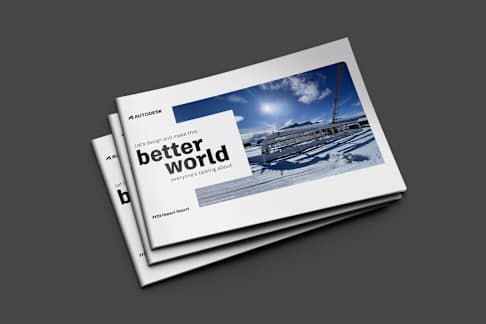
everyone’s talking about
better
FY23 Impact Report
world Let’s design and make this
Image courtesy of Stuart Webster, BAM
2FY23 IMPACT REPORT
OVERVIEW IMPROVE OUR OPERATIONS PARTNER WITH CUSTOMERS ADVANCE INDUSTRIES OPERATE WITH INTEGRITY APPENDIX
Contents Overview A message from our president and CEO
FY23 highlights
Our company
Company strategy
Impact strategy
Improve our operations Energy & Materials
• Advancing our sustainable business practices
• Autodesk Carbon Fund
• Our carbon footprint
Health & Resilience
• Resilience and well-being
• Employee health and safety
Work & Prosperity
• Living our culture
• Diversity and belonging
• Flex Forward
• Learning and talent development
• Employee impact at work
Partner with customers Architecture, Engineering & Construction
Energy & Materials
Health & Resilience
Work & Prosperity
Design & Manufacturing
Energy & Materials
Health & Resilience
Work & Prosperity
Media & Entertainment
Energy & Materials
Health & Resilience
Work & Prosperity
Education
Advance industries Catalyze innovation
Energy & Materials
Health & Resilience
Work & Prosperity
Activate innovation leaders
Accelerate collaboration
Shape policies
Operate with integrity Privacy and data security
Trust
Human rights
Ethics and compliance
Suppliers and business partners
Appendix ESG ratings, rankings, and memberships
Impact strategy assessment
Materiality assessment
Data summary
Sustainability Accounting Standards Board index
United Nations reporting frameworks
Customer ESG commitments and goals
2023 State of Design & Make report
Sustainability-enabling solutions
Endnotes
Performance data included in this report is based on the Autodesk fiscal year when noted, and the calendar year otherwise. The Autodesk 2023 fiscal year ran from February 1, 2022, through January 31, 2023. Performance data covers Autodesk’s global operations, unless otherwise stated. In some cases, segments in tables do not add up to the total due to rounding. Dashes indicate where data was unavailable. All dollar amounts listed are in USD.
OVERVIEW IMPROVE OUR OPERATIONS PARTNER WITH CUSTOMERS ADVANCE INDUSTRIES OPERATE WITH INTEGRITY APPENDIX
FY23 IMPACT REPORT 3FY23 IMPACT REPORT
Overview A message from our president and CEO
FY23 highlights
Our company
Company strategy
Impact strategy
OVERVIEW IMPROVE OUR OPERATIONS PARTNER WITH CUSTOMERS ADVANCE INDUSTRIES OPERATE WITH INTEGRITY APPENDIX
4FY23 IMPACT REPORT
OVERVIEW IMPROVE OUR OPERATIONS PARTNER WITH CUSTOMERS ADVANCE INDUSTRIES OPERATE WITH INTEGRITY APPENDIX
A message from our president and CEO
As the leader of a responsible business, I believe that we must balance the interests of society with those of our stakeholders—our customers, employees, and investors. And, increasingly, these interests are aligned.
Last year was tumultuous, with the Russian invasion of Ukraine, global inflationary pressures, and increasing political polarization in the United States—amid other crises. These immediate concerns are exacerbated by the longer-term issues of climate change and inequality. As I look back on fiscal year 2023, the significance of these societal challenges continues to grow, as does Autodesk’s response to them.
Autodesk technology is the digital foundation of the built environment, industrial production, and media and entertainment sectors. Our ability to enable better, sustainable outcomes through our tools is a responsibility we take very seriously. As the world’s premier Design & Make platform, we have a consequential opportunity to support the creation of a better world for all. You will see the results of our endeavors to date outlined in the following report.
We continue to drive meaningful progress against our corporate impact strategy, with concomitant investments across our Carbon Fund, diversity and belonging initiatives, and the Autodesk Foundation. All of this is in service of our continuing investments in our customers’ ability to deliver on their sustainability and diversity goals.
We organize our work into three complementary strategies: managing our own environmental, social, and governance (ESG) opportunities and risks; delivering on our customers’ ability to meet their climate and diversity goals; and, finally, investing in innovations that will advance our industries toward positive outcomes.
We apply innovative, industry-leading solutions to measure and manage the ESG risks associated with our business.
We are well on our way toward achieving our diversity and belonging goals that we set forth a few years ago. And we are moving up the value chain with our climate commitments— specifically, investing in renewable energy grid capacity and evolving our procurement of carbon offsets to transition from avoidance toward removal.
All these initiatives add value to Autodesk by reducing risk, and cost, associated with running our business—through higher employee retention rates, lower energy costs, and increasing regulatory compliance.
Our millions of customers are our biggest lever supporting positive change. In addition to providing free access to our portfolio of professional tools and curriculum to more than 100 million students, educators, and accredited institutions worldwide, we also believe in equitable access for underrepresented populations. Our recent $1 million grant to Howard University in support of its mechanical engineering department underscores this commitment to build the pipeline of Black engineering talent in the United States.
We are investing in solutions that are purpose-built for carbon management. We have deployed energy modeling and embodied carbon capabilities across our industry solutions this past year. Our water management tools improve efficiency and reduce waste by design. And our new industry cloud offerings have native sustainability capabilities, like energy analysis and environmental modeling features.
Our overarching technology strategy is to deliver an end-to- end platform that enables a seamless flow of data for our customers. Designers, architects, engineers, construction and manufacturing professionals, building and asset owners—all our customers—will be able to seamlessly access data and insights at the right time to achieve their most important sustainable outcomes.
Through investments in R&D as well as our wider ecosystem, we are supporting the innovations that will transform industries. Our investments in generative design and artificial intelligence are yielding real-time insights into embodied carbon, and our Foundation has recently invested in low- carbon concrete, chemical recycling of critical metals, and innovations in nuclear fusion. These investments will yield meaningful breakthroughs in materials efficiency, energy generation, and circularity.
And innovation will not succeed in a vacuum. We have partnered with several organizations driving collective solutions to cross-industry challenges—including World Business Council for Sustainable Development, the Global Alliance for Buildings and Construction, as well as the Society of Women Engineers and the National Society of Black Engineers.
We recognize the increasing significance of this work. We need to do our part in the global transition toward a low-carbon and inclusive future and are excited about the opportunities and benefits this will yield for our business— and for society. By focusing on these issues internally, we can then help our customers to address the same challenges, and subsequently transform the industries that we serve.
We appreciate your support on this journey. Autodesk has a significant role to play in helping our customers design and make a better world for all. Together, we can deliver a sustainable, resilient, and inclusive future. Thank you.
Sincerely,
Andrew Anagnost President and Chief Executive Officer
5FY23 IMPACT REPORT
OVERVIEW IMPROVE OUR OPERATIONS PARTNER WITH CUSTOMERS ADVANCE INDUSTRIES OPERATE WITH INTEGRITY APPENDIX
FY23 highlights
100% renewable energy sourcing our facilities, cloud services, and employee work from home
37.4% increase in the number of women in tech roles globally (compared to beginning of FY22)Operationalized
a hybrid-first office culture including Flex Forward program to equip the company with the tools to further enhance engagement and productivity
Hosted first Sustainability Leadership Summit with our customers and partners at Autodesk University
2.4 million metric tons CO₂e of GHG emissions reduced by the Autodesk Foundation’s global portfolio
Continued engagement at the UN Climate Change Conference (COP27) by supporting the UN Environment Programme Buildings Pavilion
27,000+ people obtained new or improved jobs through the Autodesk Foundation portfolio
$53.4 million in Autodesk product donations
$23.3 million in philanthropic funding from Autodesk and the Autodesk Foundation
Sustainability- enabling solutions introduced and enhanced to improve efficiency in building design and construction as well as factory efficiency in manufacturing
Investing in education gifted $1 million to Howard University in support of its mechanical engineering department
6FY23 IMPACT REPORT
OVERVIEW IMPROVE OUR OPERATIONS PARTNER WITH CUSTOMERS ADVANCE INDUSTRIES OPERATE WITH INTEGRITY APPENDIX
A better world designed and made for all From the greenest buildings to the cleanest cars, from the smartest factories to the biggest stories, amazing things are created every day with Autodesk. Over four decades, we’ve worked together with our customers to transform how things are made, and in doing so we have also transformed what can be made. A car’s performance now inspires the method of its manufacture, a city’s infrastructure helps predict the unpredictable, and the creation of ever-bigger universes shapes ever-bigger stories.
Today our solutions span countless industries, empowering innovators everywhere. But we are restless to do more. We do not believe in waiting for progress, we believe in making it. By combining and recombining technologies. By blurring boundaries, reinventing rules, and merging fields. By unleashing talent and unlocking insights across industries. By helping our customers converge on solutions to the challenges we all face today. At Autodesk, we believe that when you have the right tools to work and think flexibly, you have the power to transform what actually needs making.
Our customers are expected to deliver increasingly complex projects on accelerated timelines while balancing trade- offs between cost, environmental performance, impact on communities, and more. We are developing the solutions needed to measure, manage, and automate these processes while helping customers build and connect applications that unlock the value of their design and engineering data to drive sustainable outcomes. Autodesk delivers the power to design and make a better world for all.
Our company
7FY23 IMPACT REPORT
OVERVIEW IMPROVE OUR OPERATIONS PARTNER WITH CUSTOMERS ADVANCE INDUSTRIES OPERATE WITH INTEGRITY APPENDIX
independence, evaluating its own performance, and setting corporate strategy. The Board reviews our governance practices, corporate governance developments, and stockholder feedback on a regular basis to ensure continued effectiveness.
Our Board is committed to ensuring that stockholder feedback informs our strong governance practices. Members of our management team and, in certain instances, our Board participate in annual stockholder outreach to discuss topics such as diversity, sustainability, board composition, executive compensation, and governance. This outreach enables us to gather feedback from a cross section of Autodesk’s stockholder base, maintain an open dialog, and ensure that we have an in-depth understanding of our stockholders’ perspectives. Our directors also engage with our employees in various ways throughout the year, developing direct relationships below the executive management level. For example, members of our Board attend Autodesk’s annual leadership meetings, participate in fireside chats with employees, and visit our technology centers and other facilities.
Our Board of Directors regularly assesses the skills important for exercising their strategic oversight and fiduciary responsibilities on behalf of Autodesk shareholders. The board also conducts self-assessments to determine if the requisite skills are appropriately represented on the existing Board. This process occurs annually and results in specific skills and experiences that inform the board development process.
Regular continuing education programs enhance the skills and knowledge our directors use to perform their responsibilities. This includes internally and externally developed programs related to ESG issues.
To support effective corporate governance, our Board delegates certain responsibilities to its committees, who report on their activities to the Board. In 2022, the Corporate Governance and Nominating Committee and Compensation and Human Resources Committee began assisting our Board with oversight of ESG issues in the areas defined in their charters. During the year, we expanded the Corporate Governance and Nominating Committee to three members. All chairs of our Board committees are women.
Our management oversees a strong system of internal controls and compliance with corporate policies and applicable laws and regulations.
Learn more about corporate governance at Autodesk:
Company strategy Autodesk’s annual strategy process focuses on understanding our business, customer, market, and industry dynamics to determine our multiyear intent for our business, product development, and go-to-market strategies. Through this process, we develop corporate goals and strategic intents in relevant areas, including Impact. Each goal has accountability from the relevant executive vice president, the CEO, and the Board.
Corporate governance The Autodesk Board of Directors provides independent leadership in the exercise of its responsibilities.
Our directors have a mix of critical skills and diverse perspectives, and their backgrounds include leadership roles in the technology industry, in academia, and internationally. Our Board consists of 11 members, of whom 10 are independent and 5 are women.
We believe the highest standards of corporate governance and business conduct are essential to running our business in a sustainable manner, serving our stakeholders, and maintaining our integrity. Our Corporate Governance Guidelines set forth the principles that guide our Board in overseeing corporate governance, maintaining its
Our impact strategy is a part of Autodesk’s annual strategy process and engages all aspects of our business.
Autodesk executive bios
Board of Directors bios
FY23 Annual Report
Corporate governance guidelines
Committee charters
Committee composition
Accountability We utilize our governance structure to help ensure coordination of Autodesk’s ESG efforts across all area of our business.
Our Board has oversight responsibility for ESG, with assistance from our Corporate Governance and Nominating Committee and our Compensation and Human Resources Committee in specific areas defined in their committee charters.
Ultimately, our CEO has the highest level of direct responsibility for driving progress in our impact opportunity areas. CEO staff reviews progress on Strategic Realization and relevant goals quarterly, including those related to our impact strategy. The Autodesk Board of Directors reviews annual Strategic Intent and Strategic Realizations and regularly reviews status. CEO staff and the Autodesk Board of Directors are informed annually by Autodesk’s Vice President, ESG and Impact, who oversees coordination of efforts across these impact opportunity areas.
Beginning in 2022, Autodesk’s ESG Steering Committee convenes quarterly to review and prioritize issues relevant to the company’s ESG strategy. The council comprises leaders from Finance, Legal, Human Resources, and Impact with accountabilities for ESG across the business. This group is responsible for ensuring that Autodesk assesses and addresses issues that are relevant and specific to our external ESG objectives, including materiality assessment (see summary of assessment conducted in 2022), measurement, management, and disclosure.
https://www.autodesk.com/company/newsroom/corporate-info/executive-bios https://www.autodesk.com/company/newsroom/corporate-info/executive-bios#board%5D https://investors.autodesk.com/financials/annual-reports https://investors.autodesk.com/static-files/68278541-f4d5-4928-a016-e0a7a4d43cce https://investors.autodesk.com/corporate-governance/highlights https://investors.autodesk.com/corporate-governance/committee-composition
8FY23 IMPACT REPORT
OVERVIEW IMPROVE OUR OPERATIONS PARTNER WITH CUSTOMERS ADVANCE INDUSTRIES OPERATE WITH INTEGRITY APPENDIX
Impact strategy Progress demands that we work within our business, in partnership with our customers, and across our industries to advance a more sustainable, resilient, and equitable world.
We focus our efforts to advance positive outcomes across three primary areas. These impact opportunity areas, informed by the UN Sustainable Development Goals, align the top needs of our stakeholders, the most important issues of our business, and the areas where we can best accelerate positive impact at scale.
Learn about assessments that inform our impact strategy.
Improve our operations
Advance sustainable business practices —setting the standard in our culture, governance, and operations
Partner with customers
Achieve positive impact at scale—by partnering with our customers to deliver sustainable outcomes
Advance industries
Transform our industries to be inclusive, resilient, and sustainable
How we create impact
En ergy & M
aterials Health & Resilienc e
W or
k &
P ro
sp er
it y
Impact opportunity areas
Energy & Materials Enable better energy and material choices, reducing carbon emissions and waste. Encompasses key aspects related to energy, materials, waste, and supply chain.
Health & Resilience Accelerate the design and make of places and products that are safer, healthier, and more resilient. Encompasses key aspects related to safety, health, well-being, resilience, and adaptation.
Work & Prosperity Facilitate the acquisition of in-demand skills and lifelong learning to meet the workforce needs of our industries. Encompasses key aspects related to diversity, inclusion, mindset, skills, and learning.
Learn more about how we drive progress toward the UN Sustainable Development Goals.
OVERVIEW IMPROVE OUR OPERATIONS PARTNER WITH CUSTOMERS ADVANCE INDUSTRIES OPERATE WITH INTEGRITY APPENDIX
Executive compensation and ESG performance To drive the achievement of our key strategic ESG priorities related to diversity, inclusion, belonging, environmental sustainability, and philanthropy, our executive compensation program allows for the CEO to recommend to the Board of Directors Compensation and Human Resources Committee adjustments to awards for the other (non-CEO) executive officers based on ESG performance. Given that long-term incentive awards are the largest component of executive officers’ compensation, ESG adjustments will generally focus on equity grants. The Committee will take into account the CEO’s recommendations when determining the final awards for the other executive officers, and also consider overall company ESG progress and outcomes when it determines long-term incentive awards for the CEO.
In FY23, the CEO and Committee concluded that the leadership team met expectations for progress on ESG initiatives, and therefore did not adjust long-term incentive awards for executive officers. For FY24, we have defined quantitative and qualitative ESG measures that leaders will be assessed against to inform the CEO’s recommendations to the Committee and the Committee’s determination of final awards for all executive officers.
Philanthropy Autodesk's philanthropy catalyzes progress toward a more sustainable, resilient, and equitable world.
Funding Technology Talent
$12.4 million in strategic philanthropy deployed by the Autodesk Foundation* during FY23 to a portfolio of 50 nonprofits and start-ups globally
$11 million† in charitable contributions, including $7.8 million by Autodesk, $2.8 million Autodesk Foundation match of employee giving, and $0.34 million Autodesk Foundation contributions for crisis response and ERG grantmaking
Millions of students and educators used Autodesk software at no charge to learn design and make skills (see Education)
$53.4 million in Autodesk software donated to 3,551 nonprofits and start-ups worldwide
$1.3 million in employee volunteer hours, including Pro Bono Consulting volunteer hours‡
The Autodesk Carbon Fund is another key aspect of our approach. Through an internal price on carbon, which capitalizes the Fund, we invest in our efficiency and decarbonization targets as well as renewable energy and certified carbon offset and removal projects.
Impact measurement and management For more than 10 years, we have publicly reported metrics that demonstrate our progress and impact, such as GHG emissions, energy use, employee demographics, and philanthropic investments. We have set and made progress against goals related to our carbon footprint and diversity and belonging. Our biggest opportunity to create impact at scale is by enabling our customers to harness data and generate insights. Although these activities are complex, multidimensional, and outside of our direct control, we know that it is essential to equip our customers with the tools they need to measure and manage the impact of their design and make decisions.
These include:
● Employee belonging and engagement outcomes
● Turnover rates and representation of women and people of color
● Achievement of decarbonization, greenhouse gas (GHG) neutralization, and renewable energy goals
● Executive involvement in and support of employee groups, external organizations, and other efforts that promote ESG
For the April 2023 long-term incentive awards (which, consistent with SEC rules, will be disclosed in the fiscal year 2024 proxy statement in May 2024) and beyond, we anticipate that we will continue to refine our measurements and processes as we learn from our internal best practices, as well as practices that continue to emerge in the external market.
Sustainability financing To drive investments in innovative projects to advance sustainable outcomes in our industries, we are further aligning our impact strategy with our financial strategy. In October 2022, we issued our first Sustainability Bond Impact Report highlighting how the $1 billion in Autodesk’s sustainability bond offering was allocated. In FY23, we met our corporate sustainability targets and received preferential rates on the line of credit.
* The Autodesk Foundation funds its portfolio through a donor advised fund (DAF). † This total does not equal the sum of the parts due to rounding. ‡ Value of volunteer hours aligns with annual valuation from Independent Sector
($29.95 per hour was indexed in 2022). Value of employee Pro Bono Consulting volunteer hours ($195 per hour also included in this total) is based on hourly rates for various skills cited by CECP.
9FY23 IMPACT REPORT
The Autodesk Foundation has gained important insights into how impact measurement and management can establish accountability, inform decision making, and provide the evidence base for impact. As we advance and scale Autodesk’s impact strategy, we continue to apply these learnings to better enable customers to measure and manage impact—and drive collective progress in our markets and industries overall.
Moving forward We have only begun to capitalize on the broad potential of integrating our impact strategy into our business. In the coming years, we will continue expanding our governance frameworks, refining our operating model, improving metrics and management, and driving accountability throughout the company. This will enable us to better meet growing stakeholder expectations and manage rapidly evolving risks while unlocking tremendous opportunities for Autodesk and our customers.
See the Employee impact at work section for more information.
See the Catalyze innovation section for more information.
See detailed performance metrics in the Data summary.
https://investors.autodesk.com/static-files/c93d8bb3-99f5-4acd-9e4c-2382101bc3a4 https://cecp.co/wp-content/uploads/2021/01/CECP-Giving-in-Numbers-General-Valuation-Guide.pdf
OVERVIEW IMPROVE OUR OPERATIONS PARTNER WITH CUSTOMERS ADVANCE INDUSTRIES OPERATE WITH INTEGRITY APPENDIX
Improve our operations Energy & Materials Work & Prosperity
• Advancing our sustainable business practices • Living our culture
• Autodesk Carbon Fund • Diversity and belonging
• Our carbon footprint • Flex Forward
Health & Resilience • Learning and talent development
• Resilience and well-being • Employee impact at work
• Employee health and safety
10FY23 IMPACT REPORT 10FY23 IMPACT REPORT
OVERVIEW IMPROVE OUR OPERATIONS PARTNER WITH CUSTOMERS ADVANCE INDUSTRIES OPERATE WITH INTEGRITY APPENDIX
OVERVIEW IMPROVE OUR OPERATIONS PARTNER WITH CUSTOMERS ADVANCE INDUSTRIES OPERATE WITH INTEGRITY APPENDIX
Advancing our sustainable business practices
Energy & Materials
Autodesk continues to strive for excellence in embedding sustainability throughout our business—which we believe to be essential for any company operating in today’s business environment. Our programs not only reduce our own footprint, but they also enable us to thoughtfully engage with our customers and partners on their own sustainability journeys.
Autodesk first committed to neutralizing our carbon emissions across Scopes 1, 2, and 3 on an annual basis beginning in FY21.1 For the third year in a row, we made meaningful progress on our journey to decarbonize our operations and neutralized our residual emissions across our operations and entire value chain through the deployment of the Autodesk Carbon Fund.
Our sustainable operations efforts are an iterative journey guided by:
● Climate targets grounded in the latest science and aligned to a 1.5˚C climate trajectory
● Prioritization of internal investments and activities that decarbonize our operations and support our suppliers to become more sustainable2
● A commitment to responsibly neutralize our residual emissions by purchasing high-quality carbon offsets, renewable energy certificates, and virtual power purchase agreements (vPPAs) that meet our climate impact criteria (these criteria include fostering measurable, meaningful, and additional climate mitigation impact)
The SBTi validated our GHG emissions reduction targets in FY22 and determined that our FY31 Scope 1 and 2 target is aligned with the 1.5˚C trajectory. Our environmental policy underpins the company’s efforts in our own operations and with our products and services.
11FY23 IMPACT REPORT
OVERVIEW IMPROVE OUR OPERATIONS PARTNER WITH CUSTOMERS ADVANCE INDUSTRIES OPERATE WITH INTEGRITY APPENDIX
Sustainable business practices targets Reducing our emissions Sourcing renewable energy
50% reduction in Scope 1 and Scope 2 GHG emissions by FY31, compared to FY20
SBTi validated
100% renewable energy sourcing our facilities, cloud services, and employee work from home by FY21*
SBTi validated
7% increase* Achieved and ongoing
55% minimum reduction in Scope 3 GHG emissions per dollar of gross profit by FY31, compared to FY20‡
SBTi validated
Neutralize residual carbon emissions for Scope 1, 2, and 3 annually, beginning FY21
61% reduction achieved Achieved and ongoing
26.5% of suppliers for purchased goods and services and business travel, by emissions, will have science-based targets by FY27
* This refers to a combination of renewable energy generated on-site, virtual power purchase agreements, and renewable energy certificates. The increase (+7%) from our FY20 baseline was due primarily to improved data and refined accounting related to our managed fleet operations in the Europe, Middle East, and Africa region, as well as increased fleet use due to relaxed travel restrictions associated with the COVID-19 pandemic.
† This target is an approved science-based target that covers portions of our purchased goods and services, business travel, employee commuting, and fuel- and energy-related activity emissions.
‡ This reduction was due largely to Autodesk discontinuing its line of physical media kits (software on CD ROMs and other media), which eliminated associated GHG emissions.
§ Autodesk’s spend by supplier as well as emission factors may change on a yearly basis, which will in turn impact progress against this target. To accommodate these factors and provide a performance buffer, we aim to engage a higher percentage of suppliers by emissions than the stated goal of 26.5%.
17.6% achieved§
Ongoing commitments Report climate change information in mainstream financial reports
See Autodesk FY2023 Annual Report.
Integrate sustainable design capabilities into our products and services
Learn more
Conduct responsible corporate engagement in climate change policy
Learn more
Engage our top suppliers to set greenhouse gas emissions reduction targets
Use an internal price on carbon
12FY23 IMPACT REPORT
https://sciencebasedtargets.org/ https://investors.autodesk.com/financials/annual-reports
OVERVIEW IMPROVE OUR OPERATIONS PARTNER WITH CUSTOMERS ADVANCE INDUSTRIES OPERATE WITH INTEGRITY APPENDIX
Autodesk Carbon Fund The Autodesk Carbon Fund supports our efforts to measurably, meaningfully, and additionally mitigate climate change by funding activities that:
● Deliver on Autodesk’s sustainability commitments
● Advance Autodesk’s unique climate impact opportunity afforded by its employees, its customers, and its position within industry
The fund is created by applying our internal price on carbon across Autodesk’s Scope 1, 2, and 3 emissions. Moving into FY23, we increased our internal price on carbon to $20 per metric ton, from $10 per metric ton in FY22. This increase helped us take action on new, additional emission reduction initiatives within our operations and value chain and reinforced our commitment to neutralizing our residual emissions through the purchase of high-quality carbon offsets. As we look ahead, we recognize our carbon price will not be fixed. To enable the change needed to drive impact, we strive for our internal price on carbon to continue to be an effective signal, taking into account the rising social cost of carbon as well as our climate ambition as a whole.
Through the Autodesk Carbon Fund, during FY23 we continued to invest in projects that align with the company’s impact opportunity areas. We invested $3 million from the Carbon Fund during the year.
FY23
FY22
$20
$10
Internal carbon price per metric ton
Investment guiding principles and priorities Given the dynamic nature of Autodesk’s sustainability commitments, our impact strategy, and the types, prices, and quantities of solutions available, the Carbon Fund uses a set of underlying guiding principles, values, and priorities when making capital allocation decisions.
● Optimize for impact: Realize measurable, meaningful, and additional climate mitigation impact, while leveraging our technology, customer networks, and industries to drive systemic impact when possible.
● Diversify the portfolio of solutions: Balance the efforts of the Carbon Fund with a portfolio of solutions that span a spectrum of risk/reward in relation to climate impact and time frame.
● Surpass industry standards: Lead with authenticity, surpassing industry standards and generally accepted best practices when we believe it is necessary for achieving greater climate impact.
We make investments from the Carbon Fund in four types of projects and initiatives: efficiency, decarbonization, leadership and engagement, and carbon offsets.
Efficiency Investing in efficiency projects across our business and value chain improves our performance while reducing costs and managing the overall growth of our GHG footprint. Prioritizing efficiency enables us to eliminate some emissions from our footprint and decreases the need to invest in renewable energy credits and offsets.
Learn more
Energy & Materials
13FY23 IMPACT REPORT
OVERVIEW IMPROVE OUR OPERATIONS PARTNER WITH CUSTOMERS ADVANCE INDUSTRIES OPERATE WITH INTEGRITY APPENDIX
Decarbonization projects We are committed to sourcing 100% renewable energy3 in our operations and this year focused our efforts on making additional contributions to renewable energy. Since FY16, we have continued to meet our RE100 commitment and purchased 125,000 MWh of renewable energy in FY23. In addition to sourcing 100% renewable energy for our workplaces and cloud in FY23 (as in FY22), we purchased renewable energy credits for all employees working from home. Key initiatives from FY23 included:
● We funded the installation of a rooftop solar system at our Birmingham, UK, facility that is expected to meet 20% of the site’s electricity needs. One hundred percent of our owned facilities now generate renewable energy on-site that meets a portion of their energy needs.
● We evolved our approach beyond purchasing energy credits to also investing directly into vPPAs. In 2022, we engaged Sustainability Roundtable, Inc. on an aggregated purchasing opportunity for developing a new 100 MW renewable energy project.
● We continued our involvement in the United Airlines Eco- Skies Alliance and launched collaborations with Alaska Airlines, Delta Airlines, and Lufthansa Group to reduce our future business travel emissions through the use of sustainable aviation fuel (SAF). Through these efforts, we purchased more than 27,000 gallons of SAF during FY23.
Carbon leadership and engagement Autodesk actively engages with industry peers, advisors, and partners working to scale decarbonization solutions and create markets for innovations we believe are critical to decarbonizing our industries. For example, we are members of the Business Council on Climate Change (BC3), the Business Alliance for Scaling Carbon Solutions (BASCS), Ceres, and First Movers Coalition.
Carbon offset projects We support carbon offset projects to address residual GHG emissions that remain after making the investments above, while also delivering positive outcomes in alignment with our broader impact opportunity areas. We continue to strive for transparency as the sector evolves and uphold high integrity in aligning with industry standards while at the same time welcoming changes to improve on existing standards. During FY23:
● We provided climate finance to six projects that offset 120,000 metric tons of CO₂e emissions. These included methane emission reduction initiatives in Bangladesh, solar power development in India, and nature-based reforestation, restoration, and revegetation initiatives with La Fazenda (Brazil), Wu-erqihan (China), Borneo Peatlands (Indonesia), and Central Kalimantan (Indonesia).
● We advanced our carbon removal strategy through the direct procurement of carbon removal and avoidance credits associated with the architecture, engineering, and construction and design and manufacturing industries. For example, we supported the CO₂ avoidance and removal of CarbonCure’s low-carbon concrete building material alternative through the offtake of carbon credits.
14FY23 IMPACT REPORT
https://app.pachama.com/projects/la-fazenda/overview#hero https://app.pachama.com/projects/la-fazenda/overview#hero https://app.pachama.com/projects/wuerqihan-inner-mongolia/overview#overview https://app.pachama.com/projects/borneo-peatlands/overview#hero https://app.pachama.com/projects/central-kalimantan-peatlands/overview#overview
OVERVIEW IMPROVE OUR OPERATIONS PARTNER WITH CUSTOMERS ADVANCE INDUSTRIES OPERATE WITH INTEGRITY APPENDIX
Our carbon footprint Procurement We strive to embed sustainability into our purchasing practices, from our events and IT equipment vendors to office supplies such as paper. Since FY21, we have partnered with CDP to engage our suppliers and enhance collaboration and disclosure.
During FY23, we asked 104 of our top suppliers to report information about climate-related programs and GHG emissions to CDP and had a 63% response rate. We plan to roughly double the number of suppliers we engage in this effort in the coming year. Through FY23, 20 of our top suppliers set science-based GHG emissions reduction targets validated or aligned with SBTi, and we are working with suppliers to significantly increase this number during the coming two years.
We seek to provide employees with options for more sustainable purchasing. When employees search for products on Amazon Business, Climate Friendly Pledge4 products appear at the top of search results. In addition, we have partnered with our supplier for Autodesk-branded merchandise such as clothing and office supplies to add a sustainability icon in our company merchandise catalog for products that meet certain criteria such as use of recycled content. During 2022, we piloted a refurbished phone program in our Europe, Middle East, and Africa (EMEA) region. We plan to roll this program out more broadly in EMEA during 2023, and it has the potential to reduce lifecycle GHG emissions (compared to new phones) by a total of 7.5 metric tons CO₂e.5
Learn more about our expanded Partner Code of Conduct and our programs with suppliers and business partners.
Business travel We continue to reduce business travel–related GHG emissions by promoting virtual/hybrid meetings, educating employees on sustainable travel practices, partnering with sustainable hoteliers globally, and incorporating sustainability expectations into our standard meeting contracts. We help advance sustainable air travel through our SAF initiatives with major airlines, and by providing employees with visibility into estimated GHG emissions for each flight segment purchased through our online booking system, enabling more informed decisions for air travel. We are also working to decarbonize our fleet using hybrid and electric leased vehicles, and we are on target to convert at least 75% of our leased vehicles to hybrid or electric by the end of 2023. Emissions from business travel increased from 4% of our footprint in FY22 to 19% of our footprint in FY23, due largely to easing of travel restrictions related to COVID-19.6
Major conferences Autodesk University and One Team Conference (our annual channel partner and sales summit) are both carbon neutral, including the events, attendee travel, and GHG emissions related to virtual participation.7 We achieve this by enhancing efficiency, providing virtual attendance options, reducing waste, and purchasing carbon offsets.6 In FY23, both of these conferences were held in person and virtually, after being exclusively virtual in recent years due to COVID-19 travel restrictions.
Energy & Materials
Customer carbon emissions
Regulatory pressures, investor sentiment, and public sector incentives are increasingly driving Autodesk’s customers to measure and subsequently manage the carbon emissions associated with their business activities. Autodesk products have a meaningful role to play in supporting this move toward the decarbonization of the industries we serve.
The opportunity for Autodesk to measure the carbon emissions associated with our downstream customers’ projects requires access to rigorous and auditable sustainability data. Our corporate strategy to offer end-to-end software solutions and the evolution of our product offerings into platform-based industry clouds will enable this. We will continue working to offer more rigor and clarity on this in the coming years.
15FY23 IMPACT REPORT
https://damassets.autodesk.net/content/dam/autodesk/www/Company/docs/pdf/2021/partner-code-of-conduct.pdf
OVERVIEW IMPROVE OUR OPERATIONS PARTNER WITH CUSTOMERS ADVANCE INDUSTRIES OPERATE WITH INTEGRITY APPENDIX
Employee commuting and remote work To account for the impact of remote workers, in FY22 (similar to FY21) we included GHG emissions associated with home office energy consumption in our footprint (as a part of the employee commuting category based on the GHG Protocol) and purchased corresponding amounts of additional renewable energy and carbon offsets.6,8 We plan to continue this practice moving forward.
Workplaces
We assess our facilities’ environmental operating practices related to energy use and other impact areas, and we work to continuously review and make sustainability improvements. We use our operations as test cases to help refine the functionality of our solutions, improve our environmental performance, and showcase how customers can use our solutions to meet their sustainability objectives. Due to workplace closures and increased work from home, emissions in this category were 3% lower than in FY22. Our offices have sourced 100% renewable energy since FY16.
Cloud and data centers Over the past four years, we have shifted more of our data centers from Autodesk facilities to cloud infrastructure providers, increasing efficiency due to higher infrastructure capacity utilization. In addition, we strive to minimize data center energy use through server virtualization and selection of efficient equipment that meets respected industry standards and by streamlining our code. During FY23, we eliminated the need for more than 340 servers and storage units through consolidation and decommissioning.
We source 100% renewable energy for our cloud services and data centers, and our cloud services have been carbon neutral since FY16. These efforts help us provide customers with a faster, more reliable experience with reduced environmental impacts.6
See detailed performance metrics in the Data summary.
Total in FY23
115,000 metric tons CO₂e
60% Procurement
19% Business travel
12% Major conferences
4% Employee commuting and remote work
3% Workplaces
2% Cloud and data centers
16FY23 IMPACT REPORT
OVERVIEW IMPROVE OUR OPERATIONS PARTNER WITH CUSTOMERS ADVANCE INDUSTRIES OPERATE WITH INTEGRITY APPENDIX
Resilience and well‑being
Autodesk is committed to supporting our employees to adapt, grow, and bounce back from disruption or change. By cultivating a workplace where all employees can realize their potential, we offer more than just a place to work. As a company leading change, we are creating opportunities for people to thrive.
Organizational and community resilience At Autodesk, building resilience is not just about the individual. Purposeful connections, flexibility on how work gets done, and work-life balance are all part of building organizational resilience collectively.
Purposeful connections ● Employee Resource Groups: Our vibrant and growing
network of Employee Resource Groups (ERGs), open to anyone at Autodesk, provides a space for peer support and mentorship and helps drive partnerships with local communities.
Flexibility on how work gets done ● Flex Forward: The Flex Forward program allows us to
reimagine how we collaborate, innovate, and shape inclusive team norms in a hybrid-first environment. We have created a set of tools to support managers and their teams to do their best work with a focus on belonging and well-being.
● Focus Fridays and Smart Sundays: This companywide initiative reserves Friday afternoons from noon until the end of the day (local time) as a no-meeting block. (In Israel, Jordan, and Saudi Arabia, the focused work block takes place on Sunday afternoons and is called Smart Sundays.) This no-meeting time supports and encourages employees to recharge, boost productivity, and experience some relief from meeting fatigue.
Health & Resilience
Work-life balance ● Paid company holidays: In addition to each country’s
standard Autodesk vacation package, we provided six one- time, paid global company holidays in 2022, well-deserved breaks to support meaningful ways to disconnect and recharge. These days included World Mental Health Day in October and the week of December 19. In the United States and some other countries, Autodeskers also took off the last week in December, which we call our “Week of Rest,” for a total of two weeks in December.
● Digital Life Insights: To help Autodesk employees understand their work patterns and set goals to reduce meeting fatigue, we launched Digital Life Insights. Employees can choose to use this internal product to discover personalized resources that help them maintain balance and avoid burnout.
Autodesk is committed to supporting the resilience and well-being of our employees.
Autodesk builds and supports organizational and personal resilience with a broad range of programs and initiatives.
17FY23 IMPACT REPORT
OVERVIEW IMPROVE OUR OPERATIONS PARTNER WITH CUSTOMERS ADVANCE INDUSTRIES OPERATE WITH INTEGRITY APPENDIX
Benefits and personal resilience As a key part of our Total Rewards package, our Benefits program helps Autodesk attract, develop, and retain high- performing employees. We recognize that a rewarding career and personal life depend in part on good health and peace of mind. With that in mind, our benefits are comprehensive and flexible enough to support our employees through various stages of their time at Autodesk. Through these offerings, employees are better equipped to adapt, thrive, and help our customers solve critical global challenges.
Benefits My Way Our employees have diverse needs, so we offer a variety of benefits. Our Benefits My Way wellness reimbursement program provides our employees increased flexibility to support their physical, emotional, financial, and sustainable wellness. With a broad range of eligible items and activities, employees can receive reimbursements that support their well-being. For example, employees in the United States receive up to $1,000 per year in reimbursements (amount varies by country).
The following categories include a long list of eligible items, such as:
● Physical – Gym and sports club membership fees, activity trackers, camping equipment, activity/sports equipment, and fitness trainers
● Emotional – Arts and crafts supplies, hobby classes, massages, music instruments and lessons, relationship workshops, sleep assistance equipment and programs, and yoga classes
● Financial – Animal adoption fees, childcare services, elder care services for family members, financial advice, planning, and seminars/classes, legal services, and student loan repayment
● Sustainable – Electric vehicles, solar products, recycling, composting, and other items to support a greener lifestyle
Bravely Bravely gives employees access to confidential and free coaching services through a global community of on- demand professionally certified coaches. The coaches through Bravely can help with work-related topics such as managing workplace challenges and giving advice to employees to help them develop and grow at Autodesk.
Employee Assistance Program (EAP) Autodesk’s Employee Assistance Program provides our employees and their families with counseling services, as well as online access to well-being and self-care resources for additional support when needed. These resources cover a broad range of areas, such as:
● Life issues – Stress management, relationships, health and well-being, and work-life balance
● Financial services – Budgeting, getting out of debt, credit, collections, saving, and investing
● Family issues – Parenting, childcare, pregnancy, infertility, and adoption
● Work matters – Career development, coworker relationships, and job stress
● Legal services – Estate planning, real estate, landlord- tenant disputes, and IRS concerns
While benefits vary by country, see additional detail about benefits available to US employees, including health and wellness, financial, time away (including parental leave), everyday living, and more.
Supporting the well-being of our LGBTQ+ employees
In 2022, the Benefits team hosted a companywide training on transgender inclusion with Dr. Sand Chang and removed restrictions on gender-affirming care with our US medical insurance provider. Autodesk also published an online resource guide of benefits offered to our US LGBTQ+ employees.
Autodesk named 2022 Best Place to Work for LGBTQ Equality
Autodesk earned a 100% rating and was named a 2022 Best Place to Work for LGBTQ Equality on the Human Rights Campaign Foundation’s Corporate Equality Index.
LGBTQ+ benefits and resources
Employee Relief Foundation and Autodesk’s support for Ukrainian refugees The war in Ukraine sparked the largest refugee crisis in Europe since World War II and has caused millions of people to flee their homes. Autodesk has actively supported those impacted in several ways, including matching employee donations, giving paid hardship time off, and offering grants to employees temporarily housing Ukrainian refugees. The grant application process was managed by the Employee Relief Foundation (ERF), an organization set up to provide a grassroots way for colleagues to help each other in times of critical need due to disaster impact or medical expenses. In 2022, over 50 employees in 13 countries took in refugees fleeing Ukraine and received a total of $220,000 in grants from the ERF (US employees) and Autodesk (non-US employees). Through Bravely, another Autodesk benefit, colleagues who were hosting refugees could connect and support each other.
Employees who hosted Ukrainian refugees expressed that support involves much more than just providing a bed and food. It is also essential to show empathy by providing emotional support and creating opportunities for refugees to meet up with one another, to maintain a sense of community.
18FY23 IMPACT REPORT
https://benefits.autodesk.com https://reports.hrc.org/corporate-equality-index-2022?_ga=2.1836279.732188575.1682384047-19565842.1682384047 https://benefits.autodesk.com/health-and-wellness/LGBTQplus-benefits-and-resources
OVERVIEW IMPROVE OUR OPERATIONS PARTNER WITH CUSTOMERS ADVANCE INDUSTRIES OPERATE WITH INTEGRITY APPENDIX
Employee health and safety At Autodesk, we work to maintain a strong health and safety culture. We help our employees work safely and productively through participation in programs that mitigate occupational safety risks in our workplaces. All company sites have emergency response guidance, and many also have safety committees and emergency response teams to help keep our employees safe.
Through our Autodesk Flex Forward program, we provide our employees flexibility while meeting the demands of our business. We support a blend of office-based, home-based, and hybrid work, and we are dedicated to ensuring employee health and safety across these settings.
Autodesk offers flexible workspaces that are intentionally designed not only for collaboration but to be ergonomically correct. Furniture is designed for comfort and support, and visual openness with access to natural light is balanced with allowance for physical distancing.
Ergonomic injuries can be a leading source of risk, in the office setting or at home. To mitigate this, we offer an online ergonomic self-assessment and safety training program that tracks personal ergonomic risks identified by employees and suggests alternative work habits to potentially resolve those issues. If issues persist despite the employee’s best efforts, certified ergonomists are available worldwide to provide further evaluations, conduct training, and recommend corrective measures, including work habit changes and, in some cases, workstation modifications. We also provide
tailored ergonomic guidance for employees in home-based settings and offer them buying guides and input regarding the most appropriate available solutions.
Supporting the safety and security of our people as they return to in-person meetings has been a top priority in 2022. COVID-19 vaccination and testing requirements have been lifted, meeting room capacities have been modified, and touchless door hardware and restroom fixtures are used where possible. In January 2023, we introduced a new field operations training, focusing on safety and security for Autodesk employees who visit customer sites to do sales or consulting work, or who host high-risk activities and/or travel.
Autodesk relaunched its in-person emergency response team program in 2022, which had been suspended since 2020. Members of the program conduct drills and offer support to all offices and employees worldwide. In the case of fires, flooding, and other emergencies, the local team sends alerts to employees in affected areas and offers evacuation and injury support. Autodesk’s Global Security Operations Center monitored and assisted employees in relation to more than 3,000 incidents last year.
During the year, we also revamped machine guarding at Autodesk Technology Centers, launched a global ladder safety program, and initiated online training via the Autodesk Learning Center.
The recordable incident rate at Autodesk (including home- based work) equaled 0.00 in 2022. Our days away, restrictions, and transfers (DART) rate also equaled 0.00 during the year.
See details in the Data summary.
Health & Resilience
19FY23 IMPACT REPORT
OVERVIEW IMPROVE OUR OPERATIONS PARTNER WITH CUSTOMERS ADVANCE INDUSTRIES OPERATE WITH INTEGRITY APPENDIX
Living our culture At Autodesk, we take great pride in our unique culture. Our success comes from unlocking the passion, talents, and potential of all Autodeskers, who in turn help our customers achieve the new possible.
Together, we harness the power of our culture to:
● Unite Autodeskers through our shared purpose and sense of belonging
● Ensure a globally diverse workforce and culture of inclusion that drives innovation
● Amplify our Culture Code to improve professional growth and business outcomes
Our Culture Code—putting our values to work The Autodesk Culture Code expresses Our Values and the Ways We Work that make us a Customer Company. It puts our culture into meaningful, actionable terms and is embedded into performance evaluations, recognition programs, and companywide learning. By harnessing the power of our culture, we deliver a world-class employee experience, partnering with and enabling our people to thrive and realize their potential. Empowered employees help our customers achieve better outcomes for their products, their businesses, and the world.
Learn more * Represents the average employee engagement score over three pulses during
a given fiscal year. The engagement score is on a scale of 1–100 measuring the average outcome of two questions, eSat and Recommend. These data are reported on a calendar year basis. FY23 corresponds to calendar year 2022, and so forth.
Work & Prosperity
Culture drives employee retention We believe our strong company culture, including our diversity and belonging programs and approach to hybrid work anchored in flexibility, continues to contribute to a lower turnover rate as compared to our Worldwide Software industry peers. Overall turnover for Autodesk in FY23 was 13.8%, including both voluntary and involuntary exits, compared to an industry average of 16.1% during an overlapping time period (June 1, 2021, to June 1, 2022). This placed us below the 25th percentile. Our voluntary turnover rate in FY23 was 11.3%, compared to an industry average of 13.8%. This also placed Autodesk below the 25th percentile, for the second consecutive year during a time of heightened turnover.9
Learn why former Autodeskers return to the company.
Employee engagement*
FY21
FY22
FY23
83%
82%
82%
Fast Company Best Workplaces for Innovators list (2022)
Built In 2023 Best Places to Work list
The Muse VIBE (voted in by employees) Awards 2022
20FY23 IMPACT REPORT
https://www.fastcompany.com/90772167/how-one-companys-culture-code-spurred-innovation https://blogs.autodesk.com/autodesk-life/culture/boomerang-employees-china/ https://www.fastcompany.com/best-workplaces-for-innovators/list https://employers.builtin.com/best-places-to-work/ https://www.themuse.com/advice/vibe-awards-2022
OVERVIEW IMPROVE OUR OPERATIONS PARTNER WITH CUSTOMERS ADVANCE INDUSTRIES OPERATE WITH INTEGRITY APPENDIX
Ways We Work The Ways We Work describe how we operate as team members, as departments, and as a company. The Ways We Work help build a rich understanding of what we expect of ourselves and our colleagues.
Smart Humble
Innovative Courageous
Adaptable Accountable
Inclusive Pragmatic
Impactful
We act as one Autodesk to get the best results for our customers, our business, and our employees.
We empower decision makers.
We actively foster an environment where people can bring their authentic selves to work.
We hold ourselves to the highest ethical standards by embodying integrity.
Learn more
Our Values Our Values define how we at Autodesk work, both as individuals and as a company, and express the essence of who we are. They bring clarity to what we believe and what we expect of those who work with us. Our Values are organized around how we think, how we feel, and what we do. They guide and inspire our mindsets, choices, and actions.
21FY23 IMPACT REPORT
https://www.autodesk.com/company/culture
OVERVIEW IMPROVE OUR OPERATIONS PARTNER WITH CUSTOMERS ADVANCE INDUSTRIES OPERATE WITH INTEGRITY APPENDIX
Kevin Halter
Senior Director, Sales Enablement Management
“I strive to embody the Autodesk Culture Code in my own day-to-day actions and encourage the same from my team.”
Learn more
Brian Jeong
Senior Shop Supervisor, Autodesk Research
“A lot of companies talk about ‘culture,’ but everything truly does revolve around our culture here. I see our Culture Code as the backbone of the organization.”
Learn more
Shona McMoran
Senior Manager, Global License Compliance Audit Services
“Autodesk creates an environment where people can be themselves, championing values like humility, integrity, and courage—which are also critical in personal relationships. My favorite thing about Autodesk is the people.”
Learn more
Learning and living our Culture Code Our culture is a journey we take together every day. Autodesk employees learn about our Culture Code, engage with it, and contribute to it.
Through purposeful conversations, workshops, and reflective exercises, teams across Autodesk identify actions they can take to bring our culture to life in sustained and meaningful ways. Each culture learning activity gives us the opportunity to examine our current actions, identify roadblocks, and apply practical solutions. The goal is for participants to form new habits and processes, both individually and organizationally, to make our culture real at Autodesk.
Inclusion in the hybrid workplace At Autodesk, belonging means being welcomed and celebrated for who you are and what you do. We strive to create an environment where everyone, everywhere, is excited to come to work, feels a sense of belonging, and can fully contribute their talents in the workplace.
Learn more in Diversity and belonging.
In 2022, we focused on supporting inclusive team norms in the hybrid workplace. Autodesk’s Culture Code provides the foundation as we adapt to new ways of working that are more transparent, flexible, and sustainable for everyone. Below are activities and resources to support teams in centering well- being and belonging, no matter where work happens in this era of hybrid work.
Learn more in Flex Forward.
Flex Forward: Saying yes to a hybrid-first work culture.
Empowering decision makers At Autodesk, we empower decision makers. As one of the Ways We Work in our Culture Code, we clarify roles in the decision making process and work together to arrive at the best result. Instead of defaulting to consensus, deferring or rushing a decision, or making the decision but forgetting to communicate it, we work within a common framework toward more efficient and purposeful business decisions. We empower all employees from senior leaders to individual contributors to help build a culture of effective decision making at Autodesk.
Human-centered design At Autodesk, we understand the transformational potential of design thinking. For many years, the LUMA SystemTM for human-centered design has been an important part of our approach, providing a consistent method and tools across the company. When the pandemic halted in-person classes, we reimagined the LUMA System program at Autodesk for remote—and now hybrid—work with both training and structured collaboration projects taking place within digital collaboration platforms.
Across the company, more than 5,500 Autodesk employees now use human-centered design methodologies through LUMA Workplace to plan and design collaboration sessions. Teams report improved collaboration, significantly increased confidence in employee meeting and workshop facilitation, and more diversity of thought from the combination of design thinking and collaborative tools.
Autodesk designs effective hybrid work with Mural and the LUMA System.
Employee spotlights
22FY23 IMPACT REPORT
https://blogs.autodesk.com/autodesk-life/culture/advice-for-rising-leaders/ https://blogs.autodesk.com/autodesk-life/culture/culture-code https://blogs.autodesk.com/autodesk-life/culture/work-friendships/ https://adsknews.autodesk.com/en/news/flex-forward-hybrid-work/ https://www.mural.co/case-studies/autodesk
OVERVIEW IMPROVE OUR OPERATIONS PARTNER WITH CUSTOMERS ADVANCE INDUSTRIES OPERATE WITH INTEGRITY APPENDIX
Diversity and belonging At Autodesk, we are building a culture of belonging where all employees have equitable opportunities to succeed and contribute.
We strive to create an environment where everyone, everywhere, is excited to come to work, feels a sense of belonging, and can fully contribute their talents. We are creating a workplace that embraces a multitude of original minds and talents to develop the most innovative products and solutions that meet the demands of the global marketplace. By cultivating a workplace where all employees can realize their potential, we offer more than just a place to work. Autodesk is a company leading change, where people can build community and thrive.
Global diversity and belonging strategy In 2020, we launched a major global diversity and belonging strategy that focuses on individual, interpersonal, and structural dimensions of change and transformation.
As part of this process, we set three-year objectives and aspirational goals for each of these strategic change levers:
● Attract and retain a diverse workforce
● Expand leadership diversity
● Foster a culture of belonging
Through a data-driven approach, we are building our programs and measuring success.
Learn more
Work & Prosperity
23FY23 IMPACT REPORT
https://www.autodesk.com/company/diversity-and-belonging
OVERVIEW IMPROVE OUR OPERATIONS PARTNER WITH CUSTOMERS ADVANCE INDUSTRIES OPERATE WITH INTEGRITY APPENDIX
Attract a diverse workforce Expand leadership diversity Foster a culture of belonging
Objective Increase representation of women in tech, women in sales, and underrepresented people of color employees in the United States Increase geographic and demographic diversity of leadership Transform our culture so that all employees feel they belong
Goals (by the end of 2024) Increase the number of women in tech roles globally by
25%* Progress through FY23: Up 37.4%
Increase the number of leaders (director and above) based in EMEA, APAC, Japan, Canada, and LATAM by
10%* Progress through FY23: Up 13.2%
Reduce gaps between all demographic groups and companywide survey scores on belonging to
5 points or less Progress through FY23: Within 5 points
Increase the number of women in sales roles globally by
25%* Progress through FY23: Up 13.7%
Increase the number of leaders (senior director and above) in the United States who are people of color† by
40%* Progress through FY23: Up 53.3%
Reduce gaps between all demographic groups and companywide survey scores on engagement to
5 points or less Progress through FY23: Within 5 points
Increase the number of US employees who are underrepresented people of color‡ by
30%* Progress through FY23: Up 23.2%
Increase the number of US Black employees by
100%* Progress through FY23: Up 46.7%
Increase the number of Black and Latinx leaders (senior director and above) in the United States by
300%* Progress through FY23: Up 140.0%
Launch diversity and belonging training companywide, and achieve greater than
75% employee participation
Progress through FY23: 96.5% achieved (based on Professional Behaviors mandatory training)
* Compared to the beginning of FY22. Our second-year aim was to reach 60% of our overall three-year goals. † People of color includes the following United States EE0-1 categories: Asian, Black or African American, Hispanic or Latino, Native Hawaiian or Pacific Islander, Native American or Alaska
Native, Two or More Races. ‡ Underrepresented people of color includes the following United States EE0-1 categories: Black or African American, Hispanic or Latino, Native Hawaiian or Pacific Islander, Native
American or Alaska Native.
Diversity and belonging objectives and goals This page summarizes the second year of progress against our three-year diversity and belonging goals. We made significant progress during FY23 and are increasing focus in areas where additional effort is needed.
24FY23 IMPACT REPORT
OVERVIEW IMPROVE OUR OPERATIONS PARTNER WITH CUSTOMERS ADVANCE INDUSTRIES OPERATE WITH INTEGRITY APPENDIX
Attract and retain a diverse workforce We all win when we attract, retain, and advance talented individuals. This requires a holistic, multifaceted approach. We continuously work to integrate inclusive hiring practices into every step of our recruitment process, including evaluating and revising job descriptions to be more inclusive, using market intelligence to identify strong, diverse talent, and incorporating early career recruitment into our hiring plan.
To promote diversity at executive levels globally, for all leadership roles at and above the director level, we are committed to identifying and engaging with a diverse slate of candidates in terms of gender globally and race in the United States.
Our custom-designed three-day virtual Hiring Manager Bootcamp trains all people managers in Autodesk’s hiring principles and inclusive recruiting practices to help us successfully attract, interview, assess, and onboard diverse talent. The program covers topics such as mitigating bias in the interview process, leveraging diversity partnerships, sourcing diverse talent, writing inclusive job descriptions, and coaching hiring managers on inclusive hiring practices.
In 2022, we launched the Inclusive Hiring Series for Global Talent Acquisition, a three-part training that further enables and equips our global recruiting team to confidently drive a more inclusive hiring process.
Through the Autodesk Tech Program, we are collaborating with four Historically Black Colleges and Universities (HBCUs) in the United States to offer student stipends and mentoring in partnership with our technical business units. The program aims to create an immersive experience focused on mentorship, professional development, and solving real technical challenges with engineers at Autodesk. Since its inception in 2020, the program has supported the growth and advancement of more than 30 underrepresented students.
Learn more
External partnerships are key to reaching a wide array of candidates. To support our diversity goals, we collaborate with organizations such as National Action Council for Minorities in Engineering, Lesbians Who Tech, AfroTech, Fairygodboss (The Muse), myGwork, half the sky Asia, and PowerToFly. In February 2022, Autodesk committed $150,000 annually for three years to The Hidden Genius Project to support the next generation of Black tech leaders and entrepreneurs.
The Autodesk Women in Enterprise Systems & Experience (ESE) initiative supports our goal to increase women in tech roles at Autodesk by 25% over three years. This initiative aims to recruit and promote women within ESE through career and personal development. Achievements during 2022 include:
● Regular discussion forums hosted by ESE Guilds for women to safely explore workplace topics, attended by employees across Asia-Pacific and the Americas.
● Development opportunities for mid-career women in ESE through the first cohort of the WESE Leadership Program. Participants completed the eCornell Executive Women in Leadership Certificate Program and received increased corporate exposure, leadership mentoring, and career development support.
These efforts are yielding positive results, with more job candidates who identify as women (globally) and people of color (in the United States) than ever before. For example, 36.9% of external hires during FY23 identified as women. Partly as a result, women increased from 33.4% of Autodesk’s overall workforce globally at the end of FY20 to 35.4% at the end of FY23. In the United States, 7.6% of external hires during FY23 were Black. This contributed to the rise from 1.7% of the US workforce that Black employees represented at the end of FY20 to 3.5% at the end of FY23.
FY23 employee workforce data*
61.2% White
24.7% Asian
7.3% Hispanic or Latino
3.5% Black or African American
2.7% Two or More Races
0.3% Native American or Alaska Native
0.2% Native Hawaiian or Pacific Islander
35.4% Female
64.5% Male
0.1% Chose not to state
* Data are as of the end of FY23.
Overall workforce, by gender
See detailed performance metrics in the Data summary.
US workforce, by race/ethnicity
25FY23 IMPACT REPORT 25FY23 IMPACT REPORT
https://adsknews.autodesk.com/stories/hbcu-tech-program https://www.autodesk.com/company/diversity-and-belonging https://adsknews.autodesk.com/en/stories/the-hidden-genius-project/ https://ecornell.cornell.edu/certificates/leadership-and-strategic-management/executive-women-in-leadership/ https://ecornell.cornell.edu/certificates/leadership-and-strategic-management/executive-women-in-leadership/
OVERVIEW IMPROVE OUR OPERATIONS PARTNER WITH CUSTOMERS ADVANCE INDUSTRIES OPERATE WITH INTEGRITY APPENDIX
The program culminated in a capstone case competition in which groups pitched an innovative business proposal for Autodesk to deliver customer value with machine learning. The cohort will continue to benefit from sponsorship, and the Diversity & Belonging team is partnering with the HR Business Partner community and Talent Acquisition to elevate participant profiles and accomplishments and connect them with hiring managers who are looking for exceptional leaders to join their teams.
Learn more
During 2022 we also started conducting Career Advancement Retention Effort (CARE) interviews to better understand and mitigate individual reasons for attrition. As part of this initiative, members of the Diversity & Belonging team met with underrepresented people of color to better understand their experiences and motivations for staying at or leaving Autodesk. We also interviewed URPOC who had already left Autodesk to find out about their employee experience at Autodesk and what contributed to their decision to leave the company. Data collected in these interviews will support retention efforts, to be implemented in FY24. By normalizing and supporting open discussions between managers and their URPOC team members, we hope to build a greater culture of belonging leading to higher rates of retention within our underrepresented employee populations. We offer several professional and leadership development opportunities for all employees.
Learn more about learning and talent development at Autodesk.
Expand leadership diversity We are expanding leadership diversity from the Board of Directors to senior leadership and to all areas of Autodesk. As a global company, it is critical that our leadership reflects the perspectives of our customers around the world. Therefore, we have prioritized growing our leadership capabilities globally, resulting in a 13% increase in the number of leaders outside of the United States since the start of FY21.
Our Board of Directors consists of 11 members, of whom five are women and one is Black. Our commitment to attracting and recruiting diverse talent extends to our senior leadership team. Sixty percent of our executive team is women.
We are committed to the growth and development of all our employees. Some programs target specific demographics as part of our diversity and belonging strategic goals. For example, in early 2022, we launched NEXT LEVEL, a program designed to create a pipeline of underrepresented people of color (URPOC) who are ready to move into leadership roles. Twenty-four manager- and senior manager-level employees embarked on six months of leadership development and received a full year of executive sponsorship. NEXT LEVEL participants were supported by a personal advisory board, including a sponsor, a mentor, and an external coach. Training included leadership development workshops and courses throughout the six months.
FY23 leadership data*
70.6% White
21.4% Asian
3.4% Hispanic or Latino
2.2% Black or African American
1.8% Two or More Races
0.4% Native American or Alaska Native
* Data are as of the end of FY23.
34.4% Female
65.6% Male Overall leadership,
by gender
US leadership, by race/ethnicity
See detailed performance metrics in the Data summary.
26FY23 IMPACT REPORT 26FY23 IMPACT REPORT
https://adsknews.autodesk.com/news/next-level
OVERVIEW IMPROVE OUR OPERATIONS PARTNER WITH CUSTOMERS ADVANCE INDUSTRIES OPERATE WITH INTEGRITY APPENDIX
Foster a culture of belonging
We are committed to building a culture of belonging at Autodesk by listening deeply, providing education, implementing programs, and most importantly, fostering collective accountability.
Employee Resource Groups We have a vibrant and growing network of global Employee Resource Groups, employee-led communities composed of individuals who come together based on common backgrounds or dimensions of diversity aligned with Autodesk’s global diversity and belonging strategy. Each ERG is sponsored by a member of our Executive Leadership Team, and our ERG Global Leads partner with the Diversity & Belonging team to help our workplace continue to become a diverse, inclusive environment where everyone can bring their authentic selves to work. Our ERGs provide opportunities for all Autodesk employees to grow and shape our workplace and the world.
In FY23, Autodesk had seven ERGs: Asian Network, Black Network, Latinx Network, Pride Network, Veterans Network, Women’s Network, and Young Professionals Network.
Autodesk’s ERG program is evolving to make an even greater impact on our employee experience and our business globally. In 2022, we:
● Started granting a $10,000 appreciation bonus to our global ERG leads, on completion of every year of service, for the many ways they help our employees feel supported and included, both in times of celebration and in the face of social injustice. Autodesk is proud to make this investment in the future leaders of our work culture—and our company.
● Approved the addition of two new ERGs to launch in 2023—our MIND (Mental Inclusion, Neurodivergence, and Disability) Network and our Indigenous Network. We also completed the selection process for the next cohort of ERG Global Leads, which serve two-year terms.
● Hosted our first Global ERG Summit that convened ERG leaders to build their strategic vision for the coming years. Over two days, more than 30 leaders representing Autodesk’s seven ERGs connected with one another to learn and grow together.
Highlights in FY23
40% growth in ERG membership
70+ site events hosted by ERG chapters globally
12 all-employee global ERG events
$140,000 in Autodesk Foundation donations distributed by ERGs (seven ERGs by end of FY23)
Helping veterans to thrive in the workplace
Michelle Rasmussen, Incoming Global Lead of the Autodesk Veterans Network
“Veterans embody the values Autodesk is striving to teach every employee as part of our Culture Code. Values like: everyone working together as One Autodesk team to reach a shared goal; integrity to always do the right thing rather than the easy thing; courage to stand up for what is right.”
Learn more
27FY23 IMPACT REPORT
https://adsknews.autodesk.com/news/ERG-appreciation-bonus https://blogs.autodesk.com/autodesk-life/diversity/erg-leadership-summit/ https://blogs.autodesk.com/autodesk-life/diversity/erg-leadership-summit/ https:// https:// https://blogs.autodesk.com/autodesk-life/diversity/autodesk-veterans-network/
OVERVIEW IMPROVE OUR OPERATIONS PARTNER WITH CUSTOMERS ADVANCE INDUSTRIES OPERATE WITH INTEGRITY APPENDIX
Lessons in authentic leadership and personal resilience for International Women’s Day
Chelsea Bruno, former Global Lead of the Women’s Network
“As leaders, we bring new things to the table as we grow. But to grow, we must stretch outside our comfort zone. Maybe even fail. And rather than see failure as an end point, look for the lessons that we can carry forward into leadership. That’s authentic leadership. But to do so successfully, time and again, requires personal resilience.”
Learn more
Supporting the LGBTQ+ community: Autodesk Pride Network
Rachel Schnaubelt, member of the Pride Network
“Autodesk has given me space to be authentically myself. I’ve found a lot of belonging in knowing our leadership supports groups like the Pride ERG to focus on creating an inclusive culture.”
Learn more
Finding a sense of belonging through the Asian Network
Boli Lau, AAN Global Board Member and the Canada Site Lead
“Through the leadership course, I learned so much about how our culture impacts our behaviors. Every scenario explained in the course was something I could truly relate to. This was the first time I felt a real sense of belonging—I felt seen, understood, heard, and not at all alone. I felt an overwhelming sense of community, which I wanted to share and advocate for.”
Learn more
Empowering future Autodesk leaders
Daniel Gameiro, Global Lead of the Young Professionals Network
“When you join YPN, you get to expand your network through interacting with other Autodeskers across organizations and geographies, engaging with peers you relate to and trust to build a better world. You also get access to professional development opportunities to help you grow, and you have a chance to give back to communities both within and outside of Autodesk.”
Learn more
Reflecting on Black History Month at Autodesk
Angela Sam-Ibe, Co-Founder of the Black Network
“As a Black female in tech, mentorship is near and dear to my heart. Having successfully pivoted into a new career here at Autodesk, from an executive assistant to a UX designer, over the course of my career, I have had to navigate many barriers to get to my current position. While I did all of the work to get to my new role, my mentor gave me the chance I needed to make the change.”
Learn more
Autodesk celebrates Latinx Heritage Month
Guillermo Melantoni, Global Lead of the Latinx Network
“I want to make sure that everyone understands the contributions of Latinx talent. Beyond the stereotypes. It takes work from both sides and is a very rewarding effort. This process requires the team to create a space where everyone is safe to be themselves.”
Learn more
28FY23 IMPACT REPORT
https://adsknews.autodesk.com/views/iwd-2022 https://adsknews.autodesk.com/en/stories/pride-month/ https://blogs.autodesk.com/autodesk-life/diversity/autodesk-asian-network/ https://blogs.autodesk.com/autodesk-life/diversity/young-professionals-network/ https://adsknews.autodesk.com/stories/blackhistorymonth https://adsknews.autodesk.com/en/stories/latinx-heritage-month-2022/
OVERVIEW IMPROVE OUR OPERATIONS PARTNER WITH CUSTOMERS ADVANCE INDUSTRIES OPERATE WITH INTEGRITY APPENDIX
Programs across the business Across business units within Autodesk, groups of employee volunteers help foster a culture of belonging within their teams. Each group has senior leadership support and an executive sponsor at the VP level.
The Finance Diversity and Belonging Committee comprises volunteers who are passionate about inspiring a culture where diversity is celebrated and everyone feels a strong sense of belonging. In 2022, the committee hosted quarterly guest speakers, sponsored employees to attend a professional career development and networking program offered by Leading Women in Technology, and conducted inclusive sourcing trainings. For the second year, the committee partnered with DreamWakers to connect students from systemically underresourced K–12 schools with Autodesk career role models. Only 22% of the students had ever met someone in a finance-related career.
The Legal Diversity, Inclusion, and Belonging (LDIB) team is a group of volunteers in Autodesk’s legal department dedicated to promoting the company’s ongoing objective of creating and sustaining a culture of belonging and respect for people of diverse backgrounds, beliefs, and ways of living. In 2022, the team hosted the first-ever LDIB Day, a global virtual all-day event featuring live workshops, recorded webinars, and facilitated discussions on a variety of topics, such as mentorship, career development, unconscious bias, inclusive decision making, introversion, and career paths.
Around the globe During 2022, employees in offices that were reopened in Autodesk locations around the world advanced diversity and belonging through a broad range of initiatives, including:
● San Francisco, United States: Five SMASH Rising students interned in summer 2022.
● San Francisco, United States: Autodesk hosted 100+ TechWomen emerging leaders and impact coaches at the Autodesk Gallery.
● Phoenix, United States: Autodesk Research and the Fusion Community Team hosted a Autodesk® Fusion 360® workshop with Girl Gang Garage.
● New Orleans, United States: As part of Autodesk University 2022, the Architecture, Engineering & Construction Audiences Marketing team co-hosted a Black architecture tour, spotlighting the significant contributions Black and African architects have made to the industry.
● Virtual (United States): Autodesk hosted its seventh annual Girls Who Code summer immersion program, geared toward girls and nonbinary high school students.
● Montreal, Canada and France: Site Councils teamed up to spread awareness about disability inclusion for International Day of Persons with Disabilities.
● Birmingham, UK: The UK Council and Autodesk Women’s Network hosted a Period Power volunteering event focused on making packs of menstrual supplies for those without easy access to them.
● Barcelona, Spain: Autodesk joined Gender Equality Tech Hub, a group of companies from Barcelona and the surrounding area committed to closing the gender gap in the technology sector.
● Paris, France: Autodeskers participated in DuoDay to bring awareness to the importance of disability inclusion.
● Gothenburg, Sweden: The Autodesk office hosted a Spacemaker® workshop for Introduce a Girl to Engineering Day.
● Istanbul, Turkey; Amman, Jordan; and Dubai, UAE: Autodesk Women’s Network hosted activities for Breast Cancer Awareness Month and Men’s Health Awareness Month.
● Tel Aviv, Israel: Autodesk held a site event for International Day for the Elimination of Violence Against Women.
29FY23 IMPACT REPORT
https://www.dreamwakers.org/ https://www.autodesk.com/products/fusion-360/blog/girl-gang-garage/ https://adsknews.autodesk.com/stories/black-architecture-walking-tour https://adsknews.autodesk.com/stories/gwc-summer-program https://blogs.autodesk.com/autodesk-life/diversity/duoday-france/
OVERVIEW IMPROVE OUR OPERATIONS PARTNER WITH CUSTOMERS ADVANCE INDUSTRIES OPERATE WITH INTEGRITY APPENDIX
Diversity, equity, and inclusion in Autodesk Foundation programs The Autodesk Foundation is committed to advancing diversity, equity, and inclusion (DEI) through its grantmaking and impact investing, programs, support of emerging industry leaders, and innovative collaborations with stakeholders across Autodesk.
Since launching its DEI strategy in 2021, the Autodesk Foundation has stewarded significant progress in expanding gender, geographic, and racial diversity in its portfolio of industry-leading innovators.
Learn more
Tech Lead Development Program To support the growth of a diverse next generation of industry leaders, the Autodesk Foundation launched the Tech Lead Development Program (TLDP) in 2022. TLDP was a six- month cohort-based program designed to facilitate learning the most in-demand, non-technical skills of the future. The 18 members of the inaugural cohort—from North America, South America, Europe, and Africa—were nominated and recognized as emerging leaders from within the Autodesk Foundation portfolio. Two-thirds of the participants have taken on new responsibilities or been promoted within their organizations and are applying leadership skills as they advance impact within their organizations.
Learn more
Engineering for Change Fellowships
Additionally, through fellowships with Engineering for Change (E4C), the Autodesk Foundation sponsored 25 early-career engineers and technical professionals from 15 countries across five continents, who partner with portfolio organizations to drive progress toward the UN Sustainable Development Goals.
Learn more
$140,000 in unrestricted grant funds was awarded to 10 nonprofits addressing issues important to ERGs, including STEM education for girls of color and advancing human rights around the world.
Grantmaking with Employee Resource Groups
In 2022, the Autodesk Foundation partnered with Autodesk’s Diversity & Belonging team on an innovative participatory grantmaking program, through which the company’s seven ERGs each directed $20,000 in unrestricted funding to nonprofits of their choosing. This collaboration enabled ERGs to strengthen the bonds they are creating within and beyond Autodesk’s walls, leading to positive impacts in the communities they represent. Through this pilot, ERG grantmaking teams learned best practices for effective philanthropy, how to engage ERG members in decision making, and how to conduct due diligence for the grants.
The organizations selected by Autodesk ERGs include: Ascend Foundation, The Asian American Foundation, The Center for Reproductive Rights, The Colorado Veterans Project, iWish, LatinaGeeks, Michigan Veterans Foundation, Rainbow Railroad, Techbridge Girls, and The Transgender Law Center.
Learn more
Tech Lead Development Program cohort at Autodesk University in 2022
30FY23 IMPACT REPORT
https://blogs.autodesk.com/autodesk-foundation/2023/01/31/autodesk-foundation-dei-strategy-update/ https://adsknews.autodesk.com/stories/autodesk-foundation-tldp-2022 https://blogs.autodesk.com/autodesk-foundation/2023/02/16/2022-e4c-summer-fellowship/
OVERVIEW IMPROVE OUR OPERATIONS PARTNER WITH CUSTOMERS ADVANCE INDUSTRIES OPERATE WITH INTEGRITY APPENDIX
Supplier diversity At Autodesk, we use our purchasing power to increase diversity and inclusion in our supplier base, helping to create jobs and wealth in historically marginalized communities. We value our impactful relationships with small businesses as well as person of color-, women-, disability-, veteran-, service-disabled veteran-, and LGBTQ+-owned businesses. Creating a supplier base that reflects the demographics of Autodesk’s marketplace provides us with access to better ideas and ways to innovate.
To increase our engagement with diverse businesses, Autodesk belongs to the National Minority Supplier Development Council (NMSDC), the National LGBT Chamber of Commerce (NGLCC), the Western Regional Minority Supplier Development Council (WRMSDC), and tech:SCALE. During the year, Autodesk participated in the following events to provide mentoring and business opportunities to diverse suppliers:
● For WRMSDC: The MBE & Diverse Supplier Pitch Competition, the Best in the West Platinum Partner Pitch Contest, and Supplier Diversity Expo Matchmaking and Mentoring
● For NGLCC: Platinum Circle B2B & B2C Matchmakers and Communities of Color Initiative Matchmaking
● For Women’s Business Enterprise Council-West: The National Black Pitch Contest
Supporting pay equity Autodesk is committed to pay equity for our employees. We regularly conduct pay analyses to compare the alignment of pay levels across different demographic groups and make appropriate adjustments if needed. We have continued Fair Pay at Hire, which means that we do not ask candidates about their prior company compensation in the United States. Autodesk was also a proud early signer of the California Equal Pay Pledge, which affirms the commitment to conducting annual pay analysis, reviewing hiring and promotion processes and procedures to reduce unconscious bias and structural barriers, and promoting best practices that will close the pay gap.
We are transparent about our salary structures, bonus targets, and long-term incentive guidelines to ensure employees are clear on where they stand and give them insight on how they compare to the external market. All employees are eligible for long-term incentives, delivered via stock grants or cash, depending on the country. To attract, retain, and support our highly qualified employees, we offer competitive compensation and benefits, which include an element of choice to meet the needs of our diverse population globally.
We are developing an engagement model to increase our collaboration with Autodesk sourcing, finance, and business groups to identify opportunities to work with diverse suppliers. We also continue to explore expanding our program to additional countries and regions.
We spent
$51.3 million with US-based diverse businesses during FY23,
Up
47% compared to the prior year, and equivalent to 6.9% of addressable spend.11
And we increased the number of diverse suppliers participating in our contingent labor program by 33% and spent $30.5 million, a 55% increase compared to the previous year.
We worked with 280 suppliers in FY23, compared with 189 the prior year.
FY22
FY23
189
280
31FY23 IMPACT REPORT
OVERVIEW IMPROVE OUR OPERATIONS PARTNER WITH CUSTOMERS ADVANCE INDUSTRIES OPERATE WITH INTEGRITY APPENDIX
Flex Forward Autodesk is embracing flexibility in the world of hybrid work—one that fuels our mission, enhances our culture, connects us to one another, and positions Autodesk as a hybrid- first tech company.
Initially, Autodesk launched our “Flexible Workplace Program” in response to the need to accommodate remote work. Now, we’ve designed programs and policies to intentionally lean into a hybrid-first culture, equipping the company with the tools to further enhance how we stay engaged and productive within our innovative and impactful culture.
Through Flex Forward, Autodesk boosts productivity, connection, and belonging, and fosters a hybrid-first culture that serves our vision and mission while enabling us to access the untapped potential of a much more diverse talent pool. We empower our people managers to lead, role-model, and inspire, which positions employees to thrive. Our Culture Code serves as our foundation as we continually adapt to ways of working that are more flexible and sustainable, and that enhance our employee experience while meeting the needs of our dynamic and growing business.
This includes:
● Extending our global mobility policies, to provide employees flexibility to leverage Autodesk’s locations worldwide and experience life and work outside their home country.
● Harmonizing work-from-home benefits for all employees, despite workplace designations, to bring consistency and parity to overall employee experience.
● Investing in intentional office design to promote on-site experiences for gathering, collaboration, and focused work.
● Providing people managers with training and toolsets that enable them to continue to lead in a flexible workspace.
Harnessing hybrid work To support our Flex Forward program, we implemented a companywide initiative to prioritize synchronous time for employees to work heads down and boost productivity through Focus Fridays and Smart Sundays globally—as well as one-time global company holidays to help employees recharge. And in 2022, we released Harnessing Hybrid, a four-part training program founded in behavioral science principles to equip people managers to lead, inspire, and boost trust and accountability in a hybrid environment.
We will continue to deliver additional workshops and learning pathways throughout 2023 to provide guidance for hybrid working, intentional gathering, collaboration, and belonging. To prevent employee burnout and isolation, we remain focused on key initiatives related to belonging, collaboration, and well-being.
Work & Prosperity
32FY23 IMPACT REPORT
OVERVIEW IMPROVE OUR OPERATIONS PARTNER WITH CUSTOMERS ADVANCE INDUSTRIES OPERATE WITH INTEGRITY APPENDIX
We will embrace our culture Our Culture Code will continue to be our beacon that guides how we will work together as we explore new ways of working.
We will offer flexibility in how and where work gets done Design for flexibility in how and where work gets done while balancing the needs of our dynamic and growing business.
We will foster an inclusive, distributed work experience Promote the creation of thoughtful and inclusive team norms so every Autodesker can do their best work and belong, no matter where work happens.
We will enable in-person and digital collaboration and connection Design offices to inspire collaboration, creativity, and innovation. Bridge the digital and physical world with investment in space and technology to enable collaboration and solidify connection.
We will prioritize the well- being of our people Design policies and programs with employees’ physical, mental, emotional, and social health in mind, ensuring they feel valued, energized, and supported every step of the way.
Flex Forward Promise
Our Flex Forward Promise, which applies to all Autodesk employees, underpins our efforts in this area and helps us to reimagine how we collaborate, innovate, and shape inclusive team norms.
33FY23 IMPACT REPORT
OVERVIEW IMPROVE OUR OPERATIONS PARTNER WITH CUSTOMERS ADVANCE INDUSTRIES OPERATE WITH INTEGRITY APPENDIX
Learning and talent development Great employee experiences translate into great customer experiences.
Responding to the unprecedented number of professionals changing jobs, and our own employee surveys, career development is a key focus at Autodesk. In 2022, we aligned our learning and talent development resources on the development of holistic, employee-focused key personas: individual contributors, managers, directors, and executives. Career development is a journey that starts with setting goals and evolving relevant skills. We help our employees set career goals and reach those targets through digital learning, instructor-led classes, coaching, and mentorship. We encourage all employees to go through this process.
We initiated a project in 2021 to refresh job family descriptions and define critical skill profiles; as of the end of 2022, we have defined critical skills for more than 30 of the top job families at Autodesk. We will continue publication of these skills, helping leaders across the company work with employees to explore and drive their career path development with a line of sight to the organization’s future skills demand. This transformation moves us away from high-level, static job family descriptions to a data-driven, dynamic framework that can be tailored to actionable, skills-based development and career paths.
Digital learning To help employees upskill on the job and navigate their development, the MyLearning platform connects users to the world’s largest collection of professional learning content from both inside and outside Autodesk. More than 11,000 employees consumed approximately 300,000 learning assets (such as articles, videos, and podcasts) on the MyLearning platform during FY23.
The rapid pace of change in global work environments has put pressure on how fast new skills must be acquired. The need to develop and roll out learning programs much more quickly than in past years was supported by Autodesk’s growing community of learning champions. These employees have unique domain knowledge and are passionate about curating learning experiences for others. This community reached 105 members and published more than 340 new learning pathways in 2022.
Most of these training programs cover specialized or emerging skills and enable employees to stay current in their industry.
As a way of tracking current skill levels as well as progress over time, employees can choose to take an informal skill assessment and/or request feedback from their manager and peers. These skill ratings—one recent capability Autodesk is exploring to support learning companywide—are used only to help employees shape their career development focus.
Work & Prosperity Instructor-led classes Autodesk offers our employees one- and two-day high-impact instructor-led classes that cover essential skills, as well as other career development learning opportunities. For example, in FY23 Autodesk launched “Own your career,” a six-week experience that helps employees create clear roadmaps and actionable steps to advance their careers. During 2022, approximately 2,000 learners participated in 160 instructor-led classes in areas such as communication skills, negotiation, leadership, and hiring.
Coaching
Autodesk offers two different coaching programs that supplement each other and provide employees comprehensive support based on need. Through Bravely, we offer all employees shorter-term, on-demand coaching designed to support them in challenging career moments, available at any time free of charge. We also offer a six-month transformational coaching experience through BetterUp, provided to employees based on budget approval.
Both options support employees who are navigating the demands of work and personal life, or who want to develop key leadership skills through goal-oriented engagements with a certified coach. During 2022, about 1,800 employees participated in our coaching offerings and scheduled 6,000 sessions, a 30% increase compared to the prior year. Coaching has been connected to other Autodesk development programs and is one of the steps on the overall career development journey.
Mentorship All employees can participate in the Autodesk Mentorship Program as a mentor, mentee, or both. The employee-driven program breaks down the barriers of meeting and learning from colleagues around the world and gives people the space and resources they need to take ownership of their development and build their network as best suited for their careers. During 2022, the program grew to about 3,000 users with 700 new connections and 36 group mentorship circles. Like coaching, mentorship has been integrated into the larger career development journey, helping people explore what it is like to work in a different part of the organization, or prepare for a job change.
Learn more
Managing@Autodesk
Autodesk empowers its people managers, who are a critical lever for our organizational success. The Managing@ Autodesk program continues to serve as the primary vehicle to inform, inspire, and enable all global people managers with the latest information and key actions, while providing a venue to share fresh ideas, resources, and tools. In 2022, people managers enrolled more than 2,400 times in our 16 Managing@Autodesk pathways, and engaged with more than 5,000 articles, videos, and podcasts. We conducted quarterly webinars that attracted more than 1,000 managers and invited global managers to share their stories and best practices throughout the year. Nearly 500 managers attended Hiring Manager Bootcamp to drive global consistency and alignment in our hiring practices.
In 2022, we launched the Managers’ Circle program for approximately 700 managers on customer-focused Worldwide Sales and Customer Success teams. The program’s goal is to create a more connected manager community. Managers receive rapid access to curated and simplified resources and a forum to share ideas and support. The Sales Enablement team—in partnership with People and Places, Communications, Revenue Enablement, and other strategic stakeholders—creates compelling content and design experiences best aligned with the needs of leaders as they develop themselves and grow their teams. This global community comes together frequently for interactive online and in-person meetups, webinars, and Slack “Ask Me Anything” sessions. The program connects leaders across organizations, amplifies the sharing of peer-to-peer wisdom and resources, and empowers senior managers as coaches and mentors.
More than 11,000 employees consumed approximately 300,000 learning assets (such as articles, videos, and podcasts) on the MyLearning platform during FY23.
34FY23 IMPACT REPORT
https://blogs.autodesk.com/autodesk-life/culture/mentorship-program/
OVERVIEW IMPROVE OUR OPERATIONS PARTNER WITH CUSTOMERS ADVANCE INDUSTRIES OPERATE WITH INTEGRITY APPENDIX
Employee impact at work Our employees and our culture of impact bring Autodesk’s vision of a better world to life. Whether building sustainability capabilities into our tools, supporting our customers and partners to achieve their sustainability goals, or volunteering time and valuable skills to nonprofit partners and local communities, our employees play a pivotal role in driving progress toward our impact strategy.
We encourage all our employees to get involved in impact-led professional development opportunities. We believe that the more our employees engage in making a positive impact at Autodesk, the more effectively we can help our customers drive positive outcomes at scale.
Employee volunteering and giving In FY23, Autodesk employees continued to contribute their talent, time, and money in service of impact. Our employees and our culture of impact bring Autodesk’s vision of a better world to life.
Work & Prosperity
FY23 highlights
37% of employees logged a donation and/or volunteer time
4,400+ organizations globally supported through employee giving and volunteerism
23,700 employee volunteer hours, including 3,680 Pro Bono Consulting volunteer hours
$1.32 million
worth of employee volunteer hours*
$2.46 million
in employee giving
* Value of volunteer hours aligns with annual valuation from Independent Sector ($29.95 per hour was indexed in 2022). Value of employee Pro Bono Consulting volunteer hours ($195 per hour also included in this total) is based on hourly rates for various skills cited by CECP.
Image courtesy of Autodesk Life. From left to right: Pascale Naillard, Alexandre Priou, Beatrice Cassignol, Adrien Dixneuf, Florence Ferreira, David Waterhouse, Maria Cadillon, Stefano Ascani
35FY23 IMPACT REPORT
https://cecp.co/wp-content/uploads/2021/01/CECP-Giving-in-Numbers-General-Valuation-Guide.pdf
OVERVIEW IMPROVE OUR OPERATIONS PARTNER WITH CUSTOMERS ADVANCE INDUSTRIES OPERATE WITH INTEGRITY APPENDIX
Image courtesy of Nexleaf Analytics
This can involve 1:1 Pro Bono Consulting (online hour-long volunteer consulting engagements), Pro Bono Team Projects (teams of three to five employees volunteering their skills for one to three hours a week over 12 weeks), and Pro Bono Immersion (teams of five to ten employees volunteering their professional skills on-site for two weeks with an Autodesk Foundation customer). During FY23, 121 employees participated in this program.
Autodesk legal pro bono program
Autodesk’s legal department hosts a custom pro bono program whose mission is to help marginalized communities receive equal access to justice. In FY23, attorneys and staff worked with Bet Tzedek to help transgender individuals apply for legal name and gender marker changes so that their legal documents match their identity. Volunteers supported the Immigration Institute of the Bay Area to help DREAMers renew their DACA status. And members of the legal team collaborated with Legal Aid of Marin to help houseless and other marginalized individuals navigate the Marin County courts. Thirty percent of Autodesk’s legal team participated in pro bono volunteering during the year, supporting these and other partnerships, for a total of about 145 hours.
Learn more
Employee giving
In a year when many organizations and individuals needed extra support, Autodesk employees responded by donating to nonprofits around the world. Employees receive 1:1 matching funds (up to $5,000 per employee) from the Autodesk Foundation, doubling the impact of their charitable giving to communities and the causes they care about most. During our annual Employee Global Month of Giving in mid-November through mid-December 2022, more than 1,070 employees gave a total of $900,000, which Autodesk Foundation matched. Also in 2022, employees donated $1.3 million to the 2:1 match campaign addressing the war in Ukraine.
Employee volunteering From the first day on the job, Autodesk full-time employees are given 48 paid hours a year to volunteer for causes most important to them (part-time employees receive 24 paid hours a year). During our annual Global Month of Impact in June 2022, more than 2,000 employees participated in 10 virtual sessions that included interactive quizzes about Autodesk’s carbon commitments and customer success stories that showcased the impact of Autodesk tools on buildings’ carbon footprints. In addition, employees hosted 10 in-person volunteer events around the globe, including recycling events, trash cleanup adventures, educational webinars, and local expert talks.
Autodesk’s Costa Rica team took part in Global Month of Impact 2022 by organizing a trip to help clean up one of the most polluted rivers in the Americas, the Tarcoles. After a security briefing with local environmental conservation organization MareBlu, the intrepid crew of 13 Autodeskers headed to the river mouth to collect and sort trash according to its recyclability. In just one morning, the team collected more than 360 kilograms of plastic trash—trash that will no longer be clogging the mangrove forest home to American crocodiles, iguanas, rare bird species, monkeys, anteaters, sloths, jaguarundi, and river otters.
Learn more
In 2022, the war in Ukraine sparked the largest refugee crisis in Europe since World War II. More than 50 Autodesk employees in 13 countries took in refugees fleeing the country.
Pro Bono Consulting Employees also contributed Pro Bono Consulting volunteer hours during the year. We invite Autodesk employees to volunteer and apply their expertise—ranging from engineering and design to marketing and communications—in support of nonprofits and social enterprise start-ups addressing challenges that align with our impact opportunity areas.
Nexleaf Analytics
Keeping consistent temperatures across the supply chain of warehouses, trucks, refrigerators, and clinics–known as the “vaccine cold chain”– is essential to ensure vaccines remain potent and work. To advance life-saving vaccine distribution in low-to-middle-income countries, Autodesk employees worked with Nexleaf Analytics to develop a data visualization dashboard. This provides stakeholders a real-time look at performance trends in vaccine cold chains around the world, to support investments to improve performance in this area.
Learn more
Kheyti
Through user-centric design, a team of Autodesk engineers, designers, and training partners worked with Indian nonprofit Kheyti to lower costs and installation times for its signature “Greenhouse-in-a- Box” product. The team helped lay a strong foundation to scale and deliver the affordable farming solution—which uses 90% less water and grows seven times more food than conventional methods.
Learn more
During our annual Employee Global Month of Giving in mid-November through mid-December 2022, more than 1,070 employees gave a total of $900,000, which the Autodesk Foundation matched. Also in 2022, employees donated $1.3 million to the 2:1 match campaign addressing the war in Ukraine.
Image courtesy of Kheyti
36FY23 IMPACT REPORT
https://www.autodesk.org/portfolio https://www.bettzedek.org/ https://iibayarea.org/ https://legalaidmarin.org/ https://blogs.autodesk.com/autodesk-foundation/2022/02/18/customizing-pro-bono-for-legal-expertise/ https://www.mareblucr.org https://adsknews.autodesk.com/stories/global-month-of-impact-2022 https://www.autodesk.org/portfolio/nexleaf/pro-bono https://www.autodesk.org/portfolio/kheyti/pro-bono
OVERVIEW IMPROVE OUR OPERATIONS PARTNER WITH CUSTOMERS ADVANCE INDUSTRIES OPERATE WITH INTEGRITY APPENDIX
Sustainability Consulting Practice During 2022, Autodesk created the Sustainability Consulting Practice, a global team of experts who engage with customers to advance sustainable capabilities across the industries we serve. As these innovations mature, they will be scaled for the benefit of all Autodesk customers. In the first year, the team helped a major industrial manufacturer to implement generative design capabilities into its workflow, reducing material usage in its casting operations by 23%. A global engineering firm used reality capture and digital twin capabilities to renovate a multi-story headquarters building, decreasing total cost of ownership by 70% compared to new construction.
Autodesk technical community As a technology company, our technical employees play a pivotal role in driving impact. We offer incentives to engage their critical and emerging skills, and we encourage innovative thinking that motivates and effects positive change in the world:
● As part of our annual technical summit, we give a Better World Builder Award—selected from nominees across the company—for outsized contributions helping our customers design and make a better world using Autodesk technology. At TechX 2022 in Atlanta, the award went to a presales technical specialist who drove the design and build of a sustainability dashboard for a major Japanese building designer.
● The Employee patent program incentivizes creative thinking and sustainable innovation; employees who have new patents granted are given bonuses of up to $4,000.
● Autodesk’s Impact team rewards employees across the company who make exceptional contributions related to climate change.
Learn more about our employees’ connection to giving and community.
Empowering employees to drive impact
Autodesk sales employees The Autodesk Making the Future sales incentive program rewards Autodesk account teams for partnering with customers to achieve outcomes aligned with the United Nations Sustainable Development Goals. Winners in FY23 spanned account sizes and industries.
Our Sustainability G.O.A.L. Program equips our customer- facing employees with information, resources, and skills to support customers on their sustainability journeys and create positive impact with Autodesk solutions. During 2022, the program grew to more than 400 employees and executives from across the company, representing sales and customer success as well as marketing, brand, business development, and other groups from all regions globally. There are four program levels—Guest, Official, Ambassador, and Leader— and employees earn digital badges for demonstrating an advanced understanding of and ability to communicate Autodesk’s impact strategy and help customers solve at least three sustainability challenges using Autodesk solutions.
37FY23 IMPACT REPORT
https://adsknews.autodesk.com/views/sustainability-success-steve-tony
IMPROVE OUR OPERATIONS PARTNER WITH CUSTOMERS ADVANCE INDUSTRIES OPERATE WITH INTEGRITY APPENDIX OVERVIEW
Partner with customers Architecture, Engineering & Construction Media & Entertainment
Energy & Materials Energy & Materials
Health & Resilience Health & Resilience
Work & Prosperity Work & Prosperity
Design & Manufacturing Education
Energy & Materials
Health & Resilience
Work & Prosperity
38FY23 IMPACT REPORT
IMPROVE OUR OPERATIONS PARTNER WITH CUSTOMERS ADVANCE INDUSTRIES OPERATE WITH INTEGRITY APPENDIX OVERVIEW
IMPROVE OUR OPERATIONS PARTNER WITH CUSTOMERS ADVANCE INDUSTRIES OPERATE WITH INTEGRITY APPENDIX OVERVIEW
Architecture, Engineering & Construction Our architecture, engineering, and construction products improve the way building, infrastructure, and industrial projects are designed, built, and operated.
39FY23 IMPACT REPORT 39FY23 IMPACT REPORT
OVERVIEW IMPROVE OUR OPERATIONS PARTNER WITH CUSTOMERS ADVANCE INDUSTRIES OPERATE WITH INTEGRITY APPENDIX
IMPROVE OUR OPERATIONS PARTNER WITH CUSTOMERS ADVANCE INDUSTRIES OPERATE WITH INTEGRITY APPENDIX OVERVIEW
The architecture, engineering, and construction (AEC) industry and its customers have a significant impact on CO₂ emissions, accounting for about 50% of the total use of raw materials and 36% of energy use globally.1
The buildings sector represents 38% of energy- and process- related GHG emissions globally: 28% from operational energy consumption and 10% from the buildings construction industry.2 Reducing operational energy consumption in new and existing buildings remains a high priority for Autodesk and many of our customers. Tackling embodied carbon in infrastructure and building materials also offers great opportunity for near-team impact, since building materials from projected new building construction will account for half of the climate impacts between 2020 and 2050.3
As the world population continues to urbanize over the next 30 years, reducing these impacts is urgent. We will need to build an average of 13,000 buildings every day, construct 700,000 miles of roads per year, and lay more than 4 million miles of water and sewage pipes.4 Industry demand will continue to rise for solutions that enable architects, engineers, and contractors to support this rapid growth more sustainably by improving energy efficiency and managing embodied carbon thoughtfully.
In 2040, approximately two-thirds of the global building stock will be buildings that exist today.5 In the European Union, 85%–95% of today’s buildings will still be standing in 2050,6 and almost 75% of those buildings are not energy-efficient.7 Without widespread renovation, operational CO₂ emissions from existing energy-inefficient building stock will make it impossible to achieve the Paris Agreement’s 1.5°C target.
Globally, commitment to increasing green building efforts remains strong: More than 70 countries, including the biggest emitters—China, the United States, and the European Union bloc—have now set net-zero targets, covering about 76% of global emissions.8 The business case for building green is compelling: The average reduction in operating costs in the first year for new green buildings is 10.5%, and average five- year operating cost savings is 16.9%; green renovations and retrofits have an even stronger performance at 11.5% and 17% average reductions, respectively. Owners report that new green buildings and renovation/retrofit projects increase building asset value by more than 9%.9
Architecture, Engineering & Construction
In the United States, the Inflation Reduction Act of 2022 contains new government spending and tax breaks that aim to address climate change over the next five years, including grants for carbon reduction projects, promoting resilient transportation infrastructure, and improving urban air quality.10
Our customers are increasingly working to make and retrofit net-zero energy buildings, reduce embodied carbon, decrease construction waste, build better transport and water infrastructure, and develop smart and sustainable cities. Governments worldwide are using infrastructure to drive economic recovery and achieve long-term transformative outcomes, increasing funding and regulations for transportation infrastructure with a global stimulus value of over $800 billion.11
In the 2023 State of Design & Make report, 82% of AEC companies are feeling customer-driven pressure to strengthen sustainable practices.12 Autodesk is committed to providing automation tools—such as the Autodesk® Architecture, Engineering & Construction (AEC) Collection and Autodesk Construction Cloud®—to support these sustainability objectives at scale.
Energy & Materials
74% of AEC customers have a public commitment to sustainability—up 26 percentage points in three years.12
40FY23 IMPACT REPORT
https://damassets.autodesk.net/content/dam/autodesk/docs/pdfs/2023-state-of-design-and-make.pdf
IMPROVE OUR OPERATIONS PARTNER WITH CUSTOMERS ADVANCE INDUSTRIES OPERATE WITH INTEGRITY APPENDIX OVERVIEW
Embodied carbon Embodied carbon, which accounts for roughly 13% of global greenhouse gas emissions, arises from the extraction, manufacturing, transportation, installation, maintenance, and disposal of building materials.13 Because these emissions cannot be undone once a structure is completed, it is crucial to predict, measure, and manage embodied carbon throughout the building design and construction process.
At Autodesk, we are committed to developing and supporting solutions that empower designers and architects to make smarter, more sustainable choices related to measuring and managing embodied carbon. Our efforts include the Autodesk® Insight Tech Preview for Carbon Insights, a powerful tool available in Autodesk® Revit® 2023 software that enables designers to better understand the carbon impacts of their material and construction choices from the earliest conceptual design stages.
We are also proud to support the Tally Climate Action Tool (tallyCAT) currently in public beta. This free Revit plug-in helps design firms build and manage libraries of carbon- efficient materials and assemblies. With tallyCAT, Revit users can obtain accurate material takeoffs, visualize hot spots, identify the most significant carbon reduction opportunities, and access third-party verified data about climate impact before construction begins.
Autodesk is also committed to supporting TallyLCA—the first lifecycle assessment (LCA) tool to calculate whole building lifecycle impacts of building materials directly in a Revit model. This enables architects and engineers to define relationships between BIM elements and construction materials from the Tally database.
As a lead sponsor of the Embodied Carbon in Construction Calculator (EC3) developed by Building Transparency, an open source database of Environmental Product Declarations to help manage and develop the EC3 tool, Autodesk has enabled Autodesk® BIM 360® users to visualize embodied carbon reduction potential, generate code-compliant geometries, and specify and benchmark affordable low carbon construction materials. Our commitment to advancing sustainable building practices remains a top priority as we continue to invest in developing and supporting innovative technology and collaborative industry partnerships.
Sustainability Tech Partner Program
Autodesk announced our new Sustainability Tech Partner Program during Autodesk University in September 2022.
The program’s objective is to build an ecosystem of partners on the Autodesk® platform who make technology applications that enable better environmental outcomes across a process or project lifecycle—in areas such as measuring embodied carbon, minimizing energy use, and reducing material use. Impact Partners who join the program get preferential support and access to Autodesk tools, expertise, training, and events.
41FY23 IMPACT REPORT
https://www.autodesk.com/campaigns/sustainability-tech-partner-program https://www.autodesk.com/campaigns/sustainability-tech-partner-program
IMPROVE OUR OPERATIONS PARTNER WITH CUSTOMERS ADVANCE INDUSTRIES OPERATE WITH INTEGRITY APPENDIX OVERVIEW
Adaptive reuse In many cases, the lowest impact building is one that has already been built. Making the most of existing structures through adaptive reuse avoids demolition waste and reduces procurement of new material. Renovation and reuse projects typically save between 50% and 75% of the embodied carbon emissions compared to new construction.16 Architects, engineers, and designers can create virtual models consisting of real-world information directly in Revit, which can inform decisions about upgrading envelope and mechanical systems to benefit from the latest technologies. Optimizing new construction for carbon reductions hand in hand with adaptive reuse of existing structures is essential to decreasing GHG emissions and meeting climate change targets.
Most renovation projects do not have an as-built intelligent model to work from; instead, designers and engineers must use design drawings and 2D models. Autodesk® ReCap® Pro software helps users create 3D models from imported photographs, laser scans, and other physical images. ReCap Pro 2023 includes intelligent object extraction, a tool that identifies features like road curbs and gutters along a highway. Capabilities in ReCap Pro are being continually improved to support BIM workflows and project phasing in Revit, helping teams survey, plan, construct, and renovate building and infrastructure projects.
See a summary of Autodesk Architecture, Engineering & Construction solutions.
Operational carbon To align with the International Energy Agency’s (IEA) net-zero scenario, carbon emissions from building operations must decrease by over 50% by 2030.14 In the United States, new building energy codes aim to reduce the building sector’s climate change impacts, avoiding 900 million metric tons of CO₂ emissions.15 Autodesk provides a wide range of tools to assist AEC customers in their efforts to reduce operational carbon and achieve their sustainability objectives from the earliest stages of site layout, building design, and engineering through to construction and ultimately operations.
Autodesk® Spacemaker® AI-powered, cloud-based software enables architects, urban planners, and real estate developers to design more sustainable site proposals without compromising on quality. In October 2022, Spacemaker added Rapid Operational Energy analysis to its suite of sustainability capabilities. This easy-to-use tool shows predicted operational energy use in real time, helping users visualize the impacts of early-phase design decisions on the potential operational energy of their buildings.
As buildings progress from conceptual into more detailed designs, design teams can work in a collaborative cloud- based environment using Autodesk® Insight software's advanced simulation engine and building performance analysis data to visualize design decision trade-offs with high accuracy and reduce building operational energy. Additionally, the Solar Analysis tool in Generative Design for Revit or the Insight Model Viewer enables engineers and designers to optimize daylight and solar photovoltaic potential, among other passive energy performance strategies to reduce operational energy use.
HVAC systems are often the single largest contributor to building energy use, so right-sizing them from the start is essential. The Revit Systems Analysis workflow begins with concept stage energy analysis and leads to HVAC systems sizing and selection, providing mechanical design professionals a fast, simple, and flexible way to consider design options.
Using Autodesk Tandem® software, AEC firms can create a digital twin of a physical asset, which can be handed over to building owners and operators. A digital twin is a dynamic,
up-to-date replica of a physical asset that brings together design, construction, and operational data. The latest Tandem facility monitoring capabilities provide near—real-time facility monitoring and historic trend visualizations, enabling owners to track occupancy trends to mitigate peak energy demand and adjust building systems to optimize temperature, humidity, air quality, and overall occupant comfort. Users can also spot anomalies ahead of equipment failures to minimize downtime, improve health and safety, and reduce costs.
Revit interoperates with Archibus from Eptura to streamline the connection between critical design and engineering data with building operations, giving users greater visibility into the carbon usage of facilities and enhancing tracking and fine-tuning of energy reduction projects.
Sustainable construction Today’s construction professionals need powerful solutions to deliver new environments, advancing a sustainable world for today’s communities and future generations. With predictive analytics and smooth workflows, Autodesk Construction Cloud empowers innovators to improve efficiencies, minimize waste, and reduce carbon emissions. For example, with Model Coordination in Autodesk® BIM Collaborate and BIM Collaborate Pro software, teams can identify and resolve constructability issues virtually before construction starts. This helps to reduce unnecessary trips to the site and material waste from rework. Additionally, with Autodesk® Takeoff software, teams can perform both 2D and 3D takeoffs in a single cloud-based solution. By providing quick access to the quantities from the BIM models, teams can not only increase their time savings but also better visualize project scope. With a centralized location for project documents, estimating teams can feel confident they are always using the latest versions of drawings and models to ensure accuracy.
Autodesk Construction Cloud supports lean construction, a practice that helps general contractors, subcontractors, and owners optimize collaborative workflows to support higher- quality, more-efficient construction projects. For example, during pull planning, teams can digitally mark up drawings to plan out the work phasing, immediately share the look ahead schedules, capture all meeting notes, and use Forms and Issues to make sure all work gets completed on time—all within Autodesk® Build software. Image courtesy of David Wakely
42FY23 IMPACT REPORT
IMPROVE OUR OPERATIONS PARTNER WITH CUSTOMERS ADVANCE INDUSTRIES OPERATE WITH INTEGRITY APPENDIX OVERVIEW
BAS uses Revit and BIM 360 to design and build sustainable science buildings in Antarctica
Antarctica’s unforgiving and remote conditions do not allow for humans to live there permanently, but some scientists and staff spend part of the year at research stations, learning about the impact of climate change to better understand and protect the environment. British Antarctic Survey (BAS), the UK’s national polar research institute, needed to replace six existing buildings that had reached their end of life with one, sustainable, larger “Discovery” Building. But numerous construction challenges arise in such an extreme climate.
During the project’s 10-year journey, BAS —along with technical advisor Ramboll, construction partner BAM, and engineering consultant Sweco—has faced logistical complications managing materials, equipment, and construction workers. The project required a single digital model that many different partners and engineers could access.
Using Autodesk Insight and Revit, the design team developed carbon-informed design options that have saved nearly 700 tons of whole-life carbon emissions on the project so far.
“The Discovery Building was designed with a sustainability target of reducing fuel in the building’s operation by around 25%. We have also explored reductions in embodied carbon through analyzing carbon in a variety of design options, which has helped us to save an additional 700 tonnes,” says Natalia Ford, Sustainability manager at BAS.
Learn more
Making history with sustainable design in California
1 De Haro, California’s first multi-story mass timber building, exemplifies the opportunities now possible with whole-life carbon management.
Learn more
Bending carbon curves with predictive insights
Converge is harnessing AI, the cloud, and wireless sensors to revolutionize the construction lifecycle with actionable data insights that drive jobsite productivity and sustainability.
Learn more
Using Autodesk Revit to estimate embodied carbon
New Zealand firm Warren and Mahoney has ambitious net-zero goals, informed by Maori knowledge of sustainability, formal expression, and ecological balance.
Learn more
DfMA is revolutionizing industrialized construction
Bryden Wood shows how applying manufacturing techniques to the built environment can dramatically reduce a project’s cost, time, complexity, uncertainty, and environmental impact.
Learn more
Image courtesy of David Wakely
Image courtesy of Converge
Image courtesy of Warren and Mahoney
Image courtesy of Bryden Wood
Image courtesy of British Antarctic Survey
43FY23 IMPACT REPORT
https://redshift.autodesk.com/videos/buildings-in-antarctica https://www.autodesk.com/customer-stories/perkins-will https://aps.autodesk.com/customer-stories/converge https://redshift.autodesk.com/articles/warren-and-mahoney https://redshift.autodesk.com/articles/bryden-wood
IMPROVE OUR OPERATIONS PARTNER WITH CUSTOMERS ADVANCE INDUSTRIES OPERATE WITH INTEGRITY APPENDIX OVERVIEW
According to the World Economic Forum’s Global Risks Report 2023, the top risks worldwide over a 10-year period (in terms of likelihood) include failure to mitigate and adapt to climate change, natural disasters and extreme weather events, biodiversity loss, and large-scale involuntary migration.17 Each of these has profound implications for the health and resilience of communities and individuals.
There are numerous ways in which Autodesk technology can support the health and resilience of the architecture, engineering, and construction industry. These include modeling airflow and natural lighting in both residential and commercial buildings, assessing the structural strength and limitations of infrastructure, simulating traffic for evacuation planning, and visualizing the impact of flooding on buildings and infrastructure. Additionally, Autodesk technology can aid in predicting the flow of stormwater during any type of weather event, further enhancing our understanding of potential risks and improving our response to them.
Architecture, Engineering & Construction
Health & Resilience
Healthy buildings Analyses in Spacemaker enable users to test and understand proposals during the early design and planning phases, helping them to plan in greater detail and with better accuracy than ever before, including issues related to sustainability, buildability, and livability. And since the analyses are fast and easy to use, users do not need in-depth technical expertise to run an analysis. For example, Spacemaker’s microclimate analysis allows for intuitive insights into daylight potential and perceived temperature, enabling users to optimize for thermal comfort for different times of the year based on local climate data.
Customers can use Autodesk Insight Lighting Analysis in Revit to study a building model with its surrounding context and run different types of daylight studies. Results are applied to 3D and plan views of the model, and schedules are automatically created to track against lighting targets. Insight Lighting Analysis can verify compliance with the LEED credit for daylight, producing sDA and ASE results according to LEED v4 EQc Daylight: Options 1 and 2.
Resilient buildings and infrastructure When it comes to more resilient and durable infrastructure building, Autodesk solutions help professionals in the AEC industry design and construct better buildings and structures— from improving environmental outcomes such as water quality and distribution to mitigating social impacts such as occupant health and the effects of urban heat islands.
44FY23 IMPACT REPORT
IMPROVE OUR OPERATIONS PARTNER WITH CUSTOMERS ADVANCE INDUSTRIES OPERATE WITH INTEGRITY APPENDIX OVERVIEW
Water management Managing water is one of our most pressing global challenges. Two billion people still lack access to safely managed drinking water,18 and 25% of the global population lives in countries experiencing high water stress.19 During the past 20 years, floods and droughts affected more than 3 billion people worldwide, causing 166,000 deaths and nearly $700 billion of economic damage,20 making it clear that typical risk management techniques are insufficient. We extend our expertise and cloud technologies to help our customers build resilience and adaptability into complex water systems, improving risk modeling, extreme event response, and asset management planning to support better water quality for everyone.
Autodesk water software helps experts to mitigate risks by testing scenarios in virtual environments. Our water management tools help engineers:
● Understand and mitigate the risks of flooding through accurate modeling to predict where floodwaters will accumulate, inform the design of stormwater networks to safely move water, and empower emergency managers with accurate information on how to stage emergency equipment or evacuate before a severe weather event
● Design sustainable drainage systems to effectively manage stormwater and mitigate the negative impacts from flood events
● Plan water network capacity to aid in sustainable community growth while maintaining services required by regulators
● Model complex hydraulic and hydrologic elements accurately, quickly, and collaboratively
● Review and share easy-to-interpret visual results
Autodesk® InfoDrainage™ is a full design and analysis solution that designers, developers, landscape architects, engineers, consultants, and approval authorities rely on to design and audit drainage systems. Users can create designs for traditional and sustainable drainage and utilize built- in detailed hydraulic analysis to reduce the risk of flooding downstream. Enhanced integration with Autodesk® Civil 3D® software and data exchange with other CAD and geographic information system (GIS) platforms shortens design time and accelerates BIM workflows.
Autodesk® InfoWorks® ICM 1D and 2D modeling software supports water and wastewater professionals to model complex hydraulic and hydrologic network elements quickly and accurately in the cloud to plan for capacity improvements, system expansions, and emergency scenarios. Detailed and accessible models allow for rich simulation of rivers, sewer systems, runoff calculations, and overland flooding—ensuring that multiple scenarios can be assessed and confident planning can ensue to help protect communities and environments against the impacts of floods, pollution, and urban creep.
Autodesk® InfoWorks® WS Pro advanced collaborative hydraulic modeling software is designed to improve the performance of water distribution networks, so water utilities can offer their customers a better service. Water engineers within and across organizations can efficiently collaborate on the same projects simultaneously. Water teams’ productivity is increased with automated repetitive modeling processes and cloud scalability to speed up compute-heavy simulations. Teams planning water systems for the future—aiming to improve supply network resilience and ensure efficient operation—can rely on InfoWorks WS Pro to mimic the real water system, understand system behavior to predict changes and impact on customers, and improve infrastructure decisions.
Civil 3D software includes additional applications that enable users to perform a variety of stormwater management tasks, including storm sewer design, watershed analysis, detention pond modeling, and culvert, channel, and inlet analysis.
Autodesk® Info360® cloud-based products help water professionals to solve the daily operational challenges of distribution and collection networks, and to implement proactive incident management programs. Info360® Asset empowers asset practitioners at utilities and municipalities to better manage costly inspection data, and to use historical and current condition data to prioritize assets to address and recommend asset decisions. Info360® Insight enables water and wastewater utilities to understand operational performance with business intelligence and quickly identify incidents in their system, check multiple resolution scenarios, and apply recommended actions to rapidly resolve system failures. And Info360® Plant is designed specifically for water and wastewater treatment plants to improve real-time data analysis and enable workflows associated with performance, compliance, and improvement planning.
45FY23 IMPACT REPORT
IMPROVE OUR OPERATIONS PARTNER WITH CUSTOMERS ADVANCE INDUSTRIES OPERATE WITH INTEGRITY APPENDIX OVERVIEW
Sustainable cities The share of the world’s population living in cities is expected to rise from 55% today to 80% by 2050, with significant impacts on global material consumption.21 Helping our customers build lower-carbon and resource- efficient cities to mitigate pollution and carbon emissions is a priority for Autodesk.
The Spacemaker microclimate analysis tool combines wind and sun analyses with local climate data to help reduce the urban heat island effect—a phenomenon in which the built environment in cities absorbs and retains heat throughout the day, contributing to rising daytime temperatures, reduced nighttime cooling, and poorer air quality. This effect stimulates an increase in air conditioning usage that drives up energy consumption and thus carbon emissions, and it can also lead to an increase in illness and heat-related complications. Spacemaker wind analysis is a powerful tool for early-phase urban site assessment, which uses 3D computational fluid dynamics to improve thermal comfort for residents in planned urban environments. And Spacemaker noise analysis helps to address issues related to sound.
Sunlight on buildings and outdoor areas is an important factor in determining high-quality housing with access to daylight. Spacemaker software has two main types of direct sun analyses: analyses of sun hours on building facades, and analyses of sun hours on the ground. Users can set specific dates for their studies, and the analysis considers shading caused by surrounding buildings and/or terrain to optimize for daylight, energy efficiency, and occupant thermal comfort.
As part of Autodesk’s ongoing efforts to connect the physical and digital worlds, in September 2022 we announced a strategic collaboration with Epic Games to introduce Twinmotion for Revit, an AEC-focused ultra-realistic visualization tool using extended reality. Twinmotion complements the design, documentation, and delivery of building and infrastructure projects in Revit by creating immersive, real-time experiences for a fast, interactive design process. New constructions or building design can be integrated into 3D models and used for community consultation, engineering work, planning, solar simulation, and assessing lines of sight.
Sustainable infrastructure Reducing environmental impacts associated with roadways and transportation infrastructure is key to making cities more sustainable. The Mobility Simulation engine for Autodesk® InfraWorks® software helps designers create animated simulations of transit, parking, personal, and/or taxi-mode modeling. Metrics such as person-hours traveled, person- kilometers traveled, multimodal level of service calculations, and economic and environmental assessments help planners understand the relative impacts of different scenarios. This supports the development of more efficient road network systems, which have the potential to reduce energy consumption, local pollutant emissions, delays, and traffic congestion; improve safety; and support safe and accessible evacuation routes in the event of natural disasters.
Designers and planners can use the Traffic Simulation tool in InfraWorks software to analyze traffic flow through intersections, display color-coded traffic analysis results, and generate traffic simulation animations to play in a model. The Traffic Analyst panel helps to specify advanced demand matrices, profiles, vehicle types, driver types, and other variables. The InfraWorks MicroSimulation tool enables users to model complex traffic networks and alternative transportation (such as public transit, bikes, and electric vehicles), projecting queue lengths, delays, traffic, and signal synchronization, and estimating CO₂, PM10, and NOx emissions.
Autodesk Grading Optimization in Civil 3D is an interactive tool that facilitates grading design of various land areas such as sites, road interchanges, and around structures, helping designers achieve an optimal grading plan that reduces material waste, cost, and emissions by optimizing the movement of dirt.
Connected digital railway technologies can help rail systems accelerate the shift to more consistent and sustainable networks—and build the tighter links with industry partners that next-generation mobility systems demand. As in the wider AEC industry, rail is moving to greater adoption of digital tools to improve project management and delivery. BIM workflows and GIS data are enabling better collaboration across the lifecycle of major infrastructure projects around the world— from planning and design to construction and operation.
See a summary of Autodesk Architecture, Engineering & Construction solutions.
Construction safety
Construction IQ, the powerful machine learning (ML) and artificial intelligence (AI) technology built into all Autodesk Construction Cloud platform products, applies machine learning to help users identify and prioritize construction project risk. Daily risk assessments sort through hundreds of data points to categorize the highest risk factors, including design, RFIs, quality, and safety risks. Project leaders and teams can use Construction IQ to prioritize risk factors and proactively address the issues to reduce risk and maintain project quality and safety.
46FY23 IMPACT REPORT
IMPROVE OUR OPERATIONS PARTNER WITH CUSTOMERS ADVANCE INDUSTRIES OPERATE WITH INTEGRITY APPENDIX OVERVIEW
Harnessing data and technology to improve patient experience
Milton Keynes University Hospital NHS Foundation Trust is harnessing data and technology to improve patient experience and meet the needs of a growing community.
Learn more
Predictive maintenance to improve efficiency
To improve pump maintenance and service to 418,000 customers, Wellington Water trialed Info360 Insight from Autodesk as part of a solution with Stantec.
Learn more
Design for life in every sense of the word
Using Spacemaker to test ideas early in the design phase helps Cobe’s team avoid rework later in the process—and, ultimately, create better projects.
Learn more
Image courtesy of Scottish Canals
Image courtesy of Milton Keynes University Hospital
Image courtesy of Stantec
Image courtesy of Rasmus Hjortshøj – COAST
Engineering “Europe’s First Smart Canal” with Autodesk software
When Scottish Canals, Glasgow City Council, and Scottish Water came together to create the Glasgow Integrated Water Management System, they had a radical idea—to turn North Glasgow into a “sponge city,” utilizing 250-year-old canal infrastructure in an ecologically friendly way to absorb, hold, and move water.
Working with AECOM, one of the world’s largest infrastructure consulting firms, Scottish Canals developed a set of scenarios to explore capturing the water from rainfall events and the steps they would need to take to return the canal to its normal operating level after each event. They chose InfoWorks ICM and ICMLive® to help them carry out this analysis.
To create a digital twin of the entire system, data about water quality, flow, and level is collected by an integrated control system, which is combined with live and forecast weather data from the UK’s Met Office. This information is transferred to ICMLive, where it is used to optimize operations and control canal water levels in real time.
For example, the software is used to predict runoff volumes to the canal from forecasted storm events. These predictions can be used to confidently reduce water levels in the canal to provide the required storage volume to mitigate flooding while minimizing unnecessary discharge to the River Kelvin.
Because Scottish Canals chose to pursue a sustainable approach and repurpose existing infrastructure instead of constructing a traditionally engineered, concrete-rich drainage solution, this decades-long project will avoid emitting 5,000 metric tons of carbon dioxide associated with materials. Learn more
Watch the video
47FY23 IMPACT REPORT
https://constructionblog.autodesk.com/customer-story-mkuh/ https://www.autodesk.com/customer-stories/stantec-wellington-water https://www.youtube.com/watch?v=7qnYCSGSBAQ https://www.autodesk.com/customer-stories/glasgow-smart-canal https://www.youtube.com/watch?v=SEUH9xcH3OM
IMPROVE OUR OPERATIONS PARTNER WITH CUSTOMERS ADVANCE INDUSTRIES OPERATE WITH INTEGRITY APPENDIX OVERVIEW
AEC professionals are embracing digital transformation and collaboration, unifying workflows across the teams that design, build, and operate the built environment. At the same time, design and construction firms are adopting cloud-based solutions to increase productivity and overcome talent shortages. By democratizing access to opportunities and fostering inclusivity, the AEC industry is building a more equitable future.
Architecture, Engineering & Construction
Work & Prosperity
Equitable access to quality jobs In the construction industry, Autodesk® BuildingConnected® bid management technology helps owners and builders find reliable partners for every job using the Builders Network. Project teams can access over a million construction professionals, simplify bid workflows, and manage subcontractor risk in real time. To increase the diversity of contractors on a project, BuildingConnected has certification tracking capabilities that enable subcontractors to add business enterprise certifications to their profiles, so general contractors can reliably search for, identify, and track diverse partners. This enables project teams to be more inclusive, specifically focusing on Disadvantaged Business Enterprises (DBEs). Additionally, general contractors can break down bid packages to smaller scopes of work, making it easier to engage the community, attract talent, and build new relationships.
Real-time monitoring of the construction site through a digital twin can highlight potential safety hazards before they become an issue on the physical site, enabling teams to proactively address and mitigate safety risks, leading to a safer construction site and working environment. Digital twins can also be used to train workers on safety protocols and procedures in a safe, controlled environment and test “what- if” scenarios, including the impact of design changes, weather disruptions, and security events. In a survey by Gartner, 31% of respondents said they use digital twins to improve safety, citing the use of remote asset monitoring to reduce the frequency of in-person monitoring.22
Learning market-leading technology Through Autodesk Learning and Certification, AEC professionals can learn to integrate market-leading technologies with the insight to uncover what’s next in the industry. They can earn certifications to move their careers and their organizations forward by highlighting their knowledge of CAD and BIM tools.
Autodesk learning and certification provides industry- validated skillbuilder courses and certifications for professional users and students around the globe. Our certifications are both product- and role-aligned, which helps recipients market their job readiness, as well as helping educators stay current on industry-adopted tools so they can teach more effectively. Through Autodesk Learning and Certification, AEC professionals can gain the knowledge and skills to create high-quality, innovative building and infrastructure designs; optimize projects with integrated analysis, visualization, and simulation tools; and improve predictability by maximizing constructability and project coordination.
See a summary of Autodesk Architecture, Engineering & Construction solutions.
Learn how fostering employee diversity can support business growth.
48FY23 IMPACT REPORT
https://construction.autodesk.com/products/buildingconnected/? https://www.autodesk.com/certification/overview https://redshift.autodesk.com/articles/fostering-diversity-might-just-be-what-you-need-to-drive-business-growth
IMPROVE OUR OPERATIONS PARTNER WITH CUSTOMERS ADVANCE INDUSTRIES OPERATE WITH INTEGRITY APPENDIX OVERVIEW
Design & Manufacturing Our product development and manufacturing software provides manufacturers with comprehensive digital design, engineering, manufacturing, and production solutions.
49FY23 IMPACT REPORT 49FY23 IMPACT REPORT
IMPROVE OUR OPERATIONS PARTNER WITH CUSTOMERS ADVANCE INDUSTRIES OPERATE WITH INTEGRITY APPENDIX OVERVIEW
IMPROVE OUR OPERATIONS PARTNER WITH CUSTOMERS ADVANCE INDUSTRIES OPERATE WITH INTEGRITY APPENDIX OVERVIEW
Design & Manufacturing
Approximately 19% of global GHG emissions are from the manufacturing industry,23 and by 2050 the growth in population and associated demand for consumer goods will require at least twice the energy24 and materials25 currently used.
Addressing these challenges offers companies tremendous opportunities. Approaches such as design for manufacturing and circular design have the potential to increase product longevity, reduce waste and scrap, improve the overall efficiency of the manufacturing process, and decrease related environmental impacts.
Governments are driving progress toward sustainability and circularity with new regulations and funding—such as the European Green Deal, Singapore’s Green Plan, and the Inflation Reduction Act of 2022 in the United States.26 The EU is imposing legislative frameworks as part of its Circular Economy Action Plan, focusing on the repairability and durability of products, with measures anticipated to cut over 46 million metric tons of CO₂e.27
These impacts and trends are driving manufacturers to commit to more sustainable and circular outcomes. In the 2023 State of Design & Make report, 41% of executives in the design and manufacturing industry identified “decreasing waste from production and/or using more recycled materials” as a change the industry has already made to be more sustainable, and 35% are already designing products considering environmental impacts.28
In the consumer packaged goods industry, sustainability and social responsibility are valued highly by many consumers. A recent study by NielsenIQ found that 78% of consumers say a sustainable lifestyle is important to them and 30% are more likely to purchase products with sustainable credentials.29 Among Gen Z and millennials, two-thirds say that at least one ESG issue is very important in driving their buying decisions.30 Over the past five years, products that make ESG-related claims accounted for 56% of all growth—about 18% more than would have been expected given their standing at the beginning of the five-year period.31 Consumer goods brands are looking for guidance on how to manage the complexity of this transformation, and consumers need to be assured that companies are genuinely using the most innovative product design and manufacturing technology to achieve next-level sustainability innovation.
Energy & Materials
50FY23 IMPACT REPORT
https://damassets.autodesk.net/content/dam/autodesk/docs/pdfs/2023-state-of-design-and-make.pdf https://damassets.autodesk.net/content/dam/autodesk/docs/pdfs/2023-state-of-design-and-make.pdf
IMPROVE OUR OPERATIONS PARTNER WITH CUSTOMERS ADVANCE INDUSTRIES OPERATE WITH INTEGRITY APPENDIX OVERVIEW
To reduce material waste and save time, features in the Fusion 360® Nesting & Fabrication extension optimize the process of laying out parts in preparation for cutting on various CNC machines. The software automatically detects material thickness and part quantities from the models and enables creation of multi-sheet nests, setups, toolpaths, and NC code directly within Fusion 360.
Generative design capabilities in Fusion 360 can also decrease material use by informing part consolidation and lightweighting strategies while maintaining structural performance and durability. Additive process simulation in Fusion 360 helps save materials and energy by guiding users to avoid common print failures in the metal powder bed fusion process.
Finally, the Product Design Extension for consumer products includes a set of features that automatically chain the design- make workflow together specific to the materials used. Optimizing the transition from design to factory can make production leaner, saving materials and time.
Responsible supply chain management Companies face increasing pressure to assess and document the materials used in their products, and in some cases to ensure materials’ traceability throughout the supply chain. Materials regulations worldwide include the Restriction of Hazardous Substances (RoHS) Directive and Registration, Evaluation, Authorisation and Restriction of Chemicals (REACH) regulation in the European Union, legislation related to conflict minerals in the United States, and many others.
Autodesk® Fusion 360® Manage cloud-based product lifecycle management tool helps companies collaborate efficiently from a central source of connected data across departments and geographies. This can improve supply chain response time with easier order visibility and control and real-time markup and feedback loops, helping people to understand, trace, and document materials use in their products.
See a summary of Autodesk Design & Manufacturing solutions that enable sustainable design.
Material efficiency and circularity Materials use is a key environmental impact driver in product design and manufacturing. Reducing materials use and waste (through lightweighting and additive manufacturing) and using lower impact and more sustainable materials (such as recycled and renewable content) are important objectives for many of our customers. Developing more circular product designs—through design for upgradability, repairability, reuse, disassembly, and recycling—as well as transitioning to product-as-a-service and other more circular business models allow companies to gain more value from materials and strengthen relationships with customers.
Autodesk is bringing sustainability insights into the early-stage design process by partnering with Makersite. Decisions made in the design phase account for up to four-fifths of a product’s lifetime emissions—making it one of the most powerful and cost- effective points to address the carbon footprint of products. With the new Makersite add-on, product designers working in Fusion 360 can instantly calculate the environmental and cost impact of their designs, seek material recommendations, obtain heatmaps, and view history. Materials selection has a significant impact on product environmental impact. To inform decisions, the expanded Fusion 360 materials database includes two new presets—Braskem FL900PPCF and Braskem FL605R-CF— for designers’ additive workflows. These sustainable additive materials are made out of recycled carbon fiber.
Energy productivity and smart manufacturing Energy consumption is a key contributor to total CO₂ emissions throughout the manufacturing process. Autodesk® Factory Design Utilities software helps companies set up integrated factory workflows, enabling them to streamline processes, increase productivity, and stay competitive and agile. By using approaches such as digital twins, manufacturers can optimize factory layout and operations and associated energy consumption.
With the acquisition of Prodsmart, a maker of software for optimizing manufacturing processes with automation and digitalization, in February 2022, Autodesk is furthering our commitment to enabling the full range of smart manufacturing. Bringing digitization and connectivity to the shop floor, with data at the center, will help manufacturers devise a truly collaborative end-to-end, design-to-make workflow. Prodsmart technology provides a real-time system of record for data collection, management, and analysis, giving production managers insights from order all the way through to shipping.
Companies are also under increasing pressure to manufacture less energy-intensive products. In sectors such as transportation, automotive, and aerospace, designing lighter-weight products utilizing generative design and other innovative technology can reduce energy consumption of products in use.
The Fused Filament Fabrication (FFF) Energy Consumption Prediction preview in Fusion 360 enables users to compare the relative impacts of different additive manufacturing toolpaths. By considering variables such as dimensions, materials, and location, this new feature calculates and displays predicted energy use, energy cost, materials use, materials cost, and other factors within the print statistics tab.
Image courtesy of PulPac
51FY23 IMPACT REPORT
IMPROVE OUR OPERATIONS PARTNER WITH CUSTOMERS ADVANCE INDUSTRIES OPERATE WITH INTEGRITY APPENDIX OVERVIEW
Bike pedals that push for sustainability in the bike industry
Throughout his school days in the UK, Phil Law’s passion for cycling led him to design bikes and ramps, and at university he won an award for designing magnetic pedals for cyclists with knee injuries. As a graduate, Law subscribed to a non-commercial license of Autodesk Fusion 360, which enabled the budding entrepreneur to affordably develop his pedal designs.
When PEMBREE, Ltd. opened its doors in March 2020, the start-up had a small machining center, measuring equipment,
a laser marking system, a deburring machine, and a commercial suite of Fusion 360. The company has progressed rapidly and recently added a robot-loaded 5-axis CNC machining center.
The next step in PEMBREE’s Fusion 360 journey is the implementation of FEA (Finite Element Analysis) within Fusion 360. PEMBREE is an early adopter of the Makersite add-on to estimate the environmental impact and cost of its design choices.
A point of beaming pride for the micro- manufacturer is its environmental credentials. “All of our products are designed with sustainability in mind,” says Law. “In accordance with our environmental values, our pedals are 99.9% recyclable, and everything we do at PEMBREE is carbon neutral.” Learn more
Floating solar panels
A Japanese industrial designer devised floating solar panels with generative design to harvest renewable energy where land with good lighting for PV systems is not readily available.
Learn more
Optimized bot design to collect trash
EDAG embarked on an innovative closed-loop engineering process to create CityBot, an autonomous, modular robot with lighter, more sustainable parts.
Learn more
Bringing vintage vehicles into the 21st century
ICON is using Autodesk Fusion 360 to build each of its vehicles with a mix of vintage parts and modern, bespoke parts designed in-house.
Learn more
Helping aviation get closer to global emission goals with GE Aerospace and Clean Sky 2
GE and Clean Sky 2 are leading a clean aviation experiment using generative design to produce one of the largest-ever jet engine components that also reduces mass, energy use, and emissions
Learn more
Image courtesy of Satoshi Yanagisawa
Image courtesy of EDAG Engineering
Image courtesy of ICON
Image courtesy of PEMBREE
52FY23 IMPACT REPORT
https://www.autodesk.com/products/fusion-360/blog/pembree-fusion-360-machining-extension/ https://redshift.autodesk.com/articles/floating-solar https://www.autodesk.com/products/fusion-360/blog/edag-engineering-citybot-generative-design/ https://www.autodesk.com/products/fusion-360/blog/icon-vintage-vehicle-design-jonathan-ward/ https://redshift.autodesk.com/articles/clean-aviation
IMPROVE OUR OPERATIONS PARTNER WITH CUSTOMERS ADVANCE INDUSTRIES OPERATE WITH INTEGRITY APPENDIX OVERVIEW
Design & Manufacturing
In recent years, most industries in the global economy have experienced unprecedented supply chain disruptions. This is due to two primary causes: the global economic shutdown during the COVID-19 pandemic and the current evolving geopolitical crises worldwide.
To address these issues, product designers and manufacturers are increasingly designing resilience into their processes. More rapid design processes that support remote collaboration, as well as configurable factories and supply chains, are becoming the new normal and are enabled through digitalization.
Health & Resilience
Combining the industry’s history of adaptability with advanced collaboration technology is helping product designers and manufacturers remain resilient.
Supply chain resilience Companies everywhere are adapting their strategies to contend with supply chain disruptions and the slow economic recovery related to worldwide inflation. Across nearly every industry in the global economy, businesses are finding they must modify their processes to reduce risk and ensure continuity of production. With Autodesk Fusion 360 Manage, users can automate status reporting to gain better project clarity by giving third-party stakeholders secure access to product data and the ability to participate in key processes. Designers can improve supply chain collaboration with real- time markup and feedback loops for more effective and efficient communication.
Hybrid work models require new approaches that replicate the type of in-person collaboration engineering teams are accustomed to, within and across companies. Autodesk collaboration software helps teams securely access data, conduct design reviews, and stay productive wherever they are. With cloud-hosted Fusion 360® Team software, teams can centralize all design changes, comments, and markups, so everyone can easily see how a project is progressing.
Evolving health and safety protocols, such as physical distancing measures, and shifting product demands have created dramatic changes of conditions for production lines in the past few years. Factories require increased flexibility to quickly respond to a turbulent environment. Digital factory tools such as Autodesk Factory Design Utilities help teams redesign layouts, incorporate new safety elements, evaluate the impact on productivity, and plan efficient implementation.
See a summary of Autodesk Design & Manufacturing solutions that enable sustainable design.
53FY23 IMPACT REPORT
IMPROVE OUR OPERATIONS PARTNER WITH CUSTOMERS ADVANCE INDUSTRIES OPERATE WITH INTEGRITY APPENDIX OVERVIEW
Designing and 3D printing finger and hand prosthetics
Partial Hand Solutions designs and 3D prints finger and hand prosthetics using Fusion 360 and the Formlabs Fuse 1 3D printer.
Learn more
3D printing arteries with Fusion 360
Dr. Hannes Schwenke and his team are 3D printing artery models to get a closer look at patient anatomy and ease patient anxiety.
Learn more
Image courtesy of Habitat for Humanity Central Arizona
Habitat for Humanity’s first 3D printed home
In 2022, Habitat for Humanity introduced its first 3D printed home, a single-family, three-bedroom, two-bath structure measuring 1,738 square feet of liveable space. At first glance, the house—built in collaboration with PERI 3D Construction and Candelaria Design Associates—looks completely normal. However, 70–80% of the home is 3D printed using concrete.
The team started with a previously permitted, standard plan for a wood- frame house designed in Autodesk® AutoCAD® software, then exported the file to Fusion 360. They “sliced” the 2D centerline drawing, enhanced the design, and optimized it for the COBOD BOD2 printer. The home’s concrete foundation and walls took 42 hours to 3D print. From there, the rest of the house was ready for the traditional construction process.
The project revealed how a home’s structure could be constructed with less time and resources than a traditional build process. PERI 3D Construction estimates that if a printer is on-site, a house can be 3D printed and the printer removed within a week. Learn more
Image courtesy of Partial Hand Solutions
Image courtesy of Dr. Hannes Schwenke
54FY23 IMPACT REPORT
https://www.autodesk.com/products/fusion-360/blog/partial-hand-solutions-3d-prints-finger-hand-prosthetics-fusion-360-formlabs/ https://www.autodesk.com/products/fusion-360/blog/dr-hannes-schwenke-3d-printing-arteries-autodesk-fusion-360/ https://www.candelariadesign.com/pmqjg8kw9b4iwliwjgqe87gxppa8hm https://www.candelariadesign.com/pmqjg8kw9b4iwliwjgqe87gxppa8hm https://www.candelariadesign.com/pmqjg8kw9b4iwliwjgqe87gxppa8hm https://www.autodesk.com/products/fusion-360/blog/habitat-for-humanity-3d-printed-concrete-home/
IMPROVE OUR OPERATIONS PARTNER WITH CUSTOMERS ADVANCE INDUSTRIES OPERATE WITH INTEGRITY APPENDIX OVERVIEW
Digital transformation is fundamentally changing the nature of work in product design and manufacturing. New technologies and workflows demand new ways of working and learning.
More than ever, leaders are working hard to keep teams and data connected across all departments and locations and providing workers with the skills they need to thrive in a digital future. Smart manufacturing—the widespread digitization of manufacturing practices, including product design, data management, supply chain, production, distribution, and sales—helps companies to be more agile, which is crucial in today’s rapidly changing environment. As a result, everyone from designer to machinist needs to adapt on short notice by retooling, retraining, and executing while maintaining quality.
Cloud-based data management is essential to this digital transformation. Autodesk® Fusion 360® Manage with Upchain enables manufacturers to centralize data from a broad range of mechanical and electrical CAD and non-CAD tools. Teams can keep working in the CAD and business tools they already know and collaborate more efficiently. Companies can use Fusion 360 Manage with Upchain to create repeatable, reliable, and traceable processes to manage company-specific workflows and deliver higher-quality products.
The Autodesk® Product Design & Manufacturing Collection provides professional-grade tools to help our customers streamline processes, enhance collaboration, and prepare for the future. Autodesk® Vault software enables engineering teams to work from a central source of organized data, improving collaboration and streamlining workflows throughout product development.
Automated processes such as parametric modeling and generative design can also improve workflow, and smart technologies such as AI and ML go hand in hand with smart manufacturing data analysis. Fusion 360 Manage product lifecycle management platform connects people, processes, and data across departments and geographies. It digitizes paper processes and enables companies to track processes, improve productivity, and manage quality efficiently.
Enhanced tools improve design reuse and reduce rework through duplicate detection. Additionally, new cloud- connected capabilities facilitate access to digital data in the field. And users can now use Design Reservation from within Fusion 360 to view real-time feedback and design updates from team members. Interoperability between Fusion 360 and Autodesk® Inventor® workflows was further enhanced with the release of Inventor 2023 to help engineers and designers save time on everything from generative design and simulation to additive and subtractive manufacturing.
Learn more
Embracing circular principles in our product capabilities and training programs supports the design and manufacturing of more sustainable products, while helping designers and engineers learn new skills and advance their careers.
Design & Manufacturing
Automated processes such as parametric modeling, generative design, and additive manufacturing utilize circular workflows and can make manufacturing and construction more efficient and reduce material use and environmental impact.
Increasing diversity in manufacturing—including in recruiting, training, and fostering new talent—is a priority for Autodesk and many of our customers. Driving progress in this area is essential to addressing talent shortages and expanding economic opportunities in the field.
Learning and certification
All of these new technologies and workflows require new ways of working for professionals. Several options in self-paced learning can help manufacturing professionals improve their Fusion 360 skills, including videos, step-by-step tutorials, and downloadable 3D models. For example, the Tool Library video series helps users navigate the Tool Library and improve their tool management skills, and the Additive Build Extension series walks users through the process of preparing a model for 3D printing. Through Autodesk learning and certification, students, designers, and engineers can gain the knowledge and skills to streamline the product development process, create high- performing product designs and production system layouts, and connect teams and data from design through manufacture.
See Certifications.
See a summary of Autodesk Design & Manufacturing solutions that enable sustainable design.
Work & Prosperity
Cloud-based data management is essential to digital transformation.
55FY23 IMPACT REPORT
https://www.autodesk.com/products/inventor/features https://help.autodesk.com/view/fusion360/ENU/courses/AP-C-TOOL-LIBRARY https://help.autodesk.com/view/fusion360/ENU/courses/AP-C-TOOL-LIBRARY https://www.autodesk.com/certification/overview
IMPROVE OUR OPERATIONS PARTNER WITH CUSTOMERS ADVANCE INDUSTRIES OPERATE WITH INTEGRITY APPENDIX OVERVIEW
Building female representation in the automotive industry one car at a time
According to the Federal Bureau of Labor Statistics, less than 3% percent of auto service technicians and mechanics identify as women. Phoenix, Arizona–based teaching and learning space Girl Gang Garage is working to increase that percentage and bring about true gender diversity in the industry.
Girl Gang Garage is focused on changing perceptions around female mechanics, empowering more women to enter the automotive space, and acknowledging the women who are already working within it.
They offer classes and events for women looking to learn more about the industry and even facilitate year-long all-female car builds. Women of all ages, any experience level, and any location (even internationally) can register and participate—for free.
The organization’s first all-female build was a “Chevy Montage.” The project included 90 women from 23 states, ranging in experience level from 20-plus years to beginners who needed to learn how to use a ratchet. In their current build of “The Iron Maven,” they identified major skills gaps and barriers to entry related to 3D modeling and 3D printing.
Girl Gang Garage is a member of Autodesk Outsight Network, and Fusion 360 and Autodesk Research held a three-day Fusion 360 workshop at the organization’s garage. The minimal learning curve of Fusion 360 enabled the Girl Gang Garage team to more rapidly close the skills gaps they faced. Thanks to cloud-based product development, they were able to expand their reach and teach these skills internationally to their wider team.
Learn more
Image courtesy of Girl Gang Garage
56FY23 IMPACT REPORT
https://www.bls.gov/cps/cpsaat11.pdf https://www.autodesk.com/products/fusion-360/blog/girl-gang-garage/
IMPROVE OUR OPERATIONS PARTNER WITH CUSTOMERS ADVANCE INDUSTRIES OPERATE WITH INTEGRITY APPENDIX OVERVIEW
Media & Entertainment Our media and entertainment portfolio provides software solutions for creating realistic characters, scenes, and effects for film, TV, and games production.
57FY23 IMPACT REPORT 57FY23 IMPACT REPORT
IMPROVE OUR OPERATIONS PARTNER WITH CUSTOMERS ADVANCE INDUSTRIES OPERATE WITH INTEGRITY APPENDIX OVERVIEW
IMPROVE OUR OPERATIONS PARTNER WITH CUSTOMERS ADVANCE INDUSTRIES OPERATE WITH INTEGRITY APPENDIX OVERVIEW
The media and entertainment industry is undergoing a content creation boom due to the tremendous increase in global content consumption.
Traditional services, streaming services, and rapidly evolving areas such as the metaverse have undergone explosive growth and convergence, further increasing demand for new content. While this growth creates opportunities for individuals and studios worldwide, it also gives rise to new challenges. Studios must innovate ways to meet increased demand efficiently while considering environmental impact. While sustainability is generally acknowledged within the media and entertainment industry, it is not always treated as a pressing issue. Future-minded studios have the opportunity to lead the way, incorporating sustainable practices into the way they operate. Autodesk helps studios on this journey by enabling cloud-based rendering and supporting virtualized workflows.
Media & Entertainment
Energy & Materials
Cloud computing and rendering Media and entertainment companies often have thousands or tens of thousands of servers for simulation, rendering, and other virtualization tasks, and this trend is accelerating. Many studios large and small are shifting to the cloud for compute- intensive tasks, reducing the need for on-site IT infrastructure and decreasing GHG emissions, since those services are typically more energy efficient than company owned and managed servers.
Through partnerships with cloud service providers, artists can use tools such as Autodesk® Arnold global illumination renderer and Autodesk® Flame® finishing and VFX software on premises or in the cloud. With our virtualization policy and Cloud Rights that come with the software, customers can take advantage of computing resources on the cloud and run non-UI batch instances of Autodesk® 3ds Max®, Maya®, and Arnold on individual or multiple computers over the internet. The cloud brings users the ability to free up much-needed network resources and scale productions—while also reducing their use of energy-consuming computing equipment.
Product enhancements can also improve energy efficiency. For example, in 2022 we enabled a power-saving mode in Flame software that lowers the power draw of both the central processing unit (CPU) and the graphics processing unit (GPU). Now when you start Flame, the software automatically switches to performance mode—and then switches back when you exit, reducing unnecessary power consumption.
58FY23 IMPACT REPORT
IMPROVE OUR OPERATIONS PARTNER WITH CUSTOMERS ADVANCE INDUSTRIES OPERATE WITH INTEGRITY APPENDIX OVERVIEW
Image courtesy of ARTFX Montpellier
VES student award winner Green explores loss of biodiversity
The lush forest habitat and backstory of a real-life orangutan impacted by the climate crisis are masterfully captured in Green, the 2022 winner of the Visual Effects Society (VES) Student Award, presented by Autodesk during the 20th annual VES Awards. Student director Camille Poiriez from ARTFX Montpellier School of Digital Arts drew her inspiration from a documentary by French filmmaker Patrick Rouxel starring Green, an orangutan from the jungles of Indonesia. Camille wanted to tell Green’s backstory by creating an animated short about one of the major crises of our time: the loss of biodiversity, driven by deforestation and the larger climate emergency.
The ARTFX team emulated a documentary style for the film, with photoreal visuals that immerse the viewer into the story and make them confront the reality of the crisis at hand. To create a photoreal character and environment design, the team used Maya for rigging and animation and Arnold global illumination technology for rendering, which perfectly conveyed the level of detail in Green’s skin texture and the resolution of her fur.
“Compositing was key for establishing the atmosphere of the film and accentuating emotion,” says Camille. “For example, in the final look, you can see the fire in front of Green reflected in her eyes.”
Learn more
59FY23 IMPACT REPORT
https://area.autodesk.com/inspire/articles/wgATuJrzq
IMPROVE OUR OPERATIONS PARTNER WITH CUSTOMERS ADVANCE INDUSTRIES OPERATE WITH INTEGRITY APPENDIX OVERVIEW
From the beloved cult animated hit Rick and Morty to the sci-fi wildlife series Star Wars Galaxy of Pals, the global team of creatives at Mighty Studios excels at visual storytelling using vibrant, high-caliber 2D and 3D animation. Though its headquarters is in Guadalajara, Mexico, Mighty Studios has operated as a remote studio since 2012. They use Autodesk® ShotGrid® Toolkit integrations tailored to the needs of each production to sustain a pipeline that facilitates remote collaboration, allowing access to a much broader talent pool. Today, Mighty Studios’ global team is based across Brazil, Argentina, Colombia, Ecuador, the United States, Canada, Philippines, Korea, Malaysia, India, and Spain.
Six Key Components to Successfully Navigating Your Remote Workflows
Boxel Studio Scales Workload Capacity with ShotGrid-Powered Pipeline
Media & Entertainment
Health & Resilience The media and entertainment industry is undergoing a transformation as content creators innovate to meet the demands of a dramatic increase in high-quality content production globally. Audiences everywhere now expect blockbuster-quality content in every film, TV show, and game they consume. To deliver increasingly complex work and meet growing project requirements (and audience expectations), the number of people, teams, and studios involved in productions is expanding.
According to the 2023 State of Design & Make report, 60% of media and entertainment leaders and experts said they were confident in their company’s ability to handle unforeseen events.28 Business resilience relies on digitization, and digitally mature companies outperform those that are not. Digital maturity appears to be correlated with how well prepared companies are to handle change.
One of the biggest challenges the media and entertainment industry faces today is lengthening supply chains for sourcing and creating content. Studios are desperate for talent, farming out parts of the process at unprecedented rates while diversifying where they find qualified talent. This has had a democratizing effect, improving access to opportunity beyond typical concentrated entertainment hubs. However, it has also added complexity to projects—particularly when it comes to sharing content efficiently between the many teams and studios involved in today’s productions.
To help build a more resilient future for content creators, Autodesk is integrating open standards across its media and entertainment portfolio that accelerate production pipelines and facilitate the seamless exchange of data between 3D tools, teams, and studios.
Image courtesy of Autodesk Gal Yosef
60FY23 IMPACT REPORT
https://area.autodesk.com/inspire/articles/pShJ5Yxst https://area.autodesk.com/inspire/articles/six-key-components-to-successfully-navigating-your-remote-workflows https://area.autodesk.com/inspire/articles/BaUzzJpUv https://damassets.autodesk.net/content/dam/autodesk/docs/pdfs/2023-state-of-design-and-make.pdf
IMPROVE OUR OPERATIONS PARTNER WITH CUSTOMERS ADVANCE INDUSTRIES OPERATE WITH INTEGRITY APPENDIX OVERVIEW
Open standards and principles The shift toward cloud-based workflows enables increasing levels of cooperation across organizations and geographies, and shared standards and principles provide an essential foundation for these activities. In 2018, Autodesk was a founding member of the Academy Software Foundation (ASWF), which works to encourage the use of open source software across the motion picture industry to streamline global collaboration.
Large productions such as films, episodic content, and games often depend on the collaboration of many studios. This can involve multiple versions of animated characters, visual effects, and other digital assets, which increases the use of IT equipment and energy. Autodesk is working with ASWF, customers, and technology partners on open standards that accelerate and streamline production pipelines. Open standards lay the foundation for data to move seamlessly between tools and teams both in-studio and between studios, increasing pipeline efficiency, reducing the risk of rebuilding assets (since tools and workflows are connected and work together), and enabling studios to take on new and bigger projects. In a world of increasingly tight margins, open standards help studios build efficiency into their pipelines, scale to meet growing demand, and set themselves up for a more resilient future.
Universal Scene Description (USD) is a great example of how Autodesk has collaborated with the community on critical open standards. Partnering with Pixar Animation Studios, Animal Logic, Luma Pictures, and Blue Sky Studios, Autodesk has helped to refine the multiple flavors of USD into a common standard, and implemented support for USD into Maya, 3ds Max, and Arnold. Other open source projects Autodesk has helped drive include OpenColorIO and OpenTimelineIO.
We are also committed to opening our own source code to benefit our communities. In January 2023, we contributed RV, our Sci-Tech award–winning media review and playback software, to ASWF for their latest sandbox project, Open Review Initiative. As part of the open source community, Open RV now benefits from both community-driven updates and development efforts by Autodesk engineers.
Open standards play a critical role as projects scale in terms of workload and complexity. The Open Standards: Charting a Path to a More Resilient Future webinar describes how Autodesk is continuing to drive open source projects forward, including USD, LookdevX, MaterialX, and Hydra, while paving the way for tool-agnostic workflows that benefit artists. One example is the charming creatures and fantastical worlds of the stop-motion TV series ONI: The Thunder God’s Tale, which were created by Megalis VFX with the help of Arnold USD.
61FY23 IMPACT REPORT
https://www.aswf.io https://www.aswf.io https://www.aswf.io/blog/autodesk-openrv/ https://www.youtube.com/watch?v=GCjVO4UVlRA&list=PL_6ApchKwjN_XAUI-uFVoE15t-GCECsJ-&index=9&t=2932s https://www.youtube.com/watch?v=GCjVO4UVlRA&list=PL_6ApchKwjN_XAUI-uFVoE15t-GCECsJ-&index=9&t=2932s https://www.youtube.com/watch?v=2R7lPKtZUfA&list=PL_6ApchKwjN_XAUI-uFVoE15t-GCECsJ-&index=8&t=1480s
IMPROVE OUR OPERATIONS PARTNER WITH CUSTOMERS ADVANCE INDUSTRIES OPERATE WITH INTEGRITY APPENDIX OVERVIEW
Media & Entertainment
Work & Prosperity
In recent years, pandemic lockdowns and other measures have forced studios to expand beyond the traditional model of large teams based in centralized locations and embrace remote workflows. This approach enables studios to hire diverse talent in new places while reducing production costs.
Companies are struggling to attract and retain skilled workers, and this challenge is leading to tangible negative business impacts, including project delays. In the 2023 State of Design & Make report, 53% of media and entertainment companies cited talent as their most prevalent challenge. Jobs are changing rapidly and the inability to find employees with the right skills is a barrier to business growth. Sixty-two percent of media and entertainment companies struggle to find people with the right skills.28
Autodesk is committed to empowering studios everywhere to unlock new levels of creativity, collaboration, productivity, insight, and scale with production in the cloud. We are accelerating the industry’s transition to the future of production by disrupting traditional processes with new ways of working that connect geographically dispersed teams.
Supporting distance collaboration Over the past few years, the film industry has undergone a significant transformation by rapidly transitioning to cloud- based on-set production and post-production workflows. This has led to a decentralization of the traditional organizational model and enabled teams to be based anywhere in the world. The adoption of these workflows by movie studios and filmmakers has resulted in enhanced visibility across the entire production pipeline, from script to screen. It has also enabled more efficient storage of data and improved collaboration among remote teams.
MovieLabs, a consortium founded by major Hollywood studios, aims to affect transformational change in the industry by creating new dynamic creative processes enabled by cloud architecture. MovieLabs has urged industry leadership to invest in production technology for the future of media creation. This aligns with our vision to build a more prosperous future by transitioning to cloud-based workflows and business models, and we are proud to collaborate with this industry think tank.
In January 2022, Autodesk acquired Moxion®, a powerful cloud-based platform for digital dailies used by leading filmmakers on some of the world’s most complex and challenging productions. Using Moxion, on-set production teams can bring raw footage from film sets into one flexible tool for review by anyone, anywhere, moments after capture. Similarly, Autodesk® ShotGrid® software enables visual effects and animation teams to track and manage every aspect of their projects in the cloud. Studios can use both tools to work with creatives all over the world and hire the best talent regardless of where they’re located. Creatives are seeing the benefits of the industry’s shift to remote work with the flexibility to now choose where they work, including, in many cases, the option to work from home. This newfound versatility is improving overall quality of life—a much-needed change in an industry often synonymous with long hours and overtime.
By bringing powerful collaboration and review workflows to the cloud, Autodesk is paving the path for studios to build more efficient and prosperous teams around the globe.
62FY23 IMPACT REPORT
https://damassets.autodesk.net/content/dam/autodesk/docs/pdfs/2023-state-of-design-and-make.pdf https://damassets.autodesk.net/content/dam/autodesk/docs/pdfs/2023-state-of-design-and-make.pdf
IMPROVE OUR OPERATIONS PARTNER WITH CUSTOMERS ADVANCE INDUSTRIES OPERATE WITH INTEGRITY APPENDIX OVERVIEW
Technicolor Academy cultivates the next generation of industry talent
As demand for artists is at an all-time high, the Technicolor Creative Studios Academy is striving to foster new talent and help young artists prepare for roles at the company’s world-class VFX and animation facilities. Targeting recent college graduates (or equivalent) with a degree in VFX or computer graphics, the program aims to get participants production-ready with a holistic approach to training on industry-standard software and techniques.
Autodesk has partnered with the Academy to provide the technical tools and resources to support the program’s rapid growth—6,000 students to date—with a commitment to diversity and inclusion.
Autodesk Maya software is used at Technicolor Creative Studios, so it is central to the curriculum, with a focus on learning and mastering best practices for using the software’s robust toolset in production settings. And ShotGrid software offers a streamlined pipeline for organizing and updating content, helping the program continue to grow. Students can also access the curriculum via ShotGrid, offering an introduction to using the platform in a production environment and providing further preparation for entry-level positions.
Learn more
Images courtesy of Technicolor Academy
63FY23 IMPACT REPORT
https://area.autodesk.com/inspire/articles/MVwnDFvzd
IMPROVE OUR OPERATIONS PARTNER WITH CUSTOMERS ADVANCE INDUSTRIES OPERATE WITH INTEGRITY APPENDIX OVERVIEW
Education At Autodesk, we believe in lifelong learning that is personalized, portable, and pragmatic. We are motivated by professionals, students, and teachers who embrace and deliver solutions to today’s most complex challenges.
64FY23 IMPACT REPORT
IMPROVE OUR OPERATIONS PARTNER WITH CUSTOMERS ADVANCE INDUSTRIES OPERATE WITH INTEGRITY APPENDIX OVERVIEW
IMPROVE OUR OPERATIONS PARTNER WITH CUSTOMERS ADVANCE INDUSTRIES OPERATE WITH INTEGRITY APPENDIX OVERVIEW
Education
We provide educators with technology platforms, learning content, access to certifications, and education events to inspire, engage, and develop students for the workforce so they can produce lasting positive impact. We are not just helping educators, students, and lifelong learners peer into the future—we are helping them create it.
Our primary areas of focus in education are:
Toolset We are working at the forefront of industry, providing technology platforms to create solutions, connect data, and accelerate outcomes. Educational institutions benefit by adopting the same software platforms used by professionals to teach and develop the knowledge and skills necessary for their students to succeed in their careers.
Skillset We are empowering students, educators, and lifelong learners to develop the skills necessary today to help them accelerate their careers and thrive in industry, equipping them with skills to solve tomorrow’s most pressing design and engineering challenges. These skills prepare designers, makers, and doers for tomorrow’s jobs.
Mindset We help students develop a make-anything mindset by providing access to the latest software tools and training resources, encouraging them to push beyond their limits and embrace new challenges with confidence. With this attitude, students will be the innovators, creators, and makers of tomorrow.
Talent By providing access to the same software used by industry professionals, we empower students to gain real-world experience and become proficient in the tools and techniques used in industry. Our certifications empower learners to demonstrate their readiness to join the workforce and to succeed in a rapidly evolving job market.
* Free Autodesk software and/or cloud-based services are subject to acceptance of and compliance with the terms and conditions of the terms of use and/or other terms that accompany such software or cloud-based services. Software and cloud- based services subject to an Educational license or subscription may be used by eligible users solely for Educational Purposes and shall not be used for commercial, professional, or any other for-profit purposes.
Autodesk resources available to professionals, students, teachers, and school administrators include:
Autodesk Education plan The Education plan provides students and educators free* access to Autodesk’s professional-grade software portfolio, support, and other resources to help them succeed and make anything. In FY23, millions of students and educators used Autodesk software to learn design and make skills.
Autodesk Education Community Students, faculty, and educational institutions can access the latest information on Autodesk product updates and certifications, as well as information regarding workforce readiness, teaching trends, industry changes, and upcoming events and competitions through our Education Community.
Learn more
Autodesk learning and certification We provide industry-validated skillbuilder courses and certifications for professional users and students around the globe. Our certifications are both product- and role- aligned, which helps recipients market their job readiness. This helps educators stay current on industry-adopted tools so they can teach more effectively. We offer learning pathways in architecture, engineering, and construction as well as product design and manufacturing, and we offer a full line of certifications and projects for machinists and mechanical engineers. Millions of architects, mechanical engineers, and design professionals worldwide benefit from an Autodesk Certification.
Learn more
65FY23 IMPACT REPORT
https://www.autodesk.com/education/home https://www.autodesk.com/certification/overview
IMPROVE OUR OPERATIONS PARTNER WITH CUSTOMERS ADVANCE INDUSTRIES OPERATE WITH INTEGRITY APPENDIX OVERVIEW
Autodesk University Autodesk University is a global learning community for design and engineering professionals and offers conference experiences and free access to online learning resources year-round. In FY23, the Autodesk University website received more than 2.1 million visits, and users watched more than 84,000 hours of instructional video, as well as 28,000 hours on other distribution channels such as YouTube.
In 2022 at Autodesk University, we launched the Sustainability Leadership Summit, a program to inspire and equip sustainability professionals and provide an opportunity for ideas exchange. We built a cohort of customers from start-ups to global multinational companies and from subject matter experts to visionary technologists, to provide concrete steps to help organizations use technology innovation to address climate change and deliver positive impact to society.
Learn more
The American Society of Mechanical Engineers and Autodesk led a multiphase research project that revealed a divide between education programs and manufacturing industry workforce needs.
How to close the skilled labor shortage gap with young talent
The WorldSkills competition helps young people develop high standards of professional skills and abilities, addressing a major global challenge: the skilled labor shortage. Given the rate of population growth, as many as 1 billion people will need to be trained in next-generation skills by 2030.
Autodesk customers need their employees’ skills to be ahead of the curve for their businesses to adapt to technological changes. To address the growing skilled-labor shortage, construction and manufacturing firms are placing hope in young talent.
WorldSkills is the recruitment platform of choice for future talent: a place where countries and institutions have the opportunity to learn from each other. WorldSkills equips participants with technological expertise to face the skills shortage while enabling them to become agents of change to create a better world.
Autodesk has been the main industry sponsor of the WorldSkills competition for 10 years, providing expertise and technology.
Learn more
Learn more and view the e-book, Transforming manufacturing education: The path to train the Industry 4.0 workforce.
Autodesk builds on Howard University relationship with $1 million gift to the College of Engineering and Architecture
Announced in February 2023, Autodesk donated $1 million to Howard University. This gift is the largest donation ever to be designated for the mechanical engineering department and will be used by the University to help expand its manufacturing and making facilities, as well as support student and faculty programming. Autodesk has been involved with the department over the last five years, leading Fusion 360 workshops, partnering with educators on curriculum development, and ensuring that students take full advantage of free access to the company’s professional-level design software.
Currently only 3.1% of mechanical engineers in the United States are Black.32 It’s critical for the workforce to reflect the diverse world we live in, and by furthering our support at Howard, we aim to help bolster the incredible programming already taking place. Through this gift and our continued relationship, we hope to support more opportunities for the next generation of talented Black engineers.
Learn more
Image courtesy of WorldSkills Image courtesy of Howard University
66FY23 IMPACT REPORT
https://www.autodesk.com/autodesk-university/ https://redshift.autodesk.com/articles/worldskills https://www.autodesk.com/campaigns/education/transforming-manufacturing-education https://adsknews.autodesk.com/en/news/howard-university-gift/
IMPROVE OUR OPERATIONS PARTNER WITH CUSTOMERS ADVANCE INDUSTRIES OPERATE WITH INTEGRITY APPENDIX OVERVIEW
Advance industries Catalyze innovation Activate innovation leaders
Energy & Materials Accelerate collaboration
Health & Resilience Shape policies
Work & Prosperity
67FY23 IMPACT REPORT 67FY23 IMPACT REPORT
IMPROVE OUR OPERATIONS PARTNER WITH CUSTOMERS ADVANCE INDUSTRIES OPERATE WITH INTEGRITY APPENDIX OVERVIEW
IMPROVE OUR OPERATIONS PARTNER WITH CUSTOMERS ADVANCE INDUSTRIES OPERATE WITH INTEGRITY APPENDIX OVERVIEW
The Autodesk Foundation invests financial capital through grants and impact investments as well as in-kind support through Autodesk technology and employee expertise, in a portfolio of 50 nonprofits and start-ups.
This portfolio harnesses Autodesk’s resources in scaling design and engineering-based innovations that drive quantifiable impact outcomes ranging from CO₂e reduction to dignified job placements and wage gains. These innovations have the potential to dramatically reduce GHG emissions, improve resilience in communities most vulnerable to climate change, and help workers gain access to in-demand skills and dignified work.
The Autodesk Foundation focuses its investments on Autodesk’s three impact opportunity areas: Energy & Materials, Health & Resilience, and Work & Prosperity. Given the complexity of the issues addressed, there is often an overlap in impact outcomes across the three impact opportunity areas. For example, ChargerHelp! enables a workforce to diagnose and repair the wide range of unique electric vehicle charging technologies in the market today, creating good jobs while also advancing climate change solutions.
Catalyze innovation
Diversity, equity, and inclusion The Autodesk Foundation is committed to advancing diversity, equity, and inclusion throughout its grantmaking and impact investing, programs, and operations.
Since launching a DEI strategy in 2021, the Autodesk Foundation has stewarded significant progress toward increasing gender, racial, and geographic diversity in its portfolio.
Autodesk Foundation portfolio leadership*
Black or Latinx -led†
2020
2022
3%
20%
* Based on a survey conducted in June 2022. † “Led” means the organization’s CEO and/or founders identify with this group.
Woman-led†
2020 48%
2022 51%
Autodesk Foundation portfolio impact The Autodesk Foundation’s impact measurement and management practice uses data to establish accountability, evaluate and report on the social and environmental impact of the Autodesk Foundation portfolio, and support decision making—ensuring that resources flow to the most impactful innovations.
In FY23, the Autodesk Foundation global portfolio achieved the following:1
2.4 million metric tons CO₂e of GHG emissions reduced
87 million+ individuals reached with resilient solutions in housing and infrastructure, energy access, agricultural productivity, and workforce development (cumulative data from active organizations since their inception)
27,000+ people obtained new or improved jobs
Learn more about the Autodesk Foundation’s approach to impact measurement and management.
During FY20, Autodesk committed to target 1% of annual operating profit for the long-term support of the Autodesk Foundation.
The Autodesk Foundation has also collaborated with stakeholders across Autodesk to advance DEI through its programs, including the Tech Lead Development Program and a grantmaking program with Autodesk Employee Resource Groups.
2020 13%
2022
BIPOC -led†
46%
68FY23 IMPACT REPORT
https://www.autodesk.org/portfolio/chargerhelp https://blogs.autodesk.com/autodesk-foundation/2021/05/10/the-autodesk-foundation-commits-to-increasing-diversity-equity-and-inclusion/ https://blogs.autodesk.com/autodesk-foundation/2023/01/31/autodesk-foundation-dei-strategy-update/ https://www.autodesk.org/impact/impact-measurement-management
IMPROVE OUR OPERATIONS PARTNER WITH CUSTOMERS ADVANCE INDUSTRIES OPERATE WITH INTEGRITY APPENDIX OVERVIEW
The Autodesk Foundation invests in nonprofits and start-ups scaling early-stage technologies that have the potential to dramatically avoid, reduce, and remove GHG emissions within our industries.
The Autodesk Foundation targets early-stage (seed to Series A), technology-driven ventures for whom a combination of financial capital and in-kind support can de-risk their technology and business models. The Autodesk Foundation prioritizes sectors where its design and make expertise is particularly beneficial, such as renewable energy generation, electrification of transportation, low-carbon materials innovation, building and industrial efficiency, and carbon dioxide removal.
From removing CO₂ out of ambient air to refining critical, low- carbon minerals, the Autodesk Foundation portfolio is helping accelerate an equitable transition to a decarbonized economy.
Who the Autodesk Foundation funds
33% of Autodesk Foundation portfolio funding in FY23
18 nonprofits and start-ups scaling innovative technologies that avoid, reduce, or remove GHG emissions
Energy & Materials portfolio leadership
30% are BIPOC-led
20% are woman-led
The Autodesk Foundation primarily invests in the United States, where emissions per capita exceed those of most other nations. In the United States, start-ups founded by women and people of color, especially Black and Latinx leaders, receive a small fraction of total venture capital. To advance equitable access to funding for climate tech entrepreneurs from underrepresented backgrounds, the Autodesk Foundation tracks its progress in achieving gender and racial diversity across the leadership teams it invests in through its Energy & Materials portfolio.
Image courtesy of Heirloom
Energy & Materials
The Autodesk Foundation targets opportunities with the potential to reduce at least 500 million metric tons of CO₂e by 2050.2
Catalyze innovation
69FY23 IMPACT REPORT
https://www.autodesk.org/portfolio
IMPROVE OUR OPERATIONS PARTNER WITH CUSTOMERS ADVANCE INDUSTRIES OPERATE WITH INTEGRITY APPENDIX OVERVIEW
Impact measurement and management The impact of the Autodesk Foundation Energy & Materials portfolio is based on how proposed solutions are expected to affect atmospheric GHG concentration, either through GHG emissions reduction or removal. Realized impacts are those that have already occurred. Potential impacts by 2050 are estimated based on assumptions about the future emissions reduction or removal impact of proposed climate solutions relative to the status quo in the market.
The Autodesk Foundation engages third-party experts such as Rho Impact to forecast the potential GHG emissions impact of its portfolio. The Autodesk Foundation also supports efforts to improve capabilities and build consensus around terminology, methodologies, and best practices for assessing and reporting forward-looking emissions impact through participation in coalitions such as Project Frame.
Learn more about the Autodesk Foundation's Energy & Materials work.
Portfolio impact Metrics FY22 FY23
Realized GHG emissions reduction, annual (metric tons CO₂e) 203,000 165,000
Potential GHG emissions reduction by 2050, cumulative (metric gigatons CO₂e)*
14 20
Learn more about the Autodesk Foundation’s impact measurement and management practice. * This data was calculated by third-party experts Rho Impact in collaboration with the Autodesk Foundation.
70FY23 IMPACT REPORT
https://rhoimpact.com/ https://projectframe.how https://www.autodesk.org/impact/energy-and-materials https://www.autodesk.org/impact/impact-measurement-management
IMPROVE OUR OPERATIONS PARTNER WITH CUSTOMERS ADVANCE INDUSTRIES OPERATE WITH INTEGRITY APPENDIX OVERVIEW
Converting methane waste into value
M2X Energy is using AutoCAD and Inventor 3D software to generate models of its methane-to-chemical plant layout and facilitate collaboration between teams.
Learn more
Creating a new carbon removal process with minerals
Heirloom is using AutoCAD to design direct air capture devices that withstand natural forces and achieve durability and cost goals, making the carbon mineralization process quicker and scalable.
Learn more
Revolutionizing materials recovery and refinement
Nth Cycle is revolutionizing materials recovery and refinement, closing the loop on electronics waste with its electro-extraction technology.
Learn more
Bringing carbon-negative concrete to life
Prometheus Materials is replacing conventional Portland cement with an ultra-low-carbon bio-cement alternative.
Learn more
Image courtesy of M2X Energy
Image courtesy of Heirloom
Image courtesy of Nth Cycle
Image courtesy of Prometheus Materials
Building the frame for a low-carbon construction industry
As the world adds more than 13,000 new buildings daily, construction using the same carbon-intensive materials and methods will result in massive greenhouse gas emissions that exacerbate climate change.
Construction start-up BamCore is transforming the market for low- carbon building systems through its development of the world’s first global
supply chain of prefab timber bamboo wall systems. BamCore walls are two to four times stronger than conventional stud-based frame walls, made from materials that sequester five to six times as much carbon, with up to 60% more thermal efficiency. Through catalytic funding from the Autodesk Foundation, in-depth technical pro bono projects, and technical training with Autodesk training partner Microdesk, BamCore has
tripled its fabrication rate, reduced on- site installation time by 50%, and gained traction with key customers to enable more sustainable building processes.
Learn more
Image courtesy of BamCore
71FY23 IMPACT REPORT
https://blogs.autodesk.com/autodesk-foundation/2022/11/23/our-investment-in-m2x-energy/ https://blogs.autodesk.com/autocad/autocad-heirloom/ https://blogs.autodesk.com/autodesk-foundation/2023/01/10/our-investment-in-nth-cycle/ https://blogs.autodesk.com/autodesk-foundation/2023/01/23/our-investment-in-prometheus-materials/ https://www.autodesk.org/portfolio/bamcore/case-study
IMPROVE OUR OPERATIONS PARTNER WITH CUSTOMERS ADVANCE INDUSTRIES OPERATE WITH INTEGRITY APPENDIX OVERVIEW
The Autodesk Foundation invests in nonprofits and start-ups scaling technology- based solutions that improve resilience in low-resource communities most vulnerable to climate change.
The Autodesk Foundation focuses its investments on the built environment, agriculture, energy access, and water and sanitation, where technology and design and make can have the greatest positive impact.
From powering micro-business in Nigeria with clean energy to connecting communities to health care and economic opportunity through rural infrastructure, the Autodesk Foundation portfolio advances community health, climate resilience, and economic growth through technological innovation.
Who the Autodesk Foundation funds
39% of Autodesk Foundation portfolio funding in FY23
18 nonprofits and start-ups fostering health and community resilience through technological innovation
Health & Resilience portfolio leadership
56% are BIPOC-led
63% are woman-led
27% are led by proximate leaders The Health & Resilience portfolio prioritizes regions most vulnerable to climate change, including Sub-Saharan Africa, the Indian subcontinent, Southeast Asia, and South America. In these regions, women and local talent (often referred to as “proximate” leaders) historically face more hurdles in accessing grant and investment capital than their male and expatriate counterparts. To advance equitable access to capital in this portfolio, the Autodesk Foundation tracks its progress in supporting women innovators and local leaders from the regions in which it invests.
Catalyze innovation
Health & Resilience
The Autodesk Foundation invests in climate adaptation technologies that improve the health, economic opportunity, and resilience of communities in emerging markets.
Image courtesy of Terry Sebastian, Build Health International
72FY23 IMPACT REPORT
https://www.autodesk.org/portfolio
IMPROVE OUR OPERATIONS PARTNER WITH CUSTOMERS ADVANCE INDUSTRIES OPERATE WITH INTEGRITY APPENDIX OVERVIEW
Impact measurement and management The impact of the Autodesk Foundation Health & Resilience portfolio is based on how portfolio organizations improve outcomes for beneficiaries related to environmental protection, community health and well-being, and economic advancement. Collecting and aggregating aligned metrics drives accountability across the portfolio and provides the Autodesk Foundation with useful insights to drive industry change.
To quantify this, the Autodesk Foundation relies on its portfolio’s self- reported data. The Autodesk Foundation engages third-party experts such as CEA Consulting to review realized GHG emissions reduction calculations, methodology, and data sources.
Learn more about the Autodesk Foundation's Health & Resilience work.
Portfolio impact Metrics FY22 FY23
Individuals directly impacted (cumulative) 16,900,000 74,700,000
Realized GHG emissions reduction, annual (metric tons CO₂e)*
1,200,000 2,200,000
People who accessed training (annual) 76,200 26,100
People obtained new or improved jobs (annual) 1,400 5,900
Learn more about the Autodesk Foundation’s impact measurement and management practice. * The methodology to calculate this data was verified by a third-party consultant.
Image courtesy of BuildX Studio
73FY23 IMPACT REPORT
https://www.ceaconsulting.com/ https://www.autodesk.org/impact/health-and-resilience https://www.autodesk.org/impact/impact-measurement-management
IMPROVE OUR OPERATIONS PARTNER WITH CUSTOMERS ADVANCE INDUSTRIES OPERATE WITH INTEGRITY APPENDIX OVERVIEW
Building equitable health care infrastructure
Build Health International harnesses the power of Autodesk technology to design, build, and equip sustainable health care facilities in low- and middle- income countries.
Learn more
Connecting rural communities to critical resources
More than 250 million people lack reliable access to health care, education, and employment due to impassable rivers, dense forests, and challenging topography. Bridges to Prosperity (B2P) partners with local governments, global stakeholders, and communities to construct trailbridges that connect people to critical, life-sustaining resources.
Since joining the Autodesk Foundation Health & Resilience portfolio in 2020, B2P has utilized the full spectrum of in-kind support, including Autodesk software, technical training, and pro bono consultants to design cost-efficient, long-lasting bridges.
With the Autodesk Foundation’s support, B2P has expanded its remote technical assessment and virtual site visit programs, strengthening engagement with partners, donors, and volunteers to construct more than 500 bridges serving more than 1 million people globally.
Learn more
Building a hub for innovation in Nairobi
Factor[e] Ventures’ Delta40 studio in Nairobi, Kenya, is investing in innovation across Africa to increase incomes and tackle climate change.
Learn more
In Nairobi, sustainability equals affordability
BuildX Studio’s Zima Homes project is a sustainable, affordable housing development addressing Nairobi’s population boom responsibly and equitably.
Learn more
Making an impact where it counts most
The Mortenson Center in Global Engineering & Resilience at the University of Colorado Boulder uses Fusion 360 to upskill and enable engineering students to assess and improve global public health and infrastructure.
Learn more
Bringing power to remote corners
Okra Solar uses Fusion 360 to intelligently connect and power homes in remote communities through its innovative mesh-grid rooftop solar and battery systems.
Learn more
Image courtesy of Envision Rwanda, Bridges to Prosperity
Image courtesy of Ampersand
Image courtesy of Build Health International
Image courtesy of BuildX Studio
Image courtesy of Mortenson Center in Global Engineering & Resilience
Image courtesy of Okra Solar
74FY23 IMPACT REPORT
https://www.autodesk.org/portfolio/build-health-international/technology https://www.autodesk.org/portfolio/build-health-international/technology https://blogs.autodesk.com/autodesk-foundation/2023/01/13/more-than-just-a-check/ https://blogs.autodesk.com/autodesk-foundation/2022/05/03/our-investment-in-factore-ventures/ https://redshift.autodesk.com/articles/zima-homes https://blogs.autodesk.com/learn-lab/2022/11/02/cu-boulder-impacts-global-engineering-with-design-skills/ https://redshift.autodesk.com/articles/okra-solar
IMPROVE OUR OPERATIONS PARTNER WITH CUSTOMERS ADVANCE INDUSTRIES OPERATE WITH INTEGRITY APPENDIX OVERVIEW
The Autodesk Foundation invests in nonprofits and start-ups that prepare workers to thrive in the era of automation. The Autodesk Foundation supports promising solutions that help workers gain access to in-demand skills and dignified work.
The Autodesk Foundation Work & Prosperity portfolio organizations focus on upskilling and reskilling learners, facilitating quality employment for workers, and changing employer behavior within the design and manufacturing and architecture, engineering, and construction industries. While the Autodesk Foundation recognizes the crucial role that a range of organizations plays, it invests primarily in early- stage, technology-enabled start-ups, nonprofits, accelerators, and funds that help create a more inclusive economy.
Who the Autodesk Foundation funds
28% of Autodesk Foundation portfolio funding in FY23
14 nonprofits and start-ups that help workers prosper in the era of automation
Work & Prosperity portfolio leadership
44% are BIPOC-led
67% are woman-led The Autodesk Foundation currently invests primarily in organizations that are based in the United States, and has plans for international expansion. In the United States, start-ups and nonprofits led by women and people of color, especially Black and Latinx leaders, receive a small fraction of total venture capital and unrestricted philanthropic funding. To advance equitable access to capital for workforce innovators from underrepresented backgrounds, the Autodesk Foundation tracks its progress in supporting woman-led and BIPOC- led organizations through its Work & Prosperity portfolio.
Catalyze innovation
Work & Prosperity
From justice-involved designers in the Pacific Northwest and building trades apprentices in Chicago to solar installers in former coal country, Autodesk Foundation portfolio organizations are upending traditional ways of recruiting, training, and promoting talent.
75FY23 IMPACT REPORT
https://www.autodesk.org/portfolio https://www.autodesk.org/portfolio
IMPROVE OUR OPERATIONS PARTNER WITH CUSTOMERS ADVANCE INDUSTRIES OPERATE WITH INTEGRITY APPENDIX OVERVIEW
Impact measurement and management The impact of the Autodesk Foundation Work & Prosperity portfolio is based on how portfolio organizations improve outcomes related to skills acquisition and inclusive access to quality jobs. Collecting and aggregating aligned metrics drives accountability across the portfolio and provides useful insights to drive industry change. To quantify this, the Autodesk Foundation relies on its portfolio’s self-reported data.
Learn more about the Autodesk Foundation’s Work & Prosperity work.
Portfolio impact Metrics FY22 FY23
Individuals directly impacted (low-touch, cumulative)* 12,100,000 12,100,000†
Individuals trained (high- touch, annual)* 17,500 27,100
Certifications and credentials facilitated (annual) 13,800 21,200
People obtained new or improved jobs (annual) 13,500 21,200
* “Low-touch” refers to individuals impacted through educational technology or learning platform solutions. “High- touch” refers to individuals who received formal training, either on the job or through job placement programs.
Learn more about the Autodesk Foundation’s impact measurement and management practice.
† Individuals directly impacted figure for FY23 is unchanged from prior year due to rounding and estimates based on data from FY22.
76FY23 IMPACT REPORT
https://www.autodesk.org/impact/work-and-prosperity https://www.autodesk.org/impact/impact-measurement-management
IMPROVE OUR OPERATIONS PARTNER WITH CUSTOMERS ADVANCE INDUSTRIES OPERATE WITH INTEGRITY APPENDIX OVERVIEW
Closing the manufacturing talent gap
JARC Rhode Island provides cutting-edge manufacturing training and support for individuals experiencing barriers to employment.
Learn moreImage courtesy of JARC Rhode Island
Building a fair-chance employment culture
Pallet is improving social equity and inclusivity by hiring marginalized workers to construct transitional housing villages in cities with high rates of homelessness.
Learn more
A new generation addressing building carbon emissions
Stacks+Joules prepares underrepresented students and workers for climate-friendly careers in building automation.
Learn more
Designing inclusive learning for the future of industry
Education Design Lab is closing the skills gap in high-growth fields by delivering future-ready, employer-validated training and education programs.
Learn more
Future-proofing the advanced manufacturing workforce
FAME USA is a network of employer-led chapters training the next generation of advanced manufacturing technicians for the future of work.
Learn more
Image courtesy of Stacks+Joules
Image courtesy of Education Design Lab
Image courtesy of FAME USA
Image courtesy of Coalfield Development
A low-carbon workforce investment
Since the early 1800s, coal has been the primary means of earning a living wage for West Virginian communities.3 Today, more than 600 coal-fired power plants in the United States have been decommissioned, and 70% of the 162 plants that only a decade ago bought West Virginia-mined coal have since shut down.4
Coalfield Development is working to rebuild and diversify the Appalachian economy by unlocking the potential of individuals facing barriers to full-time employment. Coalfield’s training model provides professional, personal, and academic development opportunities to help communities transform perceived problems into opportunities.
Coalfield Development’s work, along with advanced manufacturing and green jobs in Appalachia, are growing at a historic rate following its award of $62.8 million in grant funding from the US Economic Development Administration’s Build Back Better Regional Challenge for its Appalachian Climate Technologies (ACT) Now coalition.
Coalfield Development and its social enterprises use Autodesk software as a tool to change the future of advanced manufacturing and construction throughout Appalachia.
Learn more
77FY23 IMPACT REPORT
https://blogs.autodesk.com/autodesk-foundation/2022/12/14/our-investment-in-jarc-rhode-island/ https://www.autodesk.com/autodesk-university/article/Building-Fair-Chance-Employment-Culture-2022 https://blogs.autodesk.com/autodesk-foundation/2022/07/14/our-investment-in-stacks-joules/ https://blogs.autodesk.com/autodesk-foundation/2022/07/07/our-investment-in-education-design-lab/ https://blogs.autodesk.com/autodesk-foundation/2023/01/19/our-investment-in-fame-usa/ https://blogs.autodesk.com/autodesk-foundation/2022/04/14/our-investment-in-coalfield-development/
IMPROVE OUR OPERATIONS PARTNER WITH CUSTOMERS ADVANCE INDUSTRIES OPERATE WITH INTEGRITY APPENDIX OVERVIEW
Igniting the urban imagination, using the city as site, subject, and canvas
The Bentway leads a creative movement to reimagine the possibilities of Toronto’s downtown elevated highway, the Gardiner Expressway. An innovative opportunity to address pressing urban needs, the public trail and corridor space project began in 2018 with the opening of the Bentway Phase 1 site, which quickly became a beloved backyard park for local families and a growing platform for community programming, recreation, green space, and culture. The Bentway’s involvement with Autodesk Technology Centers has unlocked new partnerships with local artists, thinkers, fabricators, and innovative product designers, directly impacting the development of programming and design projects—including Pulse Topology (2021), Directions to Nowhere in Particular (2021), and the Under Gardiner Public Realm Plan (2022/23).
Learn more
Scaling up ocean life restoration capability through automation
Reefgen develops automated tools to help win the race against the decline of ocean ecosystems. The company is changing ocean restoration with smart machines that outplant coral and seagrass, transporting them from nurseries back into reef habitats. The goal is to take ocean restoration from gardening to agricultural scale to make a global impact on ocean ecosystem recovery. Reefgen has already demonstrated robotic ocean outplanting in collaboration with existing restoration projects in California and Hawaii. At its recently opened site in Bali, Indonesia, the company can rapidly test iterations of designs and planting methods. During the build of several generations of Reefgen’s underwater robots, the team benefitted from access to the wide selection of advanced prototyping tools within the Technology Centers and utilized the knowledge and expertise of Autodesk Technology Centers team members to accelerate the process.
Learn more
Activate innovation leaders Autodesk Technology Centers catalyze new possibilities for making through the power of connection and innovation. They bring together a global network of innovation leaders (known as the Outsight Network), data-enabled fabrication workshops, research experts from various disciplines, and curated experiences to empower innovators in achieving the new possible. With physical sites in San Francisco, Boston, Toronto, and Birmingham, UK, the Technology Centers are a connection engine where resident teams can combine cross-industry or cross-continent collaboration with hands-on construction and fabrication. From exploring ideas on the future of design to testing new methods of production, industry teams within and outside of Autodesk can conduct speculative and thought-leading work pertaining to design and make technology.
As a part of Autodesk Research, the Technology Centers bring together the expertise of residents and Autodesk researchers to enhance and accelerate project outcomes while exploring opportunities for innovative solutions. This multidimensional approach makes data exchange more efficient, knowledge transfer more seamless, and the process to develop forward-thinking solutions more diverse and inclusive.
Learn more
Image courtesy of The Bentway Image courtesy of Reefgen
78FY23 IMPACT REPORT
https://adsknews.autodesk.com/en/stories/pride-month/ https://www.thebentway.ca/ https://adsknews.autodesk.com/en/stories/pride-month/ https://www.reefgen.io/ https://www.autodesk.com/technology-centers
IMPROVE OUR OPERATIONS PARTNER WITH CUSTOMERS ADVANCE INDUSTRIES OPERATE WITH INTEGRITY APPENDIX OVERVIEW
Accelerate collaboration Addressing and overcoming the global social and environmental challenges we face requires radical collaboration that interweaves Autodesk’s three impact opportunity areas: Energy & Materials, Health & Resilience, and Work & Prosperity. Autodesk recognizes the opportunity and responsibility inherent in developing solutions that will help build a more sustainable, resilient, and equitable world. We achieve this by working together with industry experts, innovators, and leaders across the public and private sectors. This multi-pronged approach is crucial to incentivize behavior and drive results that can transform the industries we serve.
Collaboration is core to our strategy to advance industries. We seek partners in industry, government, and innovative start- ups to galvanize future markets and solution development— whether advocating for sustainability-centric standards and policies, participating in collective action, or supporting a market ripe for growth. Partnering with these organizations and coalitions positions us among a global community actively working to achieve a net-zero built environment and the inclusive workforce needed to design, build, and operate it.
American Institute of Architects (AIA) With membership encompassing architects located in the United States and globally, the American Institute of Architects works to advance quality of life and protect the public’s health, safety, and welfare. As natural facilitators and problem-solvers, architects stand ready to develop new policies that create a better, stronger, and more equitable and sustainable society.
Building Transparency Building Transparency builds open access data and tools to address the role of embodied carbon in climate change in the AEC industry. Autodesk is one of 50 industry partners that helped to develop the Embodied Carbon in Construction calculator and we support sustainable technology development by integrating EC3, tallyCAT, and Tally into Autodesk software.
Carbon Leadership Forum (CLF) Autodesk supports the Carbon Leadership Forum to shape best practices and policy on managing embodied carbon in the built environment. Building Transparency was incubated by the CLF.
Digital Climate Alliance (DCA) Autodesk is a member of the DCA, a coalition of leading global companies with the purpose of informing public policy regarding the role of digitalization as an enabler of climate solutions.
Digital Ready Digital Ready helps underrepresented young people build tangible pathways to economic opportunities in Boston’s innovation economy. The STEM nonprofit, supported by contractors and design firms, created a bridge year that blurs the lines between secondary education, higher education, and industry. Autodesk has collaborated by providing training and offers paid work-based opportunities for students and alumni at its Boston office.
Girls Who Code Girls Who Code aims to support and increase the number of women in computer science. Since 2016, Autodesk has supported Girls Who Code’s two-week summer immersion program geared toward high school students.
Just Transition Collaborative Autodesk participated in the Just Transition Collaborative facilitated by NationSwell with the shared goal of identifying opportunities to accelerate more equitable pathways into green jobs by increasing the use of skills-based hiring.
Royal Institute of British Architects (RIBA)
The Royal Institute of British Architects (RIBA) is a global professional membership body driving excellence in architecture. We partnered with RIBA to curate Long Life, Low Energy: Designing for a Circular Economy, an exhibition of innovative renovation, adaptive reuse, and retrofitted architectural projects using technology. Our continued support is focused on propelling sustainability in the organization’s exhibitions, programming, and events.
Sustainability Roundtable, Inc. Autodesk is a charter member of this strategic advisory services and membership organization that aims to accelerate the adoption of best practices to drive more sustainable business globally. We have committed to participate in aggregated buying for vPPAs.
The list below includes representative examples of the organizations we collaborate with closely to drive impact solutions.
79FY23 IMPACT REPORT
https://www.aia.org/ https://www.buildingtransparency.org/ https://carbonleadershipforum.org/ https://www.digitalclimate.io/ https://www.digitalready.org/ https://girlswhocode.com/ https://nationswell.com/seizing-the-moment-to-close-the-opportunity-gap/ https://www.architecture.com/ https://www.architecture.com/ https://sustainround.com/
IMPROVE OUR OPERATIONS PARTNER WITH CUSTOMERS ADVANCE INDUSTRIES OPERATE WITH INTEGRITY APPENDIX OVERVIEW
World Business Council for Sustainable Development (WBCSD) WBCSD is a global advocacy and networking organization composed of over 250 global companies representing 10% of global GDP. The organization serves as a platform for collective action to accelerate the systems transformations needed for a net-zero, nature-positive, and more equitable future. Within WBCSD, Autodesk leads a workstream on the decarbonization of the built environment, including the development of principles and frameworks to establish standards for whole-life carbon assessments. To decarbonize the built environment, the industry needs commonly accepted standards for transacting on carbon. Together with the firms participating in WBCSD, we are committed to supporting the development and implementation of those standards.
Learn more
First Movers Coalition The First Movers Coalition (FMC), an initiative of the World Economic Forum and the US Department of State, uses collective purchasing power from about 65 companies with a combined market value of approximately $8 trillion to send clear demand signals to scale up critical emerging climate technologies. Autodesk joined FMC in 2022 as part of a $12 billion private sector commitment to commercialize zero- carbon solutions. As a member of FMC’s aviation partnership, we committed to replace at least 5% of the jet fuel required for our employee business travel with next generation sustainable aviation fuels, by 2030. In this way, we aim to use our purchasing power—together with that of peers and customers—to spur innovation in the low-carbon alternative fuels necessary to decarbonize the aviation industry.
Learn more
UN Climate Change Conference (COP27) This year, we continued our engagement at COP27 by supporting the UN Environment Programme (UNEP) Buildings Pavilion in collaboration with the Business Council for Sustainable Energy, the World Business Council for Sustainable Development, World Green Business Council, Architecture 2030, and the Smithsonian Institution.
Building on our success at COP26 and in alignment with Autodesk’s impact strategy, we partnered with leading global organizations and thought leaders to advance information sharing and catalyze efforts to create innovative solutions that accelerate positive impact. Meeting with representatives, partners, and policymakers from the building and construction community, we discussed ways to collectively drive progress in areas such as decarbonization and embodied carbon emissions.
Learn more
Image courtesy of World Economic Forum
80FY23 IMPACT REPORT
https://www.wbcsd.org/Overview/News-Insights/General/News/Autodesk-joins-the-World-Business-Council-for-Sustainable-Development https://www.weforum.org/first-movers-coalition https://www.weforum.org/press/2022/11/first-movers-coalition-commit-12-billion-to-commercialize-zero-carbon-tech-cut-emissions/ https://www.autodesk.com/sustainability/cop27
IMPROVE OUR OPERATIONS PARTNER WITH CUSTOMERS ADVANCE INDUSTRIES OPERATE WITH INTEGRITY APPENDIX OVERVIEW
Shape policies Collectively, we have the opportunity to create transformational change in our industries and build a better future—one that is more sustainable, resilient, and inclusive. To do so, we need to face immense global challenges together and collaborate in completely new ways across sectors, industries, and disciplines. Transformation on this scale requires heightened cooperation between government and the private sector.
Autodesk advocates for public policies around the world that enable people to design and make a better world for all. Our public policy priorities align with our corporate values and are critical to our business, customers, and employees. We focus our advocacy on advancing digital transformation in our industries, enabling a more sustainable and resilient world, and protecting privacy while fostering emerging technologies.
During FY23, governments globally moved policy and enacted laws impacting our business, industries, and employees. Autodesk engaged in select public policy debates around the world in these areas. Following are some highlights of our efforts.
In the United States, we continued our work to support significant government investment in infrastructure, sustainable industries, and resiliency. Ambitious infrastructure investments are needed to bolster economic growth, mitigate the impact of climate change, and improve quality of life. We engaged the Biden Administration to support successful implementation of the 2022 Bipartisan Infrastructure Law to
promote digital transformation in transportation and water infrastructure, to help enhance safety and security, reduce costs, mitigate the impact of climate change, improve resiliency, and address water scarcity and flooding. Autodesk supported national climate legislation and looks forward to helping the US government and our customers implement the historic Inflation Reduction Act to rapidly drive substantial GHG emissions reductions related to infrastructure, buildings, and manufacturing.
In Europe, we have focused our engagement on the efforts of the European Union (EU) to decarbonize the building sector through a revision of the Energy Performance of Buildings Directive (EPBD). Our CEO joined an industry letter urging EU policymakers to adopt an ambitious and future-proof EPBD. We will continue to educate policymakers on how digital solutions allow the design of new and retrofitted high- performance buildings, improve structural material efficiency, and make safer and more inclusive housing.
At a global level, we joined the United Nations at COP27 in Egypt to share how Autodesk and our customers are contributing to driving sustainability in our industries. In advance of the negotiations, we continued our call for governments worldwide to limit global temperature rise to 1.5˚C.
Learn more
See our recent CDP Climate change disclosure for a detailed list of climate-related policy engagements.
Public policy governance Autodesk does not contribute to individual political candidates. We have a longstanding global policy prohibiting contributions at any level. The company does not have a political action committee. Rarely, Autodesk may engage with 501(c)4s or on ballot measures, and we publicly disclose those engagements. View our political contributions policy, lobbying reports, and the trade associations, think tanks, and other organizations we belong to that advance company interests and public policy goals.
The historic US investments in the Inflation Reduction Act have the potential to transform the nation’s carbon footprint and our industries.
For the second year, Autodesk ranked in the First Tier of companies in the 2022 CPA-Zicklin Index of Corporate Political Disclosure and Accountability. Our score of 85.7 (out of 100) was 37.7 points above the IT sector average.
81FY23 IMPACT REPORT
https://www.ceres.org/news-center/press-releases/nearly-400-companies-urge-us-senate-unleash-build-back-better-acts https://euroace.org/wp-content/uploads/2023/03/23-03-08_Act_Firmly_on_Energy_Security_Final.pdf https://www.wemeanbusinesscoalition.org/cop27-all-in-for-one-point-five/ https://www.autodesk.com/company/government-affairs https://damassets.autodesk.net/content/dam/autodesk/www/pdfs/cdp-climate-change-2022.pdf https://www.autodesk.com/company/government-affairs https://www.politicalaccountability.net/wp-content/uploads/2022/10/2022-CPA-Zicklin-Index.pdf https://www.politicalaccountability.net/wp-content/uploads/2022/10/2022-CPA-Zicklin-Index.pdf
IMPROVE OUR OPERATIONS PARTNER WITH CUSTOMERS ADVANCE INDUSTRIES OPERATE WITH INTEGRITY APPENDIX OVERVIEW
Operate with integrity Privacy and data security
Trust
Human rights
Ethics and compliance
Suppliers and business partners
82FY23 IMPACT REPORT 82FY23 IMPACT REPORT
IMPROVE OUR OPERATIONS PARTNER WITH CUSTOMERS ADVANCE INDUSTRIES OPERATE WITH INTEGRITY APPENDIX OVERVIEW
IMPROVE OUR OPERATIONS PARTNER WITH CUSTOMERS ADVANCE INDUSTRIES OPERATE WITH INTEGRITY APPENDIX OVERVIEW
Privacy and data security The privacy and security of our customers’ data is critically important to Autodesk. We are committed to incorporating the core principles and requirements of applicable global laws into our global privacy and data protection program.
Privacy We build privacy into our products, services, culture, and processes to keep pace with evolving regulations and customer expectations. We believe our customers should have choices regarding their data and we are committed to being transparent about what data we collect, and how it is used, shared, and stored.
We follow Privacy by Design principles that govern the treatment of data owned by Autodesk or under our control. These are applied worldwide and reflected across the company in development plans, business plans, and day-to-day operations.
We follow Autodesk’s Privacy Principles and perform privacy impact assessments where personal data is collected or used. Our employees and contingent workers are required to comply with our privacy policies, standards, and guidelines. We also provide our workforce with general and role-specific privacy training.
The Autodesk Transparency Report explains our policy on responding to requests for customer data by government agencies for law enforcement purposes, and provides statistics on the types of requests we receive and our responses.
Autodesk Privacy Principles ● Be transparent about our actions and intent.
● Present individuals with clear and actionable choices.
● Practice purposeful collection, use, and retention of data.
● Use data for the purposes for which it was collected.
● Share data with third parties only in limited and approved ways.
● Be accountable for enforcement of these Privacy Principles.
Autodesk privacy statements ● The Autodesk Privacy Statement explains how we handle
personal data, how such data can be accessed and updated, and how we protect this data when interacting with third parties.
● The Cookie Statement describes the way we use cookies, tags, and pixels in our applications. It contains a link to a tool for users to set their cookie preferences.
● The Children’s Privacy Statement addresses how we collect, process, store, and delete children’s personal data.
● The Candidate Privacy Statement describes how we collect, process, store, and delete personal data about job applicants and prospective candidates.
Public policy We believe governments have a key role to play in ensuring responsible and ethical collection and use of data. We support and are engaged with governments in their efforts to develop public policies aimed at protecting data privacy, bolstering data security, ensuring private and secure international data transfers, fostering responsible development and use of AI and ML, and other key areas of trusted data practices.
We are a member of BSA | The Software Alliance and support their work advocating for public policies that improve privacy protections.
Learn more
Data security The Autodesk security framework was designed around industry standards to ensure consistent security practices, enabling us to build secure, run secure, and stay secure.
Autodesk implements security policies based on industry best practices. We regularly conduct internal and external audits, attestations, and third-party security assessments to monitor changes in the environment, test our policies and procedures, and identify new and emerging risks. We meet our obligations under the General Data Protection Regulation and the California Consumer Privacy Act.
We continuously monitor the environment for threats and take detective, corrective, and protective measures to ensure a swift response when incidents do occur. Autodesk Security responds to any security incidents or vulnerabilities detected internally or reported through external parties, and we publish security bulletins and advisories regarding vulnerabilities that could adversely affect Autodesk products or services. Our systems are designed to be scalable and resilient, to ensure availability to customers.
We have selected industry standard attestations and certifications for our products—SSAE-16 AT 101 SOC 2 attestation, ISO 27001, ISO 27017, and ISO 27018 certifications.
See a detailed summary of attestations and certifications associated with Autodesk products and services.
Build secure Embedding security into our products is a critical part of securing our customers’ investment in Autodesk products and services.
We build security into our products and services from the ground up.
Run secure Securing our infrastructure is another critical way that we protect the confidentiality, integrity, and availability of our customers’ information.
We also build security directly into our products and deployment infrastructure.
Stay secure Gaining visibility into our environment offers us valuable insight into persistent suspicious activity, active security incidents, and ongoing exploits impacting Autodesk and our customers.
We take proactive steps to defend against these threats with the appropriate incident response.
83FY23 IMPACT REPORT
https://damassets.autodesk.net/content/dam/autodesk/www/pdfs/transparency-report-feb2021-jan2022.pdf https://www.autodesk.com/company/legal-notices-trademarks/privacy-statement https://www.autodesk.com/company/legal-notices-trademarks/privacy-statement/cookie-statement https://www.autodesk.com/company/legal-notices-trademarks/privacy-statement/childrens-privacy-statement https://damassets.autodesk.net/content/dam/autodesk/www/content/careers/Candidate-Privacy-Statement-2023.pdf https://www.bsa.org/ https://www.autodesk.com/company/government-affairs https://www.autodesk.com/trust/incident-response https://www.autodesk.com/trust/security-advisories https://www.autodesk.com/trust/availability https://www.autodesk.com/trust/compliance
IMPROVE OUR OPERATIONS PARTNER WITH CUSTOMERS ADVANCE INDUSTRIES OPERATE WITH INTEGRITY APPENDIX OVERVIEW
Trust Autodesk is committed to continually evolving and improving our practices to earn customer trust in how we handle their data. In doing so, we can innovate and create data-driven opportunities and solutions that are beneficial to customers and consumers.
Our approach includes:
● Privacy – We are committed to protecting the privacy of the personal data our customers entrust to us and to using this data to deliver insights and value back to them—not as a product to sell to others. Our approach to data privacy is centered on establishing trust, providing transparency, and enabling customer control for their data. See Privacy.
● Data security – We use a combination of process, technology, and security controls, and collaborate with industry partners to deliver a robust security program. We implement security policies based on industry best practices and regularly conduct internal and external audits, attestations, and third-party security assessments. See Data security.
● Responsible use of AI/ML – We are committed to using AI and ML responsibly to support our business and our customers. To that end, we have created a data ethics program and associated enablement function to assess AI projects and to ensure best practices are used in the development and deployment of these capabilities.
● International data transfers – We transfer data across borders to optimize the benefits of our products and services for customers and take measures to protect the privacy and security of these data flows.
● Availability and recovery – We believe availability and recovery are key ingredients to delivering high-quality products and services that customers want to buy and renew and continue to trust with their data.
Human rights Autodesk promotes human rights wherever it does business. The Autodesk Human Rights Policy describes our commitments in this area, as well as how we promote human rights among our employees, suppliers, business partners, and customers.
Autodesk supports and upholds human rights as outlined in the International Bill of Human Rights, which includes the Universal Declaration of Human Rights, the International Covenant on Civil and Political Rights and the International Covenant on Economic, Social, and Cultural Rights. We also support the rights described in the ILO Declaration on Fundamental Principles and Rights at Work.
View our Conflict Minerals Policy and Autodesk Limited’s Statement on Countering Slavery and Human Trafficking.
Learn more about our approach and performance in areas related to human rights such as diversity and belonging, employee health and safety, and privacy and data security.
Autodesk Foundation also supports human rights through investments that drive progress related to Energy & Materials, Health & Resilience, and Work & Prosperity.
84FY23 IMPACT REPORT
https://www.autodesk.com/sustainability/human-rights-policy https://www.autodesk.com/sustainability/human-rights-policy https://www.un.org/en/about-us/universal-declaration-of-human-rights https://www.ohchr.org/en/instruments-mechanisms/instruments/international-covenant-civil-and-political-rights https://www.ohchr.org/en/instruments-mechanisms/instruments/international-covenant-civil-and-political-rights https://www.ohchr.org/en/instruments-mechanisms/instruments/international-covenant-economic-social-and-cultural-rights https://www.ohchr.org/en/instruments-mechanisms/instruments/international-covenant-economic-social-and-cultural-rights https://www.ilo.org/declaration/lang--en/index.htm https://www.ilo.org/declaration/lang--en/index.htm https://www.autodesk.com/sustainability/human-rights-policy#conflicts-minerals-policy https://www.autodesk.com/sustainability/human-rights-policy/anti-slavery-human-trafficking https://www.autodesk.com/sustainability/human-rights-policy/anti-slavery-human-trafficking
IMPROVE OUR OPERATIONS PARTNER WITH CUSTOMERS ADVANCE INDUSTRIES OPERATE WITH INTEGRITY APPENDIX OVERVIEW
Ethics and compliance
At Autodesk, we recognize that every group and individual involved in our business, from our investors to our resellers to our customers and coworkers, holds a stake in the future of our company.
Our success comes from our shared commitment to acting as One Team. Delivering on that commitment requires that our relationships with each other be founded on trust and respect, which we must earn every day by always adhering to the highest standards of ethical business conduct.
Our Code of Business Conduct (COBC) articulates standards of conduct meant to ensure we do what’s right for all our stakeholders and is aligned with our Culture Code.
During the first quarter of each fiscal year, all Autodesk officers and active employees, including those of our global subsidiaries, are required to review and reaffirm their commitment to the COBC and complete COBC training. For FY23, 100% of active employees completed this requirement.1
Our COBC includes instructions for reporting potential violations of the law or Autodesk policy. Autodesk’s Business Ethics and Compliance Hotline enables employees and third parties to report suspected violations for investigation and resolution.
We are committed to complying with all applicable anticorruption laws and regulations. This includes the US Foreign Corrupt Practices Act, the UK Bribery Act, and any similar local regulations in the areas where we operate. Partners must abide by these same standards while conducting business with or on behalf of Autodesk.
We require periodic anticorruption training for all employees and additional specialized anticorruption training for employees who work in roles of heightened risk.
Our Partner Code of Conduct, expanded in 2022, outlines the standards and practices we require our business partners, including suppliers, vendors, channel partners, and others, to follow while conducting business with or on behalf of Autodesk.
It also specifies that business partners must support internationally recognized human rights and comply with all applicable laws and regulations regarding health and safety in the workplace, the eradication of human trafficking and slavery, and the elimination of child labor. We also require our partners to support fair labor practices. If business partners do not abide by the Partner Code, they are subject to a range of actions, up to termination of their relationship with Autodesk.
The Partner Code also promotes supplier diversity and encourages our US-based suppliers and vendors to certify as diverse suppliers (if applicable), develop their own supplier diversity programs, and support diverse businesses. To drive GHG emissions reduction in our supplier base, the Partner Code encourages our business partners to implement environmental management systems, report GHG emissions to CDP annually, and set science-based targets by 2026.
To emphasize Autodesk’s requirements regarding ethical conduct, as reflected in the Partner Code, we require representatives from companies applying to become sales channel partners to complete antibribery training. During FY23, more than 350 officers and employees from over 150 current and prospective channel partners around the world completed the training.
To embed responsible sourcing into our procurement process, in September 2022 we introduced environmental, social, and governance questions into our request for proposal (RFP) process and began providing training to relevant sourcing teams on these requirements. This covers information about fair labor, human rights, GHG emissions, and science-based targets for all RFPs globally, and questions about supplier diversity for RFPs in the United States. In addition, we have added questions about sustainable business practices to RFPs worldwide related to IT infrastructure, IT hardware, facilities, marketing, events, and travel.
Suppliers and business partners
85FY23 IMPACT REPORT
https://damassets.autodesk.net/content/dam/autodesk/www/Company/docs/pdf/Code-of-Business-Conduct-EN.pdf https://secure.ethicspoint.com/domain/media/en/gui/37515/index.html https://secure.ethicspoint.com/domain/media/en/gui/37515/index.html https://damassets.autodesk.net/content/dam/autodesk/www/Company/docs/pdf/2021/partner-code-of-conduct.pdf
IMPROVE OUR OPERATIONS PARTNER WITH CUSTOMERS ADVANCE INDUSTRIES OPERATE WITH INTEGRITY APPENDIX OVERVIEW
ESG ratings, rankings, and memberships
Impact strategy assessment
Materiality assessment
Data summary
Sustainability Accounting Standards Board index
United Nations reporting frameworks
Customer ESG commitments and goals
2023 State of Design & Make report
Sustainability-enabling solutions
Endnotes
Appendix
86FY23 IMPACT REPORT
IMPROVE OUR OPERATIONS PARTNER WITH CUSTOMERS ADVANCE INDUSTRIES OPERATE WITH INTEGRITY APPENDIX OVERVIEW
IMPROVE OUR OPERATIONS PARTNER WITH CUSTOMERS ADVANCE INDUSTRIES OPERATE WITH INTEGRITY APPENDIX OVERVIEW
ESG ratings, rankings, and memberships Organization/framework Autodesk current score/engagement
Carbon Disclosure Project (CDP) Climate Change B
Corporate Knights Global 100 5, A
EcoVadis 62/100, Silver medal
Institutional Shareholder Services (ISS) Quality Scores and Corporate Rating 2, C+
Morgan Stanley Capital International (MSCI) ESG Rating AAA
RE100 (Renewable Energy Initiative) Member
S&P Corporate Sustainability Assessment (CSA) (formerly DJSI) 61/100, 2023 Sustainability Yearbook Member
Sustainalytics 16.3 (Low Risk)
UN Global Compact Member
World Business Council on Sustainable Development (WBCSD) Member
87FY23 IMPACT REPORT
https://www.cdp.net/en https://www.corporateknights.com/rankings/global-100-rankings/ https://ecovadis.com/ https://www.issgovernance.com/esg/fund-rating/ https://www.msci.com/our-solutions/esg-investing/esg-ratings https://www.there100.org/ https://www.spglobal.com/esg/csa/ https://www.sustainalytics.com/esg-ratings https://unglobalcompact.org/ https://www.wbcsd.org/
IMPROVE OUR OPERATIONS PARTNER WITH CUSTOMERS ADVANCE INDUSTRIES OPERATE WITH INTEGRITY APPENDIX OVERVIEW
Climate scenarios analysis and enterprise risk management
In 2021, Autodesk worked with BSRTM to conduct an analysis to stress test the company’s business strategy against a set of three climate scenarios, to improve our understanding of possible implications for our long-term business and sustainability objectives.
To begin, the team interviewed internal stakeholders across Autodesk to identify key environmental, social, economic, political, and technological trends that are shaping the company’s future operating context. Research deepened our understanding of these and related trends.
We then tailored three publicly available 2030 climate scenarios developed for the We Mean Business coalition to reflect industry and geographic trends relevant to Autodesk. These scenarios— ranging from ~1.5°C to ~4°C of temperature increase—illustrate plausible transition and physical risks.
Through a workshop with internal Autodesk stakeholders, we identified the potential risks and opportunities for each climate scenario and tested our business strategy against different future possibilities. Based on those insights, we discussed ideas to enhance Autodesk’s resilience, refine our business strategy, and manage climate-related risks. This exercise has enabled our team to further implement the recommendations of the Task Force on Climate-Related Financial Disclosures.
Impact strategy assessment
This analysis has also facilitated a fundamental change in Autodesk’s approach to our enterprise risk management (ERM) program, which we use as a platform to identify the 15 to 20 enterprise-level risks that could impact the company’s ability to realize our strategic objectives over a three- to five-year horizon. We perform a biannual assessment with participation from our most senior leaders across all business functions, as well as our Board of Directors and CEO staff. Based on qualitative and quantitative criteria, we assess each risk to determine potential impact, likelihood, and Autodesk’s preparation to manage that risk. We then calculate a cumulative score to determine the top four to six risks for CEO and Board review and approval.
Detailed risk profiles are then prepared and updated for each top risk to further describe criteria such as risk amplifiers, root causes, existing control mechanisms, risk consequences, and a target state definition of success. We then develop action plans to articulate key programmatic initiatives that will better mitigate the potential impacts of each risk. These plans and strategies are shared with CEO staff and the Board every six months. In the future, the ERM assessment process will consider how climate impacts could affect and potentially amplify the overall significance of each identified risk and opportunity.
88FY23 IMPACT REPORT
IMPROVE OUR OPERATIONS PARTNER WITH CUSTOMERS ADVANCE INDUSTRIES OPERATE WITH INTEGRITY APPENDIX OVERVIEW
Materiality assessment1
Priority issue Description
Collaborative industry partnerships for sustainability
Involvement in collaborative industry initiatives—such as GeSI, RBA (formerly EICC), and the US Green Building Council—can help broadly advance the role of information and communications technologies (ICT) in sustainable development and provide an opportunity to use Autodesk products for sustainability outcomes.
Related content: Accelerate collaboration
Company energy use and climate change
This refers to energy use associated with Autodesk’s operations (buildings, data centers, and telecommunications networks) and supply chain (Scopes 1, 2, and 3). This includes efforts to promote energy efficiency and the use of low-carbon energy but is exclusive of the use of Autodesk products or services.
Related content: Improve our operations: Energy & Materials
Data protection and security
This entails efforts to ensure that the manner in which data is captured, stored, and transferred is protected from unwanted parties. It includes efforts to ensure information is being collected, analyzed, used, and shared in a manner that upholds customers’ right to privacy.
Related content: Privacy and data security
Digital inclusion and access
This refers to efforts to provide people who are underserved or not served at all with greater access to the digital economy, as well as efforts to make Autodesk’s products and services more easily accessible to its customers (for example, making tools more accessible on mobile devices or remote jobsites). This includes Autodesk’s role in promoting policies that enable connectivity for all, as well as the provision of socially inclusive products, services, and technologies that enable accessibility regardless of age, language, ability, cultural group, gender, income, or other distinguishing characteristic.
Related content: Education; Catalyze innovation: Work & Prosperity
Global diversity, belonging, and inclusion
This includes efforts to create a workplace where all employees are treated fairly and without discrimination, where a wide range of nationalities and cultures are represented, and where there are equal professional opportunities and benefits regardless of gender, sexual orientation, age, ethnicity, or ability. This includes efforts to increase the representation of women and other underrepresented groups in the ICT workforce, and to ensure the company workforce reflects its global business and customers. This also includes efforts to manage employees’ health and wellness and improve work-life balance.
Related content: Diversity and belonging
Product energy efficiency
This includes efforts to increase the energy efficiency of Autodesk products, as well as enabling customers to reduce their energy use. Relative to tech solutions for climate challenges, this issue is focused on helping customers reduce their own energy footprint through the use of Autodesk’s products (such as reducing the amount of energy required to use Autodesk’s tools).
Related content: Architecture, Engineering & Construction: Energy & Materials; Design & Manufacturing: Energy & Materials; Media & Entertainment: Energy & Materials
Responsible product use
Addressing the improper use (directly or indirectly) of individuals, groups, or entities (for example, rogue states) who may use products and services to infringe on human rights or otherwise contravene Autodesk’s ESG and sustainability goals.
Related content: Human rights
Technology solutions for climate challenges
This entails developing products, services, and technologies that enable Autodesk’s customers to solve climate-related challenges, inclusive of both climate mitigation and climate resilience challenges. Relative to product energy efficiency, this issue is more focused on larger societal challenges, such as building decarbonization and resilience to heat waves and flooding.
Related content: Architecture, Engineering & Construction: Energy & Materials; Architecture, Engineering & Construction: Health & Resilience; Design & Manufacturing: Energy & Materials; Media & Entertainment: Energy & Materials
1 Our ESG reporting describes those topics we consider to be the most important to stakeholders when evaluating environmental, social, and governance issues at Autodesk. Therefore, ESG materiality in our reporting does not directly correspond to the concept of materiality used in securities law.
In 2022, BSR conducted a materiality assessment for Autodesk, building on a similar analysis in 2020. Through interviews with senior-level executives at the company, BSR analyzed the materiality of a broad range of ESG issues, based on the importance to external stakeholders and the influence on Autodesk’s business success. This analysis determined the following list of priority issues for the company.
On an ongoing basis, we also continue to take into account geo-political risks, macroeconomic trends, and evolving policy environments that impact our efforts and progress across the broad range of ESG issues.
89FY23 IMPACT REPORT
IMPROVE OUR OPERATIONS PARTNER WITH CUSTOMERS ADVANCE INDUSTRIES OPERATE WITH INTEGRITY APPENDIX OVERVIEW
Data summary Carbon footprint FY21 FY22 FY23 Greenhouse gas (GHG) emissions [metric tons CO₂e] (Market-based)1 126,000 103,000 115,000
Scope 1: Direct emissions from owned/controlled operations [metric tons CO₂e]2 867 589 1,060
Scope 2: Market-based: Indirect emissions from the use of purchased electricity, steam, heating, and cooling [metric tons CO₂e]3 102 97 94
Scope 2: Location-based: Indirect emissions from the use of purchased electricity, steam, heating, and cooling [metric tons CO₂e] 10,200 9,000 8,610
Scope 3: Upstream [metric tons CO₂e]4 125,000 102,000 114,000
Purchased goods and services5 65,200 69,400 55,500
Capital goods5 30,500 17,200 11,500
Fuel- and energy-related activities (not included in Scope 1 or Scope 2)6 802 135 239
Transportation and distribution5 5,900 5,440 4,320
Waste generated in operations7 526 1,480 2,080
Business travel5,8 17,800 4,030 35,700
Employee commuting9 4,470 4,150 4,480
Leased assets10 92 78 244
Scope 3: Downstream [metric tons CO₂e]11 2 0 0
Transportation and distribution 1 0 0
End-of-life treatment of sold products – 0 0
GHG emissions intensity [metric tons CO₂e/million US$ revenue] 33 23 23
GHG emissions intensity [metric tons CO₂e/employee]12 11 8 9
GHG emissions intensity [metric tons CO₂e/1,000 active square feet] 52 43 47
Energy use [MWh] 118,000 118,000 141,000
Direct energy use (Scope 1)13 3,890 1,050 11,500
Indirect energy use (Scope 2)14 29,400 25,200 23,900
Other indirect energy use (Scope 3)15 84,600 91,700 106,000
Renewable electricity purchases (for all indirect energy use) [MWh] 91,600 94,800 127,000
Renewable electricity [as a percent of Indirect energy use from electricity (Scope 2)] 100% 100% 100%
Renewable electricity [as a percent of Indirect energy use from electricity]16 100% 100% 100%
Carbon offset from other projects [metric tons CO₂e]17 126,000 103,000 120,000
Carbon offsets [as a percent of total Scope 1, 2, and 3 GHG market-based emissions] 100% 100% 100%
Number of facilities with LEED certifications18 14 12 9
Buildings with LEED certifications [as a percent of total active square footage] 21% 14% 13%
Waste generation [metric tons]19 1,550 4,620 4,620
Landfill diversion rate20 0.50 0.52 0.15
Environmental violations and fines21 0/$0 0/$0 0/$0
1 Data are calculated using the market-based accounting method. Autodesk’s FY23 greenhouse gas verification statement can be accessed here.
2 In FY21, the fleet emissions estimation methodology was refined to reflect vehicle specific emissions factors. All data reported align with the FY21 methodology.
3 All electricity data are calculated using the market-based accounting method, which takes into account purchased renewable energy credits.
4 Upstream and Downstream leased assets have been totaled. 5 These emissions are calculated using industry-specific emissions factors in
conjunction with Autodesk’s spend. All spend-based data reported use the US EPA’s supply chain greenhouse gas emissions factors.
6 In FY21, the fuel- and energy-related activities (FERA) emissions calculation methodology was refined to use market-based factors for the electricity-related emissions. All data reported align with the FY21 methodology.
7 Operational waste emissions have been updated to use the US EPA WARM factors for FY23. Actual waste data at some of Autodesk’s larger sites are extrapolated to represent all Autodesk sites.
8 Business travel emissions have been calculated using actual data and Autodesk’s spend. All air travel data are based on flights flown (rather than transactions). These emissions also reflect the emission reductions from sustainable aviation fuel (SAF) purchases, calculated according to SBTi aviation sector guidance.
9 All commute data reported include remote worker GHG emissions. To estimate home office energy consumption, we follow the Work from Home methodology “No Survey” approach that was developed by Anthesis. All electricity data are calculated using the market-based accounting method, which takes into account purchased renewable energy credits.
10 These emissions are calculated using industry-specific emissions factors in conjunction with Autodesk’s spend. All spend-based data reported use the US EPA’s supply chain greenhouse gas emissions factors. This figure includes downstream assets of three subleased offices.
11 This category was not relevant to Autodesk’s footprint for FY22 or FY23. 12 Includes regular employees only. Fixed term employees and interns excluded. 13 Scope 1 direct energy use includes natural gas for heating and mobile fuel. 14 Scope 2 indirect energy use includes electricity from facilities and data centers, and
purchased heating. 15 Scope 3 indirect energy use reported includes energy from remote work, events,
cloud, data centers, and fuel- and energy-related activities (FERA). 16 Scope 3 indirect electricity represented includes electricity from remote work,
events, cloud, data centers, and fuel- and energy-related activities (FERA). Beginning in FY22, the electricity transmission and distribution losses associated with FERA were added and previous years restated. Beginning in FY21, the electricity from remote work was included.
17 Gold Standard certified carbon offsets were applied to Scope 1, 2, and 3 emissions. 18 LEED certifications as of January 31, 2023, include facilities in Beijing, China; Tel
Aviv, Israel; Singapore; San Francisco, California, United States; The reduction in LEED-certified facilities since FY20 was due to COVID-19–related site closures.
19 Includes waste from major conferences and facilities. Data are extrapolated to our full real estate portfolio based on square footage of sites where data are available.
20 Based on actual data (not estimated). FY23 value reflects incomplete data. 21 In FY23, Autodesk did not receive any significant environmental violations—defined
as violations that incur significant monetary fines or nonmonetary sanctions. Autodesk received two minor environmental citations that did not result in any monetary fines or non-monetary sanctions.
90FY23 IMPACT REPORT
https://damassets.autodesk.net/content/dam/autodesk/www/pdfs/autodesk-fy2023-ghg-and-social-data-verification-statement-4-12-23-final.pdf
IMPROVE OUR OPERATIONS PARTNER WITH CUSTOMERS ADVANCE INDUSTRIES OPERATE WITH INTEGRITY APPENDIX OVERVIEW
FY21 FY22 FY23 US ethnic diversity1
US workforce White 63.7% 62.6% 61.2% Asian 24.2% 24.6% 24.7% Hispanic or Latino 6.6% 7.0% 7.3% Black or African American 2.5% 2.9% 3.5% Native American or Alaska Native 0.3% 0.3% 0.3% Native Hawaiian or Pacific Islander 0.2% 0.2% 0.2% Two or More Races 2.4% 2.3% 2.7% Not specified 0.1% 0.1% 0.1%
US leadership4
White 75.7% 73.8% 70.6% Asian 17.6% 18.8% 21.4% Hispanic or Latino 3.6% 3.8% 3.4% Black or African American 1.3% 1.4% 2.2% Native American or Alaska Native 0.3% 0.2% 0.4% Two or More Races 1.5% 2.0% 1.8% Not specified 0.0% 0.0% 0.2%
US tech workforce5
White 51.1% 51.2% 50.2% Asian 41.4% 41.3% 41.3% Hispanic or Latino 4.0% 4.2% 4.6% Black or African American 1.5% 1.5% 1.5% Native American or Alaska Native 0.1% 0.0% 0.0% Native Hawaiian or Pacific Islander 0.2% 0.1% 0.0% Two or More Races 1.6% 1.7% 2.2% Not specified 0.1% 0.1% 0.1%
US sales workforce6
White 82.1% 79.2% 76.9% Asian 4.3% 5.7% 5.7% Hispanic or Latino 7.2% 7.5% 7.9% Black or African American 3.8% 4.8% 6.5% Native American or Alaska Native 0.6% 0.6% 0.8% Two or More Races 1.8% 1.7% 1.9% Not specified 0.2% 0.5% 0.3%
US workforce hired in last 12 months7
White 54.1% 55.8% 52.6% Asian 29.4% 25.9% 25.8% Hispanic or Latino 6.3% 7.1% 8.5% Black or African American 5.9% 7.9% 7.4% Native American or Alaska Native 0.5% 0.4% 0.1% Native Hawaiian or Pacific Islander 0.0% 0.3% 0.6% Two or More Races 3.2% 2.7% 4.7% Not specified 0.7% 0.0% 0.3%
Employees FY21 FY22 FY23 Number of employees1 11,500 12,300 13,400 Regional breakdown of employees [percent of employees]1
Americas 54.10% 52.1% 51.2% Asia Pacific 23.90% 25.0% 26.5% Europe, Middle East, Africa 22.00% 22.9% 22.3%
Total turnover [percent of employees]1 7.1% 14.0% 12.4% Voluntary turnover [percent of employees]1 5.1% 11.1% 9.7% Employee engagement [score from 1–100]2 83 82 82 Training budgeted per employee globally, approximate [US$] $1,050 $1,097 $1,185 Incident rates3
Recordable incident rate 0.02 0.00 0.00 Days away, restrictions, and transfers (DART) rate 0.00 0.00 0.00
Fatalities 0 0 0 Gender diversity1
Overall workforce Male 65.4% 64.9% 64.5% Female 34.5% 35.0% 35.4% Choose not to state 0.1% 0.1% 0.1%
Board Male 50.0% 54.5% Female 50.0% 45.5% Choose not to state 0% 0%
Leadership4
Male 68.1% 67.0% 65.6% Female 31.9% 33.0% 34.4%
Tech workforce5
Male 78.1% 77.0% 76.4% Female 21.8% 23.0% 23.6% Choose not to state 0.1% 0.0% 0.1%%
Sales workforce6
Male 71.6% 70.0% 68.9% Female 28.2% 29.9% 31.0% Choose not to state 0.2% 0.1% 0.1%
Workforce hired in last 12 months7
Male 59.6% 59.9% 63.6% Female 39.4% 39.9% 36.2% Choose not to state 1.0% 0.2% 0.2%
1 Data are as of the end of the fiscal year noted. Includes regular employees only. Fixed term employees and interns excluded.
2 Represents the average employee engagement score over three pulses during a given fiscal year. The engagement score is on a scale of 1 to 100 measuring the average outcome of two questions, eSat and Recommend. These data are reported on a calendar year basis. FY23 corresponds to calendar year 2022, and so forth.
3 For consistency, we use US Occupational Safety & Health Administration (OSHA) definitions to record incident data worldwide. Rates are calculated based on the OSHA standard using 200,000 labor hours, which is equivalent to 100 employees working a full year. Contingent workers are not included in incident rates. Data reflect injuries and illnesses at all sites worldwide, and are reported on a calendar year basis. FY23 corresponds to calendar year 2022, and so forth.
4 Leadership as defined as director and above roles. 5 Tech workforce as defined according to Radford categorization. 6 Sales workforce as defined according to Radford categorization. 7 Regular employee hires via external hiring and M&A.
91FY23 IMPACT REPORT
IMPROVE OUR OPERATIONS PARTNER WITH CUSTOMERS ADVANCE INDUSTRIES OPERATE WITH INTEGRITY APPENDIX OVERVIEW
1 Data reflects combined monetary giving from Autodesk, Inc., and the Autodesk Foundation.
2 Autodesk calculates its product donations at commercial value. These data do not include the value of products granted to students, faculty, and educational institutions at no cost through the Autodesk Education Community.
3 FY21 data includes some employee Pro Bono Consulting volunteer hours. FY22 data includes all Pro Bono Consulting volunteer hours. FY23 data does not include Pro Bono Consulting volunteer hours. We estimate that approximately 20% of employee volunteer hours took place during company time.
4 For FY21, some employee Pro Bono Consulting volunteer hours are included in this total. For FY22, all 5,400 employee Pro Bono Consulting volunteer hours are included in this total. FY23 does not include Pro Bono Consulting volunteer hours. The total if it did would be $1,316,600. The Independent Sector released a value of $29.95 per hour for an updated volunteer hourly rate in April, 2022.
5 Current value of pro bono is $195 per hour according to Taproot Foundation.
Philanthropy FY21 FY22 FY23 Autodesk, Inc. and Autodesk Foundation monetary contributions [US$]1 $16,800,000 $18,500,000 $23,300,000
Company product donations [US$]2 $28,900,000 $41,300,000 $53,400,000
Employee giving [US$] $2,400,000 $2,900,000 $2,500,000
Foundation match of employee giving of time and money [US$] (also included in the “Autodesk, Inc. and Autodesk Foundation monetary contributions” line above) $2,900,000 $2,700,000 $2,800,000
Employee volunteer hours3 21,700 23,100 20,000
Value of employee volunteer hours [US$]4 $590,000 $1,300,000 $600,000
Employee Pro Bono Consulting volunteer hours (donated to nonprofits and impact-related start-ups) 6,730 5,400 3,680
Value of employee Pro Bono Consulting volunteer hours [US$]5 $1,000,000 $810,000 $720,000
92FY23 IMPACT REPORT
https://independentsector.org/resource/value-of-volunteer-time/ https://taprootfoundation.org/taproot-foundation-announces-that-the-average-hourly-value-of-pro-bono-service-is-now-195/
IMPROVE OUR OPERATIONS PARTNER WITH CUSTOMERS ADVANCE INDUSTRIES OPERATE WITH INTEGRITY APPENDIX OVERVIEW
Sustainability Accounting Standards Board index This index includes and references information related to the Software & IT Services Sustainability Accounting Standard.
Topic Reference Code Metric Response
Environmental Footprint of
Hardware Infrastructure
SASB TC-SI-130a.1 (1) Total energy consumed, (2) percentage grid electricity, (3) percentage renewable Data summary: Carbon footprint
SASB TC-SI-130a.3 Discussion of the integration of environmental considerations into strategic planning for data center needs Improve our operations: Our carbon footprint
Data Privacy and Freedom
of Expression
SASB TC-SI-220a.1 Policies and practices relating to behavioral advertising and user privacy Autodesk Privacy Statement; Autodesk Cookie Statement
SASB TC-SI-220a.3 Total amount of monetary losses as a result of legal proceedings associated with user privacy Autodesk FY2022 Annual Report
SASB TC-SI-220a.4 (1) Number of law enforcement requests for user information, (2) number of users whose information was requested, (3) percentage resulting in disclosure
Autodesk Trust Center – Data Protection and Privacy
SASB TC-SI-220a.5 List of countries where core products or services are subject to government-required monitoring, blocking, content filtering, or censoring Autodesk Trust Center – Data Protection and Privacy
Data Security SASB TC-SI-230a.1 Security incidents Autodesk Trust Center – Incident Response
SASB TC-SI-230a.2 Approach to identifying and addressing data security risks, including use of third-party cybersecurity standards Autodesk Trust Center
Recruiting and Managing a Global,
Diverse, and Skilled Workforce
SASB TC-SI-330a.1 Regional breakdown of employees Data summary: Employees
SASB TC-SI-330a.2 Employee engagement Data summary: Employees
SASB TC-SI-330a.3 Percentage of gender and racial/ethnic group representation for (1) leadership, (2) tech workforce, and (3) sales workforce Data summary: Employees
IP Protection and Competitive
Behavior; Managing
Systemic Risks
SASB TC-SI-520a.1 Total amount of monetary losses as a result of legal proceedings associated with anticompetitive behavior regulations Autodesk has not had any losses as a result of legal proceedings related to competitive issues.
SASB TC-SI-550a.1 Status of Autodesk Cloud Services Autodesk Cloud Services Health Dashboard
SASB TC-SI-550a.2
Business continuity risks related to disruptions of operations
Autodesk’s Global Business Continuity Program seeks to:
Protect the business and people from threats to our operations such that critical business functions may incur an unacceptable interruption caused by:
● Impact to our facilities
● Threats or outages affecting critical systems, applications, and data
● Impact to or loss of key vendors
● Regional events such as natural or man-made disasters, acts of war, or terrorism
● Long-term occurrences, such as pandemics
Protect shareholders from threats to company reputation related to any of the incidents listed above.
Activity Metric SASB TC-SI-000.A Total subscriptions Autodesk FY2023 Annual Report
93FY23 IMPACT REPORT
https://www.autodesk.com/company/legal-notices-trademarks/privacy-statement https://www.autodesk.com/company/legal-notices-trademarks/privacy-statement/cookie-statement https://investors.autodesk.com/financials/annual-reports https://www.autodesk.com/trust/privacy https://www.autodesk.com/trust/privacy https://www.autodesk.com/trust/incident-response https://www.autodesk.com/trust/overview https://health.autodesk.com/ https://investors.autodesk.com/financials/annual-reports
IMPROVE OUR OPERATIONS PARTNER WITH CUSTOMERS ADVANCE INDUSTRIES OPERATE WITH INTEGRITY APPENDIX OVERVIEW
UN Global Compact In 2011, Autodesk endorsed the United Nations (UN) Global Compact, a voluntary initiative that outlines 10 principles in the areas of human rights, labor, environment, and anticorruption.
In 2015, Autodesk also endorsed Caring for Climate—an initiative led by the UN Global Compact, the UN Environment Programme, and the secretariat of the UN Framework Convention on Climate Change—aimed at advancing the role of business in addressing climate change. Information about Autodesk’s progress against the Caring for Climate commitments can be found in the Advancing our sustainable business practices and Our carbon footprint sections and in the company’s CDP Climate change disclosure.
UN Sustainable Development Goals The United Nations Sustainable Development Goals (SDGs) provide an important framework to drive social, environmental, and economic progress globally. Although Autodesk addresses all 17 goals to varying degrees, we focus particularly on the following goals to maximize our positive impact with our customers and through our products, operations, and philanthropic activities.
United Nations reporting frameworks
SDG Description
Autodesk helps customers worldwide address a broad range of water-related issues and increase the resilience of global water infrastructure. Through the Autodesk Foundation, we support nonprofits and start-ups working to improve access to fresh drinking water in remote communities.
Customer story: Engineering “Europe’s First Smart Canal” with Autodesk software Learn more: Partner with customers: Architecture, Engineering & Construction: Health & Resilience; Advance industries: Catalyze innovation: Health & Resilience
We are committed to using 100% renewable energy in our operations, and to helping customers develop buildings, infrastructure, and products that are energy efficient and accelerate the use of clean energy. Complementing these efforts, we support nonprofits and start-ups working to expand access to renewable energy.
Customer story: Bike pedals that push for sustainability in the bike industry Learn more: Improve our operations: Energy & Materials; Partner with customers: Architecture, Engineering & Construction: Energy & Materials
We invest in our employees, customers, and communities, to put people at the center of the future of work transformation. Diversity fuels our innovation and belonging unites us in our shared mission to help people imagine, design, and make a better world.
Customer story: A low-carbon workforce investment Learn more: Improve our operations: Work & Prosperity; Partner with customers: Education; Advance industries: Catalyze innovation: Work & Prosperity
We collaborate with customers, nonprofits, and start-ups to create infrastructure designed to better withstand natural disasters and the impacts of climate change, and products, buildings, and entire cities that foster healthy and resilient communities. We support more inclusive and sustainable industries through our business operations and products.
Customer story: Connecting rural communities to critical resources Learn more: Partner with customers: Architecture, Engineering & Construction: Health and Resilience; Advance industries: Catalyze innovation: Health & Resilience
Urban centers will play a pivotal role in sustainability in the coming decades, as populations continue to swell. We collaborate with customers to design, build, and maintain more sustainable, safe, and resilient cities, and we support nonprofits and start-ups to drive innovation in this area.
Customer story: Building the frame for a low-carbon construction industry Learn more: Partner with customers: Architecture, Engineering & Construction: Energy & Materials; Partner with customers: Architecture, Engineering & Construction: Health and Resilience; Advance industries: Catalyze innovation: Energy & Materials; Advance industries: Catalyze innovation: Health & Resilience
We are working to drive progress toward a future with minimal pollution and waste, where materials maintain value while cycling through a circular economy. We equip our customers, nonprofits, and start-ups to better understand the impact of design and make decisions on materials use, supporting them to make choices that benefit their companies, communities, and the world.
Customer story: Habitat for Humanity’s first 3D printed home Learn more: Partner with customers: Architecture, Engineering & Construction: Energy & Materials; Partner with customers: Design & Manufacturing: Energy & Materials; Advance industries: Catalyze innovation: Energy & Materials
Autodesk has neutralized GHG emissions across our business and value chain, beginning in FY21, and we are driving progress toward new science-based GHG emissions reduction targets. We collaborate with customers, nonprofits, and start-ups to develop innovative solutions and help tackle climate change.
Customer story: BAS uses Revit and BIM 360 to design and build sustainable science buildings in Antarctica Learn more: Improve our operations: Energy & Materials; Partner with customers: Architecture, Engineering & Construction: Energy & Materials; Partner with customers: Design & Manufacturing: Energy & Materials; Partner with customers: Media & Entertainment: Energy & Materials; Advance industries: Catalyze innovation: Energy & Materials; Advance industries: Catalyze innovation: Health & Resilience
94FY23 IMPACT REPORT
https://damassets.autodesk.net/content/dam/autodesk/www/pdfs/cdp-climate-change-2022.pdf
IMPROVE OUR OPERATIONS PARTNER WITH CUSTOMERS ADVANCE INDUSTRIES OPERATE WITH INTEGRITY APPENDIX OVERVIEW
SDG UN Sustainable Development Goal FY20 FY23
Climate Action 69% 84%
Responsible Consumption and Production 65% 71%
Affordable and Clean Energy 64% 64%
Industry, Innovation, and Infrastructure 65% 65%
Sustainable Cities and Communities 50% 56%
Decent Work and Economic Growth 46% 70%
Gender Equality 35% 60%
FY20 FY23
Named accounts2
Commitment to sustainability on website 84% 92%
Commitment to UN SDGs 37% 61%
Published sustainability report within past 18 months with progress against goals
46% 65%
Mid-market customers3
Commitment to sustainability on website 19% 69%
Commitment to UN SDGs 7% 35%
Published sustainability report within past 18 months with progress against goals
10% 46%
1 Percentage of customers assessed with a goal in each area. Percentage in FY20 is based on a FY20 Autodesk assessment of more than 1,300 customers’ public sustainability goals, spanning industries, geographies, and sizes. Percentage in FY23 is based on a FY23 Autodesk assessment of more than 2,300 customers’ public sustainability goals, spanning industries, geographies, and sizes.
2 Named accounts are Autodesk’s largest accounts with multiple customer contacts and strategic relationships. These large companies have global operations and are leaders in their industries. Based on Autodesk assessments of 100% of named accounts in FY20 and in FY23, spanning industries and geographies.
3 Mid-market customer characteristics vary widely, with operations ranging from regionally focused to multinational. Based on Autodesk assessments of 517 mid-market customers in FY20 and more than 1,835 mid-market customers in FY23, spanning industries and geographies.
Customer ESG commitments and goals We conduct research on our customers’ ESG commitments and goals to better understand and address their needs. Recent analysis demonstrates high and increasing commitment across a broad range of ESG topics, including climate action, diversity and belonging, and others.
UN Sustainable Development Goals prioritized by Autodesk customers1
95FY23 IMPACT REPORT
IMPROVE OUR OPERATIONS PARTNER WITH CUSTOMERS ADVANCE INDUSTRIES OPERATE WITH INTEGRITY APPENDIX OVERVIEW
27%19%
34% 41%28%
35%22%
33%26%
33%19%
23%
23% 17%
33%
5% 6%
24% 25%
18%17%15%
19%13%
25%18%
0% 20%10% 40%30% 50% % of companies that selected each change
32%
30%
31%
29%
29%
28%
28%
12%
11%
Decreasing waste from production and/or using more recycled materials Designing products considering environmental impacts (e.g., exploring sustainable material alternatives, etc.)
Applying sustainable design principles
Increasing share of renewable energy sources used
Developed or invested in more energy-efficient processes or machinery
Helping customers decrease their carbon emissions
Using AI tools to be more sustainable
Creating clear goals for carbon neutrality
Helping or requiring decreased carbon emissions from suppliers
Participating in carbon project financing
Participating in voluntary carbon markets or carbon offsets
None
Survey question: What changes are you aware of that this industry/organization has already made to be more sustainable?
AECO D&M M&E
22%
10% 20% 30% 40%
39%34%
38%28%
37%29%
36%25%
35%28%
34%22%
29%23%
28%19%
26%26%
22%15%
19%14%
Not a challenge Top challenge
% of companies that selected each change Survey questions: What changes are you aware of that this industry/organization has already made to be more sustainable? What are the top three challenges this company faces today? Please select up to three. Selection = sustainability (related to the environment).
Decreasing waste from production and/or using more recycled materials
Applying sustainable design principles
Designing products considering environmental impacts
Developed or invested in more energy- efficient processes or machinery
Increasing share of renewable energy sources used
Creating clear goals for carbon neutrality
Helping customers decrease their carbon emissions
Helping or requiring decreased carbon emissions from suppliers
Using AI tools to be more sustainable
Participating in voluntary carbon markets or carbon offsets
Participating in carbon project financing
D&M companies face the most pressure from customers
73%
76%
66%
75%
79%
70%
% of companies that say “influential” 60% 70% 80% 90%
75%67%Government
Investors
Employees
82% 86%Customers
Survey question: How influential are the following groups in pressuring this organization to create and meet sustainability goals? 4-point scale. Top two = influential.
AECO D&M M&E
75%
78%
2023 State of Design & Make report Leaders and experts in industries that design and make the world are finding powerful ways to adapt to an accelerating rate of change. During 2022, 2,565 executives and experts in architecture, engineering, construction, product design, manufacturing, gaming, and filmmaking shared their approaches and points of view on the obstacles they are facing and opportunities they are identifying.
The 2023 State of Design & Make report is a global, annual study for leaders who design and create spaces, places, and objects. It identifies the most pressing drivers of change that are shaping today’s business decisions and helps leaders make informed, strategic decisions about how to prioritize and invest in the future.
The industries that design and make comprise a unique category that connects the digital to the physical. Architecture, engineering, construction, product design, manufacturing, gaming, and filmmaking all require complex human collaboration throughout a digital design process and delivery of a physical result.
Read the 2023 State of Design & Make report to see key findings from this research, including details at the sector and regional level, and comprehensive data tables.
Sustainability activity by industry* Respondents say their companies and industries have already made these changes.
Up to the challenge
* Survey respondents include industry leaders, futurists, and experts in the architecture, engineering, construction, and owners (AECO); design and manufacturing (D&M); and media and entertainment (M&E) industries from countries around the globe.
Sustainability influences by industry* The data showed some noteworthy differences in the sources of sustainability pressure by industry and company size.
Those who identified sustainability as a top challenge for their companies also reported that they had undertaken sustainability initiatives at higher rates than others. This suggests that respondents who cited sustainability as a challenge also see it as a priority.
96FY23 IMPACT REPORT
https://damassets.autodesk.net/content/dam/autodesk/docs/pdfs/2023-state-of-design-and-make.pdf https://damassets.autodesk.net/content/dam/autodesk/docs/pdfs/2023-state-of-design-and-make.pdf
IMPROVE OUR OPERATIONS PARTNER WITH CUSTOMERS ADVANCE INDUSTRIES OPERATE WITH INTEGRITY APPENDIX OVERVIEW
Building design and engineering ● Design high-performance buildings ● Optimize total carbon efficiencies
• Reduce embodied carbon through design and material specification • Conduct energy analysis at key project stages • Optimize HVAC system design
● Use clash detection during design to reduce waste in construction ● Plan for smart decommissioning and materials recovery ● Improve structural material efficiency ● Optimize site planning with AI to make informed choices around daylight, noise, sun, and wind ● Help mitigate the urban heat island effect with microclimate analysis
Infrastructure ● Plan and design infrastructure for resilience and adaptation to climate change ● Visualize projects in context of the surrounding built and natural conditions ● Import GIS data to design with geographic context and sustainability in mind ultimately, reduce overall design time
and project complexity ● Understand and verify existing conditions and as-built assets to gain insights and make better decisions in the planning phase ● Perform simulations to assess environmental and social impacts of designs ● Conduct traffic flow and mobility impact studies ● Evaluate scenarios for grading optimization to minimize material waste and optimize movement of dirt ● Optimize outcomes for inland and coastal flooding projects ● Manage bioretention and green stormwater infrastructure ● Reduce roadway embodied carbon and natural resource inputs ● Optimize water drainage network and pipes to mitigate flooding ● Turn stormwater into a resource by designing sustainable urban drainage reservoirs for water reuse ● Forecast storm and sewer surge events to ensure safety during construction ● Model water distribution systems to ensure clean drinking water reaches end users ● Model and simulate sewer collection, wastewater treatment plants, and other water quality–related systems ● Use real-time, actionable insights to enhance water service reliability ● Help prepare for emergencies and maintenance schedules ● AI optimization for energy, chemical, and water use reduction at water and wastewater treatment plants
Construction ● Reduce embodied carbon through low-carbon material procurement ● Minimize waste in MEP fabrication and installation ● Improve flow, reduce waste, and drive continuous improvement with end-to-end lean construction technology ● Seamlessly integrate prefabrication into projects ● Help improve worker health and safety ● Avoid rework and prevent waste by always working from the right plans and docs ● Increase precision to maximize built performance
Sustainability‑ enabling solutions Architecture, Engineering & Construction Autodesk solutions for architecture, engineering, and construction enable our customers to achieve more sustainable outcomes by utilizing insights and optimizing efficiencies from the earliest stages of design and allowing data to flow across the project lifecycle. These solutions help our customers address challenges associated with energy and carbon reduction, climate adaptation, water management, materials use, and waste reduction.
Autodesk Construction Cloud®, Autodesk® AutoCAD®, Autodesk Tandem®, BIM 360®, Build, BuildingConnected®, CFD, Civil 3D®, Formit®, Fabrication CAMductTM, ICM, ICMLive®, Info360® Asset, Info360® Insight, Info360® Plant, InfoDrainageTM, InfoWater® Pro, InfoWorks®, InfraWorks®, Insight, Navisworks®, ReCap®, Revit®, Spacemaker®, and TallyCAT
97FY23 IMPACT REPORT
IMPROVE OUR OPERATIONS PARTNER WITH CUSTOMERS ADVANCE INDUSTRIES OPERATE WITH INTEGRITY APPENDIX OVERVIEW
Materials efficiency and circularity ● Improve materials efficiency, create lighter products, and reduce waste with generative design ● Consolidate components for easier assembly/disassembly and reduced inventory with generative design ● Explore and select sustainable materials with generative design ● Nest pieces to optimize flat sheet cutting and reduce waste ● Optimize material yield ● Optimize additive manufacturing print settings for materials efficiency and quality, and minimize waste ● Minimize waste by repairing parts with hybrid manufacturing ● Analyze tolerances to increase quality and reduce scrap ● Reduce redundant part creation or ordering through geometric duplicate detection and part standardization ● Reduce machining cost and waste while maintaining proper fit with tolerance analysis ● Design for durability with enhanced FEA simulations
Energy efficiency and smart manufacturing ● Plan and validate factory layouts to maximize production performance and resource use ● Design, simulate, and create energy-efficient electronics and machines with electronics and electronic cooling simulation ● Reduce energy use in production by optimizing machine runtime and cooling cycles with injection molding
Responsible supply chain ● Audit suppliers to help ensure product quality and compliance ● Increase quality through failure analysis and reports ● Comply with regulations with materials and supplier declarations
Design & Manufacturing Autodesk solutions for design and manufacturing enable our customers to achieve more sustainable outcomes by utilizing insights and optimizing efficiencies from the earliest stages of design and allowing data to flow across the project lifecycle. These solutions help our customers address challenges associated with energy consumption, emissions reduction, materials use, and waste reduction.
Autodesk® AutoCAD®, Factory Design Utilities, Fusion 360®, Fusion 360® Manage with Upchain, Inventor®, Prodsmart, and Vault
98FY23 IMPACT REPORT
IMPROVE OUR OPERATIONS PARTNER WITH CUSTOMERS ADVANCE INDUSTRIES OPERATE WITH INTEGRITY APPENDIX OVERVIEW
Endnotes
IMPROVE OUR OPERATIONS 1 In the Autodesk FY21 Impact Report and Autodesk FY22 Impact Report, we used the
term “net-zero carbon emissions” when referring to offsetting 100% of our residual emissions across Scopes 1, 2, and 3. Since then, definitions of net zero have begun to converge; most notably illustrated by the release of the Science Based Targets initiative’s (SBTi) Corporate Net-Zero Standard in October 2021, which emphasized long-term internal decarbonization targets to 2050. We welcome this increased rigor in our journey toward net zero.
2 As part of our supplier engagement program, Autodesk has participated in the CDP Supply Chain program since FY22 requesting sustainability data from over 100 suppliers in FY23.
3 This refers to a combination of renewable energy generated on-site, virtual power purchase agreements, and renewable energy certificates.
4 Amazon partnered with trusted third-party certifications and created its own certifications, Compact by Design and Pre-owned Certified, to highlight products that meet sustainability standards and help preserve the natural world.
5 ADEME, DDemain, Firmin Domon, Laurent Eskenazi, Erwann Fangeat, Eric Fourboul, Hubblo, LCIE Bureau Veritas 2022, Julie Orgelet-Delmas, and Etienne Lees Perasso, Assessment of the environmental impact of a set of refurbished products, 2022, 64. https://librairie.ademe.fr/dechets-economie-circulaire/5833-assessment-of-the- environmental-impact-of-a-set-of-refurbished-products.html
6 Greenhouse gas emissions from business travel are included in Scope 3: “Business travel” and Scope 1 (related to fleet business travel). Emissions from facilities are included in Scope 1, Scope 2, and Scope 3: “Waste generated in operations” and “Leased assets.” Emissions from data centers are included in Scope 2 (related to purchased electricity) and Scope 3: “Purchased goods and services.” Emissions from major conferences are included in Scope 3: “Purchased goods and services.”
7 Autodesk University has been carbon neutral since FY16; One Team Conference since FY17.
8 To estimate home office energy consumption, we follow the Work from Home methodology “No Survey” approach that was developed by Anthesis.
9 Based on Salary Increase and Turnover Study—Second Edition Refresh, Aon plc. 457 organizations were included in the Worldwide Software Products & Services subindustry.
10 Includes spend with US-based diverse businesses supporting Autodesk’s business operations, as well as spend allocated to Autodesk that Autodesk’s suppliers spend with US-based diverse businesses.
11 Our aim was to reach 8% of addressable spend in the United States in FY23.
PARTNER WITH CUSTOMERS
1 McKinsey & Company, “Sectors are unevenly exposed in the net-zero transition,” McKinsey Global Institute, January 25, 2022, https://www.mckinsey.com/ capabilities/sustainability/our-insights/sectors-are-unevenly-exposed-in-the-net- zero-transition
2 United Nations Environment Programme, 2020 Global Status Report for Buildings and Construction: Towards a Zero-emission, Efficient and Resilient Buildings and Construction Sector (Nairobi: 2020), 4. https://globalabc.org/sites/default/files/ inline-files/2020%20Buildings%20GSR_FULL%20REPORT.pdf
3 World Green Building Council, Bringing embodied carbon upfront (London, Toronto: 2019), 17. https://worldgbc.s3.eu-west-2.amazonaws.com/wp-content/ uploads/2022/09/22123951/WorldGBC_Bringing_Embodied_Carbon_Upfront.pdf
4 Autodesk/Statista, Building the future: Keeping up with a growing urban population, https://damassets.autodesk.net/content/dam/autodesk/www/solutions/ architecture-engineering-construction/docs/20190322_Autodesk_Whitepaper.pdf
5 Architecture 2030, “Why the built environment?” 2023, https://architecture2030.org/ why-the-building-sector/
6 Communication from the commission to the European parliament, the council, the European economic and social committee and the committee of the regions: A Renovation Wave for Europe—greening our buildings, creating jobs, improving lives; COM/2020/662 final. https://eur-lex.europa.eu/legal-content/EN/ TXT/?qid=1603122220757&uri=CELEX:52020DC0662
7 Building codes with specific regulation on thermal insulation of the building envelope started appearing after the 1970s in Europe. This means that a large share of today’s EU building stock was built without any energy performance requirement: one third (35%) of the EU building stock is over 50 years old, more than 40% of the building stock was built before 1960. Almost 75% of it is energy inefficient according to current building standards. Source: JRC report Achieving the cost-effective energy transformation of Europe’s buildings. https://eur-lex.europa.eu/legal- content/EN/TXT/?qid=1603122220757&uri=CELEX:52020DC0662
8 United Nations Climate Action, “For a livable climate: Net-zero commitments must be backed by credible action,” https://www.un.org/en/climatechange/ net-zero-coalition
9 Dodge Construction Network, World Green Building Trends 2021 SmartMarket Report (Dodge Data & Analytics, 2021), 5. https://damassets.autodesk.net/content/dam/ autodesk/www/pdfs/world_green_building_report.pdf
10 National Association of Counties (NACo), “Legislative analysis for counties: The Bipartisan Infrastructure Law,” March 4, 2022, https://www.naco.org/resources/ legislative-analysis-counties-bipartisan-infrastructure-law
11 Global Infrastructure Hub, InfraTracker: 2021 COVID-19 stimulus tracker, https:// infratracker.gihub.org/2021-covid-19-stimulus-tracker/
12 2023 State of Design & Make report, Autodesk/Ipsos, 2023, https://damassets. autodesk.net/content/dam/autodesk/docs/pdfs/2023-state-of-design-and- make.pdf
13 Architecture 2030, “Why the built environment?” 2023, https://architecture2030.org/ why-the-building-sector/
14 Delmastro, Chiara, Buildings, International Energy Agency (IEA), September 2022, https://www.iea.org/reports/buildings
15 Department of Energy, “Secretary Granholm Announces New Building Energy Codes to Save Consumers Money, Reduce Impacts Of Climate Change,” July 2021, https:// www.energy.gov/articles/secretary-granholm-announces-new-building-energy- codes-save-consumers-money-reduce-impacts
16 Strain, Larry, FAIA, “10 steps to reducing embodied carbon,” American Institute of Architects (AIA), 2023, https://www.aia.org/articles/70446-ten-steps-to-reducing- embodied-carbon
ADVANCE INDUSTRIES
1 Impact metrics in this section rely on data aggregated and sourced from financial reports, annual reports, organizational key performance indicators, and self- reported data from the Autodesk Foundation portfolio.
2 The Autodesk Foundation aligns with the impact forecasting principles of Project Frame. https://projectframe.how/investor-profiles/autodesk-foundation
3 ClientEarth Communications, “Fossil fuels and climate change: the facts,” February 2022, https://www.clientearth.org/latest/latest-updates/stories/fossil-fuels-and- climate-change-the-facts/
4 Lavelle, Marianne, “Soaring West Virginia Electricity Prices Trigger Standoff Over the State’s Devotion to Coal Power,” Inside Climate News, November 20, 2022, https:// insideclimatenews.org/news/20112022/soaring-west-virginia-electricity-prices- trigger-standoff-over-the-states-devotion-to-coal-power/
OPERATE WITH INTEGRITY
1 This refers to Autodesk employees who were active as of February 1, 2022.
17 World Economic Forum, The Global Risks Report 2023 (Geneva: 2023), https://www. weforum.org/reports/global-risks-report-2023
18 World Health Organization (WHO) and the United Nations Children’s Fund (UNICEF), Progress on household drinking water, sanitation and hygiene 2000-2020: five years into the SDGs (Geneva: 2021), 29. https://www.who.int/publications/i/ item/9789240030848
19 Hofste, Rutger Willem, Paul Reig, and Leah Schleifer, 17 Countries, Home to One- Quarter of the World’s Population, Face Extremely High Water Stress, World Resources Institute, 2019, 2. https://www.wri.org/insights/17-countries-home-one- quarter-worlds-population-face-extremely-high-water-stress
20 UNESCO, UN-Water, The United Nations World Water Development Report 2020: Water and Climate Change (Paris: 2020), 24. https://www.unwater.org/publications/ world-water-development-report-2020/
21 Venditti, Bruno, “This chart shows the impact rising urbanization will have on the world,” World Economic Forum, April 2022, https://www.weforum.org/ agenda/2022/04/global-urbanization-material-consumption/
22 “Gartner Survey Reveals 47% of Organizations Will Increase Investments in IoT Despite the Impact of COVID-19,” Gartner, 2020, https://www.gartner.com/en/ newsroom/press-releases/2020-10-29-gartner-survey-reveals-47-percent-of- organizations-will-increase-investments-in-iot-despite-the-impact-of-covid-19-
23 IEA, Greenhouse Gas Emissions from Energy Data Explorer (Paris: 2021), 5. https:// www.iea.org/data-and-statistics/data-tools/greenhouse-gas-emissions-from- energy-data-explorer
24 U.S. Energy Information Administration (EIA), International Energy Outlook 2021 (Washington, DC: 2021), 6. https://www.eia.gov/outlooks/ieo/
25 Julian M. Allwood, et al., “Material Efficiency: A White Paper,” Resources, Conservation and Recycling 55 (2011), 363.
26 European Commission, “A European Green Deal,” https://commission.europa.eu/ strategy-and-policy/priorities-2019-2024/european-green-deal_en; Singapore Green Plan 2030, “A City of Green Possibilities,” https://www.greenplan.gov.sg/; U.S. Department of Energy, “Inflation Reduction Act of 2022,” https://www.energy.gov/ lpo/inflation-reduction-act-2022
27 European Commission, “The new ecodesign measures explained,” October 2019, https://ec.europa.eu/commission/presscorner/detail/en/QANDA_19_5889
28 2023 State of Design & Make report, Autodesk/Ipsos, 2023, https://damassets. autodesk.net/content/dam/autodesk/docs/pdfs/2023-state-of-design-and- make.pdf
29 Sustainability: the new consumer spending outlook, NielsenIQ Global Health & Wellness Study of 17 markets, September 2021, US results; NielsenIQ Omnibus Survey, Dec 2021, https://nielseniq.com/wp-content/uploads/sites/4/2022/10/ 2022-10_ESG_eBook_NIQ_FNL.pdf
30 Charm, Tamara, André Dua, and Kelsey Robinson, “Rise of the inclusive, sustainable consumers,” McKinsey & Company, April 2022/Podcast, https://www.mckinsey.com/ featured-insights/sustainable-inclusive-growth/future-of-america/rise-of-the- inclusive-sustainable-consumers#/
31 Frey, Sherry, Jordan Bar Am, Vinit Doshi, Anandi Malik, and Steve Noble, “Consumers care about sustainability—and back it up with their wallets,” McKinsey & Company, February 2023, https://www.mckinsey.com/industries/consumer-packaged- goods/%20our-insights/consumers-care-about-sustainability-and-back-it-up- with-their-wallets
32 According to research from career and jobs website Zippia.
99FY23 IMPACT REPORT
https://librairie.ademe.fr/dechets-economie-circulaire/5833-assessment-of-the-environmental-impact-of-a-set-of-refurbished-products.html https://librairie.ademe.fr/dechets-economie-circulaire/5833-assessment-of-the-environmental-impact-of-a-set-of-refurbished-products.html https://www.mckinsey.com/capabilities/sustainability/our-insights/sectors-are-unevenly-exposed-in-the-net-zero-transition https://www.mckinsey.com/capabilities/sustainability/our-insights/sectors-are-unevenly-exposed-in-the-net-zero-transition https://www.mckinsey.com/capabilities/sustainability/our-insights/sectors-are-unevenly-exposed-in-the-net-zero-transition https://globalabc.org/sites/default/files/inline-files/2020%20Buildings%20GSR_FULL%20REPORT.pdf https://globalabc.org/sites/default/files/inline-files/2020%20Buildings%20GSR_FULL%20REPORT.pdf https://worldgbc.s3.eu-west-2.amazonaws.com/wp-content/uploads/2022/09/22123951/WorldGBC_Bringing_Embodied_Carbon_Upfront.pdf https://worldgbc.s3.eu-west-2.amazonaws.com/wp-content/uploads/2022/09/22123951/WorldGBC_Bringing_Embodied_Carbon_Upfront.pdf https://damassets.autodesk.net/content/dam/autodesk/www/solutions/architecture-engineering-construction/docs/20190322_Autodesk_Whitepaper.pdf https://damassets.autodesk.net/content/dam/autodesk/www/solutions/architecture-engineering-construction/docs/20190322_Autodesk_Whitepaper.pdf https://architecture2030.org/why-the-building-sector/ https://architecture2030.org/why-the-building-sector/ https://eur-lex.europa.eu/legal-content/EN/TXT/?qid=1603122220757&uri=CELEX:52020DC0662 https://eur-lex.europa.eu/legal-content/EN/TXT/?qid=1603122220757&uri=CELEX:52020DC0662 https://eur-lex.europa.eu/legal-content/EN/TXT/?qid=1603122220757&uri=CELEX:52020DC0662 https://eur-lex.europa.eu/legal-content/EN/TXT/?qid=1603122220757&uri=CELEX:52020DC0662 https://www.un.org/en/climatechange/net-zero-coalition https://www.un.org/en/climatechange/net-zero-coalition https://damassets.autodesk.net/content/dam/autodesk/www/pdfs/world_green_building_report.pdf https://damassets.autodesk.net/content/dam/autodesk/www/pdfs/world_green_building_report.pdf https://www.naco.org/resources/legislative-analysis-counties-bipartisan-infrastructure-law https://www.naco.org/resources/legislative-analysis-counties-bipartisan-infrastructure-law https://infratracker.gihub.org/2021-covid-19-stimulus-tracker/ https://infratracker.gihub.org/2021-covid-19-stimulus-tracker/ https://damassets.autodesk.net/content/dam/autodesk/docs/pdfs/2023-state-of-design-and-make.pdf https://damassets.autodesk.net/content/dam/autodesk/docs/pdfs/2023-state-of-design-and-make.pdf https://damassets.autodesk.net/content/dam/autodesk/docs/pdfs/2023-state-of-design-and-make.pdf https://architecture2030.org/why-the-building-sector/ https://architecture2030.org/why-the-building-sector/ https://www.iea.org/reports/buildings https://www.energy.gov/articles/secretary-granholm-announces-new-building-energy-codes-save-consumers-money-reduce-impacts https://www.energy.gov/articles/secretary-granholm-announces-new-building-energy-codes-save-consumers-money-reduce-impacts https://www.energy.gov/articles/secretary-granholm-announces-new-building-energy-codes-save-consumers-money-reduce-impacts https://www.aia.org/articles/70446-ten-steps-to-reducing-embodied-carbon https://www.aia.org/articles/70446-ten-steps-to-reducing-embodied-carbon https://projectframe.how/investor-profiles/autodesk-foundation https://www.clientearth.org/latest/latest-updates/stories/fossil-fuels-and-climate-change-the-facts/ https://www.clientearth.org/latest/latest-updates/stories/fossil-fuels-and-climate-change-the-facts/ https://insideclimatenews.org/news/20112022/soaring-west-virginia-electricity-prices-trigger-standoff-over-the-states-devotion-to-coal-power/ https://insideclimatenews.org/news/20112022/soaring-west-virginia-electricity-prices-trigger-standoff-over-the-states-devotion-to-coal-power/ https://insideclimatenews.org/news/20112022/soaring-west-virginia-electricity-prices-trigger-standoff-over-the-states-devotion-to-coal-power/ https://www.weforum.org/reports/global-risks-report-2023 https://www.weforum.org/reports/global-risks-report-2023 https://www.who.int/publications/i/item/9789240030848 https://www.who.int/publications/i/item/9789240030848 https://www.wri.org/insights/17-countries-home-one-quarter-worlds-population-face-extremely-high-water-stress https://www.wri.org/insights/17-countries-home-one-quarter-worlds-population-face-extremely-high-water-stress https://www.unwater.org/publications/world-water-development-report-2020/ https://www.unwater.org/publications/world-water-development-report-2020/ https://www.weforum.org/agenda/2022/04/global-urbanization-material-consumption/ https://www.weforum.org/agenda/2022/04/global-urbanization-material-consumption/ https://www.gartner.com/en/newsroom/press-releases/2020-10-29-gartner-survey-reveals-47-percent-of-organizations-will-increase-investments-in-iot-despite-the-impact-of-covid-19- https://www.gartner.com/en/newsroom/press-releases/2020-10-29-gartner-survey-reveals-47-percent-of-organizations-will-increase-investments-in-iot-despite-the-impact-of-covid-19- https://www.gartner.com/en/newsroom/press-releases/2020-10-29-gartner-survey-reveals-47-percent-of-organizations-will-increase-investments-in-iot-despite-the-impact-of-covid-19- https://www.iea.org/data-and-statistics/data-tools/greenhouse-gas-emissions-from-energy-data-explorer https://www.iea.org/data-and-statistics/data-tools/greenhouse-gas-emissions-from-energy-data-explorer https://www.iea.org/data-and-statistics/data-tools/greenhouse-gas-emissions-from-energy-data-explorer https://www.eia.gov/outlooks/ieo/ https://commission.europa.eu/strategy-and-policy/priorities-2019-2024/european-green-deal_en https://commission.europa.eu/strategy-and-policy/priorities-2019-2024/european-green-deal_en https://www.greenplan.gov.sg/ https://www.energy.gov/lpo/inflation-reduction-act-2022 https://www.energy.gov/lpo/inflation-reduction-act-2022 https://ec.europa.eu/commission/presscorner/detail/en/QANDA_19_5889 https://damassets.autodesk.net/content/dam/autodesk/docs/pdfs/2023-state-of-design-and-make.pdf https://damassets.autodesk.net/content/dam/autodesk/docs/pdfs/2023-state-of-design-and-make.pdf https://damassets.autodesk.net/content/dam/autodesk/docs/pdfs/2023-state-of-design-and-make.pdf https://nielseniq.com/wp-content/uploads/sites/4/2022/10/2022-10_ESG_eBook_NIQ_FNL.pdf https://nielseniq.com/wp-content/uploads/sites/4/2022/10/2022-10_ESG_eBook_NIQ_FNL.pdf https://www.mckinsey.com/featured-insights/sustainable-inclusive-growth/future-of-america/rise-of-the-inclusive-sustainable-consumers#/ https://www.mckinsey.com/featured-insights/sustainable-inclusive-growth/future-of-america/rise-of-the-inclusive-sustainable-consumers#/ https://www.mckinsey.com/featured-insights/sustainable-inclusive-growth/future-of-america/rise-of-the-inclusive-sustainable-consumers#/ https://www.mckinsey.com/industries/consumer-packaged-goods/%20our-insights/consumers-care-about-sustainability-and-back-it-up-with-their-wallets https://www.mckinsey.com/industries/consumer-packaged-goods/%20our-insights/consumers-care-about-sustainability-and-back-it-up-with-their-wallets https://www.mckinsey.com/industries/consumer-packaged-goods/%20our-insights/consumers-care-about-sustainability-and-back-it-up-with-their-wallets
Forward-looking statements
This report includes statements regarding future plans, expectations, beliefs, intentions and prospects that are “forward-looking statements” within the meaning of the Private Securities Litigation Reform Act of 1995, Section 27A of the Securities Act of 1933 and Section 21E of the Securities Exchange Act of 1934. These forward-looking statements may appear through the report and the words “may,” “believe,” “could,” “expect,” “anticipate,” “estimate,” “intend,” “strategy,” “future,” “opportunity,” “plan,” “should,” “will,” “would,” “seeks,” “targets,” “looks for,” “looks to,” “continues” and similar expressions, as well as statements regarding our focus for the future, are generally intended to identify forward-looking statements. Forward-looking statements are based on current expectations and assumptions that are subject to risks and uncertainties that may cause actual results to differ materially. Factors that might cause or contribute to such differences include, but are not limited to, those discussed in the section titled “Risk Factors” of our Forms 10-K and 10-Q. Undue reliance should not be placed on these forward- looking statements, which speak only as of the date of this report. We undertake no obligation to update or revise publicly any forward-looking statements, whether because of new information, future events, or otherwise. Autodesk, the Autodesk logo, AutoCAD, 3ds Max, Autodesk Construction Cloud, Autodesk Tandem, BIM 360, BuildingConnected, Civil 3D, CAMduct, Flame, Fusion 360, ICMLive, Info360, InfoDrainage, InfoWater, InfoWorks, InfraWorks, Inventor, Maya, Moxion, Navisworks, ReCap, Revit, ShotGrid, and Spacemaker are registered trademarks or trademarks of Autodesk, Inc., and/or its subsidiaries and/or affiliates in the USA and/or other countries. All other brand names, product names, or trademarks belong to their respective holders. Autodesk reserves the right to alter product and services offerings, and specifications and pricing at any time without notice, and is not responsible for typographical or graphical errors that may appear in this document. 2023 Autodesk, Inc. All rights reserved.
Overview Improve our operation Partner with customers Advance industries Operate with integrity Appendix