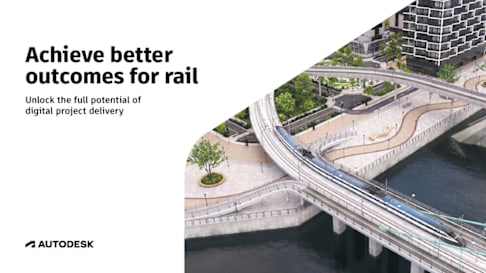
Ebook: Achieve better outcomes for rail

Ebook: Achieve better outcomes for rail

This Ebook is one of the main assets of the FY24 Q2 Rail and Transit Owners Campaign. (ABM Practice)

Ebook: Achieve better outcomes for rail

Achieve better outcomes for rail Unlock the full potential of digital project delivery

Contents

01 Invest in your digital journey

02 Digital delivery

03 Information management

04 Interoperability and openness with IFC

05 Digital Twin

03 Achieve better outcomes for rail

Rail owners and operators must maintain a dependable transportation system to keep people and goods travelling safely. This includes the maintenance and (re)design of rail infrastructure to meet future capacity demands. As the rail industry keeps changing, digitalization is turning into a key ally in the transformation, allowing rail owners and operators to maintain reliable services and reach their business goals to deliver safer, greener, and smarter rail networks.

Why take action now? Today‘s fast-paced world requires investment to improve the project management of infrastructure projects and help it comply with challenging cost, quality and deadline targets. Left unaddressed, this could lead to inefficiencies across planning and execution. Acting now will enable rail owners and operators to stay on top of the transformation and meet the expectations of all stakeholders. It means taking control of the change management and introducing digital project processes — supported by training — to meet new industry standards.

With federal governments and agencies setting their BIM (Building Information Modeling) requirements for projects, the development of a modern IT infrastructure fueled by a secure common data environment — accessible via the cloud and connecting teams that work remotely — is an essential step in the digital journey.

Safer, greener, smarter railways The opportunity to develop rail networks with the help of digital delivery is here. In this eBook, we‘ll explore how digital transformation can enhance collaborative project delivery during the design and planning stages, while helping to maintain reliable services across networks during construction.

01 Invest in your digital journey

Rail owners and operators can harness the power of BIM and a Digital Twin to design and manage rail projects, achieve their goals, and experience even better outcomes. Here’s how.

04 Achieve better outcomes for rail

Rail on the rise worldwide:

Rail is on track to be the transportation of the future There‘s no better time than now: A recent report by the International Union of Railways (UIC), in partnership with McKinsey, shows the railway industry‘s upward trajectory.

Titled Boosting passenger preferences for rail, the report outlines how rail networks can become a preferred choice of transportation for the future. Key macro trends such as sustainability, urbanization, and population growth align railways as part of the solution for tackling mobility and fulfilling global goals for greener transport. Governments are investing in rail infrastructure (see opposite) in ways that will help enhance and increase passenger rail services to relieve road traffic congestion, reduce emissions, and improve the sector‘s digital connectivity.

Europe Across Europe, the focus on modernizing and decarbonizing transport will be boosted by The European Green Deal. The wide-ranging stimulus package focused on sustainability is estimated to include €87.5 billion in investment for rail infrastructure.

€87.5 billion

Global The world‘s railway network covers more than 1.3 million route-kilometers and many countries are investing in the rail industry to boost sustainable transport.

1.3 million route-kilometers

Africa In Africa, an integrated high-speed train network is at the heart of the Agenda 2063 as a flagship project.

High-speed train network

United States In the United States, the Infrastructure Investment and Jobs Act (IIJA) allocates $66 billion in funding and grants towards corridor development, rail track modernization, and safety improvement.

$66 billion

https://www.mckinsey.com/industries/travel-logistics-and-infrastructure/our-insights/boosting-passenger-preference-for-rail https://www.statista.com/statistics/619184/metro-networks-worldwide-track-distribution/

Merely facilitating collaboration between teams is not enough. True changemakers drive operational efficiency and capacity growth by digitizing the entire project lifecycle, connecting teams in the cloud, capturing the right data, and visualizing optimal design to deliver positive project outcomes. This is especially true for railway owners and operators: Rail infrastructure‘s complexities require a phased approach that benefits from BIM.

As rail projects involve multiple stakeholders and require the coordination of design, engineering and construction teams, it‘s vital to be able to streamline workflows in the cloud across all disciplines of a project, while keeping everyone up to date. Digital delivery promotes safer, greener, and smarter outcomes in the quest to develop transportation for the future.

02 Digital delivery Stay on track with a digital journey for sustainable and efficient projects

05 Achieve better outcomes for rail

Cloud-based collaboration platforms such as the Autodesk Construction Cloud, help drive safe, efficient and sustainable project outcomes for resilient communities, buildings, and infrastructure for rail.

Watch here

See how rail owners and operators are embracing the digital transformation

Let‘s dive into the main benefits of a digital journey that affect:

1. Safety 2. Sustainability 3. Operational Efficiency

https://construction.autodesk.com/ https://www.autodesk.com/solutions/architecture-engineering-construction/railway

Digitalization for safety

When it comes to the risks associated with all aspects of the design, construction, maintenance, and operation of rail assets, the safety of customers, workforce, and the public is of paramount importance. BIM tools help generate 3D visualizations to improve general safety measures and maintain a positive performance measurement:

• Real-time monitoring of a project‘s status reduces the need for rework and injuries associated with rushing through project challenges.

• BIM allows the creation of a digital representation of a facility before the construction phase begins. By automating planning tasks, construction and maintenance tasks become safer and accidents rarer.

• Applying BIM across all project phases to streamline the management of data strengthens communication. In turn, it‘s possible to develop a smoother handover of deliverables for construction and maintenance.

• Better data insights help reinforce safety measures throughout the project and rail asset lifecycle.

06 Achieve better outcomes for rail

Digitalization for sustainability

In today‘s climate, it‘s vital to develop resilient assets that can resist extreme events such as downpours, heat waves, and storms with minimal damage and functionality disruptions. This is where cloud-based collaboration tools shine: They help provide sustainable, resilient project outcomes for rail infrastructure. The combination of BIM and Geographic Information System (GIS) data offers much-needed context to understand flooding risks and general geological conditions — thereby supporting informed decision-making.

Connecting the strength of design information and location intelligence not only optimizes material supply use, but also aids in the development of a circular economy. In addition, digital solutions help reduce the environmental impact and have a positive effect on wider communities. Rail owners and operators can display green credentials when they demonstrate to stakeholders the rail project and asset performance through data insights and analytics.

07 Achieve better outcomes for rail

Digitalization for operational efficiency

This fast-paced world pressures rail owners and operators to keep infrastructure running as efficiently as possible. Closures and train delays can be costly. Equipment downtime can affect punctuality, services, customer satisfaction, security, and safety. Using BIM and data information management tools throughout the project and asset lifecycle improves operational excellence with effective maintenance strategies.

Conceived during the planning and design stages, a digital road map keeps all stakeholders in the loop in real-time. Operators can also mitigate disruption to services with easier construction schedule management. Easily accessible project data helps to proactively plan maintenance requirements.

08 Achieve better outcomes for rail

The need to find ways to improve collaborative project delivery has never been more urgent. Rail owners and operators manage large portfolios of projects, which can include hundreds of jobs across the globe. The evolution and standardization of BIM holds the key to managing and controlling all steps of design and construction as well as maintenance.

The ISO 19650 is an international open standard for managing information over the whole life cycle of a built asset using BIM. While the use of BIM improves collaboration across projects, multiple departments often work in different ways. This is why creating a single source of truth for project data can save time by reducing miscommunication and time spent searching for documents.

Cloud services, digital tools, machine learning techniques, sensors, and the communications technologies that enable them can transform the speed and quality of that data. They support a shift from reactive to predictive maintenance, boosting resilience and better performance of your assets.

03 Information management

09 Achieve better outcomes for rail

The standardization of BIM drives collaboration across global projects

„In the rail industry, we utilize an extremely high volume of data that is frequently updated. Diverting all of it into a single place makes a huge difference in data maintenance.“

— Jeroen Tishauser Senior Specialist VolkerWessels Infra Competence Centre

10 Achieve better outcomes for rail

A single source of truth

Autodesk‘s BIM 360 platform provides a single source of truth for project data in support of the ISO 19650 standard. Rail owners and operators use it to manage project data more easily and to ensure teams have access to the most up-to-date and accurate information in real time.

The shift from doing manual documentation to a holistic digital delivery process means that high quality data is available to all stakeholders, boosting communication and simplifying decision making. It‘s key when aiming to ensure safety while not interrupting the flow of rolling stock and traffic on rail infrastructure projects.

In Europe, leading Dutch consulting engineers at Movares support public transport companies and generate solutions for capacity, safety, and integration problems. Movares employs more than 1,000 engineering professionals with an expanding portfolio that began with rail infrastructure engineering and now includes other aspects of the rail industry. BIM has added a layer of transparency across these projects that fosters collaboration.

“Within Autodesk Build, we use the ISO 19650 features that force us to standardize our project data. The naming conventions are particularly useful for our team as well as the holding area, which is where any documents that don‘t comply are held for review,“ says Design Manager Ron Rijkers. Autodesk Build workflows that comply with the ISO 19650 framework offer Movares a robust set of tools to define a structured and standardized process for publishing, sharing, and storing project information.

CUSTOMER SNAPSHOT

Read the full customer story

Movares: Complying with international standards

https://construction.autodesk.com.au/customers/movares/ https://constructionblog.autodesk.com/customer-story-movares/ https://construction.autodesk.com/products/autodesk-build/ https://constructionblog.autodesk.com/autodesk-construction-support-iso-19650/ https://constructionblog.autodesk.com/autodesk-construction-support-iso-19650/ https://www.autodesk.com/bim-360/

1 1 Achieve better outcomes for rail

Many AEC projects involve multiple solutions from varying vendors. When working with different teams, information is often lost during handover, even with high quality data. However, the open standards and common language offered by buildingSMART‘s IFC (the Industrial Foundation Class was ISO certified in 2013) help to specify outputs and neutral exchange.

By breaking down the silos of information, project planners and designers can better collaborate and cooperate, regardless of which software they use. Ultimately, IFC provides wider collaboration and knowledge-sharing, particularly for cross-border projects. It gives a standardized method for information exchange and managing processes from the design and construction phase to the operations and maintenance phase.

New schema for rail The 2022 update of the IFC4 schema delivers a more agile process for rail designers with updated online documentation, new search functions and extensions for infrastructure entities. IFC now requires the same standardized digital language for buildings to be applied to facilities. This will reduce the variation in conventions that currently exists across the globe (for example, in rail alignment). To that end, buildingSMART‘s Railway Room has prepared a new schema for rail working on the harmonization of common asset types, testing, and the deployment of projects. Globally, BIM mandates are driving the adoption of IFC as the preferred format for the handover of design deliverables, and as a way of ensuring ease of access and the ability to share data without being tied to a single software vendor. Autodesk‘s support for IFC 4.3 underpins an investment in interoperability, flexibility and openness with 3D model deliverables for construction and maintenance in the rail industry.

04 Interoperability and openness with IFC Improve rail management and maintenance by connecting teams and information

Easier integration of data

Apply IFC to build smarter, and to combine, enhance, and develop open standards for intelligent data, enabling process and data integration for rail infrastructure. Direct integration with Civil 3D and Revit also helps teams to leverage existing interoperability.

https://www.autodesk.com/collections/architecture-engineering-construction/overview?term=1-YEAR&tab=subscription https://www.autodesk.com/products/revit/overview?us_oa=dotcom-us&us_si=06651ecc-02cb-4af6-8edb-50eeefa2f86b&us_st=Revit&us_pt=RVT&term=1-YEAR&tab=subscription&plc=RVT https://www.buildingsmart.org/standards/rooms/railway/ https://www.buildingsmart.org/standards/rooms/railway/

1 2 Achieve better outcomes for rail

BIM forms the backbone of a Digital Twin — a dynamic, up-to-date replica of a physical asset that brings together design, construction, and operational data. With the addition of real-time operational data, digital twins acquire the behavioral awareness necessary to simulate, predict and inform decisions based on real-world conditions.

With this approach, rail owners and operators can predict system failures before they happen, perform ‚what-if‘ simulations, and gather rich insights into the operation, performance, and utilization of a rail asset. Applying this knowledge will help plan future projects and improve design decisions for even better ROI.

Start digital, stay digital, and deliver digital

05 Digital Twin

The benefits of a Digital Twin:

• Access a multi-dimensional view of an asset‘s design, construction and performance throughout its lifecycle to enhance the safety of passengers, workforce, and the public

• Use a digital overview to manage maintenance schedules and enhance the operational excellence of assets

• Leverage data insights and analytics to inform design and construction decisions, reduce environmental impact and optimize to meet sustainability goals

“If we have a dream, somewhere there‘s an Autodesk program that makes the dream come true.“

— Anette Beijaard Head Advisory Group Road & Rail, Arcadis

Collaborate in the cloud with Autodesk Tandem The cloud-based platform Autodesk Tandem can harness BIM data throughout the project lifecycle and create a digital twin. Rail owners and operators can connect operational systems to the digital twin, turning fragmented data into business intelligence. An end-to-end digital process links organizations and data that includes capital planning, architecture, engineering, construction, and asset management.

Develop location-based insights with BIM & GIS Cloud Collaboration By connecting the Autodesk Construction Cloud and Esri‘s ArcGIS, rail owners and operators can use configurable apps to explore and collaborate on project information with geospatial context — easing communications and improving decisions throughout an asset‘s lifecycle. Learn more about BIM and GIS integration

Automate data processing with Autodesk Platform Services Autodesk Platform Services offer APIs and services that help access and use of the design and engineering data from a digital twin via the cloud. With the Autodesk Platform Services API platform, rail owners and operators can: • Share knowledge across teams • Automate processes for improving the maintenance and

safety of railways • Eliminate siloed data that can slow down projects • Embed and interact with design files from a browser,

without needing extra software

Discover three Autodesk digital twin solutions for rail

Drive collaboration with digital project delivery

13 Achieve better outcomes for rail

https://intandem.autodesk.com/ https://forge.autodesk.com/ https://www.autodesk.com/solutions/bim/bim-gis-collaboration

Ready to fast track your digital journey? Learn more about how digital project delivery offers value throughout rail project lifecycles, or book a consultation with an expert.

Contact us

http://www.autodesk.com/campaigns/rail-owner

Autodesk, the Autodesk logo are registered trademarks or trademarks of Autodesk, Inc., and/or its subsidiaries and/or affiliates in the USA and/or other countries. All other brand names, product names, or trademarks belong to their respective holders. Autodesk reserves the right to alter product and services offerings, and specifications and pricing at any time without notice, and is not responsible for typographical or graphical errors that may appear in this document. © 2022 Autodesk, Inc. All rights reserved.


Item Type: pdf