2023 State of Design & Make by Autodesk

2023 State of Design & Make by Autodesk

Insights from industry leaders on how digital transformation is driving business resilience, sustainability, and talent management.
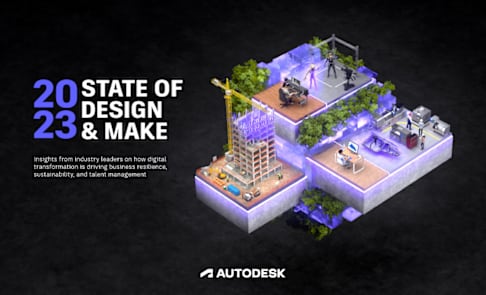
2023 State of Design & Make by Autodesk

i

20 23

STATE OF

& MAKE DESIGN

Insights from industry leaders on how digital transformation is driving business resilience, sustainability, and talent management

1

About This Study

Sustainability Drives

Business Value

Introduction

Methodology

Executive Summary

Conclusion

Business Resilience Emerges Amid

Uncertainty

Glossary

Talent Competition

Heats Up

Thank You

2

39

10

51

3

50

18

52

28

53

CONTENTS

1

2

The State of Design & Make report is a global, annual study for leaders who design and make places, objects, and experiences. It identifies the most pressing drivers of change that are shaping today’s business decisions and helps leaders make informed, strategic decisions about how to prioritize and invest in the future.

The industries that design and make comprise a unique category that connects the digital to the physical. Architecture, engineering, construction, product design, manufacturing, gaming, and filmmaking all require complex human collaboration throughout a digital design process and delivery of a physical result. Executives in these industries share their approaches and points of view on the challenges unique to their organizations and the opportunities they are identifying.

Key areas of focus for this research include: a macro view of the industries; staying resilient and relevant in an ever-changing world;

attracting, training, and retaining a skilled workforce; and achieving sustainable outcomes.

Autodesk partnered with Ipsos, a leader in global research and insights, to survey and interview 2,565 industry leaders, futurists, and experts in the architecture, engineering, construction, and owners (AECO); design and manufacturing (D&M); and media and entertainment (M&E) industries from countries around the globe.

Survey data has been broken down by global region: Asia-Pacific (APAC), which includes responses from Australia, China, India, Japan, and South Korea; Europe, with responses

from France, Germany, Italy, the Netherlands, Sweden, and the United Kingdom; and the Americas, with responses from Canada and the United States.

This report contains key findings from this research, including details at the sector and regional level. In certain instances, responses have been compared by country, but only countries with 200 or more respondents are included in these comparisons: Australia, China, France, Germany, Japan, the United Kingdom, and the United States.

The quantitative data (n= 2,489) was collected between October and December 2022, through a 20-minute online survey. In addition, 76 qualitative interviews with business leaders and futurists were conducted between September and December 2022. In some instances, Autodesk references analysis of its aggregated and anonymized data.

ABOUT THIS STUDY

2

3

Leaders and experts in industries that design and make the world are finding powerful ways to adapt to an accelerating rate of change. Executives in architecture, engineering, construction, product design, manufacturing, gaming, and filmmaking shared their approaches and points of view on the obstacles they are facing and opportunities they are identifying.

The future of the design and make industries relies on the understanding and successful implementation of thoughtful moves where digitization, sustainability, and workforce meet. As architecture, engineering, construction, product design, manufacturing, games, and filmmaking continue to transform at a rapid pace, these three drivers of change provide leaders a focus for their attention and investments in the one- to three-year time frame to stay competitive.

EXECUTIVE SUMMARY

3

*Leaders: Sixty-nine percent of survey participants are decision makers in their companies. In this report, this group is referred to as “leaders.” Job roles for the leaders group include director, industry consultant, president or CEO, senior executive, senior vice president, and vice president. Experts: The remaining 31% of respondents are referred to as “experts.” This group includes managers, senior managers, mid-level employees, and a small number of educators and entry-level employees.

Business Resilience Emerges Amid Uncertainty

Most feel prepared Business leaders and experts* reported that the future global landscape feels more uncertain than it did three years ago. However, most also said that their companies are prepared to respond to this uncertainty.

Top business objectives Sixty percent of respondents said that business growth is a top objective for their company, and 55% cited operational efficiency as another top business objective. An analysis of anonymized data from Autodesk customer projects shows that goals tied to business growth include improvements to win rate and design quality, while goals tied to operational efficiency include improvements to workflows and production, project delivery, and facility management.

Adapting to the new normal Leaders and experts reported making significant changes in response to the challenges of the pandemic. At least half said they changed how their companies worked day-to-day and how they managed their workforce. Remote work was the most significant area of increased investment during the past three years.

Digitization drives the future Seventy-nine percent of respondents said that the future growth of their company will depend on digital tools. Those that are keeping up with the pace of change in their industry are more likely to have plans to increase existing services, offer new services, and potentially expand into new markets.

79% of respondents said that the future growth of their company will depend on digital tools

Remote work was the most significant area of increased investment during the past three years

4

5

Business Resilience Emerges Amid Uncertainty

Digital maturity promotes flexibility Respondents from companies that are more digitally mature* report that they are prepared to handle change at higher rates than those from less digitally mature companies.

M&E leads in digital maturity Companies in the M&E industry appear to be further along in their digital transformation journey than those in AECO and D&M.

Digital transformation is boosting business Business leaders and experts have experienced several benefits from digital transformation. The top benefits of digital transformation include reduced costs, increased innovation and better ideas, and the ability to launch products and services faster.

Regional reactions to a shifting landscape Business leaders and experts from Europe were the most likely to say that the global landscape feels uncertain while those in the Asia-Pacific (APAC) region were the most likely to say that their companies were well-positioned to handle global changes.

Respondents from companies that are more digitally mature report that they are prepared to handle change at higher rates than those from less digitally mature companies

Business leaders in the Asia-Pacific region were the most likely to say that their companies were well-positioned to handle global changes

*Digital maturity: Respondents were asked how far their companies were in their transformation journeys. Organizations that respondents said are in the “early stage” or “right in the middle” of their digital transformation journeys are considered less digitally mature companies. Those that respondents identified as “approaching the goal” or having “achieved the goal” of digital transformation are considered more digitally mature companies.

6

72% of respondents said that the workforce has evolved more in the past three years than it had in the previous 25 years

Talent leads all challenges More than any other factor, business leaders and experts across industries identified attracting and retaining talent as a top challenge. Even for respondents who did not cite talent as a top factor, the majority said they have trouble finding skilled employees.

The importance of upskilling More than 90% of respondents agreed that upskilling is important to their companies. Also, more than half said that their companies are hiring employees who lack the skills needed for their positions and plan to train them on the job.

A rapidly changing workforce Seventy-two percent of respondents said that the workforce has evolved more in the past three years than it had in the previous 25 years. Survey respondents and interviewees mentioned the impact of recent changes such as the rise of remote work, more flexible work styles and hours, increased digitization, and more global operations at many firms.

Digitally mature companies invest in talent solutions Leaders and experts at more digitally mature companies were more likely to say their organizations had implemented various talent-related solutions than those at less digitally mature companies. These actions include investing in technology, hiring from a broader geographical area, and implementing new training programs.

Talent Competition Heats Up

More than half of respondents said that their companies are hiring employees who lack the skills needed for their positions and plan to train them

7

Respondents from China were more likely to say they face hurdles in attracting talent, including challenges related to an aging workforce

Respondents from M&E were less likely to say their companies have trouble adapting to the needs and desires of a younger generation

Talent Competition Heats Up

Skills of the future Respondents identified a broad swath of important competencies for the future, including technology skills, collaboration skills, regulatory knowledge, innovation skills, and the capacity and motivation for ongoing learning.

M&E faces fewer demographic challenges Respondents from all sectors said that talent is a top challenge, but M&E companies were less likely than those in other industries to say that the workforce is rapidly aging or that their companies have trouble adapting to the needs and desires of a younger generation of workers.

Talent challenges vary by region Respondents from China were more likely to say they face hurdles in attracting talent, citing challenges related to an aging workforce. By contrast, Australian respondents were less likely to cite an aging workforce or a slowness to adapt to a younger generation.

8

A broad consensus Nearly 90% of respondents said that their industry/organization has made changes to improve sustainability.

Sustainability is good for business Eighty percent of respondents said that improving sustainability practices is a good long-term business decision. More than half also said it is a good short-term decision.

Internal sustainability goals The majority of business leaders and experts said it is important for their companies to achieve their sustainability goals. However, only 17% strongly agree that they are proud of their company’s sustainability initiatives.

US companies lag on action Sustainability is an area where companies’ practices vary significantly based on geography. Most notably, respondents from US companies are more than twice as likely to report that their organizations aren’t engaged in any sustainability-related activities compared to the worldwide average.

Sustainability Drives Business Value

80% of respondents said that improving sustainability practices is a good long-term business decision

Respondents from US companies are more than twice as likely to report that their organizations aren’t engaged in any sustainability-related activities compared to the worldwide average

9

Sustainability focus varies by industry AECO and D&M companies are more likely to name sustainability as a challenge and more likely to say that sustainability goals are important. More than those from other industries, leaders and experts at D&M companies said their organizations planned to increase their efforts to design products while considering environmental impacts in the next three years. Furthermore, in the past three years, D&M respondents were more likely to have made efforts to decrease waste from production or use recycled materials.

Pressure from customers and employees Respondents reported that companies received pressure to define and meet sustainability goals from several sets of outside forces and internal stakeholders. Customers were the greatest source of this pressure, with more than 80% of respondents saying that customers are influencing their sustainability activities. Respondents also identified employee pressure as a significant influence.

Sustainability Drives Business Value

In the next 3 years: More than those from other industries, leaders and experts at D&M companies said their organizations planned to increase their efforts to design products while considering environmental impacts

THAN 80% of respondents said their company’s sustainability activities are being influenced by customers

MORE

10

INTRODUCTION “The thing that keeps me up at night is the idea of not changing. We have stressed the model to its maximum point. We are going to break the model, and someone is going to disrupt the construction industry.” –Frédéric Gal, Head of Business Modernisation Project, Bouygues Construction

10

11

Businesses face challenges with talent, costs, and global uncertainty

When asked to name the top three challenges facing their companies today, 48% cited the difficulty of attracting and retaining talent. The second most common challenge was cost management, cited by 40% of respondents, followed by the global economy and global events, including crises such as wars and pandemics, cited by 36% of respondents.

Although these challenges affected companies of all sizes* in all sectors and geographies, the data did show some significant differences among companies in different categories. For instance, 40% of the respondents from large companies and 37% from medium-sized companies cited the global economy as a challenge versus 31% of those from smaller companies. Meanwhile, 52% of the respondents from medium-sized companies saw talent as a top challenge, while only 42% of those from smaller companies and 46% of those from larger companies did.

Fifty-six percent of US respondents cited talent as a top challenge, and 47% cited cost management, more than those from other countries. Respondents in China were less likely to mention these as top challenges, with 40% citing talent and 30% citing cost management.

APAC EMEA AMEROverall

34%

25%

23%20% 21%

43% 56%

26%21%

44%35%

37% 38%

31%30% 33%

20% 23%11%

49%

30%

30%

28%

49%

31%

% of companies that selected each challenge 20% 30%10% 40% 50% 60%

Attracting talent / maintaining the workforce / employee retention

Cost control / management / cost efficiencies

Global economy / events (e.g., wars, pandemics, etc.)

Data automation / technological advancement / digitization

Product / service innovation

Business resiliency / improving the supply chain

Product / services diversification / new business lines

Sustainability (relating to the environment)

The regulations from government and regulatory bodies

Talent leads all challenges Leaders and experts in the Americas were the most likely to cite talent as a top challenge while those in Europe were the most likely to cite global events.

Survey question: What are the top three challenges this company faces today? Please select up to three.*Throughout this report, “small” is used to refer to companies with between one and 19 employees, “medium” for companies with between 20 and 4,999 employees, and “large” for companies with 5,000 or more employees.

12

0% 10% 20% 30% % of companies that selected each metric

40% 50% 60%

Customer satisfaction

Profit margin

Revenue

Profit

Employee satisfaction 15%

45%

43%

42%

49%

Throughout this report, readers will notice references to “companies that performed highly on their top business metrics” (or simply “top-performing companies”). This category was determined by respondents’ answers to two survey questions:

First, respondents were asked to identify the top two business performance metrics that are tracked at their companies.

Survey question: What are the top two most important business performance metrics that are tracked for this company?

Top performers

Poor performance

Below-average performance

Met expectations

Above-average performance

52%

18%

AECO

48%

23%

53%

20%

D&M M&E

Exceptional performance Top performers

Poor performers

Then, respondents were asked to rate their company’s performance against these metrics.

In 2021, 51% said their company’s performance was above average or exceptional, and these companies are considered “top performers” in this report. Companies whose leaders and experts rated their organization’s performance on top business metrics as “above-average” or “exceptional” are considered top performers.

Survey question: How has this company performed on these metrics compared to corporate expectations in each of the last three years? Responses for 2021.

Respondents report year-over-year business improvements

Respondents were asked to rate their company’s performance against their most important business metrics for each of the past three years, compared with company expectations. The portion who identified their companies as top performers increased each year from 35% in 2019 to 38% in 2020 to 51% in 2021. The APAC region saw the largest increase in performance, with 56% of respondents identifying their companies as top performers, up from 31% in 2019.

13

20%

70%

% o

f c om

pa ni

es th

at id

en ti

fy a

s to

p pe

rf or

m er

s

2019 2020 2021

40%

32% 29%

51%

43%

More digitally mature companies Less digitally mature companies

64%

Survey question: How has this company performed on these metrics compared to corporate expectations in each of the last three years? In 2019, in 2020, in 2021. 5-point scale. Top two = top performers.

Companies that are more digitally mature outperformed those that are less digitally mature in all three years. The performance gap between more and less digitally mature companies appears to be growing.

The digital maturity difference

0% 10% 20% 30% % of companies reporting being digitally mature

40% 50% 60%

China

France

United Kingdom

Germany

Australia

Japan

United States

All other

44%

33%

30%

38%

37%

37%

36%

57%

Calculation of digital transformation maturity by country. See glossary on p.52 for the definition of digital maturity.

Chinese companies lead in digital maturity.

Digital maturity global breakdown

36%

64%

30%

70% 50%

50%

AECO D&M M&E

More digitally mature companies Less digitally mature companies

Calculation of digital transformation maturity by industry. See glossary on p.52 for the definition of digital maturity.

Digital maturity by industry

Defining digital maturity

To simplify these categories, companies in the early and middle stages of their digital transformation journeys have been combined into one group of “less digitally mature” organizations.

Companies that are approaching or have already achieved their goals are considered “more digitally mature.”

*In the survey question, digital transformation was defined as “the digital conversion of data and processes.”

Seventeen percent of respondents reported that their company is in the “early stage” of its digital transformation* journey, and 45% found their company is “right in the middle of the effort.” Meanwhile, 25% said their company is “approaching the goal,” and 13% said their company has “achieved the goal.”

14

Companies are increasing investments in remote work, tech, and innovation

new technology—more than three times as many who mentioned any other development.

In interviews conducted for this report, several business leaders mentioned the need to educate customers and executives about what results are both possible and realistic through digital transformation. Andreas Rau, head of product management at construction company Max Bögl, noted that many civil infrastructure customers believe that it takes more than 20 years to design and build a new public transportation line—but, in reality, digital workflows have shrunk that process to less than five years. “Digital transformation hasn’t reached the broad industry yet,” he said.

“We need to educate upper-level executives and help them define what’s realistic,” said Carlos Caminos, manager of data asset management at global tire manufacturer Bridgestone Americas, Inc. “They need to understand: What is a digital twin? What is digital transformation? And we need to be able to speak in business terms about what digitization will help us achieve.”

AECO D&M M&E

Technology to deliver improved project outcomes

Product and/or service innovation

Developing new products and/or services

Improved processes and operations

Data management and analytics

Improved collaboration

Talent acquisition and employee retention

Sustainability (environmental)

Remote work

73%

70%

69%

70%

69%

66%

64%

54%

71%

73%

72%

72%

63%

62%

62%

48%

79%

76%

77%

74%

70%

71%

64%

49%

56%

40% 50% 60% 70% 80% % of companies that say “increase”

Survey question: How do you think this company’s investment in the following will shift in the next three years? 5-point scale. Top two = increase.

Areas of increased investment over the next three years

Planned investments are similar across industries

Where companies plan to invest in the coming years:

Organizations are making investments— and plan to make more over the next three years—to overcome the challenges they identified. Unsurprisingly, given the ubiquity of work-from-home programs during the COVID-19 pandemic, remote work tools were the most common investment made by companies in the past three years, with 76% of respondents saying they increased their remote work investments within that period.

Across all areas of investment other than remote work, respondents said that they plan to make increases over the next three years at higher rates than over the past three years.

As with the challenges, survey data showed differences in the ways that different types of companies are making investments. APAC-based respondents planned to increase investments more than those from other regions, and respondents from China were more likely to make increases in investments than those from any other country.

When asked what excites them about the future of their industry, 23% of respondents cited innovation and

74% in technology to deliver project outcomes

73% in product and service innovation

70% in data management and analytics

15

Sustainability (environmental)

40% 50% 60% 70% 80% 90%

58%

Product and/or service innovation 68% 80%

Technology to deliver improved project outcomes 70% 81%

Developing new products and/or services 68% 80%

Data management and analytics

Improved processes and operations

Improved collaboration 61%

Remote work 62%

Talent acquisition and employee retention 57% 71%

60%

Less digitally mature companies More digitally mature companies

% of respondents that say investments will increase

66%

67% 75%

75%

47%

79%

Survey question: How do you think this company’s investment in the following will shift in the next three years? 5-point scale. Top two = increase. See glossary on p.52 for the definition of digital maturity.

Companies that are more digitally mature plan to increase investments over the next three years at higher rates than less digitally mature companies. This is true not only for investment areas that might be considered a part of a company’s digital transformation journey but also for investments seemingly unrelated to technology.

Digital maturity informs investments

“We need to educate upper-level executives and help them define what’s realistic. They need to understand: What is a digital twin? What is digital transformation? And we need to be able to speak in business terms about what digitization will help us achieve.” –Carlos Caminos, Manager of Data Asset Management, Bridgestone Americas, Inc., a global tire manufacturer

16

81%71%

70%45%

70%43%

70%42%

69%48%

67%45%

58%30%

51%35%

Poor performers Top performers

Over the past three years Over the next three years

47% 71%

60%42%

77%62%

76%63%

76%63%

79%65%

79%69%

73%57%

70%47%

64%47%

% of respondents that say investments will increase % of respondents that say investments will increase 20% 40%30% 60%50% 80%70% 90% 40%30% 60%50% 80%70% 90%20%

Developing new products and/or services

Improved processes and operations

Sustainability (environmental)

Improved collaboration

Data management and analytics

Technology to deliver improved project outcomes

Talent acquisition and employee retention

Product and/or service innovation

Remote work

Survey question: How has this company’s investment in the following changed over the past three years? How do you think this company’s investment in the following will shift in the next three years? 5-point scale. Top two = increase. See glossary on p.52 for the definition of performance.

High-performing companies increased investments over the past three years at higher rates than others. However, the gaps narrow for planned investments over the next three years, suggesting that lower performers are attempting to catch up.

High performers invest at higher levels

17

Companies pursue business growth and operational efficiency

production, project delivery, and facility management. Among customers who identified improved collaboration as a desired outcome, specific goals included connecting teams and project data “from design to done,” eliminating business loss due to poor communication, and expanding creative collaboration.

A significant portion of customers also cited business growth as a desired

project outcome. Examples of goals tied to this included improvements to win rates and design quality.

Business growth and operational efficiency were also the top objectives cited by survey respondents. Sixty-two percent of these leaders and experts said that business growth is a top objective for their company, and 56% cited operational efficiency.

Across industries, respondents identified business growth as their top business driver Rating of business objectives over the past 12 months:

ARCHITECTURE & ENGINEERING

Business growth

Health & safety

Risk reduction

Sustainability

Operational efficiency

CONSTRUCTION

Business growth

Health & safety

Schedule control

Quality control

Sustainability

Cost management

DESIGN & MANUFACTURING

Business growth

Enable innovation

Sustainability

Product creation

Operational efficiency

MEDIA & ENTERTAINMENT

Business growth

Technical competence

Operational efficiency

Creative excellence

In an analysis of anonymized data from Autodesk customer projects from the past five years, operational efficiency was a common desired outcome. Within this category, customers cited more specific objectives such as improved efficiency, improved collaboration, and a reduction of overall design time. Examples of objectives tied to operational efficiency included improvements to workflows and

Survey question: Which of these business objectives is this company currently focusing on or has it focused on in the last 12 months? Please select all that apply.

18

EMERGES AMID UNCERTAINTY BUSINESS RESILIENCE

Investments increase – Companies are undaunted in their plans to increase investments in technology, talent acquisition, and other areas in the coming years, global uncertainty notwithstanding.

Transformation brings benefits – Digital transformation is yielding benefits that help companies to achieve their most important business performance goals, even at organizations in the early stages of the digital transformation journey.

Pace picks up – Top-performing businesses, and those that are more digitally mature, plan to increase investments more over the next three years than other organizations.

Data drives improvements – Companies are using internal data to improve decision-making, speed up time-to-market, and facilitate collaboration.

Maturity breeds confidence – Leaders and experts at digitally mature companies feel more confident than others about their organization’s ability to handle uncertainty.

Insights in Action Leaders and experts cite the business benefits of digital transformation and plan to continue increasing investments in the future.

18

19

This company is well prepared to handle unforeseen future geopolitical changes

The future global landscape feels more uncertain now than three years ago

Survey question: To what extent do you agree or disagree with the following statements? 5-point scale. Top two = agree.

Overall, 79% of respondents felt that global uncertainty has risen over the past three years. A smaller number—but still a clear majority, 59%—said their companies are equipped to handle this uncertainty.

The future global landscape feels more uncertain than it used to, but most leaders and experts feel prepared to handle it

79% agree 59% agree Leaders feel prepared for a precarious future

put this uncertainty and confidence into context. The COVID-19 pandemic upended the status quo for most of the world. This was followed by wars, an energy crisis in Europe, ongoing refugee crises, and a sudden spike in inflation in much of the world. Yet many companies have been able to weather these unforeseen crises.

Leaders and experts report widespread uncertainty about the future, but they also report high levels of preparedness. Global events during the past several years have forced businesses to change their operations and make new investments. Respondents from companies that are more digitally mature say they’re better positioned to handle change. Still, even respondents from organizations that are less digitally mature report an array of benefits from digital transformation.

Respondents said that the future global landscape feels more uncertain than it did three years ago. But encouragingly, most also said they feel that their companies are well prepared to respond to unforeseen global events.

A quick glance at recent world events— and the largely resilient response from world governments and economies—may

20

40% 60%50% 70% % of companies that agree

80% 90%

85%76%

46% 69%This company is well prepared to handle unforeseen future geopolitical changes

This industry is well prepared to handle unforeseen future geopolitical changes

The future global landscape feels more uncertain now than three years ago

60%40%

Automotive and other transportation Construction services

Consumer products Engineering service providers

Advertising publishing and graphic design Game developmentFilm and television

Architecture services D&M: M&E:

AECO: Energy and natural resources

gap between automotive and transportation and game development

20%

Survey question: To what extent do you agree or disagree with the following statements? 5-point scale. Top two = agree. *Segments are small sample sizes. See survey methodology on p.51 for more information about the sample size for each industry segment.

Uncertainty versus readiness: an industry segment* view Respondents from automotive and transportation companies felt that their industry is less prepared than others to handle global changes. Respondents from game development companies felt that their industry is more prepared.

21

86% of European respondents said the global landscape feels uncertain, more than the portion of respondents from the Americas or the APAC region (75% each).

82% of leaders and experts from large companies said that the future global landscape feels uncertain—more than the 76% share from small companies— although companies of all sizes feel prepared at similar rates.

65% of respondents from the APAC region said their companies are well-positioned to handle global changes, compared with 58% of European respondents and 51% of respondents from the Americas.

77% of respondents from China said their companies are well-positioned to handle global changes, showing the greatest level of confidence.

56% of leaders and experts in the D&M sector said they were confident in their company’s ability to handle unforeseen events, compared to 62% of AECO respondents and 60% of those in M&E.

Respondents’ perception on global uncertainty

21

22

Companies are driving business growth and adaptability with evolved operations

management solutions provider Delta Electronics, said in an interview that the organization has changed its planning and management strategies to be as nimble as possible in the face of

geopolitical uncertainty. The company now drafts a new 10-year plan each year. Also, Delta Electronics is moving away from centralized management and providing more resources to the regional offices that will lead business growth for the company in the future. Although it is impossible to be ready for everything, Lin noted, companies can position themselves to respond quickly to changing conditions.

Businesses are looking at new ways to respond to clients faster, as well as opportunities to increase existing services and expand into new markets. These efforts come on the heels of a challenging era that required companies to make significant operational changes.

Fifty-two percent of respondents said their companies changed how they worked to offset the impact of the COVID-19 pandemic, and 50% said the pandemic changed how the organization managed its workforce. In addition, 40% reported that the pandemic spurred their companies to find innovative ways to meet customers’ needs, 33% said it led to a rethinking of the company’s priorities, and 30% said it led to unplanned technology investments. Anonymized usage data from Autodesk customers in the AECO industries also showed this pattern, with a 57% uptick in the consumption of cloud resources in the first year of the pandemic.

Kunyueh Lin, general manager, building automation solution business unit at global power and thermal

60% 70% 80% 90%

85%

84%

81%

80%

75%

Less digitally mature companies More digitally mature companies

% of companies that agree

85%76%

68%

63%

74%

73%

79%

This company is looking to increase existing services

The future growth of this company will depend on using digital tools and the digital approaches it develops

This company is looking to add new services

This company is looking at new ways to respond to clients faster

This company is looking at new markets

This company prioritizes digital products and/or services over non-digital versions

Survey question: To what extent do you agree or disagree with the following statements? 5-point scale. Top two = agree. See glossary on p.52 for the definition of digital maturity.

Looking ahead, respondents said that the future of their companies will depend on digital tools and that their organizations are planning to add new services and markets. These numbers are even higher among more digitally mature companies.

Charting the future

Kunyueh Lin, general manager, building automation solution business unit at global power and thermal management solutions provider Delta Electronics, said in an interview that the organization has changed its planning and management strategies to be as nimble as possible in the face of geopolitical uncertainty.

52% of respondents said their companies changed how they worked day-to-day to offset the impact of the COVID-19 pandemic

23

LEADERS AND EXPERTS SPEAK:

What steps should companies in your industry take to prepare for an uncertain future?

“Over the next three years, the manufacturing industry needs to prioritize trade skill development and supply chain diversification. Widening the supply chain by supporting more raw materials suppliers and regional hubs that fabricate critical components will create more competition in the market, business opportunities, and jobs. It will also ensure that the industry will still be functional if there are supply chain disruptions.” —Samantha Snabes, Co-founder & Catalyst, re:3D Inc., a large-scale 3D printer and services company

“We’re trying to develop a new platform to digitalize our archive so that every step of the engineers’ thoughts can be documented. With these efforts, we can set up our library of knowledge, and the resources in this library can be used to inspire similar projects in the future. This end-to-end documentation of the whole process of idea, development, inspiration, and iteration will be very valuable for our future development.” —GuoJin Zhu, Chief Engineer, Kunming Engineering Corporation Limited, Power China Group, a design institute for hydropower projects

“The industry needs a comprehensive approach to making sense of data. We need to start by outlining what data needs to be collected and then consider how data collection will work; how analysis will be conducted; and, finally, how we will use the data to create and implement new strategies.” —Steve Plumb, Senior Editor, SME Media, Manufacturing Engineering, a publication of SME, a professional association of manufacturing engineers in North America

24

Digital maturity is a differentiator

37% said it had led to increased innovation/better ideas, and 36% said it had helped them to launch products and services more quickly.

At companies that respondents identified as “very effective” at leveraging data, these benefits were often more pronounced. For instance, 43% of respondents from these companies reported that digital transformation has helped their organizations increase innovation, compared with 34% of respondents from other companies.

In the group identified as “very effective” at leveraging data, 26% of respondents said digital transformation had increased business value, compared with 19% of other respondents. Also, 26% of respondents from companies identified as “very effective” at leveraging data said that digital transformation had resulted in a better reputation for their organization, compared with 20% of respondents from other companies.

An analysis of anonymized data from Autodesk customer projects showed that customers are using artificial intelligence to improve efficiency, reduce errors, and increase flexibility in manufacturing. For example, some companies have set a goal of using generative design to reduce time for design work by 20%.

APAC EMEA AMER

36% 46%

25% 26%

23% 27%

25% 36%

32% 46%

22%

26% 32%

29% 30%

34% 43%

45% 52%

40%

41%

21%

20%

42%

19%

31%

30%

30%

32%

31%

49%

18%16%

% of companies that selected each benefit 10% 20% 30% 40% 50% 60%

Able to launch products / services more quickly

Able to scale the business more easily / faster

Better reputation

Business is worth more (higher valuation)

Increased sustainability (e.g., reduce paper- based processes, improved energy efficiency, etc.)

Increased innovation / better ideas

Less risk (e.g., business or financial risks, etc.)

Easier to plan and make better business decisions

More engaged and motivated staff

More satisfied customers

Reduced costs

Survey question: Has this company experienced any of the following benefits of digital transformation? Select all that apply.

The data showed differences in the digital transformation benefits seen by companies in different regions. Most significantly, respondents from the Americas were more likely to report benefits of digital transformation, followed by those in Europe.

Regional outlook of digital transformation benefits Digital maturity appears to be correlated with how well prepared companies are to handle change.

Respondents from companies that are less and more digitally mature said they feel uncertain about the future at similar rates (77% and 83%, respectively). However, the gap was much larger when respondents were asked whether their companies are well prepared to handle uncertainty: 72% of respondents from more digitally mature companies said their organization was well prepared to handle unforeseen geopolitical changes—significantly more than the 52% of respondents from less digitally mature companies who expressed such confidence.

Among companies identified as more digitally mature, 40% said digital transformation had helped them to launch products and services more quickly, and 39% said it increased innovation/better ideas. Thirty-seven percent cited each of the following benefits of digital transformation: the ability to scale the business more easily/ faster, more satisfied customers, and reduced costs.

Even companies in the early and middle stages of digital transformation reported benefits from their efforts. For instance, 43% of respondents from organizations that are less digitally mature said that digital transformation had helped them to lower costs,

25

In an interview, Matteo Barale, co- chief executive officer of autonomous vehicle start-up PIX Moving, said that digitization can enable customization and improve the speed of product delivery—providing companies with a competitive edge. “Technology and customization go hand-in-hand,” he said. “To do this mass customization and modularity, you need to have a fast way of giving a quote to customers, and you need to do this faster than your competitors. No two products will be the same. The digital processes are the driving force, allowing us to be personalized and agile.”

AECOOverall rating D&M M&E

9 9

9

910 10 10

10

11 11 11 11

8 8 8

8

2

2

2

2

7

7

7

7

6

6

6

6

1 1

1 1

5

5

5

5

4 4

4

4

3

3

3

3

Able to launch products / services more quickly

Able to scale the business more easily / faster

Better reputation

Business is worth more (higher valuation)

Increased sustainability (e.g., reduce paper-based processes, improved energy efficiency, etc.)

Increased innovation / better ideas

Less risk (e.g., business or financial risks, etc.)

Easier to plan and make better business decisions

More engaged and motivated staff

More satisfied customers

Reduced costs

Rating digital transformation benefits

Survey question: Has this company experienced any of the following benefits of digital transformation? Select all that apply. Sorted by the % of respondents who selected each benefit.

Respondents listed cost reductions, decreased time to market, increased innovation, and the ability to launch products and services more quickly among the top benefits of digital transformation.

In addition to customization, digital tools are opening up new possibilities. Ronald Ames, a film producer for the first season of Amazon’s The Lord of the Rings: The Rings of Power and founder of The Modern Film Consortium, noted that technology is allowing more people and companies—even those without large budgets—to work on a wider array of projects. “Anything we can imagine, we can create,” he said.

“That’s extremely exciting. The tools are being democratized, and the barriers to entry aren’t as steep as when I was a young filmmaker. Now, anyone can tell a meaningful story using their phone, and I think that’s beautiful.”

“Technology and customization go hand-in-hand. To do this mass customization and modularity, you need to have a fast way of giving a quote to customers, and you need to do this faster than your competitors. No two products will be the same. The digital processes are the driving force, allowing us to be personalized and agile.”

—Matteo Barale, Co-chief Executive Officer, PIX Moving, an autonomous vehicle start-up

26

“... With the volume of information we generate through sources like project information, communications, sensors, and technology, we have access to a lot of potentially high-value data. The challenge for organizations and the industry will be how we collectively create standards and a consistent approach to realizing that value.” —Megan Stanley, Manager of Technical Applications, GHD, a multidisciplinary AEC firm

French respondents use data to collaborate with AI and automation the most (45%).

US respondents are the front-runners in using data to develop products, projects, or services faster (60%); support internal collaboration (59%); support collaboration among partners (44%); and gain an edge on their competitors (39%).

UK and German respondents lead the way in using data to drive faster internal decision-making (62% and 61%).

AECO D&M M&E

30% 50%40% 60%

33% 36%

37%35%

47% 52%

32% 33% 35%

46%

51% 54%49%

% of companies that selected each reason

41%

38%

50%

51%

Collaboration among partners

Collaboration with AI, automation

Gaining an edge on the competition

Internal collaboration among teams

Developing products, services, or projects faster

Making faster internal decisions

Survey question: Does this company leverage internal data for any of the following? Please select all that apply.

Data drives decision-making, product development, and collaboration Insight into how companies are leveraging internal data

Global leaders:

Data delivers insights

Data has become a critical tool for driving business decisions across industries—to the point that the phrase

“every company is a data company” has become a commonplace expression. Indeed, survey results revealed that large numbers of organizations are leveraging internal data to achieve their business goals. Fifty-two percent of respondents said that internal data has helped their companies to make faster internal decisions; 50% said it had helped their companies to develop products, services, or projects more quickly; and 46% said that internal data had helped their companies to facilitate internal collaboration among teams.

Large organizations are much more likely to leverage data for most benefits than their smaller and medium-sized peers.

Collecting data is, as SME Media, Manufacturing Engineering Senior Editor Steve Plumb said, often simpler than managing it. “Managing data is easier said than done,” Plumb said, adding that companies may need to find ways to be more precise about what data they are gathering and how it is used.

Dr. Amy Hochadel—executive director for global business at Connected Places Catapult, the UK government’s innovation agency for cities—pointed out the importance of prioritizing business questions, rather than technology itself. Too often, Hochadel noted, people start from the position that “technology is the answer.” She added: “But what is the question?”

Megan Stanley, manager of technical applications for multidisciplinary AEC firm GHD, said that companies must work to manage the “explosion” of data that they produce: “We realized the potential value of data some time ago, but today our sources of data are nearly endless. This has created, for many of us, a data explosion. With the volume of information we generate through sources like project information, communications, sensors, and technology, we have access to a lot of potentially high-value data. The challenge for organizations and the industry will be how we collectively create standards and a consistent approach to realizing that value.”

27

LEADERS AND EXPERTS SPEAK:

How is digital transformation affecting your company or industry?

“COVID has proven that digitization is required now. Businesses that had already started on their digitization journeys fared better when COVID hit, because they were able to transition to some of the changes that were needed. If we’re digitized, we’re at an advantage. I think that’s going to become more and more critical as we deal with climate issues and changing environments. The places that are not digitized need to get digitized quickly.” —Dr. Amy Hochadel, Executive Director, Global Business, Connected Places Catapult, the UK government’s innovation agency for cities

“We believe in the employee, and we believe in creating a space that allows employees to thrive. We’re not bringing in automation to replace the person. We’re bringing in automation to replace the position. That way, we can take the person and find a higher-level opportunity for them. Employees love it because they’re not just coming in and mind-numbingly doing the same thing over and over again.” —JJ Johnson, Chief Operating Officer, Viewrail, a modern stair and railing system company

“Digital is going to help us really bring continuity between the studio and site parts of our company. Digital is going to break the silos that are ingrained in company culture.” —Frédéric Gal, Head of Business Modernisation Project, Bouygues Construction

28

COMPETITION HEATS UP TALENT

What workers want – Remote work and a reputation for sustainability are important tools for companies looking to fill talent gaps.

Taking action – Companies at all stages of the digital transformation journey face talent-related challenges, but digitally mature organizations report taking more active steps to address the problem.

Rapid change – With jobs evolving faster over the past three years than over the previous quarter century, effective training is crucial to the success of recruitment and retention programs.

Top skills – Businesses need employees with skills in technology, collaboration, regulatory knowledge, innovation, and active learning.

Tangible business impacts – Talent shortages are delaying projects and hampering innovation goals.

Insights in Action With job roles changing at a breakneck pace, companies are embracing training and technology to shore up their talent gaps.

28

29

Talent: the most prevalent challenge

72% of respondents said the workforce has evolved more in the past three years than it did over the previous 25 years

during that quarter century. However, survey respondents and interviewees highlighted the impact of more recent workplace changes such as widespread remote work, ubiquitous digitization, and increasingly global operations at many companies.

Despite the magnitude of the challenge of attracting and retaining talent, only 15% of respondents identified employee satisfaction among the top two business performance metrics tracked at their company—less than half the number who cite any other major metric. However, the data also shows that large numbers of organizations are making, or planning to make, increased investments in training programs, as well as strengthening their employee recruitment and retention efforts.

Companies are struggling to attract and retain skilled workers, and this challenge is leading to tangible negative business impacts, including project delays. Rather than letting go of employees who lack the skills that companies need, managers are opting to train new and existing employees. Leaders and experts name a wide range of competencies that workers will need over the next three years, including skills related to technology, collaboration, regulations, innovation, and active learning.

Forty-eight percent of respondents across industries cited attracting and retaining talent as a top challenge for their companies, more than any other factor. This challenge was more pronounced in the M&E fields, where 53% of respondents cited talent as a top challenge, but talent was also the most- cited factor in both D&M and AECO. The data backs up what has become conventional wisdom over the past couple of years, as companies around the world have reported struggling with labor shortages.

Seventy-two percent of respondents said the workforce has evolved more in the past three years than it had over the previous 25 years. This may be surprising, given all of the workplace changes—including the rise of email and smartphones—that occurred

30

LEADERS AND EXPERTS SPEAK:

What steps can employers take to attract and retain top talent?

“There is a behavioral shift where people don’t want to commute anymore. Companies need to realize this and pay attention to that if they want to retain or hire talent. It’s kind of a double-edged sword, because in the design industry, collaboration is key, and working in silos is not always optimal. But there are ways to collaborate now with technology, and if companies want to attract talent, they need to make their offers attractive.” —Leonard DiChiara, Senior Director of Design, HCP Packaging, a designer and manufacturer of cosmetic packaging containers

“You have to offer a flexible working environment. If people need to pick up their kids, or whatever else, it’s important to give them that flexibility. It helps build loyalty when you’re able to meet your employees in the middle. In hiring, we’ve been able to attract a lot of people because of our technology infrastructure, which allows us to hire people around the globe. It’s also important to keep projects interesting. People really want to be stimulated.” —Jeremy Smith, Chief Technology Officer, Jellyfish Pictures, a visual effects company

“To get the best talent, you need to have an appealing work culture. Employees want to know that they won’t just be completing tasks given to them. They want to bring their own viewpoints and creativity to their jobs. That’s key.” —Stefan List, Head of Cabin Market Insights, Airbus, a designer, manufacturer, and seller of aircraft, helicopters and space vehicles

31

51%

67%

63%

53%

44%

72%

47%

33%

34%

70%

68%59%

47%

62%

50%

AECO D&M M&E

% of companies that agree 30% 40% 50% 60% 70% 80%

This industry’s type of jobs has had to evolved more rapidly the past three years than it had the past 25 years

This company struggles to find people with the right skills

Access to skilled employees is a barrier to this organization’s growth

This company struggles understanding what continuous learning program should be offered

The workforce is rapidly aging

This company’s culture is too slow to adapt to the younger generation’s needs and desires

Across industries, respondents said that jobs are changing rapidly—and that their inability to find employees with the right skills is a barrier to business growth.

Survey question: To what extent do you agree or disagree with the following statements? 5-point scale. Top two = agree.

Talent challenges vary by industry

JJ Johnson, chief operating officer at Viewrail, said the organization had moved to a four-day work week, implemented unlimited paid time off, and taken steps to ensure that people are able to take maternity and paternity leave—actions all aimed at improving the employee experience.

Companies struggle to find skilled employees

implemented unlimited paid time off, and taken steps to ensure that people are able to take maternity and paternity leave—actions all aimed at improving the employee experience.

Seventy-one percent of survey respondents said they had faced increased competition when recruiting and hiring highly skilled employees over the past 12 months. Most also said that this difficulty was leading to several specific business challenges. For instance, 59% said they experienced project delays over the past year from a dearth of talent, 52% said that an inability to find the right talent prevented their companies from meeting innovation goals, and 50% said that employee turnover hindered their company’s ability to meet overall goals.

Interestingly, large percentages of respondents who did not indicate that talent was a top challenge nevertheless said they faced these obstacles. For example, 65% of such respondents said they’ve faced increased hiring competition over the past year, 62% said that they have difficulty finding employees with the right skills, and 51% said their companies have been forced to delay projects due to talent gaps. In other words: Even for many organizations where talent is not a top- three challenge, the data shows that it remains a formidable obstacle.

Sixty-seven percent of respondents said that their companies struggle to find employees with the right skills, and 64% said that access to skilled employees presents a barrier to business growth. In addition to skills, demographic shifts present a challenge. Forty-five percent of respondents said that the workforce is aging “rapidly,” and 42% said their companies are too slow to adapt to the needs and desires of the younger generation of workers.

Kunyueh Lin, general manager, building automation solution business unit at Delta Electronics, cited both the declining birth rate and a new emphasis on work-life balance in mainland China and Taiwan as factors leading to talent shortages. Coral Butler—group head of digitally enabled lean project delivery (DeLPD) at PM Group, a firm that designs, constructs, and commissions high-tech facilities—said that a number of senior-level employees decided to retire a year or two early during the COVID-19 pandemic, leading to a loss of institutional knowledge and depriving junior employees of mentorship. And several interviewees noted the continued importance of striving to meet diversity and inclusion goals.

JJ Johnson, chief operating officer at Viewrail, a modern stair and railing system company, said the organization had moved to a four-day work week,

32

This company’s culture is too slow to adapt to the younger generation’s needs and desires

Access to skilled employees is a barrier to this organization’s growth

The workforce is rapidly aging

This company struggles to find people with the right skills

United StatesUnited KingdomFrance JapanGermanyChinaAustralia

30% 40% 50% 60% 70% 80%

75%57%

38% 61%

66%43%

34% 65%

% of companies that agree

companies in China cite talent struggles

2 in3

Survey question: To what extent do you agree or disagree with the following statements? 5-point scale. Top two = agree.

A global view of talent Chinese companies cite talent struggles at higher rates than others.

33

Small Medium Large

20% 30% 40% 50% 60% 70% 80%

73%

65%

63%

28%

77%

74%

56%

56%

32%

66%

70%

59%

53%

43%

43%

88a943

% of companies that experienced each issue

78%

75%

63%

60% 63%

57%

58%

35%

51%

80%

73%

Increased competition when retaining or hiring high performing / highly skilled employees

Difficulty finding new employees with the right technical skills

Delay in projects due to not having enough talent

Difficulty hiring new employees with the amount of experience needed for the job

This company faced higher departure rate the past three years than before

This company has had to hire new employees who do not have the skills needed for the job and plans to train them on the job

Employee turnover hindering this company's ability to achieve goals

Inability to meet innovation goals due to inability to find the right talent

Had to let employees go because they lack technology skills

Survey question: Have you experienced any of the following issues regarding employee management in the past 12 months?

Employee management issues affect companies of all sizes

33

34

Survey question: To what extent do you agree or disagree with the following statements? 5-point scale. Top two, bottom two = agree. Note: The category “Neither agree nor disagree” was omitted from this visualization.

AgreeDisagree

72%

68%

62%

55%

43%

12%

11%

19%

23%

37%

40% 20% 0% 20% 40% 60% 80% % of companies that responded

This company doesn’t have the skills nor the resources to design internal training programs

This company is looking to hire more people to work remotely

This company is implementing a continuous-learning program

In the next three years, this company is planning to invest more in technology-focused training

This company is looking for talent outside my local area

Bridging the talent gap Companies are turning to training, technology, and hiring across geographies to solve their talent challenges.

Poor performers Top performers

Survey question: To what extent do you agree or disagree with the following statements? 5-point scale. Top two = agree. See glossary on p.52 for the definition of performance.

This company doesn’t have the skills nor the resources to design internal training programs

This company is looking to hire more people to work remotely

This company is implementing a continuous learning program

In the next three years, this company is planning to invest more in technology focused training

This company is looking for talent outside my local area 77%

76%

71%

64%

45%

61%

56%

44%

40%

42%

% of companies that agree 30% 50%40% 60% 70% 80%

High performers invest in talent at higher rates

Training and technology fill talent gaps

needed for the job and plan to provide these employees with on-the-job training. This dynamic also showed up in interviews, with some business leaders saying that they are looking for employees with broad, transferable skills (such as problem-solving and collaboration) who can then learn more

job- and industry- specific skills after they are hired.

This commitment to upskilling also seems to be reflected in the relatively low rate at which respondents said their companies have terminated under-skilled employees. Although a majority said they had experienced all other cited employee management issues over the previous year,

only 29% said their companies had let people go over the past 12 months due to a lack of technology skills.

Respondents from small companies face larger obstacles related to training, with 46% saying they lack the skills and resources needed to design internal training programs—more than those at large companies (39%).

An overwhelming majority of respondents agree that training is important to their companies. Forty- nine percent said that employee upskilling is “very important,” and an additional 44% said that it is “somewhat important”—for a total of 93% who agree on the importance of upskilling. Notably, this is one of the broadest areas of agreement across the entire survey.

Largely, respondents agreed on the importance of training at similar rates across industries, companies of different sizes, and digital transformation maturity levels. However, a country- by-country breakdown of the data did reveal some differences. China was among the top countries in this category, with 97% of respondents agreeing that training is important. Respondents from Japan were least likely to agree (79%).

Broadly, respondents said their companies are using upskilling to shore up talent gaps. Fifty-six percent said that their companies have hired employees who do not have the skills

56% of respondents said that their companies have hired employees who do not have the skills needed for the job and plan to provide these employees with on-the-job training

35

prefer that their workers learn a second programming language. Upskilling is, Makovsky noted, a “forever journey.”

In both survey data and interviews, business leaders and executives suggested that a focus on sustainability* is important in attracting employees. Most survey respondents said that

their organizations face pressure from employees to take action on sustainability, and in interviews, several leaders mentioned the importance of the issue to recruits.

“Sustainability attracts talent,” said Fiona Short, principal and

architect at Warren and Mahoney, a multidisciplinary architectural practice. “You want the right people to come and want to work for you, and you want to be a company that people are proud to work for. A focus on sustainability helps you to get the best out of people because they’re passionate and their work aligns with their values. It attracts those like-minded people, and it is just the right thing to do.”

In interviews, several leaders and experts mentioned specific training, incentive, and pipeline programs they are leveraging to recruit and retain employees. Some collaborate with universities and industry associations, both to create talent pipelines for their organizations and to provide employees with ongoing training. MingLei Ma, chief of engineering research institute at China Construction Eighth Engineering Division Corporation (CCEEDC), noted the importance of customized, company- specific training. At the organization, employees participate in a points-based lifelong learning system and receive tailored training about the company’s patents and research findings.

Paul Makovsky, editor in chief of ARCHITECT magazine, pointed out that the skills employees need will continue to change—stating that, while executives may have wanted their employees to learn a second language decades ago, those leaders might now

*In survey questions about sustainability, the actual phrase used was “sustainability (relating to the environment).” In one-on-one interviews, this more expansive definition was used: “efforts related to the environment (mitigating effect on climate change), the community (social well-being, improving the life of populations), and corporate governance.”

In both survey data and interviews, business leaders and executives suggested that a focus on sustainability is important in attracting employees

36

LEADERS AND EXPERTS SPEAK:

What skills do prospective employees need to succeed, and where do you see gaps?

“Software skills are increasingly important. Problem-solving and other so-called soft skills are becoming more important, as well: being able to communicate well, being able to work with other people, being able to work autonomously.” —Steve Plumb, Senior Editor, SME Media, Manufacturing Engineering, a publication of SME, a professional association of manufacturing engineers in North America

“It’s very important that we look at designers as people that understand and anticipate users’ needs in connection with society’s numerous problems, in order to solve them by design. And realize that we are not simply driven by pure aesthetics and market trends.” —Charles Cambianica, Design Director, Decathlon International, a sporting goods retailer

“Sometimes, new graduates’ knowledge appears to be outdated in comparison to our industrial practices. In some cases, our internal R&D is more advanced than the R&D at universities. We’ve developed tutorials based on our own patent pool to help new employees acquire knowledge about our internal development and patents.” —MingLei Ma, Chief of Engineering Research Institute, China Construction Eighth Engineering Division Corporation (CCEEDC)

37

79%

68%

41%

Less digitally mature companies More digitally mature companies

67%

64% 76%

71%

48%

50%40%30% 60% 70% 80% 90% % of companies that agree

44%

56%

This company doesn’t have the skills nor the resources to design internal training programs

This company is looking to hire more people to work remotely

This company is implementing a continuous-learning program

In the next three years, this company is planning to invest more in technology-focused training

This company is looking for talent outside my local area

Survey question: To what extent do you agree or disagree with the following statements? 5-point scale. Top two = agree. See glossary on p.52 for the definition of digital maturity.

Digital transformation and talent solutions

Digitally mature companies are taking more steps to solve talent challenges

Respondents from companies across the spectrum of digital maturity experienced issues related to talent at nearly identical levels. For instance, respondents from companies that are more digitally mature were only three percentage points more likely than those from less digitally mature companies to say that access to skilled employees is a barrier to their organization’s growth (65% vs. 62%) and only one point more likely to struggle to find people with the right skills (68% vs. 67%). However, respondents from companies that are more digitally mature were more likely to say their organizations were taking active steps to solve these talent- related challenges.

In an interview, Catherine Topley— former chief executive officer of Scottish Canals, the government body responsible for managing the country’s inland waterways—noted the importance of helping employees to see the value of digital tools. Workers, Topley said, are sometimes wary of new technologies, thinking that their jobs might become obsolete. But the Scottish Smart Canal project was able to use sensors to help workers monitor conditions—a move that improved safety and working conditions for employees. “That was a turning

point, being able to show employees the value of the technology, as opposed to the threat,” Topley said.

Construction and homebuilding firm Daiwa House is using digital transformation to improve products and services, and the company actively works to promote digitization skills and creativity among its employees. “We hold various events, such as digital transformation contests and meetups, to motivate people to work on digital technology—and to spur the company as a whole to increase digital motivation,” said Senior Executive Officer Hiroshi Kono. “We received about 1,000 applications for the contests, and the board of directors and others served as judges. We encourage the younger generation to think about more efficient collaboration among teams by trying out new technologies in their workflow. It harnesses their creativity and becomes a power to transform the construction industry itself.” Tomoaki Furukawa, vice president and chief digital executive for Toshiba Elevator and Building Systems Corporation, said that a focus on digital transformation can help companies lure recent college graduates. “It appeals to them because they’re doing new, creative work,” he said. “...We encourage the younger generation to think about more efficient collaboration

among teams by trying out new technologies in their workflow. It harnesses their creativity and becomes a power to transform the construction industry itself.” —Hiroshi Kono, Senior Executive Officer, Daiwa House, a construction and homebuilding firm

38

Regulatory ■ Knowledge of regulatory framework ■ Understanding of industry standards

and codes ■ Sustainability knowledge related

to ESG

Skills of the future

Technology use, monitoring, and control ■ 3D modeling ■ Automation ■ Cloud computing ■ Data science, including

the ability to present, understand, and leverage insights from data

■ Cybersecurity and privacy

Technology design and programming ■ Artificial intelligence and

machine learning ■ Analytics programming and

data management ■ Software engineering ■ Ability to develop sustainability

tracking tools ■ Ability to design and program

technology to meet business needs

Innovation and business development ■ Ability to manage remote teams ■ Knowledge of—and ability to

uncover—new trends in the industry ■ Ability to work within a business

model that leverages digital transformation

■ Product formulation ■ Customer engagement and

experience skills

Collaboration ■ Digital collaboration with internal

and external stakeholders ■ Project management ■ Technical writing ■ Strong interpersonal communication

Professional development ■ Self-motivation and initiative ■ Agility, adaptation, and resilience ■ Ability to work in a world where

9-to-5 is irrelevant ■ Understanding of technology and

how it affects customer expectations

When survey respondents were asked to identify the most important technical skills for their company’s workforce over the next three years, those working in architecture services cited skills related to technology use, monitoring, and control more than the average across industries. Respondents in both engineering services and energy and natural resources mentioned skills related to technology design and programming more often than others, and respondents from automotive and other transportation companies emphasized innovation and business development more than those from other industries.

Survey question: In the next three years, what will be the two most important technical skills or digital knowledge for this company’s workforce? Please be specific.

39

DRIVES BUSINESS VALUE SUSTAINABILITY

Taking action – Leaders and experts say sustainability goals are important. The majority say their companies and industries have made changes to become more sustainable.

Link to talent – Sustainability-focused actions can help businesses to recruit and retain employees.

Pressure to change – Customers, investors, and employees are influencing companies to take action on their sustainability goals.

Sustainability and revenue – Respondents see sustainability as driving long-term business value, with some saying sustainability measures will eventually account for a substantial portion of revenue.

The business case – Most leaders and experts said that improving sustainability practices is good for business— both over the short term and the long term.

Insights in Action A consensus emerges on the importance of sustainability, and customers and employees pressure companies to act.

39

40

Sustainability goals are important for most

at HCP Packaging, a designer and manufacturer of cosmetic packaging containers. “It’s a mandate.”

Nevertheless, only 20% of respondents ranked sustainability among the top challenges facing their organizations. This is significant, as those who cited sustainability as a top challenge were nearly three times as likely as others to report that their companies are engaged in sustainability-centered activities.

In the United States—the world’s largest economy—19% of respondents said that their companies and industries aren’t engaged in any sustainability-related activities at all, a far higher portion than any other country. Also, just 70% of American respondents said that it is important for their companies to achieve their sustainability goals, lower than the rest of the world.

Business leaders and experts say that corporate sustainability goals are important, even though most say that sustainability is not among the top challenges facing their company. The majority of companies and industries already engage in sustainability-focused activities, and respondents say that their industries and organizations plan to take more steps in the near future, driven in part by pressure from customers, investors, and employees.

The survey data contains both good news and bad news for those concerned about environmental sustainability.

Eighty-three percent of respondents said that it was important that their companies achieve their sustainability goals, and only 7% perceived that their industry/organization is doing nothing in this area. Fifty-four percent also said that their company’s sustainability initiatives are a key part of their business growth plan, 52% said that they wish their companies prioritized sustainability as much as profits, and 52% said that they are proud of their company’s sustainability initiatives. In an interview, one industry expert contrasted the status of sustainability in the business world a decade ago with how the topic is viewed today: “It’s no longer a ‘nice-to-have,’” said Leonard DiChiara, senior director of design

Survey question: To what extent do you agree or disagree with the following statements? 5-point scale. Top two, bottom two = agree. Note: The category “Neither agree nor disagree” was omitted from this visualization.

AgreeDisagree

52%

52%

45%

43%

22%

19%

25%

27%

40% 20% 0% 20% 40% 60% % of companies that responded

This company is leading the way in this industry when it comes to sustainability initiatives

Sustainability initiatives at this company are less important now than I feel they should be

I am proud of this company’s sustainability initiatives

I wish this company prioritized sustainability as much as profits

This company’s sustainability initiatives are key parts of its business growth strategy for the next three years

54%

16%

Around half of leaders and experts are proud of their company’s sustainability initiatives

Perspective on sustainability inaction Although US respondents reported that their companies are taking no sustainability actions at rates more than twice as high as other respondents, additional research conducted by Autodesk provides additional context. It is possible that some respondents were reluctant to overstate their company’s efforts in self-reported data.

In a review of the sustainability commitments of nearly 11,000 companies (primarily in AECO and D&M), Autodesk found that the United States ranks near worldwide averages on tangible measures related to corporate sustainability. Twelve percent of US companies in the review were categorized as having a demonstrable commitment to sustainability based on their activities or memberships. That number puts the United States ahead of Australia (6%) and on par with Germany (11%) and the UK (18%) but further behind Japan, which leads this category (26%).

41

LEADERS AND EXPERTS SPEAK:

What are some of the top drivers of sustainability in your industry?

“You can never go wrong when you’re doing the right thing. For AAF, the right thing is to offer a product that lasts longer, that uses less energy, and delivers the performance that improves air quality and ultimately has a positive impact on human health. We must also focus on delivering true value for money in terms of total cost of ownership. Educating the customer is our daily work—there is an old expression, ‘you buy cheap, you buy twice,’ which is as true for the air filter industry as it is in many others.” —Sean O’Reilly, Global VP HP Sales & Innovation, AAF Flanders Inc., a manufacturer and provider of air filtration products

“You need to have that use case that is scalable, where people can leverage resources and data around repeatable opportunities. Encouraging our partners in academia and small business to share data allows us to learn from and explore the possibility of printing with more sustainable and recycled materials. Seeing waste not as garbage, but instead as a resource is going to continue to be a focus for many groups. And I think we’ll see some real upsides in the next year to 10 years that will help recruit others into the conversation.” —Samantha Snabes, Co-founder & Catalyst, re:3D Inc., a large-scale 3D printer and services company

“We’re starting to measure sustainability in terms of equity. Whatever you’re going to build, you need to be thinking about how it impacts your community. Are the things that you are doing good for your company, good for your community, and ultimately good for the world?” —Paul Makovsky, Editor in Chief, ARCHITECT magazine

42

Companies take aim at decreasing waste, increasing energy efficiency, and improving product design

expect their industry/organization to make sustainability-focused changes in the coming years.

In interviews, various leaders and experts mentioned that their companies

are paying more attention to the sustainability of the materials they use. Several cited the ability to improve sustainability by reducing the portion of embodied carbon in projects. Jeremy Smith, chief technology officer for VFX firm Jellyfish Pictures, mentioned working

with technology vendors to reduce the amount of energy used by computing hardware. “We’re making sure that our workflows are as optimized as they can be so that we’re not wasting computing cycles,” he said. “That is one of the easiest things you can do to be greener and more sustainable in our area.”

Some interviewees mentioned the link between digitization and sustainability. One cited the ability of software tools to immediately show the sustainability impact of proposed design changes. Another noted the potential for free and open data to reduce cost barriers that currently prevent some organizations from measuring and managing carbon emissions of projects and products.

Although most respondents said that their industry or organization has made changes to improve sustainability, these efforts are spread across a wide variety of activities. No single sustainability initiative was cited by a majority of respondents.

Among the top sustainability changes that companies and industries have already made, 35% of respondents cited decreasing waste from production or using more recycled materials, 30% said companies and industries were designing products with sustainability impacts in mind, and 30% mentioned the application of sustainable design principles.

There was significant overlap when respondents were asked what steps they expect their companies and industries to take over the next three years. Here, applying sustainable design principles took the top spot, cited by 34% of respondents. Thirty- two percent said they expected their companies and industries to decrease waste from production or use more recycled materials, and 31% said they expected their companies and industries to develop or invest in more energy-efficient processes or machinery. Overall, 94% of respondents said they

94% of respondents said they expect their industry/organization to make sustainability- focused changes in the coming years

43

27%19%

34% 41%28%

35%22%

33%26%

33%19%

23%17%

33%22%

5% 6%

24% 25%

18%17%15%

19%13%

25%18%

0% 20%10% 40%30% 50% % of companies that selected each change

32%

30%

31%

29%

29%

28%

28%

12%

11%

Decreasing waste from production and/or using more recycled materials

Designing products considering environmental impacts (e.g., exploring sustainable material alternatives, etc.)

Applying sustainable design principles

Increasing share of renewable energy sources used

Developed or invested in more energy-efficient processes or machinery

Helping customers decrease their carbon emissions

Using AI tools to be more sustainable

Creating clear goals for carbon neutrality

Helping or requiring decreased carbon emissions from suppliers

Participating in carbon project financing

Participating in voluntary carbon markets or carbon offsets

None

Survey question: What changes are you aware of that this industry/organization has already made to be more sustainable?

AECO D&M M&E

Respondents say their companies and industries have already made these changes.

Sustainability activity by industry

second place with 9%. Among Chinese respondents, only 1% reported that their industry/organization had done nothing to improve sustainability. However, the United States did rank near the middle of the pack for several specific sustainability initiatives.

Generally, European respondents reported the highest levels of sustainability- centered activity. Thirty-seven percent of German respondents said their industry/ organization had designed products while considering environmental impacts, 42% said they had increased

renewable energy use, 36% said they had developed or invested in more energy-efficient processes or machinery), and 30% said they had helped customers decrease their carbon emissions. France led the way in the portion of respondents whose industry/ organization had decreased waste from production or increased the use of recycled materials, with 47%, and the portion that said their industry/ organization had participated in carbon project financing, with 23%.

An analysis of the application of generative design in anonymized data from Autodesk customer projects shows that customers are using generative design to achieve sustainability outcomes such as waste reduction. Also, some companies are using generative design to decrease the weight of materials when designing airplanes or vehicles.

Survey data showed several differences in sustainability actions by company size and geography. Most consistently, respondents from large companies reported that their industry/ organization had made sustainability-focused changes at higher rates than respondents from small and medium-sized companies. This may be explained by capacity, as small companies typically lack the resources needed to maintain a dedicated sustainability team that can implement ambitious initiatives and track them over time. Nineteen percent of US respondents–double the portion of any other country—said their industry/ organization had not undertaken any sustainability initiatives. Japan took

Respondents from large companies reported that their industry/ organization had made sustainability-focused changes at higher rates than respondents from small and medium-sized companies

44

LEADERS AND EXPERTS SPEAK:

What do the economics of sustainability look like for your industry?

“If we can improve energy efficiency, we can see returns immediately. Our data center consumes a lot of energy, and if we can improve our energy efficiency by even 1%, we’ll save a lot of electricity. This is good both for our customers and our planet.” —Kunyueh Lin, General Manager, Building Automation Solution Business Unit, Delta Electronics, a global power and thermal management solutions provider

“In the long run, the share of renewable energy will exceed that of fossil fuels, but I’m concerned about the acceleration of the transition to new energy. It’s easier to use energy from fossil fuels, and the cost of green energy is still high. We need more technical advances to make green energy more affordable.” —GuoJin Zhu, Chief Engineer, Kunming Engineering Corporation Limited, Power China Group, a design institute for hydropower projects

“The pressure to change and grow sustainably is coming from everywhere—shareholders, employees, clients, governments. When you have more constraints, you are more inventive. It’s a good thing for us, but we have to implement sustainability practices without excluding ourselves from society’s building and infrastructure needs.” —Frédéric Gal, Head of Business Modernisation Project, Bouygues Construction

45

Belief in the business value of sustainability drives action

business. Fifty-five percent said that improving sustainability practices is a good short-term business decision, and 80% said that it is also a good long-term business decision. Eighty- four percent of respondents from large companies saw sustainability improvements as a good long-term business decision, compared to 77% of those from smaller companies.

Digitally mature companies appear to be more likely to apply technology solutions to their sustainability challenges. Thirty-three percent of respondents at such companies said their organizations are using artificial intelligence solutions to become more sustainable, compared with 21% of those at less digitally mature companies. Also, respondents from companies that are very effective at leveraging data were the most likely to say they were proud of their company’s sustainability initiatives (60%, compared to 44% of others) and to say that their company is “leading the way” in sustainability for their industry (52% vs. 35%).

0% 30%10% 20% % of companies that selected each response

16%

18%

27%

23%

17%

Don’t know

>10%

5%–10%

1%–5%

<1%

Survey question: To the best of your knowledge, how much business value (as a % of annual revenue) can sustainability measures generate in the long term for this company?

Companies see sustainability driving long-term revenue Portion of annual long-term revenue expected to be generated by sustainability

Respondents’ attitudes toward sustainability were a significant predictor of how likely their companies were to engage in sustainability-focused activities. For instance, respondents were asked to estimate how much business value, as a percentage of annual revenue, sustainability measures could generate long-term for their companies. Among the 18% who said that sustainability initiatives would likely account for more than 10% of their company’s revenues, respondents were much more likely to say their companies had already undertaken sustainability measures.

This difference was most pronounced for questions about helping customers decrease their carbon emissions (39%, compared with 21% of other respondents), designing products considering environmental impact (44% vs. 27%), and creating carbon neutrality goals (36% vs. 22%).

A majority of respondents view sustainability as being good for

55% said that improving sustainability practices is a good short-term business decision

80% said that it is also a good long-term business decision

&

46

10% 20% 30% 40%

39%34%

38%28%

37%29%

36%25%

35%28%

34%22%

29%23%

28%19%

26%26%

22%15%

19%14%

Not a challenge Top challenge

% of companies that selected each change

Survey questions: What changes are you aware of that this industry/organization has already made to be more sustainable? What are the top three challenges this company faces today? Please select up to three. Selection = sustainability (related to the environment).

Decreasing waste from production and/or using more recycled materials

Applying sustainable design principles

Designing products considering environmental impacts

Developed or invested in more energy- efficient processes or machinery

Increasing share of renewable energy sources used

Creating clear goals for carbon neutrality

Helping customers decrease their carbon emissions

Using AI tools to be more sustainable

Participating in voluntary carbon markets or carbon offsets

Participating in voluntary carbon markets or carbon offsets

Those who identified sustainability as a top challenge for their companies also reported that they had undertaken sustainability initiatives at higher rates than others. This suggests that respondents who cited sustainability as a challenge also see it as a priority.

Up to the challenge“One of the biggest challenges for sustainable materials is making them work commercially. There are examples in aviation where sustainable products were released too early, and they couldn’t stay in the marketplace or keep their competitive advantage.

The aircraft cabin is currently responsible for approximately 5% to 10% of an aircraft’s CO2 emissions. However, the latest research and technology developments and cabin innovations we are currently working on will contribute to reducing these figures, for example, by weight reduction or circular materials.”

–Stefan List, Head of Cabin Market Insights, Airbus, a designer, manufacturer, and seller of aircraft, helicopters and space vehicles

47

Cost center or cost saver? Depending on the context, audience, and speaker, sustainability is alternately discussed as a financial burden on—or a boon for—businesses. This is also reflected in the survey data, with more respondents seeing sustainability as a good business decision over the long term than the short term.

At Autodesk’s annual conference (Autodesk University) in October 2022, a group of industry leaders and experts met to discuss challenges and opportunities related to decarbonization, with much of the discussion centering on costs. Among the takeaways from that conversation:

Affordability drives adoption. Environmental advocates point to the long- term savings of sustainable products and projects, but these often still carry higher up-front price tags. Unless business leaders prioritize sustainability, it may be difficult for design teams to secure the budget for the often-higher cost of green materials.

Sustainability strengthens brands. Participants cited the potential for sustainability-focused actions to lead to benefits like an improved reputation, which may ultimately improve revenue and profits. By pursuing sustainable products and projects, companies may increase their appeal to future customers, particularly younger people who will pay a premium for sustainable products.

Opportunities exist in financing. Discussion participants said that clients currently lack the will to aggressively pursue sustainability in their projects.

However, lower lending rates for carbon- responsible construction could be a “carrot” that helps to spur change, they said.

Companies are missing chances to reduce costs. Although opportunities already exist to achieve a positive return on investment through decarbonization, these opportunities are not being maximized. Politics is one reason, with oil-producing countries largely against decarbonization, as is an individualistic mindset that often takes precedence over collective action.

Short-term thinking limits action. The prospect of increased short-term costs plays a role in the lack of client demand for change.

Often, companies measure sustainable approaches against the least expensive possible baseline, rather than calculating the overall return on these investments.

48

Employees

Customers

Investors

Government

20%40% 0% 20% 40% 60% 80% 100%

17% 82%

InfluentialNot influential

22% 74%

24% 74%

72%26%

% of companies that responded

Survey question: How influential are the following groups in pressuring this organization to create and meet sustainability goals? 4-point scale. Top two, bottom two = influential.

Under pressure More than any other group, customers are putting more pressure on companies to pursue sustainability goals.

*https://www.reuters.com/business/sustainable-business/sustainable-investments-account-more-than-third- global-assets-2021-07-18/

**https://www.fastcompany.com/90706552/esg-investing-continued-to-soar-in-2021-the-government-could- boost-it-even-more

A majority of respondents reported receiving pressure from internal stakeholders and outside forces to create and meet sustainability goals. Notably, 82% of respondents said their companies feel pressure from customers to pursue and achieve sustainability goals, and 74% said their companies feel this pressure from investors.

In discussions about corporate sustainability, it is common to hear observers question whether customers truly care about the issue. According to the survey data, the answer to this question seems to be yes. Anyone who has listened in on a sustainability discussion has also, no doubt, heard some participants say that companies will not be moved to take real action in this area until it affects their bottom line. If investors begin to direct their dollars away from companies that refuse to implement sustainability- focused actions, that would represent a real threat to laggers in this area.

By the end of 2021, market watchers reported, sustainable investments accounted for more than one-third of global assets*—with investors pouring twice as much money into sustainable investments that year than the year before.** If this trend continues, it could accelerate sustainability-focused efforts

at companies that rely on outside investors.

Seventy-two percent of respondents said that employees are influential in pressuring their companies to pursue sustainability goals. Non-decision makers are more likely, compared with decision makers, to

say that sustainability is a top challenge, and companies that are committed to sustainability are less likely to cite talent as one of their top challenges. This connection mirrors what a number of business leaders said during interviews conducted for this report: that many workers are demanding that their employers prioritize sustainability.

Customers, investors, and employees apply sustainability pressure

82% of respondents said their companies feel pressure from customers to pursue and achieve sustainability goals

https://www.reuters.com/business/sustainable-business/sustainable-investments-account-more-than-third-global-assets-2021-07-18/ https://www.reuters.com/business/sustainable-business/sustainable-investments-account-more-than-third-global-assets-2021-07-18/ https://www.reuters.com/business/sustainable-business/sustainable-investments-account-more-than-third-global-assets-2021-07-18/ https://www.fastcompany.com/90706552/esg-investing-continued-to-soar-in-2021-the-government-could-boost-it-even-more https://www.fastcompany.com/90706552/esg-investing-continued-to-soar-in-2021-the-government-could-boost-it-even-more https://www.fastcompany.com/90706552/esg-investing-continued-to-soar-in-2021-the-government-could-boost-it-even-more

49

D&M companies face the most pressure from customers

AECO D&M M&E

73%

76%

66%

75%

79%

70%

% of companies that say “influential” 60% 70% 80% 90%

78%75%67% Government

Investors

Employees

82% 86%75% Customers

Survey question: How influential are the following groups in pressuring this organization to create and meet sustainability goals? 4-point scale. Top two = influential.

Sustainability influences by industry The data showed some noteworthy differences in the sources of sustainability pressure by industry and company size.

Employees are the only group that small companies find more influential than large companies

% of companies that say “influential” 60% 70% 80% 90%

85%

82%

80%

69% 72%

81%

76%

69%

67% 73%

73%

80%

Small Medium Large

Customers

Government

Investors

Employees

Sustainability influences by company size

Survey question: How influential are the following groups in pressuring this organization to create and meet sustainability goals? 4-point scale. Top two = influential.

“When you’re talking about making progress on decarbonization, a major component comes down to cost. We have clients that are very interested in carbon reductions and are accurately valuing the cost of emissions, but we also have clients who are not at that stage yet. At the end of the day, important carbon reductions may not get implemented if they’re not also cost-effective.” —Dalton Ho, Regional Sustainable Design Leader, Associate, Perkins&Will, an interdisciplinary, research-based architecture and design firm

The data showed some noteworthy differences in the sources of sustainability pressure by region, industry, and company size. Companies in the Americas are facing less pressure from each category than companies in the rest of the world. In one of the most glaring gaps, just 61% of respondents at US companies said they felt pressured by investors to pursue sustainability, compared with 91% of respondents in China. The gap was similar among those reporting that government was a source of pressure: 59% in the United States, compared with 88% of Chinese respondents. Responses from Europe as a whole largely mirrored those from the APAC region.

In interviews, some leaders and experts mentioned that a reputation for environmental responsibility can help companies attract talent— especially younger workers. “Employees coming out of college, up to those in their mid-thirties and often beyond, really care about this,” said Stacy Smedley, executive director at Building Transparency, a nonprofit organization addressing embodied carbon in construction. “If you can’t walk the walk at your company, you may lose top talent in your space.”

50

CONCLUSION If there is one overarching takeaway from the survey data and interviews, it is this: While business leaders and experts expect to encounter increased uncertainty in the coming years, the exceptional challenges they’ve already faced will help them prepare for any future.

Business resilience Business leaders and experts said that they will increase investments in technology, product development, sustainability, talent, and other areas even more over the next three years than they did over the past three years. And more digitally mature companies are increasing future investments at higher rates than other companies.

Talent Across industries, more business leaders and experts said that access to skilled talent is a top challenge for their companies than any other factor. In addition to hiring from outside their geographical areas and continuing to make investments in remote work, many businesses are investing in training for new and existing employees to ensure that their workers have the skills needed for the company to succeed.

Sustainability Facing pressure from customers, investors, employees, and regulators, companies are taking concrete actions to meet environmental sustainability goals. Business leaders and experts expect these steps to achieve a long-term business payoff, with most saying that sustainability measures will eventually become sources of revenue for their companies.

Ultimately, these challenges and solutions do not exist in silos, but rather intersect with one another. By working across all three areas, companies are taking charge of their future and preparing for success in an unpredictable world.

51

METHODOLOGY

plus or minus 2.4 percentage points for n=2,489 quantitative respondents.

In addition, 76 qualitative interviews of business leaders and futurists were conducted between September and December 2022. In some instances, Autodesk references analysis of its own aggregated and anonymized data.

■ 69% of survey participants are decision makers in their companies. This group is referred to as “leaders.” The remaining 31% of respondents are referred to as “experts.”

■ Respondents had an average of 17 years of experience in their industry.

■ 59% of respondents said that they used Autodesk products.

For this report, outcome data from customer projects has been analyzed to identify common patterns, and software usage data has been analyzed to identify trends toward cloud products. In both cases, this data has been aggregated and/or anonymized.

Survey data has been broken down by global region: Asia-Pacific (APAC), which includes responses from Australia, China, India, Japan, and South Korea; Europe, with responses from France, Germany, Italy, the Netherlands, Sweden, and the United Kingdom; and the Americas, with responses from Canada and the United States.

This report contains key findings from this research, including details at the sector and regional level. In certain instances, responses have been compared by country, but only those countries with 200 or more respondents are included in these comparisons: Australia, China, France, Germany, Japan, the United Kingdom, and the United States.

The quantitative data was collected between October and December 2022, through a 20-minute online survey.* This survey leveraged an online methodology where precision is measured using a credibility interval in lieu of margin of error. The total credibility interval is

Autodesk partnered with Ipsos, a leader in global research and insights, to survey and interview 2,565 industry leaders, futurists, and experts in the architecture, engineering and construction; design and manufacturing; and media and entertainment industries from countries around the globe.

Engineering service providersAECO

M&E

D&M

Energy and natural resources

Construction services 16%

Civil infrastructure (owner / operator) 4% Buildings (owner / operator) 4%

Architecture services 18%

Process manufacturing 8%

Manufacturing (other) 11%

Life sciences manufacturing 5%

Industrial machinery 8%

Education 7%

Consumer products 42%

Building products and fabrication 6%

Automotive and other transportation 11%

Aerospace and defense equipment 3%

Game development 17% Film and TV design / development 21% Advertising, publishing, and graphic design 62%

0% 10% 20% 30% 40% 50% % of industry respondents

Note: Values in AECO and D&M do not add up to 100% due to rounding.

60% 70%

32% 27%

Survey respondents by industry segment

AECO D&M M&E TOTAL Asia-Pacific (APAC)

Australia 76 88 98 262

China 75 84 56 215

India 63 75 59 197

Japan 103 77 40 220

South Korea 58 29 23 110 Europe (EMEA)

France 80 55 67 202

Germany 79 120 55 254

Italy 44 36 29 109

Netherlands 38 35 28 101

Sweden 40 32 32 104

United Kingdom 68 89 100 257 Americas (AMER)

Canada 48 24 35 107

United States 112 140 99 351

TOTAL 884 884 721 2489 *The full questionnaire used in the survey can be found here.

https://damassets.autodesk.net/content/dam/autodesk/www/pdfs/2023-state-of-design-and-make-quantitative-questionnaire.pdf

GLOSSARY Company size: ■ Small: 1–19 employees ■ Medium: 20–4,999 employees ■ Large: 5,000+ employees

Digital maturity: Respondents were asked how far their companies were in their transformation journeys. Organizations that respondents said are in the “early stage” or “right in the middle” of their digital transformation journeys are considered less digitally mature companies. Those that respondents identified as “approaching the goal” or having “achieved the goal” of digital transformation are considered more digitally mature companies.

Industry: AECO: Architecture, Engineering, Construction, and Owners

■ Architecture services ■ Buildings (owner/operator) ■ Civil infrastructure (owner/operator) ■ Construction services ■ Energy and natural resources ■ Engineering service providers

D&M: Design and Manufacturing ■ Aerospace and defense equipment ■ Automotive and other transportation ■ Building products and fabrication ■ Consumer products ■ Education ■ Industrial machinery ■ Life sciences manufacturing ■ Manufacturing (other)

M&E: Media and Entertainment ■ Advertising, publishing,

and graphic design ■ Film and TV design/development ■ Game development

Leaders and Experts: ■ Leaders: Sixty-nine percent of

survey participants are decision makers in their companies. In this report, this group is referred to as

“leaders.” Job roles for the leaders group include director, industry consultant, president or CEO, senior executive, senior vice president, and vice president.

■ Experts: The remaining 31% of respondents are referred to as “experts.” This group includes managers, senior managers, mid-level employees, and a small number of educators and entry-level employees.

Leveraging data: Respondents were asked how effective their company is at leveraging data for a number of uses. Forty-nine percent of respondents said that their organizations are “very effective” at leveraging data for at least one of the options. In some instances, this group’s responses have been compared to those from other respondents.

Performance: Companies whose leaders and experts rated their organization’s performance on top business metrics as “above average” or “excellent” are considered top performers.

Region: ■ APAC: Australia, China, India,

Japan, South Korea ■ Europe: France, Germany, Italy,

Netherlands, Sweden, United Kingdom ■ AMER: Canada, United States

Sustainability: In survey questions about sustainability, the actual phrase used was “sustainability (relating to the environment).” In one-on- one interviews, this more expansive definition was used: “efforts related to the environment (mitigating effect on climate change), the community (social well-being, improving the life of populations), and corporate governance.”

52

53

THANK YOU Autodesk would like to thank the following industry leaders who participated in in-depth interviews to discuss industry trends and how their companies are responding to changing times.

Sean O’Reilly Global VP HP Sales & Innovation AAF Flanders Inc.

Stefan List Head of Cabin Market Insights Airbus

Hiroshi Kono Senior Executive Officer Daiwa House Industry Co., Ltd.

Takaaki Miyauchi Senior Manager Daiwa House Industry Co., Ltd.

Bert Zamzow Manager Overall System Public Transport Max Bögl

Dalton Ho Regional Sustainable Design Leader, Associate Perkins&Will

Jesse Kobayashi Visual Effects Producer/Consultant The Modern Film Consortium

Ron Ames Producer/Founder The Modern Film Consortium

Paul Makovsky Editor in Chief ARCHITECT magazine

Carlos Caminos Manager, Data Asset Management Bridgestone Americas, Inc.

MingLei Ma Chief of Engineering Research Institute China Construction Eighth Engineering Division Corporation

Frédéric Gal Head of Business Modernisation Project Bouygues Construction

Stacy Smedley Executive Director Building Transparency

Dr. Amy Hochadel Executive Director, Global Business Connected Places Catapult

Bill Pierce Founder EVinfo.net

Charles Cambianica Design Director Decathlon International

Leonard DiChiara Senior Director of Design HCP Packaging

GuoJin Zhu Chief Engineer Kunming Engineering Corporation Limited, Power China Group

Megan Stanley Manager – Technical Applications GHD

Kunyueh Lin General Manager, Building Automation Solution Business Unit Delta Electronics

Jeremy Smith Chief Technology Officer Jellyfish Pictures

Andreas Rau Head of Product Management, Transport System Bögl Max Bögl

Samantha Snabes Co-founder & Catalyst Re:3D Inc.

Matteo Barale Co-chief Executive Officer PIX Moving

Steve Plumb Senior Editor SME Media, Manufacturing Engineering

Catherine Topley Former CEO Scottish Canals

Coral Butler Group Head of Digitally Enabled Lean Project Delivery (DeLPD) PM Group

JJ Johnson Chief Operating Officer Viewrail

Tomoaki Furukawa Vice President, Chief Digital Executive Toshiba Elevator and Building Systems Corporation

Fiona Short Principal | Architect Warren and Mahoney

54

The information provided in this report is for general informational purposes only and strictly for the convenience of our customers. Autodesk, Inc. does not endorse or warrant the accuracy or completeness of any information, text, graphic, links or other items contained within the report. Autodesk, Inc. does not guarantee that you will achieve any specific outcomes or results if you follow any advice in the report.

© 2023 Autodesk Inc. All rights reserved

ABOUT AUTODESK

Autodesk is changing how the world is designed and made. Its technology spans architecture, engineering, construction, product design, manufacturing, and media and entertainment, empowering innovators everywhere to solve challenges big and small. From greener buildings to smarter products to more mesmerizing blockbusters, Autodesk software helps customers design and make a better world for all. For more information, visit autodesk.com or follow @autodesk on social media.

Contact Autodesk at state.of.design.and.make@autodesk.com about this research report or to sign up to participate in future research programs.

ABOUT IPSOS

Founded in 1975 in France, Ipsos is one of the largest market research and polling companies globally, operating in 90 markets and employing more than 18,000 people. The organization’s research professionals, analysts, and scientists have built unique multi-specialist capabilities that provide true understanding and powerful insights into the actions, opinions, and motivations of citizens, consumers, patients, customers, or employees. Ipsos helps its 5,000 customers move confidently through a rapidly changing world. For more information, visit ipsos.com.

mailto:state.of.design.and.make@autodesk.com mailto: state.of.design.and.make@autodesk.com www.autodesk.com www.ipsos.com


Item Type: pdf