Spotlight on Transportation
2025 State of Design & Make
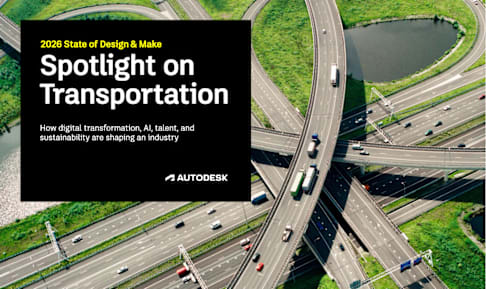
2026 State of Design & Make
Spotlight on Transportation How digital transformation, AI, talent, and sustainability are shaping an industry
About the Spotlight on Transportation
For the State of Design & Make: Spotlight on Transportation report, Autodesk surveyed and interviewed 900 leaders and experts from 14 countries across the transportation industry, including 45% civil infrastructure owners, 26% construction services, 23% engineering service providers, and 6% architecture services providers. Additional data for the report was sourced from Autodesk’s 2025 State of Design & Make survey. For the purposes of this report, AI leaders are defined as organizations that have fully integrated artificial intelligence into their transportation projects. Digitally proficient companies have made strong progress or aggressively prioritize emerging technologies. Digitally lagging companies are those that invest minimally in digital transformation or face resistance that slows digital progress.
2 SPOTLIGHT ON TRANSPORTATION
Leaders in the transportation industry report their organizations are facing significant hurdles, from aging infrastructure and climate volatility to talent and skills shortages and funding gaps. At the same time, new technologies like artificial intelligence (AI) are reshaping the entire asset lifecycle, from concept and build through delivery, maintenance, and repairs.
Introduction: The transportation industry is at an inflection point
SECTION 1
3 SPOTLIGHT ON TRANSPORTATION
State of Design & Make: Spotlight on Transportation main findings
To succeed amid continued disruption, leaders in the transportation industry are investing heavily in digital solutions, including AI, hoping to mitigate the impact of rising costs and fewer workers.
Digital transformation is a clear priority, but siloed data remains a struggle.
While the majority of transportation organizations have implemented BIM and GIS, 40% of companies are still struggling with siloed data, and more than 8 out of 10 say poor data management impacts project efficiency.
Collaboration is key.
Most transportation organizations see a clear pay off from efficient collaboration practices, with time savings and project quality topping the list of key benefits.
AI is a central driver for efficiency and perceived as essential to stay competitive.
Nearly all (99%) of transportation leaders see AI as necessary. AI is streamlining workflows, enabling better decision-making, and is considered an enabler for accelerating problem-solving for engineering teams.
Talent scarcity strains the industry; could AI be the answer?
Half of transportation industry leaders are concerned about future talent availability, especially when it comes to the steady decline in civil engineering graduates. More than one-third of organizations are already experiencing the effects of the talent shortage in the form of reduced project quality and greater operational inefficiencies. To bridge the talent gap, many leaders are turning to AI, with 72% saying AI has potential to create efficiencies that free up resources.
Sustainability is top of mind, with a focus on infrastructure resilience.
Most transportation leaders see the increasing importance of resilience and the need for greater investments to address weather extremes. Water management is a high priority, and to address these challenges, the majority of leaders are focusing on AI-enabled infrastructure resilience.
The advantages of early adoption.
One standout theme across transportation sectors is the difference in performance of AI-leading organizations compared to their less-advanced counterparts. AI leaders report stronger outcomes and more positive outlooks across the organization, from digital maturity and collaboration to talent, sustainability, and resilience.
SECTION 1 | INTRODUCTION
4 SPOTLIGHT ON TRANSPORTATION
Digital transformation has moved from aspirations to imperatives across the transportation industry. Most organizations have already adopted core digital technologies, and many are advancing toward more integrated, data-driven operating models. But the benefits of digital transformation are not evenly distributed. Organizations that have progressed further, particularly AI leaders, are realizing stronger operational outcomes and greater confidence in their ability to navigate disruption.
A majority (60%) of transportation organizations report substantial progress in their digital
transformation journeys, and an additional 16% are investing aggressively in the hopes of accelerating adoption. Core technologies such as BIM and GIS are now foundational, with more than 50% of organizations already reaching full implementation. More advanced capabilities like digital twins and generative design are still making inroads at transportation organizations and, while AI adoption appears low at only 20% full implementation, another 47% of organizations are in process, signaling that AI adoption is a priority for leaders across the industry.
The transportation industry is embracing digital transformation
SECTION 2
Most transportation organizations have or will implement GIS, BIM, cloud solutions
Survey question: Where is your company in the process of integrating the following advanced technologies into transportation projects? 5-point scale. Top two = “in the process of implementing” or “fully implemented.”
GIS BIM Cloud-based workflows
IoTAI Generative design
Digital twins
0%
20%
40%
60%
80%
100%
82% 79% 71%
67% 64%
48% 40%
5 SPOTLIGHT ON TRANSPORTATION
Building Information Modeling (BIM) and Geographic Information Systems (GIS) have long played distinct but complementary roles in transportation infrastructure. GIS provides broad spatial context— capturing information about terrain, land use, flood risk, utilities, and connectivity across cities and regions. BIM delivers highly detailed, data-rich representations of individual assets such as roads, bridges, tunnels, and stations, describing how they are designed, built, and maintained.
Historically, these systems have existed in parallel, with GIS informing early planning and BIM taking over during design and construction. Increasingly, transportation organizations are integrating the two—embedding geospatial context directly into design models—to make more informed decisions across project lifecycles.
BIM & GIS integration: Bringing context and precision together in transportation
This integration enables smarter planning and risk mitigation. By combining GIS data on environmental conditions, right-of- way constraints, or flood zones with BIM models, teams can evaluate design options earlier and reduce downstream rework. For example, planners can assess how a proposed roadway alignment interacts with existing utilities, terrain, or climate risks before detailed design begins.
BIM & GIS integration also improves coordination and data accuracy. Rather than translating information between disconnected systems, integrated workflows allow spatial and design data to be reused from planning through construction and into operations. This reduces duplication, improves data reliability, and supports collaboration among owners, designers, contractors, and operators.
SECTION 2 | THE TRANSPORTATION INDUSTRY IS EMBRACING DIGITAL TRANSFORMATION
Notably, infrastructure owners stand out as early technology adopters, particularly in Geographic Information Systems (GIS) and BIM—75% of infrastructure owners have fully implemented GIS, and 69% have fully implemented Building Information Modeling (BIM), compared to 56% and 53%, respectively, for the industry in general. These higher adoption rates reflect the owners’ long-term responsibility for asset performance and lifecycle value, and their focus on resilience.
85% of transportation leaders say BIM & GIS convergence is essential for project management
6 SPOTLIGHT ON TRANSPORTATION
Data management struggles impact projects across transportation
Survey question: How much do you agree or disagree with the following? [statement] Top two = “agree” or “strongly agree.”
Strongly disagree
Somewhat agree
Somewhat disagree
Neither agree nor disagree
Strongly agree
Poor data management impacts
project efficiency
Our organization struggles with
siloed data
11%
19%
30%
30%
10%
10% 3% 3%
35%
49%
While technology adoption is widespread and data is plentiful, turning information into organizational insights is now less about individual tools and more about how well data flows across systems, teams, and partners. The vast majority (86%) of transportation leaders say that smooth workflows with industry partners are important, and 83% believe improved data interoperability would enhance collaboration. Leaders are also nearly unanimous about the negative effects of poor data management, with 84% agreeing it impacts project delivery.
Despite widespread agreement about the benefits of data interoperability, 40% of transportation leaders say their organization still struggles with siloed data, and the majority (48% sometimes, 8% often, 1% always) have had project rework because of poor interoperability. At digitally lagging organizations, the risks of poor data management rise exponentially—they are nearly three times as likely (17% vs. 6%) to always or often have rework due to interoperability issues than their more mature peers.
Jay Mezher, digital delivery practice lead at Mott MacDonald, highlights how these challenges occur day to day. “There are always varying levels of digital maturity among agencies, contractors, and consultants,” he says. “When those gaps exist, they often lead to fragmented workflows, data gaps, and ultimately rework on projects.”
Tetsuhiro Kurahashi, BIM manager at Nippon Koei, an engineering consulting and electric power engineering company, echoes this sentiment but sees the potential of data interoperability. “Siloed data is a big issue,” he says. “Each department has valuable data, but I don’t think it’s utilized well. By appropriately combining these data, we can enhance our productivity.”
The seeming contradiction between data interoperability perception and reality is not for lack of trying— transportation leaders face a myriad of implementation challenges, from security mitigation to data formatting to resistance within the organization.
“We are stewards of data, whether that be an old drawing from 1900 or a model with asset data attached to it. Our role is to understand what data is important to the organization and how we capture it, store it, maintain it, and make it available to the rest of the organization.”
AMANDA COLEMAN Engineering Innovation & Digital Center Manager, Port of Portland, OR
SECTION 2 | THE TRANSPORTATION INDUSTRY IS EMBRACING DIGITAL TRANSFORMATION
7 SPOTLIGHT ON TRANSPORTATION
Data challenges are varied across the transportation industry
Survey question: What are the primary challenges you face with interoperability of data in your projects? Please select all that apply. Percent selected.
We face no challenges
Insufficient training on tools/technology
Software incompatibility
Lack of standardized protocols
Data format inconsistencies
Resistance to change
Regulatory compliance issues
High costs of integration
Security and privacy concerns
Engineering service providers Construction services Civil infrastructure owners
50%
39% 44%
38%
40% 42%
33%
26% 40%
32%
34% 31%
33%
35% 30%
29%
33% 30%
25%
35% 32%
21%
29% 33%
1% 2% 2%
0% 10% 20% 30% 40% 50%
Nearly half (45%) of transportation industry leaders identify security and privacy as the leading challenge to data interoperability. Transportation project data often includes sensitive asset, organizational, and operational details, and leaders must ensure it remains accurate, controlled, and compliant with regulatory requirements. Without clear governance and consistent security standards across stakeholders, interoperability can be limited, causing delays and rework, rather than improving collaboration.
Not surprisingly, organizations that address these challenges
and report stronger workflow connectivity also report better performance outcomes in the form of reduced rework, shorter project timelines, and smoother collaboration with external partners.
AI leaders show significantly stronger agreement than non- leaders that interoperability (94% vs. 81%), open standards (93% vs. 82%), and leveraging digital tools (88% vs. 81%) improve project outcomes. This suggests that organizations investing in AI are also strengthening the underlying data foundations required to see the impact of interoperability at scale.
SECTION 2 | THE TRANSPORTATION INDUSTRY IS EMBRACING DIGITAL TRANSFORMATION
8 SPOTLIGHT ON TRANSPORTATION
Solution spotlight: BIM delivers faster design, fewer revisions at EMAY Engineering
EMAY Engineering, an international engineering and technical consultancy firm based in Türkiye, designs and delivers large transportation projects including highways, metro systems, bridges, and tunnels. As its projects grew more complex and schedules became tighter, EMAY recognized that traditional 2D, document-based workflows were no longer sufficient. Coordination challenges, late design changes, and limited visibility across stakeholders were increasing risk and effort, particularly on larger projects.
To address these issues, EMAY made a deliberate shift toward BIM. The goal was not only to produce 3D models but also to improve coordination, reduce rework, and create a more reliable design process. The firm invested in training its teams, redefining workflows, and standardizing how models and data were created and shared across projects.
Using BIM, EMAY was able to model infrastructure elements in greater detail and identify clashes—such as conflicts between roadway geometry, structures, and utilities—much earlier in the design process. This reduced late-stage changes and helped teams resolve issues before construction documentation was finalized. Parametric and automated design approaches also made it easier to test alternatives and respond to design changes without starting over.
On large transportation projects like metro lines and major motorways, these BIM-driven efficiencies translated into faster design cycles, fewer revisions, and clearer alignment among teams, improving overall project delivery quality and consistency.
SECTION 2 | THE TRANSPORTATION INDUSTRY IS EMBRACING DIGITAL TRANSFORMATION
READ MORE
9 SPOTLIGHT ON TRANSPORTATION
https://www.autodesk.com/customer-stories/emay-engineering-story?us_oa=dotcom-us&us_si=5c786b50-754b-4c1b-97b3-cd621023e154&us_st=transportation
AI is fundamentally changing the way many organizations function— and the transportation industry is no different. AI has rapidly become a strategic imperative, with an overwhelming 99% of leaders saying AI adoption is necessary to stay competitive, and more than half agreeing that AI is critical or very necessary.
AI is essential SECTION 3
3% 1%
AI is essential for competitive advantage 99% of transportation leaders agree AI adoption is necessary
Survey question: In your opinion, how necessary is AI adoption to remain competitive in the civil engineering industry? See the digitally lagging organization and AI leader definitions on page 3.
Not at all necessary
Very necessary
Somewhat necessary
Moderately necessary
Critical
Total Digitally lagging organizations AI leaders
12%
1%
31%
43%
12% 24%
38%
29%
6% 5%
17%
54%
24%
10 SPOTLIGHT ON TRANSPORTATION
One of the most universal benefits of AI across organizations is time savings, or an increase in productivity. In transportation sectors specifically, 84% of leaders say AI gives time back to focus on other, higher priority tasks. Notably, how that extra time is spent differs between AI leaders and non-leaders, and those choices are leading to a surprising competitive advantage.
AI leaders are more likely to reinvest reclaimed time into quality improvement (63% vs. 56%), complex problem- solving (54% vs. 49%), and professional development (46% vs. 38%) than their nonleading counterparts. This creates a positive cycle wherein AI adoption increases capacity, which is then reinvested into higher-value work that further differentiates performance.
AI time savings allow transportation leaders to shift focus to other priorities
Survey question: If you save time with AI tools, how do you utilize that time? Please select all that apply. Percent selected. “Other” and “AI does not save me time” are not shown.
Improve project quality
Focus on complex tasks
Reduce workload/stress
Enhance quality assurance
Conduct more tasks/projects
Address unexpected project issues
Engage in professional development
0% 10% 20% 30% 40% 50% 60%
58%
50%
49%
43%
41%
40%
40%
“We’re using AI to automate tasks in parametric design; a lot of coding that we used to do manually is now automated.”
JAY MEZHER Vice President, Digital Delivery, Mott MacDonald, an engineering, development, and management consultancy company
SECTION 3 | AI IS ESSENTIAL
11 SPOTLIGHT ON TRANSPORTATION
While it may be understandable that AI leading organizations see more benefits from AI, the disparity in infrastructure talent resilience is substantial. Ninety percent of AI leaders say AI enhances infrastructure resilience, compared to 74% at nonleading organizations. A similar gap exists for bridging the talent gap, with 89% of AI leaders saying AI can bridge talent shortages compared to just 67% of nonleaders. Considering the newness of widespread AI adoption in the industry, this performance gap can be expected to grow, as can the outsize benefits afforded to early adopters.
Spotlight on Transportation survey results indicate AI is a differentiator between organizations that are adapting and those that are struggling to keep pace. Leaders who delay AI adoption risk compounding existing challenges related to talent, efficiency, and resilience.
79% agree AI accelerates solving tough engineering problems by making workflows more efficient
77% agree AI contributes to infrastructure resiliency
76% say AI helps solve difficult engineering problems through better decision-making
72% say AI can help bridge the talent gap
Transportation leaders see AI’s growing impact across their organizations
“If you don’t start using AI now, I think you are going to get behind. The momentum is already there, and organizations that wait too long will struggle to catch up.”
YANISSA DE JONGHE Head of Data and Digital, Lantis, a management and civil engineering company
SECTION 3 | AI IS ESSENTIAL
12 SPOTLIGHT ON TRANSPORTATION
Solution spotlight: BIM and digital twins help deliver Cross River Rail
Cross River Rail is one of Queensland’s largest and most complex transport infrastructure projects, delivering a new 10.2-kilometer rail line beneath Brisbane’s river and central business district. The program includes 5.9 kilometers of twin tunnels, four new underground stations, three new above-ground stations, and the rebuild of eight suburban stations alongside new stabling yards and high-capacity signaling. With 17 active work sites, thousands of contributors, and billions of dollars at stake, the project required an extraordinary level of cross-team collaboration and risk mitigation. To manage this complexity, the project adopted a digitally driven, BIM-enabled approach, creating a federated digital representation of the rail system that aligned engineering models with
real-world conditions. Design data was connected to utilities, property boundaries, environmental layers, and construction sequencing, ensuring that critical decisions were informed by accurate spatial context rather than static documentation. This digital foundation is also now enabling large-scale simulations well before opening day, including Olympic- scale passenger movement, emergency and fire scenarios, evacuation paths, and vertical circulation. In addition, by using the digital twin to assist with critical stages of acceptance and assurance, teams have also been able to identify future sign off issues and refine designs to resolve possible conflicts. As a result, the project has avoided millions in potential design or construction rework later in the project.
SECTION 3 | AI IS ESSENTIAL
13 SPOTLIGHT ON TRANSPORTATION
Technology is only half the equation for successful implementation and adoption of new workflows; talent determines how fast and how far you get with that technology. New platforms, AI, and connected data can only create value when teams know how to use them in their everyday work. But the transportation industry is facing a growing talent gap, and the implications are significant. Ninety percent of transportation leaders say they are concerned about future talent availability in the industry, with 51% saying they are moderately or majorly concerned.
Talent scarcity is a growing concern—could AI be the answer?
SECTION 4
“I am extremely concerned about the talent situation. We have a lot of people who know everything retiring, and not enough people with the experience ready to replace them.”
ALAN WEED BIM Manager, City of Portland, OR
14 SPOTLIGHT ON TRANSPORTATION
Of note, construction services (58%) and engineering service providers (56%) have substantially higher concern than civil infrastructure owners (43%). And, according to the 2025 State of Design & Make report, 61% of civil engineering leaders say that lack of access to skilled talent is a barrier to their company’s growth, up from 38% in 2024. The current effects of the workforce shortage are already being felt by 38% of transportation organizations, in the form of higher recruitment costs, reduced project quality, and other operational inefficiencies.
Tetsuhiro Kurahashi, BIM manager for Nippon Koei, a global engineering consulting firm, says his organization is already seeing the impact of fewer
graduates: “Recently we experienced a shortage of construction workers, and management is struggling to hire both new graduates and skilled candidates,” he says. “This is becoming a serious issue across the industry.” A major factor for talent anxiety is the steady decline of civil engineering graduates in the past decade. Thirty- eight percent of leaders say the decline in graduates has already affected their business. While a shrinking talent pool is the most glaring result—experienced by 35% of leaders—the loss of graduates is manifesting in other ways across organizations. Loss of new workers is leading to a loss of innovation, delays, and increased costs for projects.
The impact of declining civil engineering graduates Transportation leaders say fewer graduates means greater talent shortage and loss of innovation
Survey question: How has the decline of civil engineering graduates affected your business? Open-ended response analysis.
35% shortage
of qualified candidates
13% loss of
innovation/ expertise
13% project delays/ increased costs
7% increased
hiring competition
6% increased
reliance on older workforce
2% increased
automation/ outsourcing
9% increased training/
development costs
9% reduced
project scope/ scalability
SECTION 4 | TALENT SCARCITY IS A GROWING CONCERN—COULD AI BE THE ANSWER?
15 SPOTLIGHT ON TRANSPORTATION
Faced with fewer workers for an increasing list of new projects, many transportation leaders are turning to AI to try and fill the talent gap. Seventy-two percent of transportation leaders say AI has the potential to bridge the talent gap. Among AI leaders, this number is significantly higher at 89%, signaling that leaders investing in AI are confident their investment will pay off in the form of scalable, organization-wide talent solutions. But even AI solutions require workers with the skills to use them, driving organizations to prioritize AI skills for
future hiring. Among technical skills, the ability to work with AI ranks first for civil engineering hiring priorities, with 44% of leaders citing it in the 2025 State of Design & Make report.
As the demand for skilled workers in general, and AI skills specifically, grows, leaders who want to effectively mitigate the impact from talent shortages should focus on a hybrid approach of adopting AI solutions along with training programs that help existing workforces adapt to new technologies and workflows.
“AI is not going to take my job. But someone that knows AI better than me will. The people who learn how to use it effectively are going to have a real advantage over those who don’t.”
ALLEN WEED BIM Manager, City of Portland, OR
SECTION 4 | TALENT SCARCITY IS A GROWING CONCERN—COULD AI BE THE ANSWER?
16 SPOTLIGHT ON TRANSPORTATION
Transportation projects are complex, often involving dozens of outside teams and vendors, and each additional team member adds a layer of risk if projects lack proper collaboration. In digital workflows, collaboration occurs not only among people and teams, but also across the software and tools used by different organizations. “Everybody doesn’t have to be on the same platform, but everybody should be looking at the same data,”
says Amanda Coleman, engineering innovation & digital center manager at the Port of Portland, OR. “People can work in different tools, as long as the information itself is consistent and trustworthy.” Yanissa De Jonghe, head of digital and data at Lantis, a management and civil engineering company, agrees, noting the benefits of working from a single source of truth. “If everyone agrees on the data, the facts and figures become
nonnegotiable,” she says. “That alone saves an enormous amount of discussion and meeting time.” Transportation leaders largely echo these sentiments, with the majority seeing a clear payoff from efficient collaboration practices in the form of time savings and project quality. In addition to productivity gains, 78% of leaders say collaboration has had a positive impact on project outcomes, leading to creative and unexpected solutions.
Collaboration is a cornerstone of success
SECTION 5
17 SPOTLIGHT ON TRANSPORTATION
Solution spotlight: Cloud-based design and collaboration at Buro Happold
Buro Happold, a global engineering consultancy, undertook a shift toward cloud-based design and data management to address long-standing challenges in how complex projects were delivered across distributed teams. Previously, project teams relied on local servers, email exchanges, and disconnected file systems, which often led to version confusion, delays, and extra coordination work—especially on large infrastructure and building projects involving many disciplines and partners.
By moving project models and data into a shared cloud environment, teams across different offices and regions were able to work from the same up-to-date information at the same time. Engineers no longer needed to download, copy, or reconcile files from multiple locations. Instead, changes were visible immediately, reducing errors caused by outdated information and minimizing time spent managing files rather than designing.
The shift delivered substantial efficiency gains. Routine tasks such as opening, syncing, and updating models were completed far more quickly, with some workflows seeing time savings of up to 80% to 90% compared to earlier approaches. These improvements freed teams to focus on higher-value work, such as design coordination and problem solving, rather than administrative overhead.
Equally important, the shared digital environment strengthened how teams worked together. Engineers, consultants, and project partners—often spread across multiple countries—could review designs, coordinate changes, and resolve issues in a more direct and transparent way. Working from a single, shared set of data improved continuity across project phases and helped teams maintain momentum even when working remotely.
Collaboration yields benefits across transportation projects
Survey question: What benefits has your organization experienced through collaboration with industry partners? Please select all that apply, percent selected. “Other” and “none” are not shown.
0% 10% 20% 30% 40% 50% 60% 70%
Saves time 61%
Enhances project quality 59%
Reduces costs 49%
Improves communication 49%
Improves risk management 48%
Fosters innovation 44%
Provides access to specialized expertise 43%
Reduces rework 43%
Enhanced asset sustainability/longevity 34%
SECTION 5 | COLLABORATION IS A CORNERSTONE OF SUCCESS
READ MORE
18 SPOTLIGHT ON TRANSPORTATION
https://www.autodesk.com/customer-stories/buro-happold-story?us_oa=dotcom-us&us_si=5c786b50-754b-4c1b-97b3-cd621023e154&us_st=transportation
To reap the greatest benefits from successful collaboration, organizations are investing heavily, with 81% reporting that they have a dedicated role or team for facilitating collaboration. Despite these efforts, survey data reveals a surprising disconnect between perceived impact and actual performance—while 79% of leaders feel there is adequate collaboration across their teams
for project success, more than half of those same leaders (52%) have had projects fail or underperform due to lack of collaboration. This skewed perception could have a downstream impact on outcomes if recurring issues are left unaddressed and cause preventable delays across multiple projects.
Here again, AI implementation emerges as a differentiator. Nearly all (90%) AI leaders report adequate collaboration, compared to 77% of non-leaders. AI leaders are also more likely to say that collaboration leads to innovation (52% vs. 42%), more creative solutions (86% vs. 76%), and even greater asset longevity (45% vs. 32%).
SECTION 5 | COLLABORATION IS A CORNERSTONE OF SUCCESS
Image courtesy of Portcoast
19 SPOTLIGHT ON TRANSPORTATION
Sustainability and resilience are no longer peripheral concerns in transportation—they are central to how projects are planned, from concept through maintenance. Leaders overwhelmingly agree that resilient infrastructure, informed by data and supported by technology, is essential for long-term value creation.
More than four in five transportation leaders (82%) agree that better access to data contributes directly to more resilient infrastructure, and an equal share (82%) say delivering projects resilient to extreme weather is essential. These views reflect growing exposure to climate-related disruptions and the recognition that resilience must be built in from the outset, not addressed after assets are in service.
Sustainability and infrastructure resilience are top of mind
SECTION 6
20 SPOTLIGHT ON TRANSPORTATION
Sustainability and resilience are top of mind for transportation leaders
Survey question: How much do you agree or disagree with the following? [statement]
It has become even more essential to deliver projects that are
resilient to extreme weather events
In the past five years, water-related risks have become
more prominent in our design criteria
Investment in sustainable transportation infrastructure is critical to mitigate
impact from extreme weather events
When designing projects, we consider their long-term impact on
the local community’s well-being
Neither agree nor disagree
Strongly disagree
Somewhat agree
Somewhat disagree
Strongly agree
16% 43% 39%
7% 21% 43% 27%
18%4% 42% 35%
15%3% 43% 38%
2%
2%
SECTION 6 | SUSTAINABILITY AND INFRASTRUCTURE RESILIENCE ARE TOP OF MIND
21 SPOTLIGHT ON TRANSPORTATION
AI leaders see data as the key to greater resilience and predicting long-term impact
Survey question: How much do you agree or disagree with the following? [statement] See the AI leader definition on page 3.
AI leaders
Non-AI leaders
AI leaders
Non-AI leaders
Better access to data contributes to more resilient infrastructure.
When designing projects, we consider their long-term impact on the local community’s well-being.
Neither agree nor disagree
Strongly disagree
Somewhat agree
Somewhat disagree
Strongly agree
7% 41% 50%
4% 17% 43% 35%
2%
12% 37% 50%
17% 49% 32%
2%
3%
1%
Climate risk is already influencing transportation design, and the industry is responding by focusing on infrastructure resiliency and water management. Eighty- one percent of leaders report that long-term community well-being is a factor in project design, and 78% say continued investment in sustainable transportation infrastructure is critical, signaling that resilience is being evaluated not only through asset performance, but also through social and economic impact.
Organizations that lead in AI adoption are significantly more likely to embed resilience into projects from inception. Seventy-eight percent of AI leaders incorporate water-related risks into design, compared to 67% of non-leaders; and 91% of AI leaders consider long-term community well-being when designing projects, versus 79% among their peers. These differences suggest that digitally proficient organizations are better equipped to translate sustainability strategy into action.
SECTION 6 | SUSTAINABILITY AND INFRASTRUCTURE RESILIENCE ARE TOP OF MIND
22 SPOTLIGHT ON TRANSPORTATION
Water management stands out as a near-universal environmental concern—99% of transportation leaders say it’s important, and 69% say water-related risks have become more prominent in design decisions. Foundational systems such as stormwater drainage (57%), wastewater sewer systems (56%), and water recycling or reuse (51%) are already widely implemented
across the industry, and newer technologies are emerging as major sustainability enablers. According to 2025 State of Design & Make report data, AI is now the top sustainability enabler across the civil engineering industry. Seventy-eight percent of civil engineering leaders believe that sustainability measures can generate more than 5% of their
annual revenue, meaning near- term investments in sustainability- enabling technologies could pay dividends down the road.
Embedding resilience into strategy requires aligning data, technology, and people around long-term outcomes, ensuring sustainability investments deliver both environmental and business value.
SECTION 6 | SUSTAINABILITY AND INFRASTRUCTURE RESILIENCE ARE TOP OF MIND
“One of our moonshots is that we want to build eco‑positive. That means constantly challenging how we design and build infrastructure.”
YANISSA DE JONGHE Head of Technology and Digital Innovation, Pennsylvania Department of Transportation
23 SPOTLIGHT ON TRANSPORTATION
This means moving beyond isolated initiatives and building connected ways of working that span the entire project lifecycle. When data is treated as a shared asset, teams can anticipate risk earlier, collaborate more effectively, and make project decisions with greater confidence. Technologies such as BIM, GIS, and AI are most valuable when they are embedded into everyday workflows and supported by clear standards and governance.
Action is also required on the human side of transformation. Leaders must invest in training, create clear pathways for adoption, and empower teams to work differently across disciplines and partners. Collaboration does not happen on its own—it must be encouraged and enabled.
Today, the industry is being asked to do more than ever before: deliver complex projects faster, manage aging assets more effectively, respond to environmental uncertainty, and do so with fewer people and tighter resources. Meeting these demands requires a fundamental shift in how infrastructure is planned, delivered, and sustained.
What distinguishes leading transportation organizations is not the absence of these roadblocks, but their ability to adapt. Digitally proficient organizations and AI leaders consistently outperform their peers, not because they face fewer or different challenges, but because they are better equipped to respond.
Finally, leaders should align digital transformation with long-term organizational goals for resilience, sustainability, and community impact. Infrastructure built today must perform under conditions that are increasingly uncertain, and decisions made early in the lifecycle will define outcomes for decades.
Organizations that act decisively—connecting data, enabling people, and embedding resilience into strategy— will be best positioned to deliver transportation systems that are durable, adaptive, and fit for the future.
Conclusion: Leading through complexity
24 SPOTLIGHT ON TRANSPORTATION
About the State of Design & Make: Spotlight on Transportation report
The data for the State of Design & Make: Spotlight on Transportation report is derived from our Spotlight on Transportation survey which includes responses from 900 transportation leaders across 11 countries/regions: Australia, Canada, France, Germany, India, Italy, Japan, New Zealand, Nordics (Denmark, Finland, Norway, Sweden), the United Kingdom, and the United States.
Additional data for the State of Design & Make: Spotlight on Transportation report was compiled from a subset of Autodesk’s 2025 State of Design & Make report, which includes 344 respondents from the civil engineering industry. The civil engineering industry subsample for 2024 was 435 respondents.
The report also features qualitative interviews with leaders and experts from across the transportation industry.
About Autodesk
Autodesk is changing how the world is designed and made. Its technology spans architecture, engineering, construction, operations, product design, manufacturing, and media and entertainment, empowering innovators everywhere to solve challenges big and small. From greener buildings to smarter products to more mesmerizing blockbusters, Autodesk software helps customers design and make a better world for all. For more information, visit autodesk.com or follow @autodesk on social media.
Contact Autodesk at state.of.design.and.make@autodesk.com about this research report or to sign up to participate in future research programs.
The information provided in this report is for general informational purposes only and strictly for the convenience of our customers. Autodesk, Inc., does not endorse or warrant the accuracy or completeness of any information, text, graphics, links, or other items contained within the report.
Autodesk, Inc., does not guarantee that you will achieve any specific outcomes or results if you follow any advice in the report.
© 2026 Autodesk, Inc. All rights reserved.
25 SPOTLIGHT ON TRANSPORTATION
https://www.autodesk.com/design-make/research/state-of-design-and-make-2025 mailto:state.of.design.and.make%40autodesk.com?subject=State%20of%20Design%20%26%20Make%3A%20Spotlight%20on%20Transportation