Formula for agile pharmaceutical manufacturing
Creating excellence in plant construction and operation with a digital factory approach! Aging populations, growth in emerging markets, and the rise of personalized medicine are all driving increased demand for pharmaceuticals. Europe’s leading pharmaceutical companies are expanding capacity to meet this demand. They’re also fortifying supply chains to mitigate future disruption—all while maintaining quality control, compliance, and sustainability standards.
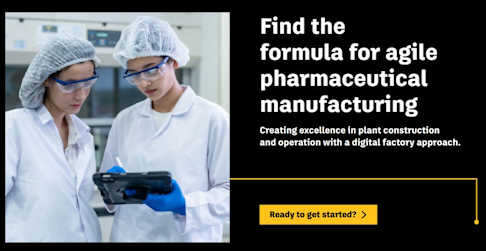
Find the formula for agile pharmaceutical manufacturing Creating excellence in plant construction and operation with a digital factory approach.
Contents
Find the formula for agile pharmaceutical manufacturing
2
Introduction Aging populations, growth in emerging markets, and the rise of personalized medicine are all driving increased demand for pharmaceuticals. Europe’s leading pharmaceutical companies are expanding capacity to meet this demand. They’re also fortifying supply chains to mitigate future disruption—all while maintaining quality control, compliance, and sustainability standards.
Doing this successfully will help you get your innovations from the lab to the production line and safely into homes more quickly and reliably. But whether you’re building new plants or reconfiguring existing ones, you can’t foresee all the challenges that may disrupt your plans.
What you can do is ensure teams can face those challenges with more agility. Building agility into the entire process will help you get new, sustainable facilities up and running faster and strengthen your competitiveness today. It will also equip your teams to be ready for the challenges of tomorrow, be that new regulations or market disruptions.
Find the formula for agile pharmaceutical manufacturing
3
Stay ahead with a digital factory approach A digital factory approach can help you achieve that agility by making your plants digital from day one. That way, your teams could enjoy more predictable design and construction schedules involving better collaboration and fewer mistakes. Then, all the data from a plant’s design and construction could feed into its operation, opening up opportunities for greater operational efficiency and improved margins.
The objective is clear: to increase capacity in a way that enhances agility and efficiency, so you can monetize innovations faster than the competition.
Find the formula for agile pharmaceutical manufacturing
4
In this e-book, we’ll shed light on three best practices to build in agility and efficiency as you expand your capacity:
Take ownership of your project data from the start. 1
3 Embed sustainability into your plants now. 2 Plan, design, build, and operate plants that help you get to market faster.
Airplan, a company specializing in turnkey projects for life sciences plants, increased productivity by 30% using cloud collaboration solutions.
Find the formula for agile pharmaceutical manufacturing
5
https://www.autodesk.com/eu/customer-stories/airplan
Approach 1: Take ownership of your project data from the start
If you have the data from your plant’s design and construction, you’ll be able to optimize its operation. That means you, as the plant owner, must mandate that all project data is captured from the beginning and included in the handover of your newly built plants.
Without that, your teams may not have the agility to reconfigure production lines when there’s a change in regulation, introduction of a new product, or to respond to the demands of personalized medicine. This is especially true if, like 70% of manufacturers, you still rely on manual data entry, as teams are more likely to work with wrong, duplicated, or out-of-date information, leading to unnecessary delays and mistakes.
Find the formula for agile pharmaceutical manufacturing
6
https://manufacturingleadershipcouncil.com/seventy-percent-of-manufacturers-still-enter-data-manually-2-37141/?stream=all-news-insights
Get ahead of your data By taking control of all the data associated with or generated by your plant, you’ll be able to provide everyone involved in its entire lifecycle with a common data environment to collaborate from. Because the information in your environment will always be up-to-date, you’ll reduce the risk of errors that typically cause construction projects to go off track. You will also be capturing vital data to optimize the operation of your plant using technologies like digital twins. 1/3 of all poor decisions made
during construction are a result of bad data.
The result: An ecosystem for agile manufacturing
• Improved collaboration.
• Ability to react faster to market changes.
• Optimized production.
Find the formula for agile pharmaceutical manufacturing
7
https://construction.autodesk.com/resources/guides/harnessing-data-advantage-in-construction/
Approach 2: Transform plant construction and operation to get to market faster A digital factory approach involves streamlined collaboration using shared data. It will benefit teams throughout each stage of your plant lifecycle:
Plan Your project will be set up for success as architects, engineers, and construction managers can work from the same plans as early as site-feasibility assessments. You’ll be able to identify potential risk areas upfront, build more accurate forecasts, and ensure better project predictability. On subsequent projects, you’ll be able to use historical asset data to apply lessons from previous plants
Design Instead of working separately, architects, building engineers, and production engineers can co-create the plant design together with you. This will help to avoid costly errors and clashes being discovered at the construction phase—a column where your production line needs to be, for example. You can also use simulation to model how people, processes and products move across your layout, helping you optimize space and maximize throughput.
Find the formula for agile pharmaceutical manufacturing
8
The result: The entire lifecycle of your plant is optimized
• Improved plant performance.
• Faster time-to-market.
• Fewer unexpected costs.
Operate At this stage, digital twins—dynamic digital replicas of built assets—can let you use the data from your construction process, as well as real-time data from onsite sensors and more, to continuously optimize plant efficiency.
You’ll be able to simulate ‘what if’ scenarios virtually, so teams can respond to market changes with more agility as they have insight into the impact of changes like new layout designs. You’ll also be able to test the quality of your assemblies with simulations that predict when maintenance should be performed, reducing downtime and lengthening equipment lifespans.
Build Once you begin construction, all internal and external stakeholders will have visibility into project status and timelines, and will be automatically notified of last- minute changes. This will help to reduce costly errors and rework, streamline timescales and ensure the plant is built to spec with fewer defects at handover.
Every £1 invested in information management during construction can generate a total cost saving of up to £7.40—or up to 740% ROI.
Find the formula for agile pharmaceutical manufacturing
9
https://www.cdbb.cam.ac.uk/files/cdbb_econ_value_of_im_report.pdf
Approach 3: Get to net zero with sustainable plant design and operation
Pharma companies must navigate intensifying EU sustainability regulations. But the industry’s focus on sustainability is not just about compliance. According to Autodesk’s State of Design & Make report, 81% of leaders in life sciences view sustainability initiatives as a key part of their company’s growth strategy for the next three years.
Become sustainable from the ground up By reducing errors and rework, the strategies listed in section two above will reduce waste during the construction phase, helping you build plants more sustainably. You can also plug in strategies like standardizing key building elements and leveraging offsite fabrication to reduce waste further during the build.
And you can embed sustainability before that too, when you design your plant. AI-powered tools can help teams assess the environmental implications of siting the building based on microclimate, wind, or solar conditions, so they can consider lower- carbon materials or energy efficiency options before being locked into a specific design.
Find the formula for agile pharmaceutical manufacturing
10
Reach your net-zero goals Once you’re operational, using digital twins can be a game- changer. They will model your plant’s energy efficiency throughout its lifecycle, so your teams can monitor energy use in real time. And, because your plant data will all be accessible in your shared data environment, your teams can analyze lessons from previous plants and apply them to new ones, so you can continuously improve your sustainability with each new project.
The result: More sustainable pharmaceutical production
• Reduced carbon emissions.
• Compliance with legislation.
• Improved company reputation.
79% of business leaders in life sciences believe sustainability is a good short-term business decision, and 90% believe it’s a good long-term decision.
Find the formula for agile pharmaceutical manufacturing
11
https://www.autodesk.com/design-make/research/state-of-design-and-make
In summary
By investing in more agile approaches to plant design, construction and operation, you can face these challenges head on. Being digital from day one will help you achieve more sustainable outcomes, improve margins, and optimize operational efficiency, so your innovative pharmaceuticals get to the patients that need them faster.
Europe’s leading pharmaceutical manufacturers are focused on expanding their capacity to meet growing demand—all while mitigating challenges such as supply chain disruptions or EU regulation changes.
Find the formula for agile pharmaceutical manufacturing
12
www.autodesk.com
Autodesk and the Autodesk logo are registered trademarks or trademarks of Autodesk, Inc., and/or its subsidiaries and/or affiliates in the USA and/or other countries. All other brand names, product names, or trademarks belong to their respective holders. Autodesk reserves the right to alter product and services offerings, and specifications and pricing at any time without notice, and is not responsible for typographical or graphical errors that may appear in this document.
© 2024 Autodesk. All rights reserved.
Introduction Approach 1: Take ownership of your project data from the start Approach 2: Transform plant construction and operation to get to market faster Approach 3: Get to net zero with sustainable plant design and operation Summary
Button 35: Button 42: Button 38: Button 39: Button 40: Button 41: Button 34: Page 2: Page 3: Page 4: Page 5: Page 6: Page 7: Page 8: Page 9: Page 10: Page 11: Page 12:
Button 32: Page 2: Page 3: Page 4: Page 5: Page 6: Page 7: Page 8: Page 9: Page 10: Page 11: Page 12:
Button 33: Page 2: Page 3: Page 4: Page 5: Page 6: Page 7: Page 8: Page 9: Page 10: Page 11: Page 12:
Button 37: Page 13:
Button 36: Page 13: