ISAIC drives people-focused sustainability with help from Autodesk
SOFTWARE Fusion Operations
ISAIC drives people-focused sustainability with help from Autodesk Fusion Operations
When you think of sustainability, what first comes to mind is likely the environment. But for Lionel Cruz, Director of Manufacturing and Innovation at the Industrial Sewing and Innovation Center (ISAIC), a nonprofit in Detroit, Michigan, and part of the Autodesk Foundation’s Work & Prosperity portfolio, the idea of sustainability is much bigger.
“Our mission at ISAIC is finding a sustainable way to manufacture garments in the US, and our belief is that sustainability starts with people,” Cruz says. “We want to make sure that the materials we’re using are environmentally friendly, among other things. But if you’re not growing your people and giving them opportunities for upward mobility, that’s not true sustainability.”
On a practical level, this means ISAIC devotes just as much attention to
data about its waste, emissions, and supply chain as it does business leadership training and profit sharing.
Overall, the vision for ISAIC is two- pronged, focusing on both workforce development and innovation. This vision aligned ISAIC with the Autodesk Foundation, Autodesk’s philanthropic arm, which invests in design and engineering solutions addressing climate change and inequality. ISAIC’s work aligns the Work & Prosperity impact area of the Autodesk Foundation, which invests in building a skilled and resilient workforce that meets the changing needs of the construction and manufacturing industries in the era of automation.
Workforce development includes the organization’s nationally recognized apprenticeship program,
“When I joined ISAIC two years ago, I wanted to understand everything about our current state. Fusion Operations was very helpful. I was able to understand our productivity and waste and get down to the root cause of problems.”
Lionel Cruz Director of Manufacturing and Innovation Industrial Sewing and Innovation Center (ISAIC)
which should expand to 10 or more states within the next three years. It also includes classroom training in the fundamentals of industrial sewing to help employees learn the language of the cutting room as well as get a big-picture understanding of sewing in a large factory setting — knowledge they can take with them as they build their own businesses or move up the ranks in the industry.
To foster innovation, ISAIC creates pilot programs for brands interested in relocating production to the US or developing new products. The organization is collaborating with Carhartt, for example, to ramp up production of the company’s signature beanies in the US. ISAIC also works directly with innovators in these pilot programs. Recently, the organization established a program with Variant 3D, which uses AI to develop stitching programs automatically from 3D images.
“Typically, a manufacturer would have to hire a senior engineer with experience in stitching programs to do this,” Cruz says. “But with Variant 3D you can do it with AI. It’s currently in a beta trial. When we get access to the software, our goal is to
have brands like Ford and Carhartt and others come in and put it to the test.”
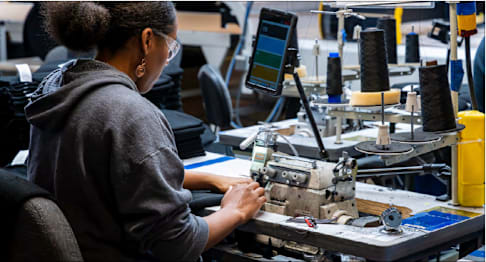
Diving into the details with Fusion Operations To bring all of these ideas to life, ISAIC is focused on optimizing its own performance as a manufacturer with help from Autodesk Fusion Operations production management and production floor tracking software.
“I’m a very data-driven person,” Cruz says. “When I joined ISAIC two years ago, I wanted to understand everything about our current state. Fusion Operations was very helpful. I was able to understand our productivity and waste and get down to the root cause of problems.”
For example, Cruz used Fusion Operations to quickly identify a machine that was creating too much scrap. Its scrap rate was 7.5%, well above the standard of 3.5%. By focusing on that machine, ISAIC was able to get the scrap rate down to 2.1%. But this exercise also helped the organization discover that they were overestimating their capacity, which helped build the case for a second
Autodesk and the Autodesk logo are registered trademarks or trademarks of Autodesk, Inc., and/or its subsidiaries and/or affiliates in the USA and/or other countries. All other brand names, product names, or trademarks belong to their respective holders. Autodesk reserves the right to alter product and services offerings, and specifications and pricing at any time without notice, and is not responsible for typographical or graphical errors that may appear in this document. © 2024 Autodesk, Inc. All rights reserved.
machine.
“The reality was, we were never going to be able to hit our capacity goals,” Cruz says. “We learned that by looking at the data in Fusion Operations. First, we created staggered shifts to get more capacity from the existing machine. Then we used the data to justify adding a second machine.”
With a second machine in the shop, the benefits compound on one another. Cruz notes that with one machine, you’re stuck with the scrap rate you have.
“Obviously, when you only have one machine, you tend to leave it alone because you aren’t going to stop the machine and stop producing goods. With two machines, we can always shut one down and work on it if there is an issue rather than compromise product quality.”
Fusion Operations has also helped ISAIC to identify bottlenecks in the process and then determine if the issue is related to the material, the machine, the method, or the manpower — the so-called “4 Ms” of manufacturing.
“Essentially, we look at everything else before we look at the operator,” Cruz says. “And if the issue is operator related, we can make sure they receive the proper training and develop the right skill set for that particular operation. Using the information from Fusion Operations, we can look at all those data points and understand exactly where our issues are. That’s the biggest way Fusion Operations has helped us improve.”
Measuring productivity, quality and downtime For Cruz, Fusion Operations is the focus of his daily work. Each day starts with an overview of the dashboards that shows the status of everything on the factory floor.
“I appreciate having access to information right on time,” Cruz says. “I can see the work rate of everyone who is working currently. I can see the status of every machine. We have a really
good understanding of how to use the machine dashboard and track downtime.”
Specifically, Fusion Operations allows Cruz to detect which a machine is experiencing downtime issues consistently, which triggers a closer investigation.
“When we started tracking downtime, we were at something like 18%,” Cruz says. “Very quickly, we got that number down to around 11%. Now we’re at 9.5% and still improving. Our goal is 7%.”
Cruz also depends on the quality dashboard to understand scrap rates on a daily basis.
“We want to make sure we understand where our scrap rates are highest on the floor every single week,” he says. “With Fusion Operations, we can make sure we’re working on the right issues, which is often the fabric we use for the beanies. The impact can be huge because we’re producing anywhere from 27,000 to 35,000 units a month.”
According to the latest Fusion Operations data, ISAIC has reduced waste rates from 1.3% in January of last year to 0.4% in January of 2024. That’s a big improvement, but Cruz isn’t stopping there. He sees too many opportunities to make ISAIC even more efficient.
“Now we’re moving forward with inventory management with Fusion Operations,” he says. “We’ve developed new standard operating procedures for inventory management that we hope to implement within the next few months. We will have all our inventory running through Fusion Operations.”
Of course, the more efficient ISAIC becomes as a manufacturer, the better able it will be to achieve its vision for continued sustainability, intentional workforce development, brand-based innovation, and inclusive community collaboration.
“Hopefully that’s a dream that comes true,” Cruz says.
“The impact can be huge because we’re producing anywhere from 27,000 to 35,000 units a month.”