Bringing the benefits of digital manufacturing to life for Industrial Machinery
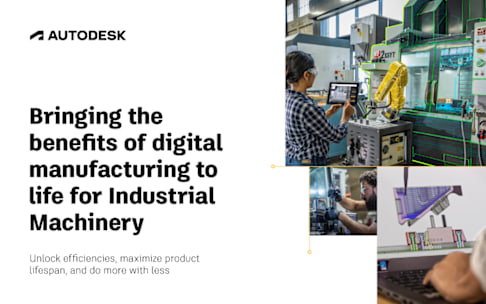
Bringing the benefits of digital manufacturing to life for Industrial Machinery Unlock efficiencies, maximize product lifespan, and do more with less
While digital manufacturing has opened up a number of opportunities, it has also seen many organizations reach breaking point. This isn’t surprising, given the number of manual systems still in use plus the broad mix of both paper and digital data formats. And this causes many broken processes up- and downstream that compromise operational efficiency.
Standardized data and tools play a vital role in solving this problem. Firstly, to streamline processes with consistent insight that’s accessible across the enterprise. Then, to inform effective decision-making with the right information at the right time. With this standardization properly in place, you can take full advantage of automated workflows.
In practical terms, let’s look at three key areas modern manufacturers must focus on to make the most of data and automation in the digital manufacturing opportunity:
• Reinforcing business-wide operational efficiencies to ensure price competitiveness in the face of rising costs.
• Shifting to a servitization model that best aligns with ‘market of one’ customer expectations. • Managing labor shortages while maintaining productivity.
Here, we’ll consider how technology can help improve throughput, reduce complexity, and empower your workforce to do more with less.
2 Bringing the benefits of digital manufacturing to life for Industrial Machinery
For industrial machinery organizations, operational and material costs are continuing to rise just as service models flex to embrace both commoditization and personalization, driven by long-term economic and supply- chain volatility. This means achieving greater efficiency across production lifecycles is now more important than ever.
There’s no better place to start than with the factory itself. Digital tools enable you to test the entire reconfiguration process and better understand the impact of different changes will have on operations. This can help manufacturers more effectively balance the competing challenges of customization and time efficiencies, as well as reducing material waste.
The supply chain offers similar opportunities. Integrated data management provides transparency and insight-sharing that empower your team to make data-driven decisions. These result in supply-chain agility to minimize redundancy and downtime.
Digital twin modeling allows you to simulate the manufacturing process of each component, optimizing machine availability, line performance, and material flow without real-world risk. Generative design then lets you analyze part performance in the context of real-life conditions—and then apply the optimizations to your production line.
Unlock digital operational efficiencies for an agile, seamless production cycle
Use case: Data efficiency in action Deeper digital insight helps Austrian plant and machinery specialist ANDRITZ intelligently optimize plant processes and realize savings of more than €150 million for its customers.1
Read more long-arrow-right
3 Bringing the benefits of digital manufacturing to life for Industrial Machinery
https://www.autodesk.com/design-make/articles/digital-manufacturing
Boost efficiency for factories, new and old
• Stay on schedule and within budget as you reconfigure your manufacturing processes for both greenfield sites and retrofits, with integrated factory layout.
• Maximize site-wide ROI with efficient installation sequencing.
Improve time to market
• Ensure faster production times and more effective use of resources.
• Create high-quality products more quickly and sustainably with Design for Manufacturing (DFM) insights.
Minimize risk & maximize opportunity
• Make informed decisions and optimize production lines virtually with preventive maintenance before making costly physical changes.
• Prevent downtime by simulating and predicting potential issues with digital twin modeling.
• Anticipate equipment failures and schedule repairs proactively with predictive maintenance tools, ensuring the maximum lifespan of your machinery.
Broaden supply-chain visibility and control
• Gain transparency and agility across your supply chain, to quickly identify parts, know their use in other designs, and switch to other suppliers when substitutions are needed.
• Enhance your internal capabilities with intelligent automation to avoid over-reliance on external sources.
• Improve team collaboration and reduce errors with integrated data management.
4 Bringing the benefits of digital manufacturing to life for Industrial Machinery
Despite the inherent complexity of the industrial machinery sector, customer demands have shifted significantly, in particular the increasing expectations for product customization and personalization. In turn, this transition from equipment supplier only to strategic partner, means industrial machinery manufacturers need to pivot to a servitization model.
With the appropriate software platform you can adopt a service-focused manufacturing approach, providing you the foundation you need to deliver new business models with confidence. This includes configurators that allow customers to specify requirements in a way that is aligned to your production line. Naturally, this helps build the strong, trusting, and reliable partnerships needed for a servitization model to succeed.
Maximize product lifespan and uptime: the power of servitization
Use case: Configurators in action GARANT-Filter, manufacturer of industrial air pollution control systems, uses Autodesk configurators to develop accurate 3D models of complex custom systems up to five times faster than before.2
Read more long-arrow-right
5 Bringing the benefits of digital manufacturing to life for Industrial Machinery
https://www.autodesk.com/customer-stories/garant-filter
You can build servitization capabilities into your product lines from the beginning, with Autodesk’s Design for Service software. This includes factors such as ease of maintenance, as well as the ability to monitor and collect vital data from the product in use. There are also design tools for rapid customization, as well as collaboration platforms that bring you closer to your customers with product co-creation.
Digital twin modeling is important here too, providing you with a virtual sandbox environment to simulate customizations without risk. This includes testing performance and predicting maintenance needs—before a bespoke product goes live.
Pivot from supplier to strategic partner
• Operate with consistent insight from a single digital source of truth across your full product lifecycle, shared with all your teams via a cloud-based, API- integrated platform.
• Easily track and trace data, designs, and processes, from your production line, across your supply chain, to your customers.
• Promote seamless collaboration and real-time information sharing, to quickly address customer demand.
Strengthen reliability across your servitized production
• Quickly identify and proactively resolve quality issues, with a platform built for efficient tracking and monitoring of product quality.
• Access advanced simulation study types to validate real-world design performance through side-by-side design comparisons.
Reimagine your products as a service
• Manage product inventories and maintenance to support an efficient and effective -as-a-service approach to product selling.
• Adapt and respond to evolving customer needs with integrated data exchange and easy collaboration across teams and systems.
• Validate real-world performance virtually for maximum product customization with minimal risk.
6 Bringing the benefits of digital manufacturing to life for Industrial Machinery
With operational efficiencies unlocked and the value of industrial servitization being realized, the next step is to ensure your workplace is fit for the future. This is especially important with the current labor and skills shortages in the industrial machinery sector.
Central to this is the ability to design workflows with appropriate process automation and data integration. This helps establish a truly collaborative working environment that connects every corner of the digital factory and helps share knowledge and expertise to collectively solve the complex challenges that industrial machinery workforces continually face.
Do more with less: streamline the modern industrial workplace
Use case: Connected knowledge in action GEA uses Autodesk to automatically convert complex processing system designs from 2D to 3D, closely connecting sales and engineering teams and achieving 80% time savings in the process.3
Read more long-arrow-right
7 Bringing the benefits of digital manufacturing to life for Industrial Machinery
https://www.autodesk.com/customer-stories/gea
Maximize output with fewer resources
• Address labor shortages by optimizing factory layouts, automating workflows, and leveraging advanced tools for a leaner workforce.
• Enable your engineers to explore new design possibilities and innovations with cutting-edge tools and features like generative design.
Facilitate collaboration and knowledge-sharing
• Overcome individual skill gaps with collaborative workflows on an easy-to-use, cloud-based platform that enables employees to leverage each other’s expertise.
• Foster a culture of collaboration and shared knowledge that helps get new employees up to speed more quickly in solving complex challenges.
Automation offers critical support in manufacturing where workforces are often overloaded with repetitive tasks. Robotic Process Automation (RPA) tools help remove potential bottlenecks by taking menial tasks and enabling workers to focus on more rewarding, value-adding tasks. In this way, RPA streamlines workflows in a way that reduces cycle times and increases profit.
Design for Manufacturing (DFM) principles play a valuable role in maximizing productivity and capacity, even with labor shortages. DFM is a design process that helps engineers consider manufacturing processes, materials, and constraints from the very beginning of a project. This reduces errors and reworks—and therefore production time and costs. Likewise, generative design capabilities help engineers pinpoint, troubleshoot, and solve any product defects earlier in the design process.
8 Bringing the benefits of digital manufacturing to life for Industrial Machinery
Digital transformation in the industrial machinery sector is about reimagining operations across a complex landscape—from workflows and processes through to supply-chain integration and factory layout optimization. This requires a comprehensive suite of industry- specific software solutions, designed to address all your process and data challenges in one place.
By partnering with Autodesk, you maximize value and consistency of your product-driven services, while also lowering total cost of ownership. Digital manufacturing can open up new revenue streams that will help you differentiate your offer. And you can continue to flex and meet market demands with resource elasticity that’s ready for whatever the future holds.
Make digital manufacturing your day-to-day reality with Autodesk
Speak to us today to discuss how we can help your organization’s digital transformation.
9 Bringing the benefits of digital manufacturing to life for Industrial Machinery
https://www.autodesk.com/solutions/digital-factory
Autodesk and the Autodesk logo are registered trademarks or trademarks of Autodesk, Inc., and/or its subsidiaries and/or affiliates in the USA and/or other countries. All other brand names, product names, or trademarks belong to their respective holders. Autodesk reserves the right to alter product and services
offerings, and specifications and pricing at any time without notice, and is not responsible for typographical or graphical errors that may appear in this document.
© 2024 Autodesk. All rights reserved.
www.autodesk.com
1 Paper Mill Machines Built With Digital Manufacturing, article by Harald Henkel, June 8 2021
2 GARANT-Filter customer story
3 GEA customer story
https://www.autodesk.com/design-make/articles/digital-manufacturing https://www.autodesk.com/customer-stories/garant-filter https://www.autodesk.com/customer-stories/gea