Sustainability and design trends in the consumer electronics industry
Autodesk commissioned a recent research study to understand more fully the current dynamics of the consumer electronics industry and sustainability — especially in the face of shifting market forces such as supply chain challenges, evolving consumer demand, and government regulations. Interviews with 20 high-level, consumer-electronics product designers, engineers, and sustainability consultants provide a new understanding about their views and the role of sustainable practices.
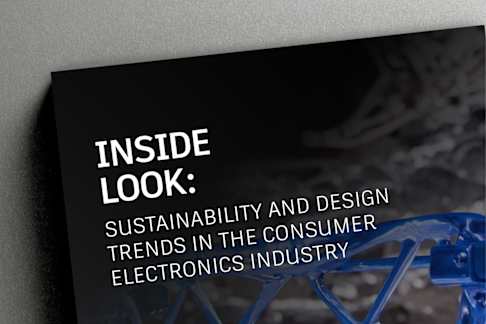
New research provides insights on the current changes and growth of sustainability
SUSTAINABILITY AND DESIGN TRENDS IN THE CONSUMER ELECTRONICS INDUSTRY
INSIDE LOOK:
Table of Contents Executive Summary
Market Forces Driving Sustainability in Consumer Electronics Industry
Research Findings - Part 1: 6 Key Insights on Adoption of Sustainability in Consumer Electronics Industry
Research Findings - Part 2: Overcoming Sustainability Challenges
Research Findings - Part 3: Key Initiatives for Sustainability Growth in Consumer Electronics Industry
Research Findings - Part 4: Role of CAD in Consumer Electronics Industry Adoption and Growth of Sustainability
Conclusion
03
04
07
15
22
25
27
C O N T E N T S22
Executive Summary
Experts in the consumer electronics industry have shown the willingness and ability to adopt sustainable practices, but there is still room for improvement. An increased focus on sustainability by the consumer electronics industry is widely viewed as underway, but the implementation of sustainable best practices continues to compete with other priorities and the bottom line. The research found strong agreement that laws and regulation will move the needle to prioritize and act with sustainability in mind.
The research revealed some of the most challenging aspects that still need to be addressed. Sourcing and using trusted and less expensive sustainable materials remain problematic. Total carbon management and calculation of lifecycle analysis (LCA) are also difficult. Designers see the need to carve out more of an emphasis on design for emotional connection and the circular economy.
Respondents were also asked to share their thoughts on the key initiatives required to drive sustainability growth. The following ranked as the most important areas to pursue: manufacturing optimization, simplifying design, and compliance and certification.
According to the European Commission, it’s estimated that 80% of all product-related environmental impacts are determined in the design phase. Software can help mitigate this impact. However, there is a limited awareness about how CAD can help to design more sustainable products. A need for further awareness, understanding, and ongoing education about driving sustainable outcomes using CAD is critical.
Autodesk commissioned a recent research study to understand more fully the current dynamics of the consumer electronics industry and sustainability — especially in the face of shifting market forces such as supply chain challenges, evolving consumer demand, and government regulations. Interviews with 20 high-level, consumer-electronics product designers, engineers, and sustainability consultants and officers provide a new understanding about their views and the role of sustainable practices in both their organizations and day-to-day roles. All responses are anonymous for honest, unfiltered feedback. Key themes, take-aways, and actions surfaced from the research.
E X E C U T I V E S U M M A R Y33
Sustainable design practices are becoming a mandate within the design and manufacturing industry. What was once considered an internal business or socially responsible decision has now shifted to an essential component of business legitimacy and success.
External forces—such as government regulation, consumer demand, access to capital, and need for supply chain resilience—are positioning sustainable practices as non-negotiable.
CONSUMER DEMAND Consumers increasingly seek products and brands that align with their values and a company’s commitment to sustainability is paramount. Consumers are also demanding more transparency especially as greenwashing has become apparent.
Companies that meet these new demands can see a positive impact on sales and, ultimately, the bottom line. According to Sebastian Glatzer at McKinsey, “Across consumer categories, those marketed as sustainable have been growing five to six times faster than the average market. Also, sustainable products come at a high price premium. Consumers say they’re willing to pay a little or even a lot more if they know that those products have been sustainably sourced and produced.”
Market Forces Driving Sustainability in Consumer Electronics Industry
US $3.5 billion in new sales wins in 2021 where Sustainable Impact was an influencing factor.
Source: 2021 HP Sustainable Impact Report.
44M A R K E T F O R C E S D R I V I N G S U S T A I N A B I L I T Y I N C O N S U M E R E L E C T R O N I C S I N D U S T R Y
https://www.mckinsey.com/industries/retail/our-insights/prioritizing-sustainability-in-the-consumer-sector https://viewer.joomag.com/hp-sustainable-impact-report-executive-summary-2021/0452452001654023478?short&
Fin an
cia l Supply Chain
Re gu
lat ory
Consumer
REGULATIONS Around the world, countries are adopting new initiatives to fight climate change. That means government regulations also continue to change and grow.
While global standardization will make significant progress, local and regional norms will flourish due to geographic uniqueness, placement in the global economy, local politics, and more. In turn, independent environmental certification agencies and third-party consumer auditing firms will grow due to increasing regulations and accountability.
Grassroots efforts are also shaping new regulations. The “right to repair” movement advocates for consumers to have the legal right to repair and maintain their own electronics, as well as the ability to access the tools, information, and replacement parts needed to do so. The EU Charger regulation promotes the idea of standardization in electronics. By reducing the number of chargers required for different devices, the regulation both promotes more sustainable electronics and reduces the amount of electronic waste generated by consumers.
FINANCIAL Due to climate change and the inherent business impact, financial services and insurance industries are making new adjustments.
Financial services and investment firms, such as BlackRock, increasingly include ESG criteria to evaluate companies, forcing traditional players to evolve. Institutional investors are divesting from assets with significant material risks such as coal mines and oil/gas wells as they develop sustainable portfolios and new environmental, social, and governance (ESG) metrics.
Finance is now being channeled to more sustainable companies through ESG funds or sustainability- linked loans. Investors are also exerting pressure on executives and boards to make their companies more sustainable.
Pressure is being exerted at the very top as well. According to Merel Spierings, a researcher for the ESG Center at The Conference Board,
“ The majority of S&P 500 companies are now tying executive compensation to some form of ESG performance—growing from 66 percent in 2020 to 73 percent in 2021. As a result of the ever-growing attention to climate change, the share of S&P 500 companies that tied carbon footprint and emission reduction goals to executive pay also grew considerably, from 10 percent in 2020 to 19 percent in 2021.”
M A R K E T F O R C E S D R I V I N G S U S T A I N A B I L I T Y I N C O N S U M E R E L E C T R O N I C S I N D U S T R Y55
https://corpgov.law.harvard.edu/2022/11/27/linking-executive-compensation-to-esg-performance/ https://corpgov.law.harvard.edu/2022/11/27/linking-executive-compensation-to-esg-performance/
Insurance companies are increasingly investing in renewable energy and other sustainable technologies to reduce their exposure to fossil fuels and other high-carbon assets that contribute to climate change. This shift in investment strategy is in line with efforts to reduce carbon emissions and mitigate the impacts of climate change. Cities and local governments are also suing oil companies for damages resulting from the impacts of climate change. A recent lawsuit from the state of Delaware claims that oil companies have contributed to climate change and have misled the public about the risks associated with fossil fuel use.
SUPPLY CHAIN The COVID pandemic delivered the biggest and broadest supply chain shock in recent memory. But it is only the latest in a series of disruptions— especially when it comes to climate change. According to McKinsey Global Institute’s “Risk, Resilience, and Rebalancing in Global Value Chains,” “Changes in the environment and in the global economy are increasing the frequency and magnitude of shocks. Forty weather disasters in 2019 caused damages exceeding $1 billion each— and in recent years, the economic toll caused by the most extreme events has been escalating.”
New manufacturing methods are being pursued and companies will pivot to a trusted, multi-local operating model. Sustainable procurement creates a new opportunity for collaboration across industries. Leveraging existing technologies—while tapping into emerging tech such as blockchain, Internet of Things (IoT), artificial intelligence (AI), and machine learning (ML)—can significantly accelerate sustainable procurement through real-time data, information transparency, and the ability to see trends and create forecasts with sustainability in mind. For example, IoT can drive sustainable outcomes like resource efficiency and waste reduction with smart home devices. These IoT automatic adjustments to heating and cooling help reduce energy consumption and greenhouse gas emissions.
Explosive Growth of ESG Investment $50 billion by 2025 from about $35 trillion due to concerns about climate change and other societal issues.
Source: Bloomberg Intelligence
Impact of Supply Chain and Greenhouse Gas Emissions
“Organizations’ supply chains often account for more than 90% percent of
their greenhouse gas (GHG) emissions, when taking into account their overall
climate impacts.”
Source: EPA Center for Corporate Leadership
90%
$50B
66M A R K E T F O R C E S D R I V I N G S U S T A I N A B I L I T Y I N C O N S U M E R E L E C T R O N I C S I N D U S T R Y
https://www.mckinsey.com/~/media/McKinsey/Business%20Functions/Operations/Our%20Insights/Risk%20resilience%20and%20rebalancing%20in%20global%20value%20chains/Risk-resilience-and-rebalancing-in-global-value-chains-full-report-vH.pdf https://www.mckinsey.com/~/media/McKinsey/Business%20Functions/Operations/Our%20Insights/Risk%20resilience%20and%20rebalancing%20in%20global%20value%20chains/Risk-resilience-and-rebalancing-in-global-value-chains-full-report-vH.pdf https://www.mckinsey.com/~/media/McKinsey/Business%20Functions/Operations/Our%20Insights/Risk%20resilience%20and%20rebalancing%20in%20global%20value%20chains/Risk-resilience-and-rebalancing-in-global-value-chains-full-report-vH.pdf https://www.bloomberg.com/news/articles/2022-02-03/esg-by-the-numbers-sustainable-investing-set-records-in-2021 https://www.epa.gov/climateleadership/supply-chain-guidance#:~:text=Organizations%27%20supply%20chains%20often%20account,account%20their%20overall%20climate%20impacts
6 Key Insights on Adoption of Sustainability in the Consumer Electronics Industry In the face of these market forces, consumer electronics companies know sustainability is a major disrupter. While many are embracing sustainability, the approach varies in scope and magnitude. Some companies have sustainability embedded in their mission, while others are just thinking about introducing it.
But what do consumer electronics designers and engineers really think about the adoption of sustainability in the industry? An in-depth research study of 20 industrial designers, mechanical engineers, and sustainability consultants reveals both the personal and professional challenges to adopting sustainability. They understand the urgency and openly take pride in work that reflects their personal values and passion for sustainability. However, they feel there are still substantial barriers to making truly sustainable products.
Here are six of their key insights from the study. All respondents’ answers are anonymous to provide open feedback.
1. INCREASED FOCUS ON SUSTAINABILITY BY CONSUMER ELECTRONICS INDUSTRY Across the board, respondents have seen more focus on the importance of sustainability over recent years. This is especially evident with the prioritization of material choices and reducing the overall impact of a product’s carbon footprint.
“ In the last ten years, the vast majority of projects we’ve encountered have been focusing on reduction of carbon footprint, domestic production, end-of-life designs, and material innovations to cut the amount of petroleum-based materials.” Designer @ Architectural Design Studio
R E S E A R C H F I N D I N G S – P A R T 177
“ I’ve personally noticed a strong shift in the last 2-3 years, and every project I did in recent years had a sustainability ask or component to it. Whereas just 4-5 years ago that was not the case, and sustainability or eco materials were taken less seriously.” Designer @ Scandinavian Innovation Agency
88R E S E A R C H F I N D I N G S – P A R T 1
2. SELF-REFLECTION AND IMPLICATIONS OF DESIGN AND SUSTAINABILITY Whether it’s the use of fossil fuels for manufacturing or the choice of materials, designers are taking a step back to view the scale of the industry’s impact on climate change.
“ One of the things that relates to sustainability that I have thought much more about over the past few years is how much waste there is particularly in terms of plastic parts or assemblies we design that can’t be recycled and eventually land in a landfill. When you consider that we are selling millions of products each year, it really does make me step back and realize the negative environmental aspect to what we do.” Engineer @ Audio Manufacturing Company
3. DIFFERING APPROACHES TO SUSTAINABILITY LEADERSHIP AND ROLES While some consumer electronics companies create a dedicated sustainability leadership role, most take a less formal approach with efforts driven by project or client demands.
“ I work with many kinds of organizations. Some have sustainability reporting to the CEO, some to marketing, ops, finance, government affairs, etc. You learn a lot about a company’s sustainability priorities by seeing where it sits in the org.” Sustainability Consultant
“ Sustainability is managed throughout the company with oversight extending from the sustainability team and council to senior executives and, at the highest level, to the board of directors.” Chief Sustainability Officer @ Electronic Manufacturing Company
R E S E A R C H F I N D I N G S – P A R T 199
4. EVALUATION OF SUSTAINABILITY IN PARALLEL WITH OTHER PRIORITIES Startups typically have one goal: Get the product launched and out the door. Often, sustainability efforts take a back seat when considering and prioritizing cost, compliance, or process.
“ While I work for a sustainability focused company in its mission, I don’t necessarily think that our current design decisions are always driven by sustainability choices. We’re largely focused on solving autonomous driving technology and eventually having impacts in environmental sustainability. But solving autonomy takes priority over sustainability currently. Necessity to innovate prioritizes getting the product out there before optimizing the process and carbon impact. Design first, optimize (and sustain-ify) later.” Engineer @ Automotive Start-up
“ Not currently at my company because it’s a startup that focuses on making things work first. But definitely and increasingly prioritized at more mature companies like Google (where I used to work) and consumer electronics industry in general.” Engineer @ Fitness Start-up
1010R E S E A R C H F I N D I N G S – P A R T 1
5. BOTTOM LINE STILL WINS Consumer electronics companies remain concerned with the bottom line. If sustainability efforts cost more or cause significant delays in product development, then they often get shelved.
“ From a business perspective we have not yet reached the tipping point where there is a benefit to designing sustainable products so it will need to be driven by personal ambition. We want to do so but it needs alignment of the complete value chain from being at least cost neutral to being risk reduced to being commonly known throughout engineering and PM top being easy to source and second source. Our priority and opportunity are to highlight the social cost of what we produce and limit the impact. I am not sure that is enough. We need an industry to change. It’ll need the cost carrot or the cost stick.” Designer @ Creative Consultancy
R E S E A R C H F I N D I N G S – P A R T 11111
“ Most companies are trying to save money, but every now and then you get a Patagonia who on a brand level wants to prioritize sustainability at every level possible.” Designer @ Global Technology Design Group
1212R E S E A R C H F I N D I N G S – P A R T 1
6. LAWS AND REGULATIONS WILL MOVE THE NEEDLE Overwhelmingly, consumer electronics designers and engineers believe that change will come through laws or taxes. They are the catalyst to take sustainability objectives from “nice to do” to “must do.”
“ I hope for legislation that will force an industries hand, such as the PVC ban or the European ‘right to repair’ bill.” Designer @ Creative Consultancy
“ I’m assuming it’s a culmination of a few factors why that shift is happening. One being new generations of consumers (Gen Z and others) growing up with a heightened sense for sustainability and ecological awareness. We also see incoming legislation in the EU (‘right to repair’). I think many brands now realize they need to act if they want to resonate with consumers of tomorrow and not be subject to penalties once new laws are in place.” Designer @ Scandinavian Innovation Company
“ The only real external forces would be consumers with their wallets and regulations requiring a more sustainable solutions to development.” Engineer @ Audio Manufacturing Company
R E S E A R C H F I N D I N G S – P A R T 11313
1414
“ In a free market it’s difficult to drive these changes. Legislation or more PR focus on these types of decisions would be the only way to swing that balance.” Engineer @ Automotive Start-up
R E S E A R C H F I N D I N G S – P A R T 1
Overcoming Sustainability Challenges While the consumer electronics industry clearly wants to do more, designing more sustainable products also provides its own unique challenges. Here, respondents shared the most challenging aspects that still need to be addressed.
TRUSTED AND LESS EXPENSIVE SUSTAINABLE MATERIALS Designers are excited to discover and use more sustainable materials. But adoption of using these materials—such as post-consumer waste— continues to lag. This is mainly due to the lack of trusted sources for these materials, expense from recycling costs, or fear of inconsistencies with color, texture, durability, and more.
“ Most companies will continue creating products from petroleum-based polymers and urethanes. They will mostly be from virgin materials and be un-sustainable and un-recyclable. Some however will lead the way and show business that products can be made with post-consumer waste, be sustainable and recyclable, and make healthy profits.” Designer @ Digital Health Care Company
PulPac is on a mission to replace single-use plastics globally with its ground- breaking manufacturing technology for low-cost, high-performance fiber- based packaging and single-use products. PulPac focused on sustainability throughout their design and manufacturing processes and realized a host of positive outcomes, including energy and material cost savings, faster product design, and more durable and resilient products.
“Single-use plastics are overengineered. They don’t break down. A coffee cup will last three hundred years when it’s needed for five minutes, so every day, we are adding millions of these cups into the system.”
Viktor Börjesson, Chief Partnership Officer, PULPAC
Image courtesy of PulPac
R E S E A R C H F I N D I N G S – P A R T 21515
https://www.autodesk.com/products/fusion-360/blog/pulpac-plastic-free-revolution/
UK-based PEMBREE uses Fusion 360 to design and manufacture a growing range of mountain bike components.
“ All our products are designed with sustainability in mind and are 100% carbon balanced,” says Phil Law, founder, and product designer, PEMBREE.
“ This goes beyond design, manufacture, and sourcing of materials to include the cost of consumables and packaging all the way through to final delivery. Our pedals are 99.9% recyclable and everything we do at PEMBREE is carbon neutral.”
Image courtesy of PEMBREE
1616R E S E A R C H F I N D I N G S – P A R T 2
https://www.autodesk.com/customer-stories/pembree# https://www.autodesk.com/customer-stories/pembree#
Image courtesy of PEMBREE
Image courtesy of PEMBREE
TOTAL CARBON MANAGEMENT Total carbon management (TCM) relates to the measurement and minimization of embodied and operational carbon in the design and make process. It’s urgent to reduce carbon emissions—yet TCM is difficult to estimate and perform.
“ The most relevant/urgent in my personal view is total carbon management. This feels like it could be a nice metric to judge one design over another and possibly lead to larger changes in the industry. However, it seems really, really hard to implement at the early design stages I’m usually concerned with. Early on, I don’t always know exactly all the parts that will be going into a product. Lots of unknowns.” Designer @ Global Technology Design Group
DESIGNING FOR EMOTIONAL CONNECTION Designing for emotional connection means creating a more durable, quality product—and one that the consumer will treasure and not be so quick to throw away.
“ Making a quality, long lasting product is something more and more clients are interested in as opposed to shorter lifespan/mass-produced cheap ones. Even trends in electronics are embracing a DIY aesthetic that encourages people to re-use things, repair them, and make them build a stronger connection to the objects—hopefully making those things less disposable.” Designer @ Product Engineering and Design Group
1717 R E S E A R C H F I N D I N G S – P A R T 2
Image courtesy of WHILL
“ I think our design embodies the essence of generative design,” says Yoshihiro Hirata, head of WHILL’s Vehicle development group.
“ We were able to lighten the frame alone by more than 30%.”
WHILL is exploring the latest technologies to develop even smarter designs by lightweighting mobility devices with generative design to empower users with even greater mobility and style. The WHILL team had to consider what materials to use to ensure they’re strong, lightweight, and cost-effective enough to meet the customer requirements.
R E S E A R C H F I N D I N G S – P A R T 2 1818
https://www.autodesk.com/customer-stories/whill-generative-design
DESIGNING FOR THE CIRCULAR ECONOMY The circular economy is the ultimate example of sustainability as it accounts for the product’s entire life span. It is also the most difficult to pursue.
“ Designing for a circular economy is the most desirable and impactful, but it requires the most systemic change and needs committed advocates within the client’s organization. A project must be set up by the client to specifically target those systemic changes in order to have a successful outcome.” Designer @ Architectural Design Studio
According to the World Economic Forum, a circular economy is “an industrial system that is restorative or regenerative by intention and design.”
R E S E A R C H F I N D I N G S – P A R T 21919
https://www.weforum.org/agenda/2019/10/europe-rules-household-appliances-easier-to-fix?fbclid=IwAR22NUQhJNneVr2qpl4j9dclMED45--bOj_Dm49g3l1lXgAgGdZgTkoj-TU
Image courtesy of YUMA LABS
“ It occurred to me that sunglasses would be an ideal vehicle for making people enthusiastic about the circular economy,” De Neubourg, founder of YUMA LABS says. “I wanted to demonstrate that it can be easy, affordable, and convenient. That’s more likely to create a light-bulb moment where people say: ‘Okay, I get it. This is what the circular economy looks like.”
Sebastiaan De Neubourg started YUMA LABS, a company that manufactures sunglasses entirely from plastic reclaimed from the sea. When customers wear out a pair, a bar-coded return label inside the product package (made from reclaimed paper and cellulose) lets them slip the sustainable sunglasses into the nearest mail slot. No matter where in the world they go, the sunglasses can find their way back to Yuma Labs for disassembly and recycling.
2020R E S E A R C H F I N D I N G S – P A R T 2
https://redshift.autodesk.com/articles/sustainable-sunglasses
CALCULATING LIFECYCLE ANALYSIS According to the U.S. Environmental Protection Agency, lifecycle analysis (LCA) is a comprehensive method for assessing a range of environmental impacts across the full lifecycle of a product system, from materials acquisition to manufacturing, use, and final disposal. For the consumer electronics industry, it is still difficult to calculate LCA.
“ Most designers don’t know how a LCA looks like in detail, or how you best design for a circular system since it’s now part of our core process and still a fairly new topic.” Designer @ Scandinavian Innovation Company
“ Unfortunately, end-to-end sustainable design is difficult to achieve in our industry when we do not have explicit control of the entire design lifecycle or supply chain (as one may perhaps in an-house role).” Designer @ Product Design Company
R E S E A R C H F I N D I N G S – P A R T 22121
In the research study, respondents were asked to share their thoughts on the key initiatives required to drive sustainability growth. The following ranked as the most important areas to pursue.
MANUFACTURING OPTIMIZATION Efficiently using materials and energy during manufacturing is the top focus, especially with the potential for cost reduction.
“ Manufacturing optimization is a focus for productivity and cost to manufacture. This often carries over to increases in sustainability due to decreased waste and effort.” Engineer @ Lighting Architectural & Engineering Firm
“ Ultimately, design is about the theory and strategy to reduce the amount of material used. That’s why it was so important to use the minimum material possible for this chair. We should be trying to use less material with the objects we create.”
Philippe Starck, Industrial Architect and Designer
Key Initiatives for Sustainability Growth in Consumer Electronics Industry
R E S E A R C H F I N D I N G S – P A R T 3 2222
https://adsknews.autodesk.com/en/news/generative-design-starck-kartell/ https://adsknews.autodesk.com/en/news/generative-design-starck-kartell/ https://adsknews.autodesk.com/en/news/generative-design-starck-kartell/
I N T R O D U C T I O N
Designers input design goals into the generative design software, along with parameters such as performance, spatial requirements, materials, manufacturing methods, and cost constraints. The software explores all the possible permutations of a solution, quickly generating design alternatives. It tests and learns from each iteration what works and what doesn’t.
Evolve, a company that specializes in high- quality bespoke systems and products, used generative design to achieve 40% weight reduction on an electric hypercar component. The team initially assumed generative design was too complicated and expensive. They applied generative design in Fusion 360 for an electric hyper car component and quickly realized the time and cost-savings.
Product designers are discovering how generative design can make a difference. Generative design can be used to create designs that use fewer materials while still taking care of important parameters like strength and performance, leading to material savings. It can also create designs that require less energy to manufacture.
Image courtesy of Evolve
Image courtesy of Evolve
2323 R E S E A R C H F I N D I N G S – P A R T 3
https://www.autodesk.com/customer-stories/evolve
COMPLIANCE AND CERTIFICATION Substance compliance requires products to meet all the safety and regulatory requirements before reaching the customer. While companies must adhere to substance compliance, the respondents shared that consumers are cynical about product certifications.
“ The vast majority of consumers want to make better, safer choices. But don’t want to get stuck in the weeds on the issues and they are a bit cynical about certifications schemes. They have other more important things to consider.” Sustainability Consultant
SIMPLIFYING DESIGN Reducing the number of features and streamlining parts is an effective way to speed production and reduce costs. This has a “ripple effect” as it leads to other sustainability-related decisions.
“ For me simple is a beautiful thing. All the extra bells and whistles that something might have just complicates things. A product doesn’t need to be everything you want it to be, it needs to be everything you need it to be.” Designer @ Agricultural Intelligence Company
2424R E S E A R C H F I N D I N G S – P A R T 3
AWARENESS AND UNDERSTANDING ABOUT MATERIALS AND IMPACT
With software such as Makersite Add-on for Fusion 360, product designers can make high-conviction decisions on CO2 and cost in real-time by leveraging sustainability insights within Autodesk Fusion 360’s product design environment. Designers can now:
• Calculate the environmental and cost impact of the design
• Seek material replacement recommendations from the material library
• Obtain heatmap visualization
“ I think a resource that would allow me to find and discover new sustainable materials and links to manufacturers that can handle these materials for each specific CAD design would be helpful— especially if it is seamlessly integrated with the CAD platform.” Designer @ Digital Health Care Company
CONCEPT EVALUATION
Using technology such as generative design in Fusion 360, designers can quickly identify multiple design options that map to sustainability goals.
“ Allowing us to compare three different design options and measure how they perform with sustainability: weight, materials used, production complexity, and any other parameters. That would give us numbers to frame our concepts when we present them to clients and introduce more fact-based decision-making.” Designer @ Scandinavian Innovation Company
When it comes down to it, the design phase is the most important aspect to making major sustainability inroads. It’s when materials are chosen, manufacturing decisions are made, and so much more. According to the European Commission, it’s estimated that “over 80% of all product-related environmental impacts are determined during the design phase of a product.” Opportunities to advance sustainability with CAD are prevalent, but challenges and ongoing education remain.
OPPORTUNITIES The good news is that CAD can make a difference in meeting the needs of producing more sustainable products.
Role of CAD in Consumer Electronics Industry Adoption and Growth of Sustainability
R E S E A R C H F I N D I N G S – P A R T 42525
https://www.autodesk.com/products/fusion-360/blog/makersite-add-on-for-fusion-360-sustainability/ https://joint-research-centre.ec.europa.eu/scientific-activities-z/sustainable-product-policy_en#:~:text=It%20is%20estimated%20that%20over,throughout%20their%20entire%20life%20cycle https://joint-research-centre.ec.europa.eu/scientific-activities-z/sustainable-product-policy_en#:~:text=It%20is%20estimated%20that%20over,throughout%20their%20entire%20life%20cycle
CHALLENGES
LIMITED AWARENESS OF CAD CAPABILITIES
A limited awareness remains as to whether CAD software can play a role in helping to design more sustainable products.
“ Mentally, CAD and sustainability are still somewhat disconnected in the current design process (in the design industry) in my own experience.” Designer @ Scandinavian Innovation Company
“ To be honest, it has never been clear to me how a CAD program can help me achieve my sustainability objective beyond helping me be a better engineer. CAD (and CAD-connected simulations like FEA or CFD) empowers me to create new technologies and improve existing technologies to be more sustainable. However, beyond that, I have never felt that a ‘sustainability-specific package’ would help me be more sustainable.” Engineer @ Product Development Company
ONGOING EDUCATION
Designers in the consumer electronics industry require more training and examples to realize the power of CAD.
“ There are so many ways to be sustainable, reducing material waste, recycling, longer product life cycles, etc. It’s hard to know what really makes a big impact. I would love to learn more about that all. Specific examples are really important, such as case studies of how companies have made sustainability a priority.” Designer @ Agricultural Intelligence Company
2626R E S E A R C H F I N D I N G S – P A R T 4
The consumer electronics industry is at a tipping point for sustainable product development. There is an overarching optimism for the promise of new inroads to design and manufacture more sustainable consumer electronic products.
The research showcases the current push- and-pull factors for design and manufacturing, as well as the observations of both challenges and opportunities while contending with business realities. Advancements in the education of how CAD software can make an impact combined with sustainability regulations, access to low-cost and sustainable material alternatives, new initiatives, and optimization opportunities will empower the industry to blaze new paths toward a sustainable future.
LEARN MORE
Want to bring sustainability into your design process? Discover how to get real-time sustainability and cost insights with the Makersite Add-on for Fusion 360.
Download Makersite
Conclusion
C O N C L U S I O N
https://apps.autodesk.com/FUSION/en/Detail/Index?id=1537063973914260316&appLang=en&os=Win64 https://www.autodesk.com/products/fusion-360/blog/makersite-add-on-for-fusion-360-sustainability/
Button 1: