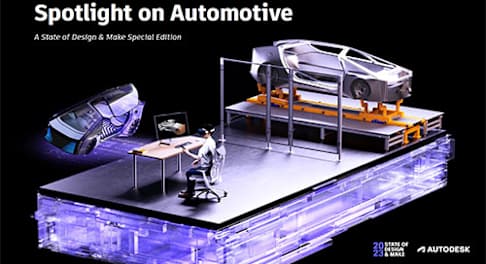
State of design and make: spotlight on automotive

State of design and make: spotlight on automotive

State of design and make: spotlight on automotive

i

Spotlight on Automotive A State of Design & Make Special Edition

1

Since its inception, the automotive industry has been driving the world forward. The widespread availability of consumer vehicles in the early 20th century changed how people lived, how cities were built, and how companies recruited workers. Today, automakers are pursuing innovations including electrification and autonomous driving, while navigating global uncertainty and responding to the changing demands of both consumers and workers.

Despite this history of evolution and adaptation, recent research shows that those working in automotive don’t believe their industry can handle change as well as others. According to data collected for Autodesk’s State of Design & Make report1 —a global survey of nearly 2,500 leaders and experts—only 44% of people in automotive and transportation agree their industry is prepared to handle global change. This is below the 49% who agree in other design and manufacturing sectors and the 52% who agree across all industries. Leaders and experts in automotive and transportation are also more likely to say that their supply chain is fragile (61%, compared to 55% in other design and manufacturing sectors).

This survey data, as well as interviews with leaders in the automotive space, show the key challenges facing the industry today, the steps companies are taking to solve those challenges, and several areas of actionable best practices. The interviews also highlight the areas where other sectors can learn from the industry.

For instance, leaders point to the use of data, a willingness to try new technologies, and the use of virtual reality in design and development as areas where the automotive sector is breaking new ground. Another area of emphasis is safety. Industry leaders pointed out that the consequences of product defects or user error can be disastrous. They also noted that

automakers have consistently made vehicles safer without compromising on performance, design, or user experience.

“The commitment of the automotive industry—to the user, to safety, to performance, to quality—is really on the highest level,” Joaquin Garcia, head of design for Italdesign says. “Some people would say that aviation is more advanced. But in terms of comfort, user experience, attention to detail, and materials, we are far ahead. The investment that the automotive industry puts into innovation is comparable to the world of electronics and the world of software.”

To stay at the forefront of innovation, leaders say, automotive companies will need to continue to embrace new technologies—including artificial intelligence and generative design. “We need to incorporate generative design and continue to speed things up,” says Amy Gile, co-founder and CEO of Silverdraft. “There’s sometimes a fear of technology putting people out of a job, but there will be new jobs.”

Pacing the field

1

1 Read the full 2023 State of Design & Make report: https://www.autodesk.com/insights/research/state-of-design-and-make/thanks

https://www.autodesk.com/insights/research/state-of-design-and-make/thanks

2

Talent, global unpredictability, and costs lead to challenges

According to survey data, the top challenges that automotive and other transportation companies face include attracting and retaining talent, responding to global events, and managing costs. These areas of concern also come up in interviews with automotive leaders, who explain these and other challenges often intersect with one another in complex ways.

For instance, A regional real estate development manager at a large car manufacturing company in Europe , says the greatest challenge facing the industry is “change,” but they note that this manifests itself in a number of ways: As automakers respond to competitive pressures, they are changing the ways that they use technology. This, in turn, changes the types of employees that companies need to hire, which ultimately leads to a change in

perspective throughout organizations. Similarly, Siegmar Haasis, founder and CEO of Haasis DEC, identifies “speed” as the top challenge facing automakers—which not only requires companies to find ways to shorten their product development cycles, but also to incorporate technologies that are evolving more quickly than the industry as a whole, and to facilitate new types of collaboration.

What are the key challenges your company or industry is facing today?

“For automotive design, this moment of learning, implementing, and experimenting with artificial intelligence is a very big challenge, but not in a negative way. Every transformation is a challenge, because at the end of the day, we are humans, and I’m responsible for our team of people. These people have to feel comfortable with the change. It’s not only a tool, but it’s also a mindset that has to change.” — Joaquin Garcia, Head of Design for Italdesign

“We have more car companies today than ever. All you need is an electric engine, and you put a body on it, and you’ve got a car. But the reality is, it has to drive on the road, it has to protect its occupants, and you have to be able to reproduce it several hundred thousand times. That may not be a challenge for the companies that are mature, but it is a challenge for all these new companies that are coming up.”

— Ehab Kaoud, Former Chief Designer for Trucks and SUVs at Ford

“One of the biggest challenges is that we are on the bleeding edge of technology. And we have to be, and we will continue to play in that space, especially when it comes to compute architecture. But clients don’t know what tools are available to them. Pain points for the clients have become part of their workflow, and they don’t even know it’s a pain point until you remove it and you’re able to show them what it is like without it.” — Amy Gile,Co-Founder and CEO of Silverdraft

0% 10% 20% 30% 40%

Attracting talent, maintaining the workforce, employee retention

Global economy, events (e.g., wars, pandemics, etc.)

Cost control, management, cost efficiences

Product/services diversification, new business lines

Business resiliency, improvng the supply chain

Product/service innovation

Data automation, technological advancement, digitization

The regulation from government and regulatory bodies

Sustainability (relating to the environment)

% of respondents reporting challenge

46%

19%

26%

27%

29%

30%

31%

40%

40%

What are the top three challenges this company faces today?

3

Increasing investments in digitization and product development

Automotive companies are proactively tackling these challenges through a number of strategic investments. Around 70% of survey respondents from automotive and other transportation industries say their companies plan to increase investments in data management and analytics, technology to deliver improved project outcomes, and the development of new products and services. In interviews, leaders say that their companies have also ramped up investments in technologies to help them achieve their goals for talent acquisition and retention, product development, and collaboration between partners.

“We’re working on getting a really good understanding of where we are as an enterprise, and deciding what to change first,” says James Bow, lead enterprise architect for digital architecture, JLR “We’re trying to move away from departments working in a siloed fashion, because that’s how manufacturing has traditionally worked: You design something, you pass it through engineering, you make it, and then you sell it. The way that digital works is a singular flow. That is challenging, because that’s a massive behavior shift to how the industry works now.”

The importance of partnerships

In interviews, automotive leaders highlight the role of partnerships—

with third-party vendors and service providers, and in some instances with other automotive companies—in helping their organizations position themselves for sustained success and ongoing innovation. In some cases, these partnerships are spurred by a need to increase capacity for technology. While these partnerships open up new opportunities, they can also create challenges of their own.

“For us, managing two different company cultures is the first big challenge,” says Taku Kono, general manager for the design and branding strategy division at Sony Honda Mobility, a partnership between two Japanese giants of electronics and automobile manufacturing, respectively. “The automotive industry and the IT industry are so different.”

“A good partnership requires shared values and complementary skills. We’ve built solid eco-partnerships over the years, and they’re still going strong. If you have good partners, you can greatly reduce the time it takes to bring a product to market.” — Matteo Barale, Co-CEO and Chief Product Officer for PIX Moving

46% of respondents say that increasing operational efficiency is a high priority

45% cite controlling and managing costs as a high priority

43% say that business expansion is a high priority

Top priorities for automotive and other transportation companies:

4

In an era defined by digital transformation, automakers have raced to implement digital tools that are dramatically transforming the design process. Digital models let teams leverage a far greater volume of data than physical models, leading to greater precision. It’s also much simpler and faster to make a tweak to a digital model than to build an entirely new physical prototype from scratch. The use of digital models even reduces the use of materials, helping companies to improve the sustainability of their operations.

“Digital transformation is key,” says Italdesign’s Garcia. “In the ideation process, in the modeling, the rendering, the animation, the communication processes—everything is now digital. Since 2015, I have only used physical models for validation, and not during design . Digital is much faster, it is much cheaper, and it is much more precise.”

These sentiments echo the feelings of other automotive leaders, who consistently report that digitization is transforming the prototyping process in ways that save both time and money. Similarly, in the survey data, respondents from automotive and transportation companies identify the top three benefits of digital transformation as reduced costs,

the ability to launch products and services more quickly, and increased innovation and better ideas.

Digital tools allow designers to cycle through more options more quickly, and without the additional per- unit expense of creating a physical prototype. Also, because digital models incorporate so much data, they offer an unparalleled level of precision. Siegmar Haasis, founder and CEO of the digital engineering consulting firm Haasis DEC, notes that the production of prototype cars have traditionally been a significant cost driver for automakers, and he says that digital twins give design teams a “head start.” Several leaders mention how digital tools have improved their time-to-market—with the typical timeline for a new product

Digital maturity leads to cost efficiencies and time savings

4

29% of respondents from automotive or other transportation companies report that their organizations are more digitally mature2

2 Defined as respondents who said their company is either approaching or has already achieved the goals of its digital transformation efforts.

5

Digital transformation: real-word results

“The increase in transparency as a result of digitization is saving up to 30% in costs – especially when working with external partners that are doing operations, that’s the buffer they’re putting on top for not knowing, that’s lack of transparency. And there’s another 5 to 10% savings when we switch suppliers every several years, and the new suppliers don’t have to re-create data that already exists.” — A regional real estate development manager at a large car manufacturing company in Europe

“We are very much focusing on development speed, especially for styling development. In our industry, car design normally started with sketches. In our company, we’re starting with 3D data from the beginning. It saves a lot of time compared to the conventional process.” — Daisuke Ishii, Head of Creative Center, Sony Group and Head of Design & Brand Strategy, Sony Honda MobilityGroup

“Speed is the big difference with digitization. We can shorten several months of steps during the design process” — Taku Kono, General Manager for the Design and Branding Strategy Division at Sony Honda Mobility

gradually shrinking, thanks in large part to technology. Others point to the way that digital tools unlock data throughout the organization, making it easier for stakeholders and boards to locate and leverage important information; and to have a real-time view of their business.

Automotive and other transportation companies were already pursuing digital transformation initiatives before 2020, but in many instances,

COVID-19 accelerated these efforts. Forced by lockdowns to send large portions of their employees home, automakers rapidly adopted new digital tools (such as real-time collaboration software) to facilitate remote work.

JLR is increasingly relying on digitization to improve transparency throughout the organization, reduce time-to-market, and unlock new revenue streams. “Only two to three

years ago, IT was very much seen as a service provider,” says Joanne Pilkington, partner domain product manager for the company.

Now, times have changed. “We’re massively shifting to digital being at the center of everything and part of all strategic decisions as we transform into a digital-first business.” Pilkington says. “I would say that ‘digital’ is now the most-used word in our business.”

52% of respondents report that digital transformation helps to reduce costs

48% say it helps to launch products and services more quickly

36% say it leads to increased innovation and better ideas

Biggest benefits of digital transformation for automotive and other transportation companies:

6

For a time, artificial intelligence (AI) in the automotive and transportation industry was synonymous in the minds of many with self-driving automobiles. However, industry leaders point to the potential of AI solutions to transform their product design workflows and other business processes.

Forty-one percent of respondents from automotive and other transportation companies say their organizations leverage internal data for collaboration with AI and automation, compared to 34% in other design and manufacturing industries. And in interviews, automotive leaders point to the potential of AI solutions to shrink product development times, automate portions of the design process, and improve manufacturing workflows. Ehab Kaoud, former chief designer for trucks and SUVs at Ford, sees AI as the

next step in the series of technologies that have already helped automakers to accelerate the product development cycle. “There is a reason why, at one point, cars took five to six years to make, and now it’s two years,” he says. “It has to do with technology. The same people are doing the same things, but with the help of technology—and now with the help of AI.”

Interviewed leaders predict that automakers, at least in the short term, will chiefly use AI design tools to

generate potential concepts, rather than to create final designs. “We can use AI systems in design, but we may still need humans to make the final decision,” says Kono. “AI is more about giving options.”

Leaders also note that while they’re still in the early stages of learning about AI tools and their capabilities, it’s important to move quickly to incorporate the technology into organizations—or risk being left behind.

“We’re bringing AI to manufacturing, we’re bringing it to design, we’re bringing it to business development,” says Matteo Barale, co-CEO and chief product officer for PIX Moving. “We’re bringing AI to everything, because if you don’t bring that inside the company, you’re done.”

6

The rise of artificial intelligence

“Designers should be able to look at outputs from AI and decide which are the best to develop. We have to find the added value of the human in this case. This is a challenge. But the first thing, for me, is learning the tool. We cannot ignore the tool, because then we will become obsolete. You can’t put your head in the sand, because when you take it out of the sand, everyone is gone.” — Joaquin Garcia, Head of Design, Italdesign

7

Upskilling in action

With the labor market extremely tight in much of the world, some automakers are turning to in-house development programs to shore up their talent gaps. JLR, for example, offers a 14-month data analytics fellowship to 400 internal employees.

“It’s one day a week for 14 months, and it’s a really rigorous course that helps attract and retain talent by upskilling people within the data analytics world,” explains Joanne Pilkington, partner domain product manager for Jaguar Land Rover. “It offers people the potential to move into data analytics from completely different areas of the business.”

Companies around the world are struggling to attract and retain talent. Even with analysts predicting imminent recessions and many of the world’s largest companies laying off workers, unemployment rates remain historically low in many countries. In the US, the unemployment rate in the transportation sector sat at 4.6% near the end of 2022, down from 6.1% the year before.3 Globally, automotive manufacturing is the largest of all manufacturing industries, accounting for 7% of all jobs in Europe alone,4 and is expected to grow at a rate of 3.7% until 2030.5

Stakeholders at automotive and other transportation companies say they are continuing to grapple with the challenge of hiring and keeping top talent. In the survey data, 82% of respondents report that their company faces difficulty finding new employees with the right technical skills (compared to 71% of other design and manufacturing respondents), and 78% say they have difficulty finding new employees with the amount of experience needed for the job (compared to 70% of other design and manufacturing respondents).

In interviews, automotive leaders tend to connect their talent challenges to the rapid pace of digitization within their

companies, noting that they are now competing with leading technology companies for software engineers. In some cases, these software teams have only existed for a couple of years, meaning that new hires are sometimes stepping into environments without established best practices and mature cultures. High turnover rates can also make it difficult for companies to develop institutional knowledge and a sense of continuity, especially in an industry where product development cycles last for multiple years. “Talking with people from automotive, we see that talent nowadays is staying with their company for maybe only one or two years,” says Barale. “The automotive timeline for a product usually is two to three years, at least. But you may see the entire team changing jobs in that span of time.”

The changing talent landscape

7

3 https://www.bts.gov/newsroom/us-transportation-sector-unemployment-rate-46-november-2022-was-below-november-2021-level 4 https://www.acea.auto/figure/employment-trends-in-eu-automotive-sector/ 5 https://www.azom.com/article.aspx?ArticleID=22236#:~:text=Current%20Global%20Market%20of%20Automotive,0.6%25%20between%202017%20and%202022

https://www.bts.gov/newsroom/us-transportation-sector-unemployment-rate-46-november-2022-was-below-november-2021-level https://www.azom.com/article.aspx?ArticleID=22236#:~:text=Current%20Global%20Market%20of%20Automotive,0.6%25%20between%202017%20and%202022 https://www.acea.auto/figure/employment-trends-in-eu-automotive-sector/

8

In the past, employees often joined a car company planning to retire with a corporate pension. However, as these sorts of benefits have been reduced or eliminated, workers in the industry are less attached to their companies. “Employees are looking for immediate gratification,” says Ehab Kaoud, former chief designer for trucks and SUVs at Ford. “They want to be managers, and they want to be seen as successful, and they want to do it right now.”

Automakers are using training programs to equip their existing employees with the skills that the company needs (see sidebar). However, it is also important for automakers to make efforts to improve their corporate cultures and ensure that they are seen as attractive places to work. In interviews, several leaders note the importance of helping employees connect their work to a “higher purpose.”

“You need to motivate people from an intrinsic perspective, so they see the benefit of what they’re doing,” noted A regional real estate development manager at a large car manufacturing company in Europe.

Asked to identify the most important technical skills for their company’s workforce over the next three years, those working in automotive and other transportation companies emphasized innovation and business development at higher rates than those in other industries. This tracks what automotive leaders say in one-on-one interviews. While certain technical skills are, of course, needed to fill roles on software development teams and other highly digitized departments, leaders say they are looking for adaptable people who are capable of keeping up with an industry that is evolving faster than ever.

“Universities can’t keep up with educating students for the current job landscape,” says Amy Gile, co-founder and CEO of Silverdraft. “At a certain point, it’s not really about the skills they’re coming to the table with. It’s about the person—their willingness to learn quickly and try things.”

Still, prospects with both automotive experience and a technology background are in particularly high demand. “If you have a combination of industry experience and digital experience, that’s really attractive,” says Joanne Pilkington, partner domain product manager for JLR. “The people that can speak both languages are going to be a really important part of our future as we reimagine luxury mobility.”

51% of respondents say the workforce is rapidly aging

44% say that their company culture is too slow to adapt to the younger generation’s needs

Talent challenges for automotive and other transportation companies:

9

0% 10% 20% 30% 40%

0% 10% 20% 30% 40%

Increasing the share of renewable energy sources used

Decreasing waste from production and/or using more recycled materials

Developed or invested in more energy-efficient processes or machinery

Helping customers decrease their carbon emissions

Designing products considering environmental impacts

Applying sustainable design principles

Developed or invested in more energy-efficient processes or machinery

Decreasing waste from production and/or using more recycled materials

The most common measures companies have already taken:

The most common measures companies plan to take:

37%

40%

40%

41%

39%

42%

42%

43%

Top sustainability measures automotive and other transportation companies

The automotive industry has an outsized impact on sustainability metrics, with transportation causing 23% of global greenhouse gas emissions.6 However, electric vehicles have made notable inroads over the past few years, and a significant share of respondents from automotive and other transportation companies see economic opportunity in sustainability. Thirty-five percent of industry respondents say that sustainability measures can eventually generate more than 10% of their company’s annual revenue, well more than the 22% of respondents across other design and manufacturing subsegments who say the same.

While electrification presents an economic opportunity for automakers, it also represents a monumental transition for the industry. “The change from the internal combustion engine to the electric vehicle is a huge revolution,” says Siegmar Haasis, founder and CEO of the digital engineering consulting firm Haasis DEC. “The entire engineering organizations at car companies have focused on combustion engines for 150 years.”

Alongside the shift to electric vehicles, respondents from transportation companies say their organizations are already taking actions to become more sustainable (such as decreasing production waste) and plan to take more in the future (such as applying sustainable design principles).

A regional real estate development manager at a large car manufacturing company in Europe, notes the importance of digitization in enabling

sustainable building design for automakers. “You can simulate before you build, trying to optimize as much as possible before you even set foot on a construction site,” they explain. “And then you build it as sustainably as possible, using green energy.”

Leaders and experts at automotive and transportation companies say they face pressure to become more sustainable from a number of sources. Eighty-seven percent say their companies face this pressure from customers, and 85% cite pressure from government regulators. “I think there is a social pressure to become more sustainable,” the leader continues. “Automakers’ standing with the next generation is not as high anymore, and it’s becoming difficult to find interns, because young people don’t want to identify with car companies. I’ve even heard of an organization declining a car manufacturer as a sponsor, because they didn’t want to have that image. That change came very quickly.”

Sustainability = economic opportunity

9

6 https://www.edf.org/issue/clean-transportation

https://www.edf.org/issue/clean-transportation

10

As the automotive sector prepares for an increasingly electric future, leaders are beginning to feel less prepared to handle global change, and are more likely to say their supply chains are fragile. To face these challenges, many are now investing in new technologies that will pave the way for more innovation than ever before.

The top takeaways leaders revealed were:

Conclusion

Challenges: The automotive and transportation industry is facing challenges with talent, the global economy, and cost control.

Investments: Most automotive companies are investing in data management and analytics, technology to deliver improved project outcomes, and the development of new products and services.

Artificial intelligence: Although still an emerging technology, AI is projected to have a significant influence on product design. Forty-one percent of industry respondents say their companies leverage internal data for collaboration with AI and automation.

Top priorities: Top priorities for most automotive companies include operational efficiency, cost management, and business expansion.

Digital transformation: Fifty-two percent of industry respondents say digital transformation reduces costs, 48% say it helps launch products and services more quickly, and 36% say it leads to increased innovation. Interviewees also cite increased transparency.

Talent: Top talent is hard to find and keep, and job roles are changing quickly. As a result, employers are looking for people with adaptable skills who are capable of continuous learning.

Sustainability: Automakers are facing pressure to become more sustainable, and they also see economic opportunity in the transition to a more sustainable business model.

1 3 6 72 54

11

The information provided in this report is for general informational purposes only and strictly for the convenience of our customers. Autodesk, Inc. does not endorse or warrant the accuracy or completeness of any information, text, graphic, links or other items contained within the report. Autodesk, Inc. does not guarantee that you will achieve any specific outcomes or results if you follow any advice in the report.

© 2023 Autodesk Inc. All rights reserved

ABOUT THE RESEARCH

The State of Design & Make report is a global, annual study for leaders who design and make places, objects, and experiences. It identifies the most pressing drivers of change that are shaping today’s business decisions to help leaders prioritize and invest in the future.

Autodesk partnered with Ipsos, a leader in global research and insights, to survey and interview 2,565 leaders, futurists, and experts in the architecture, engineering, and construction (AEC); design and manufacturing (D&M); and media and entertainment (M&E) industries.

Read the full State of Design & Make report including all glossary terms and research insights here: https://www.autodesk.com/state-of-design-and-make-2023.

Spotlight on Automotive focuses on the quantitative data from professionals in automotive, aerospace, and other transportation (n=124). In addition, 11 qualitative interviews of business leaders in the automotive industry were conducted in May 2023.

The quantitative data was collected between October and December 2022, through a 20-minute online survey, including responses from Australia, China, India, Japan, South Korea, France, Germany, Italy, the Netherlands, Sweden, the United Kingdom, Canada, and the United States.

THANK YOU

Matteo Barale, Co-CEO and Chief Product Officer, Pix Moving

James Bow, Lead Enterprise Architect for Digital Architecture, Jaguar Land Rover

Joaquin Garcia, Head of Design, Italdesign

Amy Gile, Co-founder and CEO of Silverdraft Siegmar Haasis, Founder and CEO, Haasis DEC – Digital Engineering Consulting; former CIO of R&D for Mercedes-Benz

Daisuke Ishii, Head of Creative Center, Sony Group and Head of Design & Brand Strategy, Sony Honda Mobility

Ehab Kaoud, Former Chief Designer for Trucks and SUVs, Ford

Taku Kono, General Manager for Design and Branding Strategy Division, Sony Honda Mobility

Joanne Pilkington, Partner Domain Product Manager, Jaguar Land Rover

ABOUT AUTODESK

Autodesk is changing how the world is designed and made. Its technology spans architecture, engineering, construction, product design, manufacturing, and media and entertainment, empowering innovators everywhere to solve challenges big and small. From greener buildings to smarter products to more mesmerizing blockbusters, Autodesk software helps customers design and make a better world for all. For more information, visit autodesk.com or follow @autodesk on social media.

Contact Autodesk at state.of.design.and.make@autodesk.com about this research report or to sign up to participate in future research programs.

https://www.autodesk.com/state-of-design-and-make-2023 mailto: state.of.design.and.make@autodesk.com www.autodesk.com


Item Type: pdf