「行业电子书」移动出行的新形态
对小型电动汽车的需求不断增长,30%的消费者计划利用微型交通工具。在这十年里,46%的人愿意用其他交通方式取代私家车。 2022年至2030年,仅电动摩托车市场的复合年增长率预计就将达到10.2%。 此外,对汽车和更广泛的基础设施的投资平均每年将达到3.4万亿美元,这增加了消费者的信心。 那么,什么能给那些投资电动汽车的人带来好处呢?
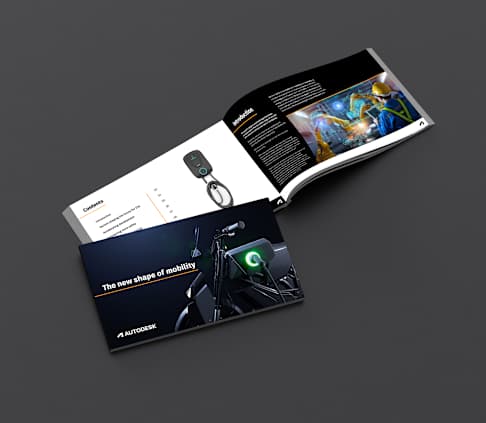
The new shape of mobility
Contents
Introduction
Factors shaping the future for EVs
Accelerating development
Engineering more safely
Maximized manufacturing
Scaling up to meet demand
Managing today and tomorrow
Ready when you are
03
04
05
06
07
08
09
11
2
Introduction
The world’s largest automobile manufacturers are planning to offer the widest range of low and zero-emission vehicles ever seen in the market.
Meanwhile, many oil companies are expanding and extending the infrastructure needed to charge up new EVs, and remove their drivers’ range anxiety.
But the electric passenger car isn’t the only area of opportunity.
While many consumers are planning a plug-in charge point on their driveway, what about the millions who live in apartments, or other buildings of multiple occupation? They too desire a sustainable form of transport—but of a more manageable size. And, as the gridlock in our cities continues, could future EVs even take to the air?
There is space for all kinds of mobility in the market—for two- or three-wheeled EVs that take you to work. For autonomous vehicles that come to your home. For heavy duty EVs that cross the world. Which means business opportunities for manufacturers large and small. Especially as digital solutions are making traditional problems such as huge development costs more manageable, and new innovations are constantly bringing times-to-market down further.
Whether you’re a big, established manufacturer diversifying into alternative powertrains or even a completely different vehicle segment, or a small start-up in micro- or minimobility or large commercial EVs, this eBook will help you explore the advances that could accelerate your growth (and the issues that could put the brakes on it). And discover how a successful future is about developing key digital capabilities over time.
3
Factors shaping the future for EVs
4
The future is all about numbers. Keeping the rise in global temperatures to 1.5°C (34.7°F). Numbers 7, 11, 12 and 13 of the United Nations’ 17 Sustainable Development Goals*. C40—mayors of the world’s leading cities, uniting to confront climate change. The EU’s aim to make Europe climate neutral by 2050.
A key factor in making those numbers work will be a switch from internal combustion engines (ICEs) to electric vehicles (EVs). And for companies looking to enter or diversify into the EV market, there are some equally compelling figures.
Rising demand for smaller electric vehicles is such that 30% of consumers plan to leverage micromobility this decade, with 46% open to replacing a private vehicle with other modes of transport. Between 2022 and 2030 the electric motorbike market alone is projected to have a compound annual growth rate of 10.2%. Plus, investment into vehicles and the broader infrastructure is set to average $3.4T a year, adding to consumer confidence.
So, what could put a spoke in the wheels of those investing in the EV mobility?
While the opportunities are clearly visible, there are barriers. Research and development costs. Physical prototyping and long lead times to market. Government regulations, particularly those associated with vehicle safety, factory emissions and waste. Supply chain disruption due to political and economic factors.
The graphic illustrates many of the major challenges you may be trying to solve across the product development lifecycle.
Even if you’ve already invested in the solutions to speed these processes, you may, like many manufacturing companies, be currently stretched to breaking point, managing a mixture of analogue and digital information, or incompatible digital data. Some firms are being slowed down by teams working in silos, unable (or unwilling) to collaborate. Others are dealing with manual systems or outdated and highly customized production lines originally designed for ICEs.
The EV sector, however, is one borne out of technology. And it may be technology that plays the biggest role in helping the sector develop and grow.
In the next few pages, we’ll look further into the ways that you can develop your capabilities through digitalization, to ensure that you not only overcome the barriers just discussed, but are equipped and ready to capture the opportunities.
Data Whole lifecycle Continuous innovation Risk
Cost Weight / space Performance Safety Reliability
New markets /new regulations New facilities & infrastructure expansion Supply chain resilience People & skills
Facilities & infrastructure Supply chain Production costs Quality
Smarter more multi disciplinarily systems Collaboration across industries
Accelerating development
5
Creating a vehicle from scratch using traditional methods makes for one epic journey. The automotive design process goes through many stages of product design, starting from concept sketching, physical modeling, reverse-engineering the physical model, visualization, and physical and digital prototyping, using different software and different methods in each phase. By the time you’ve done all that, your competitors will have potentially beaten you to market.
Increasing your digital capabilities will dramatically speed up your end-to-end design workflow.
Historically, clay modeling has been the way to visualize Class-A surfaces—those the end user sees and touches— which is why it was such an important stage in traditional design workflows. Some automotive companies use up to 100 tons of clay each year. Much of that is not recycled. Digitalization delivers modeling capabilities that significantly reduce the need for expensive and time- consuming clay models. Realistic-looking 3D models can be developed from product sketches, cutting time and costs. Plus, with sub-division modeling, iterating
on design forms and controlling highlights on everything—from the bodywork covering electric motors on two-wheeled machines, to the interior surfaces in micromobility applications—is faster and easier too.
Design and development can be further accelerated through the creation of a digital twin. Using this virtual replica, designers can experiment with different designs quickly and cheaply, while engineers can simulate the behavior of the vehicle or individual components under a variety of conditions. Best of all, once the EV is in production and on the road, the digital twin can collect and process data from various sensors, allowing performance to be monitored. This makes it easier to identify areas for improvement, and ultimately, warn of component failures before they happen.
The development process can be speeded up even more using a suitable data management solution. Because manufacturers have to juggle multiple CAD systems as they move from design concept to Job 1, the potential for confusion and delay-inducing data loss is huge. The right solution can integrate all those systems, breaking down collaboration barriers, yet keeping teams working in the tools they know and love. The clay model for the Ford Raptor
required 1,935 pounds of clay and 20,000 hours modelling time**.
Engineering more safely
6
New sectors come with new challenges. One of the biggest for the EV sector is surely the constantly changing guidelines, rules and regulations. The answer to keeping pace with changing government and customer requirements used to be investing hugely in R&D facilities, or the costly construction of multiple prototypes for testing. An option now thankfully replaced with simulation tools.
Physically prototyping every design option is limiting. Time, cost and output constraints will see to that. Simulation tools not only answer key questions in the design stage, they can also ensure the manufacturability of parts. Through simulation, designers can explore far more options, and experiment with multiple variants and materials—all before you commit to investing in tooling and manufacturing processes.
One example is ensuring the safety of peripherals such as on-board chargers.
Most chargers contain a combination of mechanical, electrical and software components. This makes them particularly challenging to manufacture. With totally
different heat loads than ICE parts, on-board chargers (OBCs) need to be located and controlled in a specific way to achieve the required kilowatts, while keeping the temperature of certain components under tolerance—key to both performance and safety. (An OBC will need to meet the IP65 regulatory standards, requiring complete protection from dust, oil, water, and other corrosive materials.)
That means experimenting with different outer casings, fans, etcetera, and observing the effects of heat dissipation, differences in heat distribution, and other temperature- critical issues. Imagine the cost and time involved in creating all those physical prototypes.
Yet with tools such as computation fluid dynamics (CFD) software, not only can physical prototypes be dramatically reduced, but critical design decisions also influencing energy consumption, risk of component failure and extension of operational life can all be made faster, reducing costs, further.
Prototyping and fabricating has also traditionally involved teams moving back and forth between 3D modeling, simulation and electronics tools, to produce multiple iterations before arriving at the best design. Multiple software systems limit communication between teams too, especially between internal engineers and external contractors.
Now, through integrated, cloud-based CAD CAM CAE and PCB tools, prototyping and fabricating can be a seamless, connected process.
From designing electronic circuits to generating toolpaths for additive, subtractive and hybrid manufacturing, integrated systems allow teams to work faster without compromising quality. And to spend less time switching between systems, and more time for the things that keep an EV firm ahead of the game—experimenting and innovating.
Maximized manufacturing
7
When it comes to mobility, ICE and EV companies still share some common ground. Both rely on a robust supply chain for essential parts, with the bulk of investment going into designing the complex, sometimes large and often critical components, assemblies and systems.
Take for example, the most essential component of a 3- or 4-wheeled vehicle—the chassis (or in the case of 2-wheeled mobility, the frame). Such is the expense of designing and developing a chassis that, for years, even the major manufacturers have shared platforms and architectures—designing their own body, then bolting it onto a common chassis.
For such an integral component needing strength and rigidity, how could it meet today’s demand for products that customers can customize to their own specification, yet still be mass-produced?
The cost-effective answer is AI-powered generative design. Major components (or smaller products) developed this way harness AI to quickly calculate the most optimized design, depending on the specific outcomes and attributes
you wish to achieve. By combining generative design with other hybrid digital manufacturing technology such as metal 3D printing and machining, companies can produce a near-unlimited variety of customized frames, platforms and vehicles, with much shorter lead times (not to mention reduced materials waste). Algorithms can produce several geometry outputs, giving the customer the flexibility to stay close to the original design, or push their imagination as far as the parameters allow.
Plus, as indicted earlier, gen AI is equally advantageous in the design and manufacture of smaller (yet equally critical) components. One prime example is a major manufacturer recently developing a new seat belt bracket. The design brief was to replace an 8-part welded bracket with a single-piece, 3D-printed bracket. Using generative AI to create the new part, not only was it 40% lighter than the original component, it was also 20% stronger.
Of course, generative AI is just one way of maximizing the manufacture of EVs in one area of production. To truly level up your manufacturing operation, the next thing to explore should be the digitalization of your entire factory…
Scaling up to meet demand
8
The factory where you manufacture your products is bound to be your biggest investment. A building borne of multiple disciplines. External building teams and project coordinators. Production line planners, manufacturing engineers and the production people themselves. Not to mention IT experts and facilities engineers to keep the lights on and everything moving as planned.
Once designed and built, and your production line moving, it’s simply not economically viable to change it. But in the fast-paced, ever-changing EV market, the need to re-engineer your factory could go from frequent to almost continuous.
That will mean having to re-brief planners and designers, many working in silos, some using different software and their own custom processes, others working with outdated data in complex legacy systems. Together, this makes the process of re-engineering both slow and costly.
Then, once you’re up and running, the market could shift and you may need to start all over again.
Now re-imagine that nightmare scenario with a different factory, built on exactly the same footprint. But here everything—building, factory floor, packaging facilities—and everyone—factory floor personnel, suppliers, distributors— is integrated. This enables the creation of a flow of connected data, essentially turning your factory into a source of intelligence. One you can use to help you quickly respond to market changes, or to automate processes further. One that can predict issues and maximize efficiency across your entire operation.
This is the digital factory, where bottlenecks are eliminated, where adding features to existing products is simplified, and where supply chain disruption can be factored in.
Cloud-based connected solutions are fast-becoming the standard in constructing the built environment by streamlining the entire construction process from planning to design to operation—even to the disposal of every brick, pipe or pane of glass at the end of the building’s lifecycle.
Using a cloud-based model, the highest level of flexibility can be designed into the factory and all design teams, contractors, engineers, and stakeholders are connected throughout the process. Errors can be detected early and the time for design and construction is significantly reduced. Once up and running, the model can then be copied if more factories are planned.
Using this process, one German electric car company saved up to 35% of overall costs††.
This methodology is also the ideal construction tool for EV infrastructure. As modern construction looks to pre-fabrication as a way of building more efficiently, more sustainably and for lower cost, companies are already looking to accelerate the standard charging point to the next level. One European manufacturer has already taken onboard the idea that customers living in apartments may not be able to charge their EV at home. By creating central urban charging ‘hubs’ around a physical building, owners of the manufacturer’s EVs can plug in their car, then use the environment and its facilities to relax with a coffee, shop online, or enjoy other experiences.
30% of consumers plan to leverage micromobility this decade†.
Managing today and tomorrow
9
Like it or not, it’s a hybrid working world. While people on the production line generally need to be physically present to do their job, design teams have more flexibility, thanks to the tools now available to them. Plus, as automation continues to grow apace, the number of workers on the factory floor will continue to fall.
Yet everyone involved in the design, manufacture, sales and supply of your mobility-based product can be more collaborative and connected than ever before.
As technology has progressed, it’s unsurprising that different disciplines at different manufacturers have chosen to use different programs, software solutions and so on. Now though, thanks to APIs, cloud-based computing and the ability to connect data environments, your teams can collaborate in ways never thought possible only a few years ago. Today, they can preview every angle of every machine or component in an assembly line, months before it’s complete. They can collaborate in detail with colleagues to refine designs from their living room sofa.
Customers and clients no longer need to visit your factory to see how the products you’re making for them are progressing. Through meetings via immersive AR and VR, customers can review and approve product designs remotely, feeding back fast to keep the project on schedule.
And this is not some future dream. For the story of how one automotive company has already embraced many of the advances talked about in this eBook, head to the Jendamark case study.
In the digital factory, everything and everyone—building, factory floor, personnel, suppliers—is integrated, turning your factory into a source of intelligence.
Revolutionizing assembly line design
10
With a presence in South Africa, India, and Germany, Jendamark specializes in automotive assembly systems. Every project the company takes on is unique. This creates a constant need for its teams to deliver customized high-precision manufacturing solutions on tight schedules. With teams located in different countries, many working remotely, collaboration was tricky, and this had a negative impact on the design revision process and thus, ultimately, on delivering against those tight deadlines.
The onset of the pandemic, however, prompted Jendamark India to accelerate its plans for digital transformation.
Investing in its digital capabilities has enabled the company’s teams to work from home without compromising project timelines. Even the most remotely located team members can now control all design data in one location, so they can keep revision histories intact, lock approved designs, and reuse previous designs.
Jendamark’s designers can just as easily collaborate with customers—gaining quicker input from multiple stakeholders, resolving ergonomics issues, optimizing line layout, and obtaining faster sign offs—to make design modifications before manufacturing begins. According to India CEO, Himanshu Jadhav, the changes have helped improve individual as well as team productivity in the overall project life cycle.
Another game-changing part of their digital transformation has been incorporating virtual and augmented reality solutions into the design process. Sophisticated VR product visualization enables the team to demonstrate innovative machine designs more effectively to customers.
VR gives Jendamark an edge in working with customers. “We won a prestigious project to design and manufacture a futuristic engine line,” explains CEO, Jadhav. Using a VR setup to present machine designs helped speed up design approvals and reduced rework, saving time and money. Plus, as Jadhav puts it, “The customer’s own experts were awestruck when they experienced this virtual design approval system.”
In addition to improving productivity, reducing unforeseen redesign costs, and improving remote collaboration, Jendamark India’s digital transformation has also enabled the team to take steps towards a broader company vision—creating a unique brand identity.
Our digital journey has helped solidify our position as a tech-savvy manufacturing company,” Jadhav says. “Today, Jendamark is a trusted brand in an ecosystem of clients and partners…
Ready when you are
11
Meeting the opportunities in EV mobility, head on, could involve your company transforming itself to become more agile during development and efficient in operations. To do more with less, especially when it comes to resources.
Digital transformation, however, can sound like an overwhelming task that will take more time, people, and investment than most companies have at this moment.
But it’s not something that you have to embrace all at once. Because it’s not just about technology, it’s a journey that’s built on developing capabilities. Autodesk are here to help you start that journey, and at any point on it that you choose.
The solutions talked about in this eBook are designed to keep you ultra-competitive, iron out operational inefficiencies, customize at scale, and reduce waste, costs, and time to market.
And to help you simultaneously meet the challenges you face today while leveraging the opportunities arriving tomorrow.
See Autodesk solutions for Mobility and Transportation here
Contact Autodesk to start the conversation.
*7. Affordable and Clean Energy, 11. Sustainable Cities and Communities, 12. Responsible Consumption and Production, 13. Climate Action.
**https://media.ford.com/content/fordmedia/fna/us/en/news/2016/10/17/molding-a-more-sustainable-future--how-ford-recycles-clay-to-red.html
† Source tbc
††https://www.autodesk.com/design-make/articles/modern-factory-design
https://www.autodesk.com/industry/automotive