Read our Digital Maturity for Utilities eBook
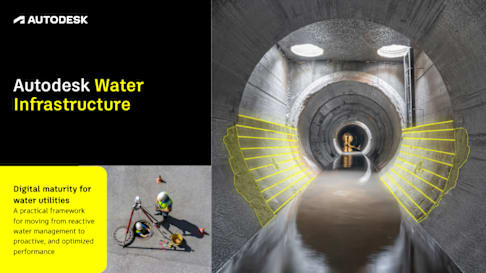
Autodesk Water Infrastructure
Digital maturity for water utilities A practical framework for moving from reactive water management to proactive, and optimized performance
Autodesk Water Infrastructure: Digital maturity for water utilities 2
Contents Introduction 04
Chapter 1 – Why being digitally mature matters more than ever 07
Chapter 2 – The digital maturity framework for water utilities 12
Chapter 3 – Case studies: Digital maturity in action 19
Chapter 4 – What’s next in your journey 23
Conclusion – Move forward with clarity and confidence 25
Autodesk Water Infrastructure: Digital maturity for water utilities 3
What this e-book delivers This e-book provides a practical, outcome-focused view of how a roadmap towards maturity helps utilities respond with greater clarity and confidence.
Inside, you’ll find:
• �A clear view of the pressures shaping water utilities today
• �A practical definition of digital maturity— and Autodesk’s role in the journey
• �A 5-stage digital maturity framework to assess current capability and guide progress
• �Key outcomes utilities can achieve at each stage
• �Guidance to connect next steps to measurable value
Who this is for
This e-book is designed for water professionals who are responsible for improving performance, managing risk, and guiding investment decisions.
This includes:
• Utility Executives
• Operation & Maintenance Leaders
• Engineering & Planning Teams
• Innovation & Digital Leaders
• Asset Management Professionals
It is most relevant for teams working across:
• �Water, wastewater, and stormwater management and operations
• Asset management and capital planning
• Digital, data, and technology strategy
• �Engineering consulting and infrastructure delivery
The question is no longer whether digital transformation will happen, but how it can be applied to deliver operational value.
“
Introduction
Autodesk Water Infrastructure: Digital maturity for water utilities 4
Today’s water utilities are facing a new reality Water utilities are operating under increasing pressure to improve performance, manage risk, and deliver measurable outcomes.
Aging infrastructure.
Climate volatility.
Workforce transitions.
Heightened regulatory expectations.
Utilities are being asked to modernize critical assets, maintain reliable service, reduce environmental impact, and demonstrate measurable return on investment—often with constrained budgets and limited staff.
At the same time, digital transformation is accelerating across infrastructure sectors. In water, the question is no longer whether digital transformation will happen, but how it can be applied to deliver operational value.
Utilities continue to generate increasing volumes of data. Yet much of that data remains unused or fragmented across systems and teams—limiting visibility, slowing decisions, and increasing operational risk.
Autodesk Water Infrastructure: Digital maturity for water utilities 5
The data paradox Utilities are generating more data than ever before—but more data alone does not create better outcomes. When information lives across disconnected systems, teams face fragmentation, duplication, and limited visibility.
Having one source of truth and systems that work together helps turn complexity into reliability and transparency—so stakeholders can collaborate effectively, reduce rework, and make informed decisions across the asset lifecycle.
When utilities solve inconsistency effectively, they do more than streamline work. They build a data foundation that supports better decisions, more reliable service, and stronger operational performance. Utilities with traceable information are better equipped to demonstrate progress and support accountability with regulators, investors, partners, and the public.
Digital capability, built deliberately over time, is becoming a key driver of organizational credibility and trust.
“
Autodesk Water Infrastructure: Digital maturity for water utilities 6
Progress starts where you are Digital maturity is a utility’s ability to use connected data, systems, and workflows to make better operational decisions and improve outcomes over time.
It is not about adopting a single tool or chasing the latest trend. It is about building the operational capability to move from reactive decisions to more connected, proactive, and predictive performance.
The journey toward stronger capability starts from where you are today.
Utilities that advance in their journey can achieve:
• Greater operational visibility across systems
• More confident, risk-informed decisions
• Reduced exposure to service and compliance risk
• Improved regulatory performance
• Stronger cross-team alignment
• Clearer return on technology investments
Autodesk helps water utilities assess their current digital capability, identify practical next steps, and connect the data, models, and workflows needed to improve performance over time.
Autodesk Water Infrastructure: Digital maturity for water utilities 7
Chapter 1
Why being digitally mature matters more than ever From reactive to proactive and predictive.
Many utilities have invested in digital tools, but when systems remain disconnected, it limits visibility, coordination, and the ability to turn data into meaningful action.
As digital capability advances, operations become more aligned and forward-looking—enabling a shift from reactive response to more proactive, data-informed decision-making.
This progression is not a binary state. Utilities build capability over time as data, systems, and workflows become more connected and technologies and solutions are being used in their full capacity. For utility leaders, the challenge is not whether to invest in digital tools, but how to ensure those investments deliver measurable operational value, improved performance, and clearer return on investment over time.
Autodesk uses a five-stage framework to help utilities assess current capability, align investments to outcomes, and identify the next practical step forward as digital maturity evolves.
• �Foundational: Manual processes and fragmented data limit visibility and consistency
�• �Emerging: Digital tools deliver value within functions, but systems remain disconnected
• �Integrated: Systems and data begin working together, improving visibility and coordination
�• �Intelligent: Predictive models and analytics support more proactive, risk-informed decisions
• �Adaptive: AI-assisted analytics and continuous learning environments enable real-time responsiveness and ongoing operational improvement.
Foundational > Emerging > Integrated > Intelligent > Adaptive
Autodesk Water Infrastructure: Digital maturity for water utilities 8
Stronger capabilities. Stronger decisions. Better outcomes. As utilities progress across these stages, data becomes more accessible, connected and actionable—enabling stronger collaboration, more advanced analytics, and more confident decision-making.
This progression supports the adoption of cloud-enabled workflows, predictive modeling, and digital twin capabilities, helping utilities improve performance, reduce risk, and maximize the return on their digital investments.
When capability strengthens, utilities can:
• Take a more proactive approach to operations
• Detect anomalies earlier
• Model scenarios before implementing changes
• Forecast demand and capacity impacts
• Prioritize maintenance based on risk
• Align capital planning with operational insight
Autodesk Water Infrastructure: Digital maturity for water utilities 9
Turning technology into operational value Building the foundation for connected, data-driven operations.
A utility may implement advanced modeling software, deploy new sensors, or migrate systems to the cloud. These are important steps—but value is realized when data is securely collected and systems work together to increase visibility, reduce risk, and enable more confident, data-driven decisions.
Strengthening digital capability requires alignment across:
• �People: Skills, training, cross-functional collaboration, and change readiness
• �Process: Standardized workflows, clear decision frameworks, and defined accountability
• Data: Accurate, accessible, interoperable, and trusted information
• Technology: Integrated, secure, and scalable systems
• �Governance: Clear ownership of data, along with standards for quality, security, and access
Autodesk Water Infrastructure: Digital maturity for water utilities 10
Progress happens in stages Progress towards maturity happens in stages, with each stage unlocking capabilities that enable the next. At early stages, utilities may rely on manual processes and siloed records. As capability grows, data becomes more structured and accessible.
Over time, more advanced capabilities—such as digital twins, AI-assisted analytics, and cloud-enabled collaboration—become sustainable. This allows utilities to anticipate risk, optimize resources, and improve service reliability.
Systems begin to connect.
Visibility improves.
Decisions become more
aligned.
Predictive capabilities
emerge.
The goal is not to accelerate to a point on a chart, but to build capability deliberately.“
Autodesk Water Infrastructure: Digital maturity for water utilities 11
Progress also happens across the full water lifecycle:
A utility may be more advanced in some areas than others. What matters is understanding where capability exists today— and where focused progress can deliver the greatest operational and financial impact.
The framework in the next chapter provides a structured way to assess current capability and identify the most valuable next step forward.
The end-to-end journey
Raw water and source management
Improved source reliability and water quality monitoring
Stormwater and flood management
Better preparedness for extreme weather
events and moving from reactive emergency
response to proactive risk management
Treatment plant operations
Lower energy and chemical
costs, reduced compliance risk
Wastewater and collection systems
Reduced overflow risk and improved
compliance confidence
Asset management (embedded across all areas)
More defensible and effective capital
planning
Water distribution
Real-time visibility into pressure, flow,
and asset performance across the distribution
network
Autodesk Water Infrastructure: Digital maturity for water utilities 12
The digital maturity framework for water utilities 5-stage framework overview
Utilities do not become digitally mature all at once. Progress unfolds in stages, when data is more reliable, workflows are more connected, and visibility and collaboration increase across teams.
Autodesk explains this progression through the Digital Maturity Framework and provides a practical way to assess current capability and identify the most valuable next steps. The framework defines five stages of digital maturity:
Used effectively, it becomes more than an assessment tool, providing a shared language for progress and helping utilities understand where they are, what matters most, and how to move forward with confidence.
This framework helps utilities:
• Understand current capabilities with clarity
• Identify gaps and prioritize high-value opportunities
• Align teams around shared priorities
• Define measurable outcomes before investment
• Benchmark performance against peers
• Build confidence with boards, regulators, and funding partners
Chapter 2
Foundational > Emerging > Integrated > Intelligent > Adaptive
The 5-stage digital maturity framework
Bu
si ne
ss v
al ue
Digital maturity
Autodesk Water Infrastructure: Digital maturity for water utilities 13
Foundational The starting point for most utilities. Essential services are delivered, but systems and workflows are largely manual and disconnected with limited visibility.
3
5
4
Adaptive AI-assisted analytics, digital twins, and continuous learning environments enable real-time responsiveness and ongoing operational improvement.
2
1
Integrated Systems and data begin to work together. Cross-functional visibility improves and planning and operations become progressively more aligned.
Emerging Digital tools begin delivering value within defined workflows, but systems operate largely independently and insight does not yet flow across teams.
Intelligent Forecasting, scenario modeling, and advanced analytics inform proactive decision-making—enabling utilities to anticipate and mitigate risk.
Autodesk Water Infrastructure: Digital maturity for water utilities 14
Stage 1: Foundational
Digitizing core processes and establishing baseline visibility
Stage snapshot At the Foundational stage, utilities rely heavily on manual processes and fragmented data. Information is often difficult to access, inconsistent across systems, and dependent on individual knowledge.
Typical characteristics:
• �Paper-based workflows or isolated digital records
• Limited, or no, system integration
• Reliance on individual expertise
• Inconsistent data quality
If utilities stay stuck here:
• �They face limited visibility across operations
• They rely on reactive response to issues
• �They experience knowledge silos and workforce dependency
Practical next steps:
• Standardize data collection and workflows
• Digitize key records and processes
• Establish baseline data governance
What this unlocks
Establishing consistent, accessible data creates a more reliable operational baseline— improving visibility, reducing reliance on individual knowledge, and enabling more consistent decision-making.
Establishing digital consistency with Autodesk
How Autodesk helps Autodesk helps utilities replace manual, disconnected processes with more consistent digital workflows and better-structured data.
Autodesk helps utilities:
• Digitize key modeling, asset, and operational records
• Standardize workflows and improve data consistency
• Create a more reliable foundation for reporting and decision-making
• Reduce dependence on paper-based processes and individual knowledge
Autodesk Water Infrastructure: Digital maturity for water utilities 15
Structuring early digital adoption and improving consistency
Stage snapshot At the Emerging stage, utilities begin implementing digital tools within defined workflows. Early progress improves data capture and process consistency, but systems and teams often remain only partially connected.
Typical characteristics:
• �Adoption of modeling, monitoring, or asset systems
• �Improved data capture within specific functions
• Early process standardization
If utilities stay stuck here:
• Systems may remain siloed
• �There is limited cross-functional visibility
• �They face difficulty scaling digital practices
Practical next steps:
• Expand system use across teams
• Improve data consistency
• Begin connecting key workflows
What this unlocks
As digital tools begin supporting defined workflows, utilities gain more informed planning, fewer operational surprises, and more repeatable processes.
Expanding and standardizing digital adoption with Autodesk
How Autodesk helps Autodesk helps utilities expand early digital success by making workflows more repeatable, data more consistent, and reporting more structured.
Autodesk helps utilities:
• Strengthen modeling, monitoring, and asset workflows within key functions
• Improve data consistency and reporting across teams
• Support more informed planning and prioritization
• Begin connecting workflows that are still operating in silos
Stage 2: Emerging
Autodesk Water Infrastructure: Digital maturity for water utilities 16
Integrating systems and improving collaboration with Autodesk
How Autodesk helps Autodesk helps utilities integrate systems and data to enable shared visibility and more coordinated decision-making.
Autodesk helps utilities:
• �Run cloud-enabled simulations to evaluate scenarios faster and support coordinated decisions
• Connect modeling, asset management, and GIS systems
• Improve visibility across teams through shared dashboards and reporting
• Strengthen interoperability to better align planning and operations
Stage 3: Integrated
Connecting systems and aligning data across teams
Stage snapshot At the Integrated stage, systems begin to connect and data becomes more accessible across the organization.
Typical characteristics:
• �Integration across key systems (e.g., GIS, modeling, asset management)
• Shared data environments
• Improved cross-team collaboration
If utilities stay stuck here:
• Integration becomes harder to manage
• Data quality and governance gaps grow
• Teams stay misaligned across workflows
Practical next steps:
• Expand integration across key operations
• �Strengthen governance and cloud readiness
• �Align planning, operations, and data workflow
What this unlocks
As systems integrate, utilities achieve faster decision-making, improved coordination, and stronger lifecycle alignment across teams.
Stage 4: Intelligent
Autodesk Water Infrastructure: Digital maturity for water utilities 17
Enabling predictive, model-informed decisions with Autodesk
How Autodesk helps Autodesk helps utilities move from shared visibility to earlier action by applying live data, forecasting, and analytics to decision-making.
Autodesk helps utilities:
• Calibrate models using live operational and sensor data
• Prioritize maintenance and investment based on risk
• Improve scenario planning for climate variability and demand forecasting
• �Enable real-time monitoring and anomaly detection across the network
Applying predictive insight to improve planning and operational performance
Stage snapshot At the Intelligent stage, utilities move from integrated visibility to advanced insight—using data, models, and analytics to anticipate risk and support more proactive decision-making.
Typical characteristics:
• Forecasting and scenario modeling
• Risk-based asset prioritization
• �Integration of operational data into models
• Advanced analytics workflows
If utilities stay stuck here:
• �Predictive insights may exist, but without greater automation, teams still rely too heavily on manual intervention
• �Value from connected data can plateau, making it harder to scale efficiency gains across the utility
• �Advanced analytics may identify issues faster, but slower execution can limit operational impact
• �Utilities risk falling short of a truly adaptive, resilient operating model that can respond in real time
Practical next steps:
• Automate high-value workflows
• Connect insights to action
• �Strengthen governance and change management
What this unlocks
Utilities at this stage gain augmented decision support—enabling more proactive risk management, optimized resource allocation, and greater confidence in planning and investment decisions.
Autodesk Water Infrastructure: Digital maturity for water utilities 18
Enabling continuous optimization and adaptation with Autodesk
How Autodesk helps Autodesk helps utilities improve performance by connecting live data, analytics, and automated workflows across the water lifecycle.
Autodesk helps utilities:
• Integrate operational data into adaptive digital twin environments
• Automate alerts and support AI-guided workflows across operations
• Scale cloud-based simulation, modeling, and collaboration
• Continuously refine models using real-time information
Stage 5: Adaptive
Enabling continuous optimization and real-time operational responsiveness
Stage snapshot At the Adaptive stage, utilities establish continuously improving operational environments— where data, models, and workflows evolve together to support ongoing optimization.
Typical characteristics:
• �AI-assisted analytics supporting optimization
• �Automated alerts and guided response workflows
• �Regular, recurring feedback between data, models, and operations
• �Cloud-enabled scalability across domains
Practical next steps:
• �Embed AI-assisted workflows into operations
• �Continuously refine models with real-time data
• �Shift from periodic improvement to ongoing adaptation
What this unlocks
At this stage, utilities achieve more optimized operations and real-time responsiveness, supported by predictive insight and continuously improving data and models.
Autodesk Water Infrastructure: Digital maturity for water utilities 19
Chapter 3
Digital maturity in action Digital maturity develops over time as utilities strengthen visibility, connect systems, improve decision-making, and apply digital tools to real operational challenges.
The following case studies highlight how Autodesk supports utilities as they build digital capability—helping them connect data, improve visibility, and make more informed decisions across the water lifecycle.
Autodesk Water Infrastructure: Digital maturity for water utilities 20
SA Water Adelaide, South Australia Live operational modeling for faster, more informed network decisions
The challenge SA Water delivers water and wastewater services to more than 1.8 million South Australians across a large and operationally complex network. As infrastructure expanded and customer service demands increased, the utility needed a better way to understand live network conditions, respond faster to incidents, and support more confident operational decisions across its Operational Control Centre.
How Autodesk helped SA Water implemented live hydraulic modeling powered by Autodesk IWLive Pro, with offline scenario analysis in InfoWorks WS Pro. By integrating real-time operational data into a live network model, the utility gained a dynamic view of how the system behaves under actual conditions. This allows operators to monitor system performance in real time, test shutdown and outage scenarios safely offline, evaluate alternative supply routes, and anticipate the impact of operational changes before they are made.
The outcome By combining real-time visibility with scenario testing, SA Water has strengthened operational resilience and improved coordination between planning and operations. The utility reports faster, more confident decision-making, fewer supply interruptions, and stronger coordination between field operators and OCC teams. The live model has also helped SA Water respond during drought- related demands by identifying temporary water fill points with adequate pressure, safe access, and minimal impact on broader network performance.
Why it matters SA Water shows how Autodesk solutions can help utilities move beyond static planning models toward more proactive, risk-informed network operations— improving service reliability while building confidence in day-to-day operational decisions.
Live modeling gives us the ability to see what’s happening now and what’s likely to happen next.
— �Oras Abbas, Network Operations Modeling Engineer, SA Water
“
https://www.autodesk.com/products/iwlive-pro/overview https://www.autodesk.com/products/infoworks-ws-pro/overview
Autodesk Water Infrastructure: Digital maturity for water utilities 21
A digital twin allows us to better understand our system and make more informed decisions.
— �Ignacio Casals, Director of Innovation, Aguas de Alicante
“
Aguas de Alicante Alicante, Spain Digital twin-enabled planning and resilience across the water cycle
The challenge Aguas de Alicante manages the integrated water cycle for Alicante and surrounding municipalities and has made digital transformation a strategic priority to strengthen resilience, improve planning, and support more informed decision-making. With growing infrastructure demands and increasing climate uncertainty, the utility needed a more connected way to use data across water supply, wastewater, and flood risk management.
How Autodesk helped At the center of Aguas de Alicante’s approach is a hydraulic digital twin supported by Autodesk InfoWorks WS Pro and InfoWorks ICM. The utility uses InfoWorks WS Pro to plan future water supply, compare multiple scenarios, and evaluate tradeoffs across different sources, including groundwater and desalinated water. It uses InfoWorks ICM to better understand combined sewer overflow behavior, design new wastewater detention tanks, and couple its digital twin with rainfall forecasts to predict the timing and extent of flooding.
The outcome By bringing together GIS data, asset information, weather forecasts, and water consumption data, Aguas de Alicante has built a more connected decision-making environment. The digital twin supports faster scenario testing, better maintenance planning, and reduced operational disruption by helping teams understand the effects of repair and maintenance actions before they are carried out. It also provides a foundation for deeper day-to-day operational use, with future plans to integrate real- time data streams and AI-supported forecasting.
Why it matters Aguas de Alicante demonstrates how Autodesk solutions can help utilities turn digital twin investments into practical value—improving planning, reducing risk, preserving institutional knowledge, and creating a more resilient and responsive water system.
https://www.autodesk.com/products/infoworks-ws-pro/overview https://www.autodesk.com/products/infoworks-ws-pro/overview https://www.autodesk.com/campaigns/one-platform-for-every-catchment-infoworks-icm
Autodesk Water Infrastructure: Digital maturity for water utilities 22
Using data to drive our asset management decisions allows us to prioritize investments where they matter most.
— �Troy Edwards, Engineer, Orange County Sanitation District (OC San)
“
OC San Orange County, California Connected, risk-based asset management for stronger wastewater resilience
The challenge OC San serves 2.6 million residents and manages a large wastewater system that includes more than 380 miles of pipe and two centralized treatment plants processing an average of 190 million gallons of wastewater per day. Faced with aging assets, budget constraints, and growing volumes of inspection data, the utility needed a more efficient and defensible way to manage condition information, prioritize risk, and direct resources where they would have the greatest impact.
How Autodesk helped OC San used Autodesk Info360 Asset to manage large volumes of CCTV inspection and GIS data in a single connected cloud environment. Contractors can upload inspection data directly for review, while internal and external stakeholders can access condition information, risk analysis, and scoring more easily through connected workflows. Integration between Info360 Asset and Esri software was a key part of the solution, improving efficiency and making asset information more accessible across teams.
The outcome With better access to trusted condition data and risk insights, OC San has improved workflow efficiency and strengthened its ability to prioritize the riskiest assets. The utility reports improved capability to allocate resources where they have the greatest impact, leading to better-prioritized projects and stronger long-term value for both the organization and the communities it serves.
Why it matters OC San illustrates how Autodesk can help utilities move from fragmented inspection and asset data toward more connected, risk-based asset management—supporting smarter investment decisions, stronger collaboration, and greater wastewater system resilience.
https://www.autodesk.com/products/info360-asset/overview
Autodesk Water Infrastructure: Digital maturity for water utilities 23
Chapter 4
What’s next in your journey Every utility begins from a different point. What matters most is having clarity on what comes next—and how progress will be measured.
Utilities that move forward successfully focus on outcomes first, aligning digital investments to operational priorities, risk reduction, and long-term performance.
A practical path forward
Utilities can take the next step by:
• Assessing current capability across people, process, data, and technology
• �Defining clear targets tied to measurable operational and financial outcomes
• Prioritizing investments based on risk, performance, and expected return
• Strengthening data governance and cross-team alignment
• Expanding cloud-enabled workflows to improve scalability and visibility
Autodesk Water Infrastructure: Digital maturity for water utilities 24
Autodesk supports utilities at every stage of capability development—helping teams connect data, models, and workflows to improve performance over time. By combining technology with industry expertise, Autodesk helps utilities move from insight to action—supporting measurable progress at each stage.
Autodesk helps utilities to:
Benchmark capability
Understand current capability and identify priority areas for improvement
The opportunity for consulting partners
For engineering consulting partners, the opportunity is equally significant. Utilities are looking for partners who can help navigate increasing complexity— not just deliver technical outputs.
Firms that understand a utility’s current level of digital capability can provide more strategic guidance, deliver more integrated solutions, and support more effective decision-making.
Connecting capability, roadmap, and measurable outcomes positions consulting firms as strategic partners—not just service providers.
Define targets
Align capability development to operational and financial outcomes
Prioritize investments
Link investments to measurable value and long-term performance
Build a phased roadmap
Plan and sequence progress in a way that is scalable and sustainable
Connect the lifecycle
Integrate data, models, and workflows across the water lifecycle
Working with Autodesk Water Infrastructure
Autodesk Water Infrastructure: Digital maturity for water utilities 25
Move forward with clarity and confidence The future of water infrastructure will be shaped by more connected systems, better insight, and more adaptive operations. Progress happens step by step—and begins with a clear understanding of where you are today and what to do next.
Start the conversation
Connect with Autodesk Water Infrastructure experts to explore how your organization can strengthen digital capability, benchmark performance against sector peers, and build a clear, credible roadmap for progress across the full water lifecycle.
https://www.autodesk.com/industry/water/digital-maturity-for-water-utilities/