AI Pulse Report
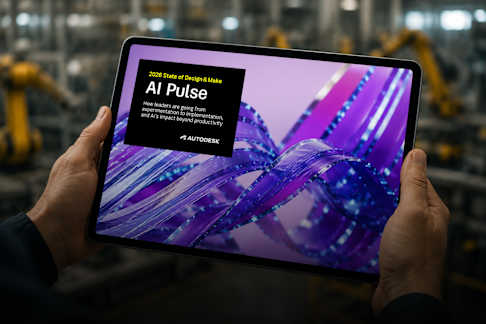
2026 State of Design & Make
AI Pulse How leaders are going from experimentation to implementation, and AI’s impact beyond productivity
The 2026 State of Design & Make: AI Pulse report was compiled from the AI Pulse survey conducted between January and February 2026 with Statista Plus Research. This survey includes responses from 2,500 global industry leaders across the architecture, engineering, construction, and operations (AECO); design and manufacturing (D&M); and media and entertainment (M&E) industries.
Key terms:
Early adopters are respondents who agree their organization is effectively embracing AI and have already integrated advanced AI systems such as agentic AI or LLMs into their workflows. This group represents 19% of 2026 respondents (n=469).
Digitally mature organizations are those whose digital transformation journeys are described as “approaching the goal” or having “achieved the goal.” Those describing their journeys as “early stage” or “right in the middle of the effort” are considered less digitally mature. Digitally mature organizations represent 42% of 2026 respondents (n=1,057).
What is Design and Make?
A convergence of technologies and ways of working across industries that create the world around us has given rise to a distinct category: Design and Make. Design and Make shapes the surrounding world, translating complex ideas into powerful experiences, whether it’s transforming a sketch into a school, turning a concept into a car, or making a myth into a movie. Globally, Design and Make employs, conservatively, 295.7 million people, according to the World Economic Forum.
For those working within it, Design and Make is not just a set of processes, but an evolving way of thinking about how work gets done. As digital tools, connected data, and new methods of collaboration become more common, the process is becoming less linear and more iterative, with decisions informed by a broader set of inputs over time. Practitioners are increasingly navigating complexity across disciplines, balancing speed, sustainability, and risk. In this context, Design and Make reflects a shift toward more integrated, adaptive approaches to solving the challenges of a rapidly changing world.
About the State of Design & Make: AI Pulse
2 AI PULSE
Introduction
SECTION 1
3 AI PULSE
As AI becomes increasingly embedded in everyday workflows across Design and Make industries, the question is no longer whether organizations should use AI, but how they can implement it to deliver meaningful value. As adoption accelerates, competitive advantage is beginning to move away from access to the technology itself and toward the ability to apply it effectively across systems, processes, and teams.
At the same time, a new layer of capability is starting to emerge. AI is moving beyond tools that respond to inputs and toward systems that can participate more actively in how work gets done. This idea of agentic AI—systems that can coordinate tasks, move work forward, and operate across workflows—is starting to take shape.
These capabilities point toward a future in which AI becomes an active layer in how work is organized—connecting data, automating processes, and enabling more dynamic decision-making. But realizing that future depends on foundations that many organizations are still building.
Introduction 2026 State of Design & Make: AI Pulse key findings
Yusuke Okura, BIM manager at Semba Corp, a spatial design firm, addresses the inherent challenge of leading during a time of technological innovation: “Technology is progressing many times faster than human understanding, which makes it difficult for organizations to keep people, processes, and skills aligned with the pace of change.”
Olivia Columbus, chief of staff at Last Energy, a developer of micro modular PWR power plants, agrees with this assessment: “AI is just a fundamental shift in the way we’re going to interact with technology,” she says. “We’re experiencing something similar to the internet or search, and it’s going to change how everything works.”
Ultimately, the opportunity ahead is substantial, and the organizations that succeed will not be those that adopt AI the fastest, but those that integrate it most effectively—aligning AI, data, and talent around strategic priorities.
AI tool use is ubiquitous. 98% of leaders across Design and Make industries use at least one AI tool.
Use of agentic AI is rapidly increasing. 59% of organizations already are or plan to use agentic AI within a year.
AI has the greatest impact on productivity. 84% of leaders say AI has increased productivity at their organization.
AI early adopters see advantages across the board. Organizations that are aggressively pursuing AI implementation are seeing outsize benefits. Decision-making, quality of output, innovation, and cost all improved by double-digits over other organizations.
4 AI PULSE
AI is now table stakes for Design and Make organizations
SECTION 1
98% of leaders are using at least one AI tool
81% of organizations will increase investment in AI
78% of leaders want to accelerate digital transformation to be more competitive
5 AI PULSE
Artificial intelligence is being adopted quickly across Design and Make industries, driven by increased integration into everyday workflows. Tools like ChatGPT, Copilot, and Claude are now being used in offices everywhere as organizations encourage their workforce to adopt AI to improve outcomes. Nearly all (98%) leaders say they use at least one AI tool, and the majority of tools have double-digit usage growth year over year.
98% of leaders are using at least one AI tool Most tools see at least 10% usage growth year over year
Survey question: “Which tools, if any, that you personally currently use incorporate AI?” Please select all that apply; Percent selected. Note: Some answer options are shortened for better readability. “Other” and “I don't know” are not shown.
As si
st an
t t oo
ls
or c
ha tb
ot s
De si
gn
pr og
ra m
s
Pr oj
ec t
m an
ag em
en t
pl at
fo rm
s
To ol
s fo
r pe
rs on
al iz
in g
us er
e xp
er ie
nc e
Vi de
o ed
it in
g su
ite s
M od
el in
g to
ol s
CA D
so ft
w ar
e
20262025
Su pp
ly -c
ha in
op
tim iz
at io
n pr
og ra
m s
To ol
s to
e nh
an ce
su
st ai
na bi
lit y
an d
en vi
ro nm
en ta
l im
pa ct
N on
e of
th
e ab
ov e
60%
40%
20%
0%
39% 39% 42%
50%
55%
43%
47%
58%
38%
32% 31%
27% 27% 24% 24%
9%
40%
35% 34%
2%
“AI is pretty good at optioneering, where you can ask it to generate multiple options that vary by factors like cost and carbon, which changes how teams evaluate tradeoffs early in the process.”
BRAD SARA Digital Practice Lead, Warren & Mahoney, an architecture and design firm
78% of leaders say their company needs to accelerate digitization to be more competitive
6 AI PULSE
Small businesses are catching up on AI adoption
Survey question: “Which tools, if any, that you personally currently use incorporate AI? Please select all that apply;” Percent of respondents using at least one AI tool.
2025
93% Small businesses
99% Medium businesses 98% Large businesses
2026 100%
75%
80%
85%
90%
95%
Making significant gains in the AI race are small businesses (1–49 employees), which saw an 11-point increase in the number of leaders using at least one AI tool, compared to four points in medium businesses and three points in large organizations.
More notable than the speed of adoption is how quickly the nature of that adoption is evolving and how expectations are changing. AI has gone from experimentation to baseline in a few years and, for Design and Make organizations, AI is no longer a differentiator. To remain competitive when AI is ubiquitous, it’s less about the number of tools and more about how they are implemented at scale.
Brad Sara, digital practice lead at Warren & Mahoney, echoes this sentiment: “AI is already becoming the new expectation—if you’re on the front of the wave you get an advantage, but very quickly everyone catches up and it just becomes part of how work gets done.”
Only 2% of leaders at Design and Make organizations don’t use AI tools
“We’re already seeing companies develop AI tools that can streamline highly regulated processes like licensing, which has the potential to significantly reduce timelines in complex industries.”
OLIVIA COLUMBUS Chief of Staff, Last Energy
7 AI PULSE
Design and Make leaders are increasingly bullish on AI
Survey question: “How has your organization’s investment in AI changed in 2025 compared to 2024?” “Don't know/Not applicable” is not shown.
1 in 3 organizations significantly increased investment
1% Decreased significantly
3% Decreased somewhat
14% About the same
41% Increased somewhat
33% Increased significantly
7% Increased substantially
Focused on scaling already successful AI solutions, organizations are investing heavily. Eighty-one percent of leaders say their organization increased AI investments in the last year, with 40% saying they have significantly or substantially increased investment.
Not surprisingly, investments are particularly strong at digitally mature organizations, with 54% significantly or substantially increasing their investments compared to 30% of less mature organizations. But, while small companies saw a jump in tool usage, their investments aren’t matching their enthusiasm—only 22% of small
companies will significantly or substantially increase investment compared to 51% at large organizations. With AI helping to level the playing field, organizations that take on the additional cost early could see their AI dollars pay dividends in the long-term in the form of competitive advantage.
8 AI PULSE
As AI adoption increases, so do its benefits
SECTION 2
84% of organizations see increased productivity from AI
48% of organizations will incorporate LLMs within a year
77% of leaders say AI increases innovation
9 AI PULSE
AI is driving positive impact across Design and Make 84% of leaders say AI has had a positive impact on productivity
Survey question: “How has your company’s use of AI impacted the following?” Response options: “Negatively impacted,” “No impact,” and “Positively impacted.” If positive impact, survey question: “By what percentage do you think AI has impacted the following?” Response scale: “Marginally (<25%),” “Moderately (25%–50%),” “Considerably (50%–75%),” “Significantly (75%–100%),” and “Drastically (≥100%).”
Negative impact
Positive impact
Costs
Decision-making
Innovation
Productivity: Time saved
Quality of output
59%
58%
8%
5%
65%
55%
3%
5%
77%
68%
2%
3%
84%
77%
1%
2%
73%3%
2026
2025 At Design and Make organizations AI is, so far, living up to the hype. As it becomes more integrated into everyday workflows, leaders say AI has enabled better outcomes across the board this year compared to 2025, and four out of five organizations say AI has improved productivity.
“We’re seeing AI produce work in 10 to 15 minutes that would have previously taken weeks,” says Thomas Hyde, chief transformation and innovation officer at Beca, an engineering, advisory, and consulting firm. “This fundamentally changes expectations around productivity and how quickly teams can deliver value.”
While organizations are seeing positive impact in all areas, cost stands out as the only category with no change in positive impact. This stall is likely reflective of the increase in AI investment as organizations spend time and money now to realize greater results downstream.
84% of Design and Make organizations say AI improves productivity
10 AI PULSE
While much of the conversation around AI focuses on productivity gains, meaningful impact is happening at every level of the organization. Rather than just doing the same work faster, AI can help organizations change how that work is done altogether and bring visibility into the downstream environmental impact of decisions. This shift is subtle but significant and changes AI from being a tool that improves tasks to a capability that can reshape processes.
At Design and Make organizations, decision-making has seen the greatest increase in positive impact over the past year at 10 points, with 65% of leaders
now saying they use AI to make better decisions. Of these leaders, 20% say AI has had a significant positive impact (75%–100%) on decision-making. Similarly, 24% of leaders saw quality of output improve significantly, and 27% realized a significant impact to innovation.
“AI has a huge opportunity to improve coordination across projects, particularly in complex environments where multiple teams need to align,” says Cillian Kelly, digital project delivery at John Sisk & Son, a construction and engineering firm. “And that creates real potential for better outcomes.”
77% of leaders say AI increases innovation
73% of leaders say AI increases quality of output
11 AI PULSE
Nexus Power optimizes manufacturing with AI-driven insights
Nexus Power is rethinking battery manufacturing by replacing traditional lithium-based systems with biodegradable batteries made from agricultural waste.
Instead of relying on traditional trial- and-error methods, the team uses digital simulation and advanced modeling to test, refine, and optimize battery designs before physical production begins. This approach allows engineers to explore a wider range of design possibilities, identify performance improvements earlier, and reduce the need for costly physical prototyping.
AI-supported workflows also help streamline development by improving accuracy and reducing rework. By validating designs in a digital environment, Nexus Power can move more quickly from concept to production-ready solutions while minimizing material waste.
The company’s batteries achieve up to 25% better performance than comparably sized alternatives due to higher energy density, while also benefiting from lower production costs driven by abundant, low- cost input materials.
Through a combination of sustainable materials, digital design, and scalable manufacturing processes, Nexus Power is building a new model for energy storage— one that aligns performance, cost, and environmental impact. The result is not just a new type of battery, but a rethinking of how products can be designed and made in a more sustainable, circular economy.
SOLUTION SPOTLIGHT
READ MORE
Nexus uses Autodesk Fusion to design and prototype its battery packs. Image courtesy of Nexus Power.
12 AI PULSE
https://www.autodesk.com/design-make/articles/nexus-power-sustainable-battery-manufacturing?us_oa=dotcom-us&us_si=914eb10e-3bcc-4f00-935f-60de9cdfc1b2&us_st=nexus%20power
As AI integration increases, leaders expect big—and immediate—impact
Survey question: “When do you realistically expect to…?” [statement] 8-point scale. Combined for the visualization.
Already have it
Within 1 year
In 1–5 years
Longer than 5 years
I don’t know/ Never
Incorporate LLMs and other machine-
learning models
See AI meaningfully improve work
Use real-time data to enable better decision-making
13%
48%
29%
4%
7%
32%
39%
24%
2%
2%
27%
44%
23%
3%
3%
AI early adopters—organizations that are embracing and already integrating AI—are realizing greater benefits than peers who are slower to adopt. While not especially surprising, the size of the impact over such a short period demonstrates how early adoption can provide immediate results.
The real benefit for AI early adopters is amplification: an exponential increase in iterations and options without a corresponding increase in effort. Over time, as these systems get more integrated into workflows, that amplification starts to compound. Time is where AI early adopters have an advantage—by investing time and budget early, they see positive
returns sooner, widening the gap for both performance and competitive advantage.
AI early adopters are already realizing significant benefits from AI integration, and organizations across Design and Make industries are racing to catch up and want to see big impact relatively quickly. Forty-eight percent of leaders plan to incorporate LLMs, and 44% expect to use real-time data to make better decisions within the next year. A short implementation runway isn’t slowing down expectations—39% of leaders expect to see meaningful improvements from AI within the same time.
The Early Adopter advantage AI early adopters are far outpacing their peers when it comes to seeing a positive impact from their AI investments.
Decision- making:
+18pp Innovation:
+14pp
Productivity/ time saved:
+7pp
Quality of output:
+15pp
Cost:
+12pp
13 AI PULSE
The next innovation: Agentic AI
SECTION 3
59% of organizations are or will be using agentic AI within a year
44% of organizations are investing in agentic AI
65% of AI early adopters are already using agentic AI
14 AI PULSE
Agentic AI, and the broader idea of AI agents, is emerging as one of the most talked-about developments in the current wave of AI, but it is also one of the most misunderstood, according to Mike Haley, SVP of Research at Autodesk.
What AI agents are now, and what they will be in the future
“In practice, we tend to think about AI agents in three distinct ways,” Haley says. “The first is relatively lightweight: agents as assistants that can carry out a sequence of tasks on behalf of a user. In this framing, an agent is essentially an extension of existing tools—something that can take a prompt, break it into steps, and execute those steps across systems. This is closest to how many organizations are experimenting with AI agents today.
“The second interpretation is more workflow oriented. Here, agents are not just executing tasks but coordinating processes. They can move across different tools and data sets, manage dependencies, and carry work forward without constant human intervention. This begins to shift AI from being a tool that responds to instructions to something that actively participates in how work is getting done.
“The third interpretation is more ambitious and still largely aspirational. In this view, agents are systems that can operate with a high degree of autonomy— understanding intent, making decisions, and adapting to changing conditions. This is the version of agentic AI that is often discussed in forward-looking scenarios, but it is not yet fully realized in most practical applications.”
“We’re beginning to use and experiment with AI agents, and we expect these agentic capabilities to expand rapidly across our tools and workflows in the coming years.”
THOMAS HYDE Chief Transformation and Innovation Officer, Beca
15 AI PULSE
Agentic AI sees a jump in adoption across Design and Make organizations
Survey question: “When do you realistically expect to…?” [statement] 8-point scale. Combined for the visualization.
16% Already have it
43% Within 1 year
29% In 1–5 years
5% Longer than
5 years
7% I don’t know/
Never
2% since 2025 9% since 2025 1% since 2025 1% since 2025 9% since 2025
The potential of AI agents for Design and Make organizations is significant, even at their current level of maturity. Agents can begin to reduce friction in workflows by connecting systems, automating repetitive processes, and enabling collaboration between stakeholders at every stage of a project. Because of this mostly untapped potential, leaders are eager to be early adopters—43% of organizations plan to be using agentic AI within a year, a 26% increase year over year.
“We’ve trained over 4,000 people on AI agents and now
have over 200 agents actively in use,” says Andrew Stanford, director of digital technology at Haskoning, a consulting engineering firm. “They’re supporting everything from tender reviews to legal contract analysis, which shows how embedded AI is becoming in daily operations.”
The potential impact of this shift is substantial. If AI systems can coordinate tasks, manage dependencies, and move work forward across systems, they can reduce friction in complex processes and enable organizations to operate much more efficiently.
“Leveraging AI has become essential for us, particularly in streamlining routine documentation and information gathering, which allows our teams to focus more time on higher-value creative and design work.”
YUSUKE OKURA BIM Manager, Semba Corp
16 AI PULSE
Gearbox Software scales cinematic production with automated pipelines
Gearbox Software transformed its animation pipeline by introducing a highly automated system that coordinates complex production workflows across teams. Instead of relying on manual processes to manage scenes, assets, and data, the studio built a pipeline that automates repetitive tasks such as file creation, data management, and scene assembly—reducing friction across the production process.
Traditionally, cinematic content creation in games is highly manual and resource- intensive, limiting how much narrative content can be produced. Gearbox addressed this constraint by automating large portions of its animation and pipeline processes, allowing systems—not individuals—to manage sequencing, data flow, and production coordination.
By automating workflow orchestration rather than just individual tasks, Gearbox effectively moved toward an agentic model of production. Systems now handle coordination, asset tracking, and sequencing, freeing teams to focus on storytelling and creative direction.
Meanwhile, the time they spend working is more fulfilling. Before Gearbox implemented its cinematic workflow, the company’s digital artists spent an estimated 60% of their project time on logistical tasks like file management and just 30% on creative work like animation, with the remaining 10% devoted to administrative things like email. Now, digital artists at Gearbox spend 60% of their time on creative work, 30% on logistics, and 10% on administration.
SOLUTION SPOTLIGHT
READ MORE
Players control the decisions the characters make in the explosive cinematic adventure New Tales from the Borderlands. Image courtesy of Gearbox Software/2K Games.
17 AI PULSE
https://www.autodesk.com/customer-stories/gearbox-animation-pipeline-story
AI investments focus on generative AI, automation, agentic AI
Survey question: “Which of the following AI areas are priorities for your organization’s investment over the next 12 months?” Please select all that apply; Percent selected. Note: Some answer options are shortened for better readability. “I don't know” is not shown.
55%
52%
44%
43%
41%
31%
18%
Generative AI
Process automation AI
AI agents
Predictive AI
Decision support AI
LLMs
AI in general (not sure)
Nearly all (98%) AI early adopters say their senior leaders encourage AI adoption, compared to just 73% at other organizations. While the full benefits from agentic AI systems have yet to be realized, early adopters can likely expect to see outsized benefits in the long- term, increasing an already sizeable performance gap.
Organizations are hoping that increased investments will help close the performance gap—44% of all leaders are prioritizing AI agents for investment, which is aligned with the dedication from leaders to implement AI agents in the next year.
However, this potential is constrained by the same factors that affect AI more broadly: quality of data, structure of workflows, and the extent to which systems are integrated. Organizations that master the basics will be in an ideal position to see benefits from early agentic AI adoption.
57% of AI early adopters are investing in agentic AI compared to 41% of other organizations
18 AI PULSE
The unique challenges of, and solutions for, an AI- focused future
50% of leaders say AI integration is a top implementation challenge
73% of leaders say common data environments improve trust between collaborators
60% of leaders are concerned about security when it comes to AI
SECTION 4
19 AI PULSE
AI implementation presents challenges at every level of the organization
Survey question: “To what extent is each of the following a challenge for AI implementation in your organization?” Top two: “Significant challenge” and “Major challenge.” Note: "Not applicable" is not shown.
Integrating AI with existing systems
Lack of necessary talent/ skills to implement AI
Cost of AI implementation
Regulatory or compliance concerns
Data quality issues Measuring the ROI/ impact of AI investments
50%
25%
0%
50% 47%
44% 43% 43% 42%
Integration and talent are the most common challenges
Despite the AI imperative, implementation remains a struggle across Design and Make organizations.
Integrating AI with legacy software tops the list of implementation challenges for 50% of leaders. Merging these systems requires expertise in areas that extend well beyond traditional software development, including machine learning, data engineering, large- scale infrastructure, and user experience design. It also requires navigating legal and regulatory considerations, which are evolving rapidly as AI adoption increases.
Implementing AI requires sustained investment, evaluation, and iteration. Organizations must build capabilities over time, which can make it difficult to justify investment, particularly in environments where ROI is expected to be clear and measurable. To succeed, leaders should focus on both short-term use cases that can provide immediate value and planning extended initiatives that demonstrate the long-term ROI impact of AI integrations.
“We need much more real-world data before building full AI systems. Without enough data the models will not be reliable enough for the kind of decisions we need to make.”
SWAPNIL SHRIVASTAV CEO, Uravu Labs, a provider of air-to-water generating systems
20 AI PULSE
Survey question: “What are your biggest concerns for AI in your industry?” Please select all that apply; Percent selected. Note: “I have no concerns” is not shown.
AI security and accuracy are top of mind for leaders Concerns about AI-related job loss are easing
Security Accuracy Costs
Efficiency Job loss Plagiarism
60% in 2026
53% in 2025
49%
39%
35%
28%
35%
25%
32%
38%
29%
32%
As AI becomes more deeply embedded in workflows, questions about how data is used, protected, and controlled move to the center of the conversation. Security, data accuracy, and control are not optional features for an AI-enabled future; they are prerequisites.
Leaders in Design and Make industries agree—security is top of mind for 60%, a 7-point increase over 2025, and by far the largest area of concern when it comes to AI.
Closely related to security, concerns about accuracy saw a significant jump year over year as rapid proliferation is increasing skepticism of output produced by relatively untested models.
“If organizations haven’t established the fundamentals around data and processes,” says Cillian Kelly, digital project delivery at John Sisk & Son, “Then even the most advanced AI tools won’t deliver the outputs they expect.”
It is not enough for AI to be powerful—it must also be predictable, transparent, and aligned with organizational expectations.
21 AI PULSE
Data is now a cornerstone for Design and Make organizations
Survey question: “How much do you agree or disagree with the following?” [statement] 5-point scale. Top two: “Somewhat agree” and “Strongly agree.”
My company’s data is secure
73% in 2025
81% in 2026
My company’s data is well-structured
69% in 2025
CDEs improve trust between collaborators
65% in 2025
73% in 2026
79% in 2026
Notably, despite growing security and accuracy concerns related to AI for their industry, leaders are extremely confident in the security and accuracy of their own data. Four out of five organizations say their data is secure and that their company’s data is well-structured.
The result is a paradox: high confidence in data security alongside rising concern about AI-related security risks. Leaders may feel that their data is secure in a
traditional sense, but AI introduces new ways of interacting with that data that can create uncertainty.
One thing helping leaders feel more confident about shared data are common data environments (CDEs), which function as a single source of truth across all stakeholders for a project. Most (73%) leaders say CDEs improve trust between collaborators.
The AI early adopter advantage
AI early adopters see a clear advantage when it comes to data foundations.
+15pp say their data is secure
+16pp say their data is well-structured
22 AI PULSE
Kalyon Construction overcomes complexity with digitization at Ziraat Towers
Kalyon Construction faced a set of complex technological challenges in delivering the Ziraat Towers in Istanbul. The project required managing a highly intricate facade made up of thousands of unique components, while coordinating design, engineering, and construction teams across a fragmented workflow. Traditional tools and disconnected systems made it difficult to maintain accuracy, ensure alignment, and efficiently translate design intent into buildable outcomes.
To address this, Kalyon adopted a fully digital, model-based approach. By integrating detailed 3D modeling, parametric design, and cloud-based collaboration, the team created a shared environment where all stakeholders could access real-time, accurate project data. Automated workflows were used to generate thousands of unique facade elements and construction drawings, reducing manual effort and improving consistency. Digital simulation and
planning tools also allowed teams to coordinate tasks more effectively and identify issues earlier in the process.
This approach delivered measurable results, accelerating production time of 3D models and shop drawings by 25% compared to the traditional method. At the same time, the team achieved high levels of technical accuracy and quality, while also lowering the project’s carbon footprint and achieving LEED Platinum certification.
Beyond a single project, the impact extended to how Kalyon approaches future work. By embedding digital workflows and automation into its operations, the company has created a more repeatable and scalable model for managing complex construction projects—improving efficiency, reducing risk, and enabling better outcomes at scale.
SOLUTION SPOTLIGHT
READ MORE
Ziraat Towers, the centerpiece of the new Istanbul Financial Center, showcases ways using digital design and collaboration tools improves processes and achieves sustainability goals. Image courtesy of Kalyon Construction.
23 AI PULSE
https://www.autodesk.com/design-make/articles/kaylon-construction-ziraat-towers
Survey question: “How much do you agree or disagree with the following?” [statement] 5-point scale. Top two: “Somewhat agree” and “Strongly agree.”
Despite AI imperative, training is still lacking 2025
86% Mastering AI tools will better position me for opportunities in my industry
83% I am confident embracing AI in my daily work
78% Senior leaders at my company encourage AI adoption
72% Senior leaders at my company have a good understanding of how to adopt AI effectively
68% There is a sense of urgency to adopt AI
59% AI training currently available to me is sufficient
2026 90%
50%
60%
70%
80%
Implementing AI is not just a technical challenge; it also requires new skills— both technical and conceptual—across the organization.
Two-thirds of leaders say there is a sense of urgency around AI adoptions, and the percentage who say their organizations encourage adoption rose 13 points to 78%. Yet, only 59% say their AI training is sufficient. While a majority, there is still quite a large gap between where organizations say they need to be and the current level of training to get them there.
Carlos Rogéliz, technical director at the N4W facility for The Nature Conservancy, a global environmental nonprofit, says the challenge goes beyond simply adopting new tools: “The challenge is not only the tools themselves, but whether people know how to use them in the right conceptual framework so that the outputs can actually support the work.”
This lack of AI training and preparedness is already affecting organizations—47% of leaders say lack of talent and skills is a major or significant challenge for AI implementation, and concern about labor shortages is up 5 points to 36%. As technology continues to outpace skills development, upskilling and reskilling can become a competitive advantage.
24 AI PULSE
Conclusion
SECTION 5
25 AI PULSE
Cross-industry convergence is focused on visualization tools
Survey question: “In the previous question, you said your company adopts digital techniques and tools from other industries; which specific cross-industry techniques and tools?” Please select all that apply; Percent selected.
80%
60%
40%
20%
0%
Design and Make organizations are adopting tools from outside their industry
Graphical visualization programs
Industrialized construction/DfMA
Digital factory Digital twins & IoT Spatial intelligence Extended reality
AECO
D&M
M&E
61% 58%
71%
49% 42%
24%
38% 41% 35%
30% 35%
31% 32% 31% 30% 30% 28% 35%
Despite these hurdles, there is a clear path forward. The organizations that succeed will be those that recognize AI challenges are not temporary obstacles, but part of the process of adopting a fundamentally new way of working. Operationalizing AI across full project lifecycles requires investment in the people, processes, and technology required to support it.
Many of the problems organizations are facing are not specific to their sector but translate across all Design and Make industries. As such, leaders are increasingly looking for solutions from outside their own industry, hoping to learn how to accelerate their own progress.
Two-thirds of organizations are adopting techniques and tools from other industries, and 75% look for inspiration for innovation outside their industry, both up five points year over year. Among AI early adopters these numbers are even higher, with 80% adopting new tools and 87% looking for innovation outside their industry vs. 65% and 73%, respectively, at other organizations.
26 AI PULSE
Populous scales delivery through industrialized construction and AI-enabled workflows
Populous is redefining how large-scale venues are designed and delivered by applying productization principles from manufacturing to architecture. Traditionally, each stadium or arena has been treated as a one-off project, requiring teams to start from scratch. Populous is shifting this model by developing reusable design components, standardized systems, and digital workflows that can be applied across projects.
This approach enables teams to move faster and work more efficiently. By reusing proven design elements and integrating digital tools across disciplines, Populous reduces duplication of effort and improves coordination between architects, engineers, and contractors. In practice, this has led to measurable gains in efficiency. In one example, the firm was able to increase design efficiency to approximately 95% through the use of generative design and automated workflows.
The impact extends beyond design. Productization supports more predictable delivery, helping teams manage complexity across large, multi-stakeholder projects. It also enables more sustainable outcomes by reducing material waste and supporting the creation of flexible, multi- use venues that can adapt over time.
By combining industrialized construction methods with digital technologies, Populous is building a more scalable model for Design and Make. The result is not only faster and more efficient project delivery, but also a shift in how organizations think about value— moving from bespoke, one-time builds to repeatable systems that can drive long-term performance across an entire portfolio of projects.
SOLUTION SPOTLIGHT
READ MORE
Populous used venue productization strategies to design Hong Kong’s Kai Tak Sports Park. Image courtesy of Populous.
27 AI PULSE
https://www.autodesk.com/design-make/articles/populous-venue-productization
This cross-industry convergence is reshaping how organizations think about digital transformation and AI adoption. Companies that embrace this mindset appear better positioned to move forward with confidence—exploring new markets, adopting new technologies, and rethinking traditional ways of working.
Similarly, AI early adopters are more likely than other organizations to be considering new markets (81% vs. 71%) and are less uncertain about the future (53% vs. 60%), suggesting these companies are better positioned to see opportunity over risk.
As technology continues to evolve, leaders across Design and Make turn an eye toward what’s next for an AI-enabled future.
“I think there’s a lot of opportunity for new innovations and new solutions to really take off now,” says Swapnil Shrivastav, CEO of Uravu Labs. “The foundation has been set, and we’re going to see a lot more ideas and technologies being built in this space.”
Mike Haley, SVP of research at Autodesk, agrees: “If this is the beginning, then what comes next is going to build on this in ways that we are only just starting to understand, especially as these capabilities get applied to real workflows and real industry problems.”
28 AI PULSE
About the 2026 State of Design & Make: AI Pulse
The data for the 2026 State of Design & Make: AI Pulse report was compiled from the AI Pulse survey conducted between January and February 2026 with Statista Plus Research. This survey includes responses from 2,500 global industry leaders and experts spanning various regions: Australia, Brazil, Canada, China, France, Germany, India, Italy, Japan, Mexico, the Middle East (Saudi Arabia & the United Arab Emirates), the Nordics (Denmark, Finland, Norway, Sweden), Spain, South Korea, the United Kingdom, and the United States. It draws insights from a wide range of industry professionals in architecture, engineering, construction, and operations (AECO); product design and manufacturing (D&M); and media and entertainment (M&E) from across sectors.
Additional data for the 2026 State of Design & Make: AI Pulse was compiled from a subset of Autodesk’s 2025 State of Design & Make: Digital Transformation Pulse.
The report also features qualitative interviews with leaders and experts from across Design and Make industries.
About Autodesk
Autodesk is changing how the world is designed and made. Its technology spans architecture, engineering, construction, operations, product design, manufacturing, and media and entertainment, empowering innovators everywhere to solve challenges big and small. From greener buildings to smarter products to more mesmerizing blockbusters, Autodesk software helps customers design and make a better world for all. For more information, visit autodesk.com or follow @autodesk on social media.
Contact Autodesk at state.of.design.and.make@autodesk.com about this research report or to sign up to participate in future research programs.
The information provided in this report is for general informational purposes only and strictly for the convenience of our customers. Autodesk, Inc., does not endorse or warrant the accuracy or completeness of any information, text, graphics, links, or other items contained within the report.
Autodesk, Inc., does not guarantee that you will achieve any specific outcomes or results if you follow any advice in the report.
© 2026 Autodesk, Inc. All rights reserved.
29 AI PULSE
https://www.autodesk.com/design-make/articles/2025-digital-transformation-pulse https://www.autodesk.com/design-make/articles/2025-digital-transformation-pulse mailto:state.of.design.and.make%40autodesk.com?subject=SDM%3A%20AI%20Pulse