5 Ways AI Leaders in AECO are Designed to be Different
Autodesk surveyed 1,965 industry leaders, futurists, and experts across 20 countries in the architecture, engineering, construction, and operations (AECO) industries. From this research, we identified a distinct group of artificial intelligence (AI) leaders—organisations that are approaching or have successfully achieved their goals in incorporating AI technology—and compared them with those who haven't started or are still in the middle of incorporating AI.
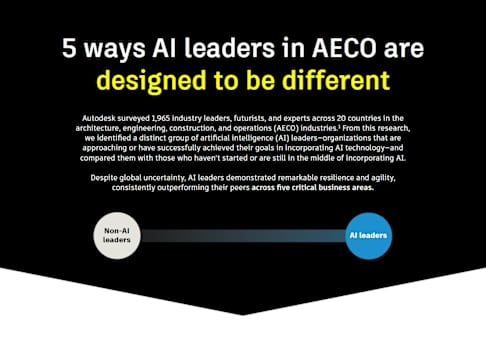
Autodesk surveyed 1,965 industry leaders, futurists, and experts across 20 countries in the architecture, engineering, construction, and operations (AECO) industries.1 From this research,
we identified a distinct group of artificial intelligence (AI) leaders—organizations that are approaching or have successfully achieved their goals in incorporating AI technology—and
compared them with those who haven't started or are still in the middle of incorporating AI.
Despite global uncertainty, AI leaders demonstrated remarkable resilience and agility, consistently outperforming their peers across five critical business areas.
5 ways AI leaders in AECO are designed to be different
1. Superior performance from digital transformation
While many organizations are still at an early stage of their digital transformation journey, AI leaders who identified productivity and innovation as benefits of digital transformation are already seeing much greater improvements compared to non-AI leaders who identified the same benefits, representing a critical competitive differentiator in increasingly digital markets.
On average, when combining these two capabilities, 87% of these AI leaders demonstrated superior performance through digital transformation efforts, compared to just 53% of their non-AI counterparts, a significant difference of 34 percentage points.
+34% 87%53%
3. Turning sustainability into advantage
AI leaders aren't just talking about sustainability, they're turning environmental responsibility into measurable business advantage. Eighty-six percent of AI leaders believe sustainability measures can generate more than 5% of annual revenue compared to 62% of non-AI leaders, a difference of 24%.
+24% 86%62%
4. More proactive approach to talent
Rather than simply competing for existing talent in an increasingly constrained market, AI leaders are taking proactive steps to create the capabilities they need internally—recognizing that the skills required for future success may not exist in today's workforce. Seventy-six percent of AI leaders implement continuous learning programs for their employees compared to 53% of non-AI leaders, a difference of 23%.
+23% 76%53%
5. Greater growth prospects
While non-AI leaders remain cautious with capital allocation, AI leaders are better positioned to capitalize on market opportunities through their superior technological infrastructure and data-driven decision-making capabilities. The combination of increased future investment, entering into new markets, and the offering of new services widens their competitive advantage over traditional organizations. Eighty-one percent of AI leaders are more likely, on average, to invest in growth opportunities overall, compared to 55% of non-AI leaders, a difference of 26%.
+26% 81%55%
2. Greater preparedness for the future
+29% 77%48%
In an era of unprecedented volatility, AI leaders demonstrate remarkable confidence in their readiness for what lies ahead, contrasting sharply with non-AI leaders. The data shows that 77% of AI leaders feel ready for the future compared to 48% their non-AI counterparts, a difference of 29%.
AI leadersNon-AI leaders
Get in touch for a customized consultation on how to advance your digital journey
At Autodesk, we can help you build an “AI blueprint” that enables teams to redesign workflow for greater efficiency, makes data-driven design decisions to boost sustainable practices, and helps better anticipate risk with predictive analytics. We also offer courses with certifications that highlight advanced design and make skills, and help you co-innovate with customers, partners, and Autodesk to test new AI use cases.
Autodesk, the Autodesk logo are registered trademarks or trademarks of Autodesk, Inc., and/or its subsidiaries and/or affiliates in the USA and/or other countries. All other brand names, product names, or trademarks belong to their respective holders. Autodesk reserves the right to alter product and services offerings, and
specifications and pricing at any time without notice, and is not responsible for typographical or graphical errors that may appear in this document.
© 2025 Autodesk, Inc. All rights reserved.
1 https://www.autodesk.com/design-make/research/state-of-design-and-make-2025