Streamlining Factory Modelling In Automotive

Streamlining Factory Modelling In Automotive

Focuses on the challenge of continuous factory remodeling faced by automotive manufacturers.

Streamlining Factory Modelling In Automotive

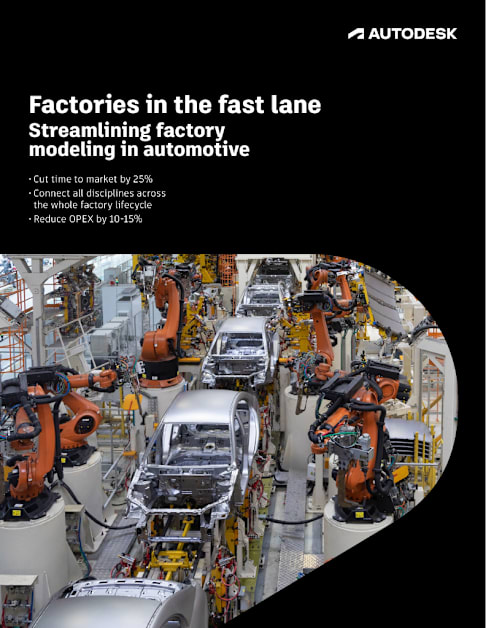
Factories in the fast lane Streamlining factory modeling in automotive • Cut time to market by 25% • Connect all disciplines across the whole factory lifecycle

• Reduce OPEX by 10-15%

The automotive market has rarely been one for moving slowly. Now though, with rapid advances in technology, even the producers of a modest family saloon must move at the pace of a Formula One team. Add to that a growing trend for individualization, and the need to re-engineer your factory has moved from frequent to almost continuous.

As you’re all too aware, this involves bringing together multiple disciplines each and every time. External building teams and project coordinators. IT experts and maintenance engineers. Production line planners and product designers. All of whom often work in silos that are connected only at the top of the organization. Many use different software and their own custom processes. Some hold vast amounts of outdated data in complex legacy systems. Together, this makes the process of re-engineering both slow and costly.

Rethinking the factory flaw

There’s now a need for a more flexible and agile factory modeling process. One that can break down the silos and allow for the integration of each discipline – from the team that decides on the factory exterior right down to those who design the product interior. An approach that enables the connection of all project stakeholders, right at the outset, in order to gain far greater coordination across the different phases of a factory’s lifecycle.

The key to achieving this is through data, which in turn enables the right decisions at the right time. And that’s the thinking and methodology behind Integrated Factory

Modeling, or IFM. An open approach that allows the data created in different systems by different disciplines to be stored at a central point and accessible to all.

The result is everything and everyone involved interconnected – everywhere – on any device, all by a single, accurate, real-time data set. It’s the convergence of the digital factory with Building Information Modeling (BIM), a methodology that has achieved much success in the built environment by streamlining the entire process from design to operation – even disposal.

IFM as an approach has already proved highly successful in automotive. By adopting it, some manufacturers have seen cuts in time and cost to market of up to 25%. A reduction in time to volume of 20%. These same companies have also slashed OPEX by between 10 and 15%.

So long, silos.

Integrated Factory Modeling is a way of enabling the right decisions to be made early through reliable, up-to-date information. Decisions about ideal factory layout all the way through to production strategy and where to produce which models. Decisions that ultimately impact time and cost to market.

So how is all this to be achieved? The first thing is how to break down your own existing organizational silos to be more integrated in your thinking and communication. Adopt a pilot scheme that creates better interaction between the

various disciplines: infrastructure, building design, MEP systems, production line planners, product designers and operators.

Appropriately, the methodology of IFM itself has been developed through collaboration and integration. At Autodesk, we have worked in close partnership with the University of Aachen in Germany, industry specialists and experts in factory planning. Together, we now guide companies through the IFM process. Working in a structured way, a typical first step is to bring all the stakeholders to the same table, capture the current situation and benchmark it against a standardized maturity assessment. From there, we can start to define the journey towards an integrated future that works for you.

One premium car manufacturer we partnered with stated that by using a fully integrated model, it made savings of over $353M p.a. across all green and brownfield projects.

That’s when IFM changes from a model to business benefits on a grand scale.

By partnering with Autodesk and using a fully integrated model, a premium car manufacturer reduced its yearly investment for brown and greenfield projects by 15% – a saving of over $353M p.a.

By adopting a ‘One Data Model’ for the factory lifecycle, electric car manufacturer e.GO, which is reportedly to set up a joint venture in China, saved up to 35% of overall costs - watch the video.

Porsche used IFM to build the new Taycan factory, its most complex and sustainable factory to date. It replaces traditional assembly lines with “flexi- lines” that can be moved throughout the factory, directed via QR codes.

Factories in the fast lane Streamlining factory modeling in automotive

https://www.electrive.com/2020/01/21/e-go-planning-jv-with-unnamed-chinese-company/ https://fast.wistia.net/embed/iframe/j9jqktbqms


Item Type: pdf